






Tesla Roadster
The First Car Orbiting the Sun
Quick Reader
| Attribute | Details |
|---|---|
| Object Name | Tesla Roadster (Elon Musk’s car) |
| Object Type | Artificial heliocentric object |
| Launch Vehicle | Falcon Heavy (Demo Flight) |
| Launch Date | 6 February 2018 |
| Launch Agency | SpaceX |
| Launch Site | Kennedy Space Center (LC-39A) |
| Initial Mission Goal | Falcon Heavy test payload |
| Current Orbit | Heliocentric (Sun-orbiting) |
| Orbital Type | Earth-crossing |
| Perihelion | ~0.99 AU |
| Aphelion | ~1.66 AU (beyond Mars) |
| Orbital Period | ~1.53 Earth years |
| Human Artifact | Yes (car + mannequin “Starman”) |
Key Insights
- Tesla Roadster is not in Earth orbit
- It permanently orbits the Sun
- It became the first car in interplanetary space
- It is a cultural symbol and a tracked Solar System object
Introduction – When a Car Became a Solar System Object
On 6 February 2018, the Falcon Heavy rocket lifted off for the first time.
Instead of a concrete block or dummy mass, SpaceX chose something unexpected:
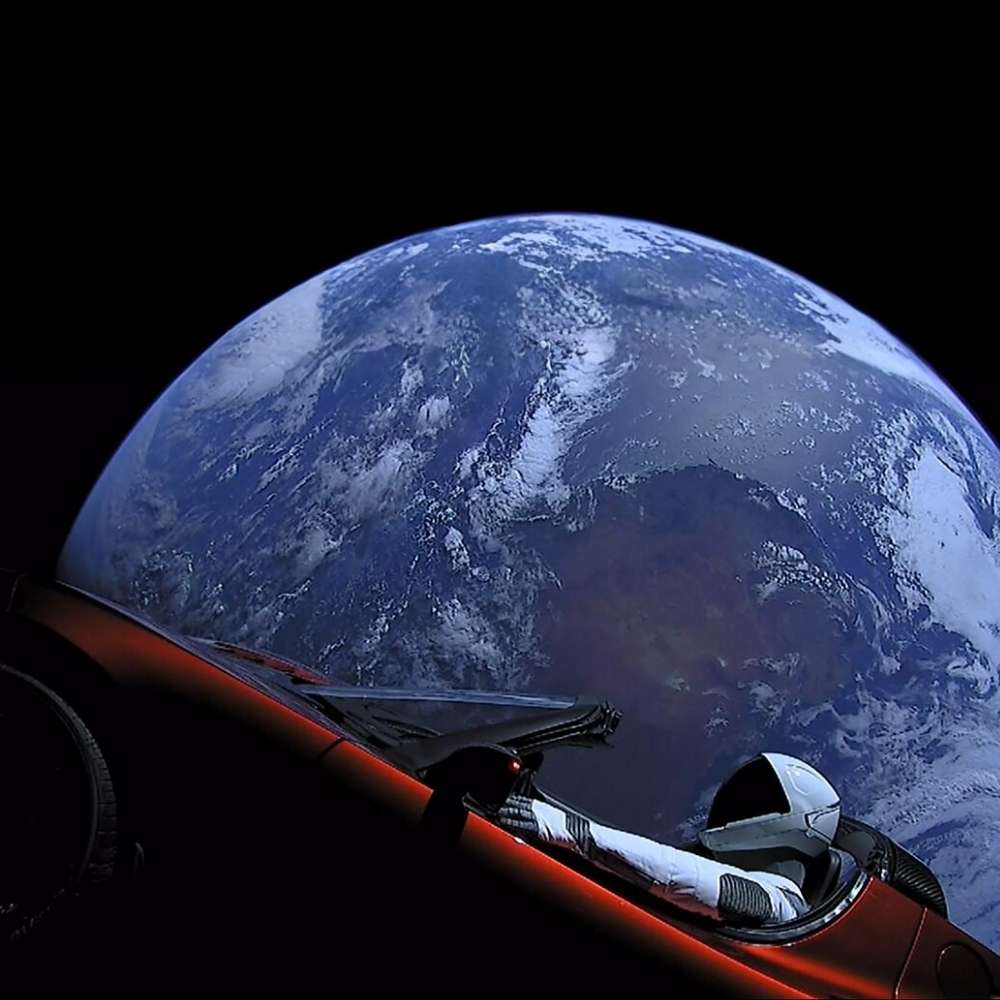
a red Tesla Roadster with a mannequin named “Starman.”
What began as a test payload became something unprecedented.
That car is now an artificial object permanently orbiting the Sun, cataloged alongside asteroids and spacecraft debris.
What Is the Tesla Roadster in Space?
The Tesla Roadster is:
A human-made artifact
Released into heliocentric orbit
Dynamically similar to near-Earth asteroids
Once separated from Falcon Heavy’s upper stage, it:
Escaped Earth’s gravity
Entered an independent orbit around the Sun
Became a long-lived Solar System object
In orbital mechanics terms, it is closer to an asteroid than a satellite.
Why It Was Launched
The Falcon Heavy launch was a demonstration mission.
Its goals were to:
Test the rocket’s performance
Validate booster recovery
Prove deep-space injection capability
A mass simulator was required — and SpaceX chose the Roadster because:
It matched mass requirements
It avoided sensitive payload risk
It captured public imagination
The result was both technical and cultural impact.
Starman – The Mannequin Passenger
Inside the Roadster sits a mannequin nicknamed Starman, wearing a SpaceX pressure suit.
Starman serves no technical function.
Its role is symbolic:
Visual scale reference
Human presence in deep space
A reminder of exploration beyond Earth
Starman and the Roadster together form a single tracked object.
The Orbit – Not Random, Not Escaping
The Tesla Roadster’s orbit is:
Elliptical
Earth-crossing
Extending beyond Mars’ orbit
It does not escape the Solar System.
It does not orbit Earth.
Instead, it loops around the Sun every ~1.5 years, occasionally passing near Earth’s orbital distance.
Why the Roadster Did Not Go to Mars
Although often described as “headed toward Mars,” the Roadster was never aimed to land on or orbit Mars.
Mars is only:
A potential orbital crossing point
Not a mission destination
The Roadster’s orbit intersects Mars’ distance, but timing prevents capture.
Is the Tesla Roadster a Spacecraft?
Technically, no.
It has:
No propulsion
No communication
No active control
It is classified as space debris / artificial object, though its trajectory is carefully modeled like a spacecraft or asteroid.
Why Astronomers Track the Tesla Roadster
Despite being symbolic, it matters scientifically because:
It is a known-mass object in heliocentric orbit
It serves as a test case for long-term orbital evolution
It behaves like a near-Earth asteroid
Organizations such as NASA and JPL include it in orbital simulations.
Universe Map Context – Why Tesla Roadster Belongs Here
For Universe Map, Tesla Roadster represents a unique category:
Human artifacts that have become Solar System objects.
It connects:
Spaceflight history
Orbital mechanics
Near-Earth object dynamics
Cultural astronomy
It marks the moment when everyday human technology crossed into planetary-scale space.
Orbital Evolution – How the Roadster Moves Through the Solar System
Once released from Falcon Heavy’s upper stage, the Tesla Roadster entered a stable heliocentric orbit governed only by gravity.
Key characteristics of its motion:
Elliptical path around the Sun
Crosses Earth’s orbital distance
Extends outward beyond Mars’ orbit
Repeats roughly every 1.5 Earth years
From a dynamical perspective, the Roadster behaves much like an Apollo-type near-Earth asteroid.
Earth Encounters – Close but Not Captured
Because its orbit crosses Earth’s distance from the Sun, the Roadster occasionally passes near Earth.
However:
These encounters are not close approaches in the planetary sense
Earth’s gravity does not capture it
Resonant timing prevents repeated deep encounters
Over long timescales, Earth encounters slightly reshape its orbit, but do not remove it from heliocentric space.
Mars Encounters – A Common Misunderstanding
The Roadster’s aphelion lies near Mars’ orbital distance.
This leads to a common misconception:
that it is “headed for Mars.”
In reality:
The Roadster does not target Mars
Orbital intersections do not imply collision
Mars encounters are infrequent and distant
Mars’ gravity may perturb the orbit slightly over millions of years, but capture or impact is extremely unlikely.
Long-Term Stability – Millions of Years, Not Forever
Numerical simulations suggest that the Roadster’s orbit is long-lived but not permanent.
Over very long timescales:
Planetary perturbations slowly alter eccentricity and inclination
The orbit may evolve chaotically after millions of years
It could eventually be ejected, collide, or spiral inward
This behavior is typical of small Earth-crossing objects.
Is the Tesla Roadster a Hazard?
No.
Despite media hype, the Roadster poses no meaningful risk to Earth or Mars.
Reasons include:
Very small cross-sectional area
Vastness of interplanetary space
Lack of repeated close encounters
Its impact probability is comparable to — or lower than — many natural near-Earth asteroids of similar size.
How Long Will the Roadster Survive in Space?
Without atmospheric drag or weathering, the Roadster will physically degrade very slowly.
However, it is exposed to:
Solar radiation
Micrometeoroid impacts
Extreme temperature cycling
Over millions of years:
Plastics will embrittle
Paint will fade
Surfaces will erode
Eventually, it will resemble a metallic, skeletal relic rather than a recognizable car.
Tesla Roadster vs Natural Asteroids
Although artificial, the Tesla Roadster’s dynamics resemble those of natural objects.
| Feature | Tesla Roadster | Near-Earth Asteroid |
|---|---|---|
| Origin | Human-made | Natural |
| Orbit Type | Earth-crossing | Earth-crossing |
| Control | None | None |
| Longevity | Millions of years | Millions of years |
| Composition | Metal, composites | Rock, metal |
From a gravitational perspective, the Solar System does not care about origin.
Why Scientists Simulate the Roadster’s Orbit
The Roadster serves as an unusual but useful test case.
It allows researchers to:
Validate long-term integration models
Study artificial object evolution
Compare natural vs artificial debris behavior
It is one of the best-documented small objects ever injected into heliocentric space.
Cultural vs Scientific Significance
Culturally, the Tesla Roadster symbolizes:
Commercial spaceflight confidence
Public engagement with space
A blending of technology and spectacle
Scientifically, it represents:
A tracked artificial near-Earth object
A case study in orbital mechanics
Proof that human artifacts can become Solar System residents
Both interpretations are valid — and complementary.
Universe Map Perspective – Artificial Objects as Celestial Bodies
The Tesla Roadster highlights a modern reality:
The Solar System now contains human-made objects that behave like natural ones.
Universe Map treats such objects not as gimmicks, but as:
Dynamical entities
Historical markers
Evidence of humanity’s expanding footprint
The Ultimate Fate of the Tesla Roadster
On human timescales, the Tesla Roadster will keep circling the Sun quietly and predictably.
On astronomical timescales, its future becomes uncertain.
Long-term simulations indicate that:
The Roadster’s orbit will slowly change due to planetary perturbations
Small gravitational nudges from Earth, Mars, and Venus accumulate over time
After millions to tens of millions of years, chaotic evolution becomes likely
Possible end states include:
Ejection from the inner Solar System
Collision with a planet or the Sun
Fragmentation after countless micrometeoroid impacts
None of these outcomes are imminent. The Roadster is a long-lived interplanetary object.
Will It Ever Hit Earth or Mars?
The probability is extremely low.
Even over millions of years:
Interplanetary space is vast
The Roadster’s size is tiny compared to planetary targets
Repeated resonant encounters are unlikely
Its statistical impact risk is comparable to — or lower than — many small natural near-Earth asteroids.
In practical terms, it is harmless.
From Car to Relic – Physical Degradation Over Time
While its orbit may last millions of years, the Roadster’s physical form will not remain intact forever.
Exposed to deep space, it will experience:
Constant cosmic radiation
Solar ultraviolet and particle bombardment
Extreme temperature swings
Micrometeoroid erosion
Over very long periods:
Paint and polymers will degrade rapidly
Rubber and plastics will crack and vaporize
Glass will fracture
Only metal and composite frameworks may persist
Eventually, the Roadster will become an unrecognizable artificial fragment, more artifact than automobile.
Is the Tesla Roadster Space Debris?
Technically, yes.
By strict definition, it is:
A non-functional artificial object
In heliocentric orbit
Without operational purpose
However, unlike orbital debris around Earth, it poses no collision cascade risk and requires no mitigation.
It occupies a category closer to:
Defunct interplanetary probes
Upper stages in solar orbit
Long-lived artificial celestial objects
Ethical and Philosophical Questions
The Tesla Roadster sparked debate far beyond engineering.
Key questions included:
Should symbolic objects be sent into deep space?
Does this represent contamination of the Solar System?
Where is the line between exploration and spectacle?
From a scientific perspective:
The Roadster is inert
It does not contaminate planets
Its mass is negligible compared to natural material
From a cultural perspective, it marks a moment when human identity entered interplanetary space in a personal, recognizable form.
Tesla Roadster as a Historical Marker
Centuries or millennia from now, if rediscovered, the Roadster would represent:
Early commercial spaceflight
The transition from government-only missions
A symbolic expression of 21st-century culture
Like the Voyager Golden Records, it carries implicit information about its creators — not in data, but in design.
Frequently Asked Questions (Expanded)
Is the Tesla Roadster still being tracked?
Yes. Its orbit is modeled and updated like other heliocentric objects.
Does it transmit any signals?
No. All electronics are inactive.
Is it legally considered space junk?
It is an artificial object, but not regulated like Earth-orbit debris.
Could it be recovered in the future?
Theoretically possible, but practically unrealistic and unnecessary.
Will it outlast humanity?
Physically, no. Orbitally, possibly. Its trajectory may persist longer than its structure.
Why the Tesla Roadster Matters for Universe Map
For Universe Map, the Tesla Roadster represents a new category:
Human artifacts that have become Solar System residents.
It bridges:
Spaceflight history
Orbital mechanics
Cultural astronomy
The expanding human footprint beyond Earth
It shows that the Solar System is no longer composed solely of natural bodies.
Related Topics for Universe Map
Artificial objects in heliocentric orbit
Near-Earth asteroids
Falcon Heavy
Space debris beyond Earth orbit
Human presence in deep space
Together, these topics explain how humanity has begun to leave durable traces beyond Earth.
Final Perspective
The Tesla Roadster is not important because it is a car.
It is important because it marks a boundary.
For the first time, an everyday human object crossed into permanent solar orbit — not as a scientific instrument, but as a statement of capability and confidence.
Long after its paint has vanished and its shape has eroded, the Roadster’s trajectory will remain — a quiet loop around the Sun, reminding us of the moment when human technology stopped orbiting Earth and began orbiting a star.