



STEREO A
Humanity’s First Solar Observer Outside Earth’s Line of Sight
Quick Reader
| Attribute | Details |
|---|---|
| Mission Name | STEREO-A (Ahead) |
| Full Mission Name | Solar Terrestrial Relations Observatory |
| Mission Type | Solar & heliospheric observatory |
| Operating Agency | NASA |
| Launch Date | 26 October 2006 |
| Twin Spacecraft | STEREO-A (Ahead), STEREO-B (Behind) |
| Orbit Type | Heliocentric orbit, drifting ahead of Earth |
| Primary Objective | Three-dimensional study of the Sun and coronal mass ejections (CMEs) |
| Key Targets | Solar corona, CMEs, solar wind |
| Mission Status | Active (STEREO-A only) |
| Unique Role | First continuous off-Earth solar viewpoint |
Why STEREO-A Is Special (Quick Context)
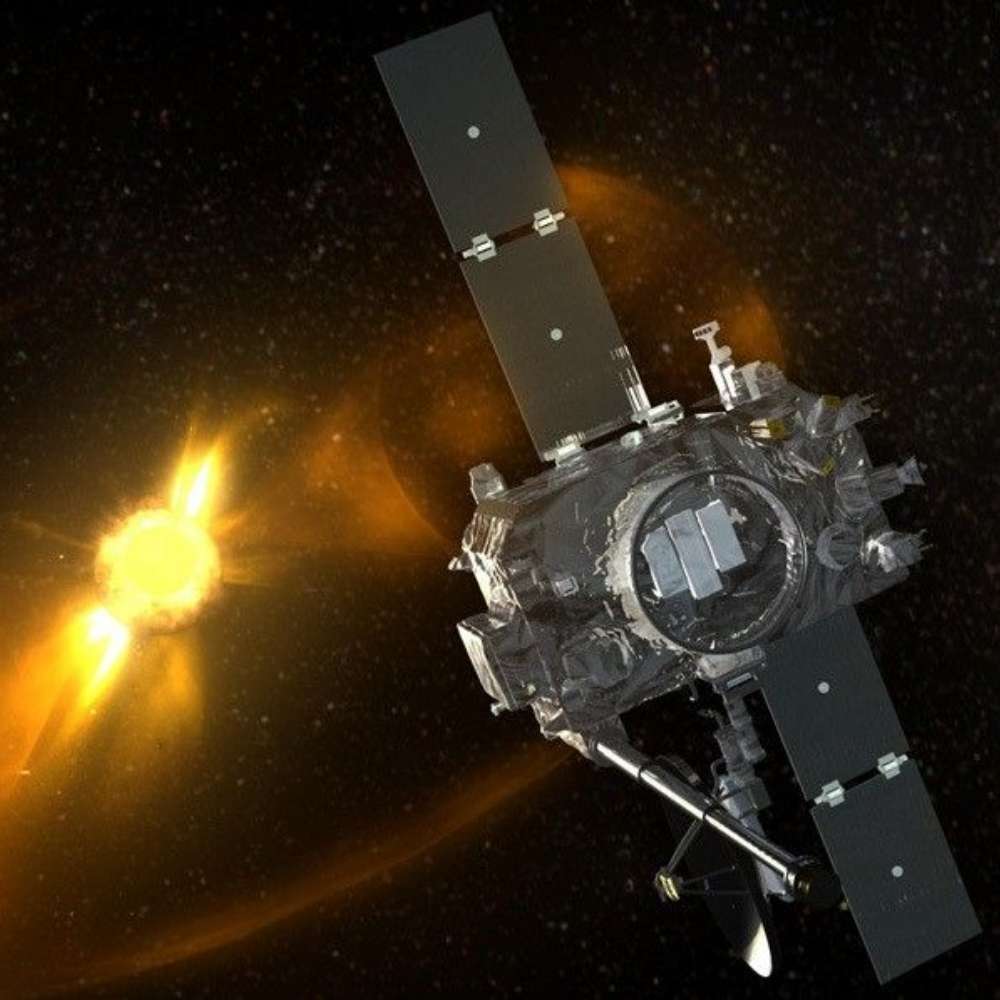
STEREO-A is the first spacecraft to continuously observe the Sun from outside Earth’s direct line of sight. By drifting ahead of Earth in its orbit, it enabled unprecedented three-dimensional views of solar eruptions.
This unique geometry fundamentally changed how scientists interpret the structure, speed, and direction of coronal mass ejections, improving space weather prediction capabilities.
Key Insight Snapshot
- First mission to image coronal mass ejections in true three dimensions
- Provided side-on perspectives of Earth-directed solar storms
- Resolved long-standing uncertainties in CME speed and trajectory
- Revolutionized the scientific foundations of space-weather forecasting
- Still operational nearly two decades after launch
Introduction — Why One View of the Sun Was Never Enough
For most of spaceflight history, humanity observed the Sun from a single vantage point: Earth’s line of sight.
This limitation created a critical problem.
Solar eruptions—especially coronal mass ejections (CMEs)—appear dramatically different depending on viewing angle. From Earth, a CME could look slow, fast, narrow, wide, weak, or catastrophic—often deceptively so.
STEREO-A was designed to break that illusion.
By observing the Sun from a different angle, it allowed scientists to finally see solar storms as three-dimensional structures moving through space, not flat projections on the sky.
The STEREO Mission Concept — Stereo Vision for the Sun
STEREO was launched as two nearly identical spacecraft:
STEREO-A (Ahead) — drifting ahead of Earth
STEREO-B (Behind) — drifting behind Earth (contact lost in 2014)
As they separated from Earth over time, the two spacecraft created a widening baseline—much like human eyes—allowing true stereoscopic vision of the Sun and heliosphere.
This geometry enabled:
3D reconstruction of CMEs
Accurate speed and direction measurements
Separation of line-of-sight effects from real motion
STEREO-A remains the surviving eye of this system.
What STEREO-A Observes
STEREO-A studies the Sun across a vast range of distances:
The solar surface and corona
The inner heliosphere
CMEs traveling all the way toward Earth and beyond
Its observations link solar activity directly to conditions in interplanetary space—bridging the gap between solar physics and space weather.
Why “Ahead” Matters
STEREO-A orbits the Sun slightly faster than Earth, gradually moving ahead in its orbit.
This placement allows it to:
View Earth-directed CMEs from the side
Observe active regions before they rotate into Earth view
Detect solar events hidden from Earth-based observatories
In many cases, STEREO-A sees what Earth cannot yet—or cannot see at all.
Solving the CME Direction Problem
Before STEREO, scientists struggled with a fundamental uncertainty:
Is a CME actually heading toward Earth, or just appearing that way?
Earth-based coronagraphs often misinterpreted CME geometry due to projection effects. STEREO-A provided the missing perspective.
By comparing Earth-view and side-view data, scientists could:
Determine true CME trajectories
Measure real expansion speeds
Estimate arrival times more accurately
This was a turning point for space-weather prediction.
The Heliospheric Imager — Following Storms Through Space
One of STEREO-A’s most revolutionary instruments is its Heliospheric Imager (HI).
Unlike traditional solar telescopes, HI can:
Track CMEs continuously as they move away from the Sun
Observe solar storms over millions of kilometers
Follow disturbances almost to Earth’s orbit
This made it possible, for the first time, to watch a solar storm evolve from eruption to impact.
STEREO-A and Space Weather Forecasting
Although STEREO-A is primarily a research mission, its data has become critical for operational forecasting.
Its observations help:
Validate CME arrival models
Improve storm intensity predictions
Identify dangerous events earlier
STEREO-A transformed space weather from reactive to increasingly predictive science.
Why STEREO-A Still Matters Today
Even after the loss of STEREO-B, STEREO-A remains uniquely valuable because:
It offers a non-Earth solar viewpoint
It provides continuity across solar cycles
It observes regions and events Earth-based missions miss
Few missions demonstrate more clearly that where you observe from can matter as much as what you observe.
STEREO-A’s Instrument Suite — Seeing the Sun in Three Dimensions
STEREO-A carries a powerful and carefully coordinated set of instruments designed to observe the Sun, the solar corona, and the heliosphere as a connected system. Together, these instruments made true 3D solar science possible for the first time.
Rather than focusing on a single layer of the Sun, STEREO-A observes solar activity from the surface outward into interplanetary space.
SECCHI — The Mission’s Core Imaging System
The heart of STEREO-A is SECCHI (Sun–Earth Connection Coronal and Heliospheric Investigation), a multi-instrument package that tracks solar eruptions from birth to propagation.
SECCHI includes:
EUVI (Extreme Ultraviolet Imager)
Observes the solar surface and lower corona, identifying flare sites and active regions.COR1 & COR2 (Coronagraphs)
Block direct sunlight to image the solar corona and capture the early expansion of CMEs.HI-1 & HI-2 (Heliospheric Imagers)
Follow CMEs far from the Sun, deep into the heliosphere—something no previous mission could do.
This continuous coverage solved a major gap in solar observation.
Why the Heliospheric Imagers Were Revolutionary
Before STEREO, solar missions could see:
The Sun and its immediate surroundings
Conditions near Earth
But the vast space between remained largely invisible.
STEREO-A’s heliospheric imagers changed that by allowing scientists to:
Track CMEs over tens of millions of kilometers
Measure how storms accelerate or decelerate
Observe interactions between CMEs and the ambient solar wind
For the first time, solar storms could be followed as evolving objects, not isolated events.
In-Situ Instruments — Feeling the Solar Wind Directly
STEREO-A does not only image the Sun—it also directly samples the environment it observes.
Its in-situ instruments measure:
Solar wind speed and density
Magnetic field strength and orientation
Energetic particles accelerated by shocks
These measurements allow scientists to compare what is seen remotely with what actually arrives at the spacecraft.
This closed the loop between imaging and physical impact.
Landmark Discoveries Enabled by STEREO-A
STEREO-A transformed solar physics by resolving long-standing uncertainties.
Key breakthroughs include:
Accurate 3D measurements of CME speed and direction
Proof that many “halo CMEs” were optical illusions
Direct observation of CME–CME collisions
Improved understanding of shock formation in interplanetary space
These discoveries reshaped how scientists classify and model solar eruptions.
STEREO-A vs SOHO vs SDO — Complementary Roles
STEREO-A did not replace earlier solar observatories—it completed them by adding a critical off-Earth perspective.
| Mission | Viewpoint | Primary Strength |
|---|---|---|
| SOHO | Earth–Sun line | Long-term, continuous solar monitoring |
| SDO | Near-Earth orbit | Ultra-high-resolution imaging of the Sun |
| STEREO-A | Off-Earth perspective | True three-dimensional geometry of CMEs |
Together, these missions functioned as a multi-angle solar observatory, dramatically improving the accuracy, context, and reliability of solar interpretation and space-weather forecasting.
Why STEREO-A Was Crucial for CME Arrival Predictions
Before STEREO-A, predicting when a CME would reach Earth often involved large uncertainties—sometimes ±24 hours or more.
With side-on observations, scientists could:
Eliminate projection errors
Measure real CME expansion rates
Refine arrival-time models
This reduced uncertainty and improved early warning for severe space weather events.
STEREO-A and the Loss of STEREO-B
In 2014, contact with STEREO-B was lost, ending true stereo vision.
However, STEREO-A continued to provide:
Independent solar viewpoints
Critical side-angle context
Coverage of regions invisible from Earth
Even alone, STEREO-A remains scientifically irreplaceable.
Why STEREO-A’s Data Still Shapes Modern Heliophysics
Many current solar models and forecasting tools were:
Developed using STEREO-A datasets
Validated through multi-year observations
Calibrated against its heliospheric measurements
Its legacy is deeply embedded in modern space-weather science.
STEREO-A and Extreme Solar Storms — Seeing Danger Before It Arrives
Some of STEREO-A’s most important contributions came during major solar storms, when accurate interpretation matters most.
By observing CMEs from the side, STEREO-A allowed scientists to:
Distinguish Earth-directed storms from harmless sideways eruptions
Measure true CME speeds instead of projected illusions
Track how CMEs expand, distort, and interact with the solar wind
In several cases, storms that appeared weak from Earth were revealed by STEREO-A to be fast, massive, and potentially dangerous—or vice versa.
This fundamentally changed how space-weather risk is assessed.
Why Off-Earth Solar Viewpoints Are Essential
STEREO-A proved a critical lesson in heliophysics:
One viewpoint is never enough.
From Earth alone:
CME width is often overestimated
CME speed is often underestimated
Direction is frequently ambiguous
STEREO-A showed that accurate space-weather prediction requires geometry, not just resolution.
Seeing solar storms in three dimensions is the only way to understand their true structure and threat level.
Life After STEREO-B — Why STEREO-A Still Matters
The loss of STEREO-B in 2014 ended true stereo vision—but STEREO-A did not lose its value.
Even as a single spacecraft, STEREO-A continues to:
Provide side-angle views unavailable from Earth
Observe solar regions before or after Earth-facing visibility
Track CMEs through the inner heliosphere
Its long operational life also allows scientists to compare solar behavior across multiple solar cycles, something few missions can offer.
Frequently Asked Questions (Expanded)
Is STEREO-A still operational today?
Yes. STEREO-A remains active and continues to return valuable heliospheric data.
Why was STEREO launched as two spacecraft?
To provide stereoscopic (3D) vision of the Sun, eliminating projection errors in CME observations.
What happened to STEREO-B?
Contact was lost in 2014 after a communication and orientation failure.
Can STEREO-A replace Earth-based solar observatories?
No. It complements them by providing a different viewpoint rather than replacing near-Earth missions.
Does STEREO-A improve space-weather forecasts?
Yes. Its data helps validate CME direction, speed, and arrival-time models.
Why don’t we always use off-Earth solar observers?
They are more complex to operate and communicate with, but STEREO-A proved their scientific necessity.
STEREO-A’s Legacy in Solar Physics
STEREO-A permanently changed how solar eruptions are studied.
Its legacy includes:
Establishing 3D CME reconstruction as standard practice
Demonstrating the importance of heliospheric imaging
Proving that space weather must be observed as a Sun-to-Earth system
Modern missions now assume multi-view geometry as a requirement, not a luxury.
STEREO-A in the Universe Map Context
Within Universe Map, STEREO-A connects naturally to:
Solar observatories
Coronal mass ejections (CMEs)
Heliospheric imaging
Space-weather monitoring
Lagrange-point and heliocentric missions
Together, these topics show how understanding the Sun requires observing it from beyond Earth’s shadow.
Final Perspective
STEREO-A did not discover new physics—it revealed old physics correctly.
By stepping away from Earth’s line of sight, it exposed how much misunderstanding came from perspective alone. Solar storms did not change—our ability to see them did.
STEREO-A reminds us of a simple truth in astronomy and science alike:
Understanding often depends not on looking harder, but on looking from a different angle.