



Sun–Earth L₁
Earth’s Frontline Watchtower Against the Sun
Quick Reader
| Attribute | Details |
|---|---|
| System | Sun–Earth gravitational system |
| Lagrange Point | L₁ |
| Distance from Earth | ~1.5 million km (toward the Sun) |
| Direction | Between Earth and the Sun |
| Stability Type | Semi-stable (halo / Lissajous orbits required) |
| Orbital Geometry | Continuous Sun–Earth alignment |
| Primary Role | Space weather monitoring |
| Key Advantage | Early warning of solar disturbances |
| Typical Warning Time | ~15–60 minutes |
| Famous Missions | SOHO, WIND, ACE, DSCOVR |
Why Sun–Earth L₁ Is Special (Quick Context)
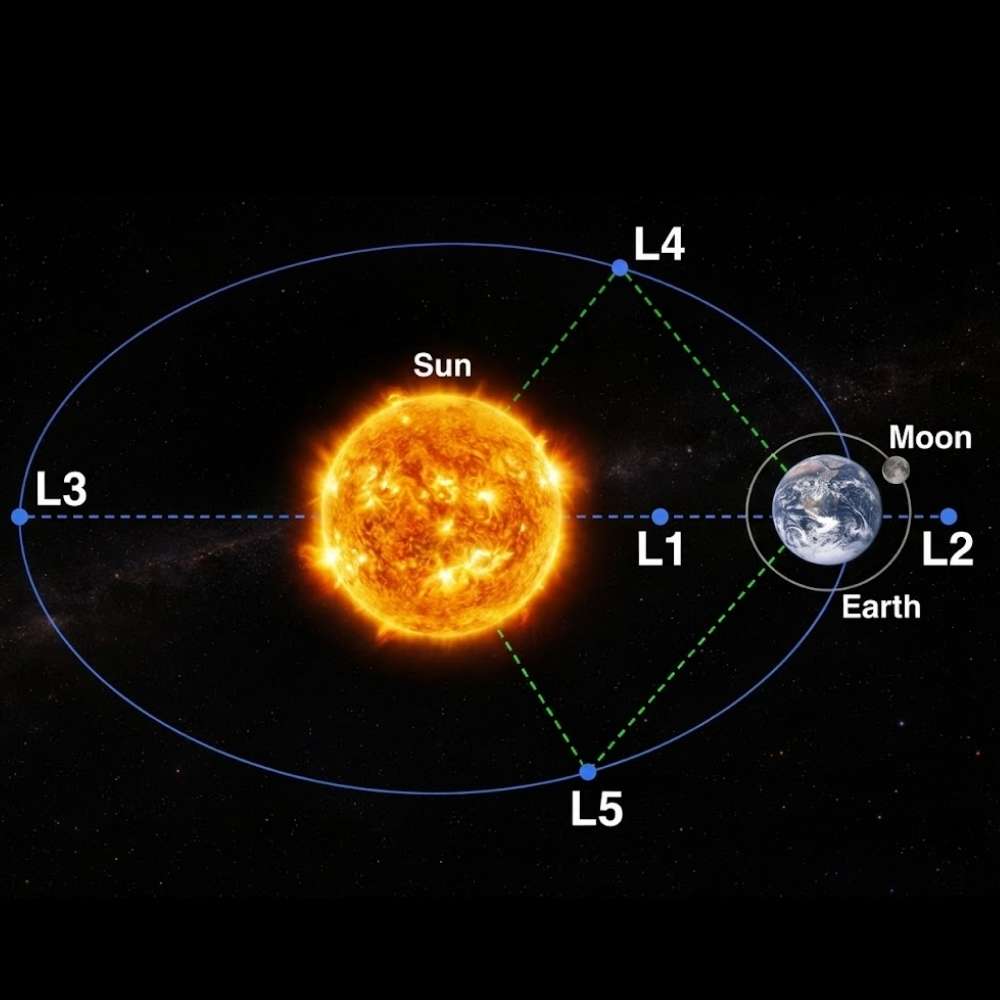
Sun–Earth L₁ is Earth’s early-warning outpost. From this position, spacecraft directly sample the solar wind before it reaches Earth, giving humanity crucial minutes to prepare for geomagnetic storms.
These storms can disrupt satellites, power grids, navigation systems, and global communications, making L₁ an essential component of modern space-weather defense.
Key Insight Snapshot
- Earth’s primary space-weather defense line
- Directly measures solar wind and interplanetary magnetic fields
- Provides real-time, operational monitoring data
- Essential for protecting modern technological infrastructure
- Complements the deep-space observation role of L₂
Introduction — Where Earth Meets the Sun
Earth does not passively orbit the Sun in empty space.
It is constantly bombarded by a stream of charged particles and magnetic fields known as the solar wind, punctuated by violent eruptions such as solar flares and coronal mass ejections (CMEs).
The Sun–Earth L₁ point exists exactly where we need to observe this activity:
Directly between Earth and the Sun
Far enough away to sample pristine solar wind
Close enough to transmit warnings in real time
L₁ is where cause is observed before effect occurs.
What Is Sun–Earth L₁, Physically?
Sun–Earth L₁ is a gravitational balance point where:
The Sun’s gravity pulls strongly inward
Earth’s gravity partially counteracts that pull
A spacecraft can orbit the Sun in step with Earth
At L₁, a spacecraft completes one orbit around the Sun in the same time as Earth, allowing it to remain continuously aligned between Earth and the Sun.
This alignment is the key to L₁’s importance.
Why L₁ Is Not a “Parking Spot”
Like L₂, Sun–Earth L₁ is not fully stable.
Important clarifications:
Spacecraft cannot sit motionless at L₁
Small disturbances grow over time
Continuous station-keeping is required
Instead, spacecraft operate in:
Halo orbits
Lissajous orbits
These looping paths keep spacecraft near L₁ while ensuring uninterrupted solar viewing and avoiding Earth’s shadow.
Why L₁ Is Perfect for Space Weather Monitoring
From L₁, spacecraft observe the solar wind before it interacts with Earth’s magnetosphere.
This allows them to measure:
Solar wind speed
Particle density
Temperature
Interplanetary magnetic field (IMF) direction
Among these, the magnetic field orientation is the most critical factor in determining storm severity.
A southward-pointing IMF can trigger major geomagnetic storms—and L₁ detects it first.
How Much Warning Time Does L₁ Provide?
The solar wind travels at speeds between ~300 and 800 km/s.
From L₁ to Earth, this translates to:
~15 minutes for fast solar wind
~60 minutes for slower streams
This short window is often enough to:
Put satellites into safe modes
Adjust power grid operations
Protect astronauts and high-altitude flights
Those minutes are strategically invaluable.
Why Earth Orbit Is Not Enough
If space weather satellites orbited Earth:
They would measure solar wind after impact
Data would arrive too late for warnings
Earth’s magnetosphere would contaminate measurements
L₁ solves this by sampling the solar wind upstream, before Earth alters it.
That is why all serious space weather systems begin at L₁.
Sun–Earth L₁ vs Sun–Earth L₂ — Opposite Roles
Although L₁ and L₂ are at similar distances, their purposes could not be more different.
L₁ looks inward toward the Sun
L₂ looks outward toward the Universe
L₁ is about protection and forecasting.
L₂ is about precision and discovery.
Together, they form a balanced observational system.
The First L₁ Missions — A Turning Point
The deployment of missions like SOHO and WIND at L₁ marked a turning point.
For the first time, humanity could:
Continuously monitor the Sun–Earth connection
Link solar activity directly to geomagnetic effects
Move from reactive to predictive space weather science
Modern civilization’s reliance on space technology made this capability essential.
Why L₁ Became Operationally Critical
As satellites, GPS, aviation, and power grids became integral to daily life, space weather monitoring transitioned from research to operational necessity.
Sun–Earth L₁ became:
A permanent monitoring location
A non-negotiable part of space infrastructure
The first line of defense against solar storms
Today, L₁ is as important to technological society as meteorological satellites are to weather forecasting.
How L₁ Missions Actually Work — From Measurement to Warning
Sun–Earth L₁ missions are designed around one core principle:
measure first, warn second, protect third.
Spacecraft at L₁ continuously sample the pristine solar wind before it reaches Earth. Their data streams are transmitted to Earth in near real time, where automated systems and human analysts assess storm potential.
The operational flow is simple but powerful:
Solar wind reaches L₁
Spacecraft instruments measure particles and magnetic fields
Data is sent to Earth within seconds
Forecast models evaluate geomagnetic risk
Alerts and advisories are issued
This upstream monitoring is what turns space weather from a surprise into a manageable hazard.
Key L₁ Missions — Roles and Contributions
Several missions have defined how L₁ is used today.
SOHO (Solar and Heliospheric Observatory)
Observes the Sun directly
Tracks solar flares and CMEs at their source
Provides early identification of eruptive events
WIND
Research-focused solar wind mission
Established the physics linking solar wind conditions to geomagnetic storms
Provides long-term baseline data
ACE (Advanced Composition Explorer)
Hybrid research and operational role
Measures solar wind composition and energetic particles
One of the first near-real-time warning platforms
DSCOVR
Fully operational space weather sentinel
Provides real-time alerts to NOAA
Current backbone of space weather forecasting
Together, these missions form a layered defense system, combining solar observation with direct particle measurement.
Halo Orbits at L₁ — Continuous Sun Exposure
Like L₂, L₁ spacecraft do not sit exactly at the point.
They operate in:
Halo orbits
Lissajous orbits
These orbits ensure:
Continuous view of the Sun
No Earth eclipses
Stable thermal and power conditions
Typical halo orbits around L₁ are hundreds of thousands of kilometers wide, allowing spacecraft to remain safely aligned while minimizing fuel use.
Communication and Data Flow from L₁
At ~1.5 million km from Earth, L₁ communication is reliable and continuous.
Key characteristics:
~5-second one-way light-time delay
Constant line-of-sight to Earth
High reliability for operational data streams
Unlike deep-space astronomy missions, L₁ missions prioritize:
Low latency
Data continuity
Redundancy
Because in space weather forecasting, minutes matter.
What L₁ Can Predict — And What It Cannot
Sun–Earth L₁ is powerful, but not omniscient.
What L₁ Does Well
Detects incoming solar wind conditions
Measures magnetic field orientation
Identifies shock fronts and storm triggers
Provides short-term impact warnings
What L₁ Cannot Do
Predict solar eruptions days in advance
Determine exact ground-level impacts
Fully forecast storm duration or recovery
L₁ tells us what is coming, not why it erupted or how Earth will respond in detail.
That is why L₁ data is combined with solar observatories and magnetospheric models.
Why Magnetic Field Direction Is Everything
One of the most important lessons from L₁ missions is this:
Speed alone does not make a storm dangerous.
A fast solar wind with a northward magnetic field may cause little disturbance. A slower wind with a sustained southward field can trigger major geomagnetic storms.
L₁ missions are the only way to measure this orientation before Earth is affected.
This insight reshaped space weather forecasting forever.
Operational Decisions Driven by L₁ Data
When L₁ instruments detect threatening conditions, actions may include:
Satellites switching to safe mode
Power grids reducing load stress
High-latitude flights adjusting routes
Astronauts seeking radiation shielding
These decisions are often made within minutes, based directly on L₁ data.
L₁ as a Permanent Infrastructure Node
Sun–Earth L₁ is no longer a temporary science outpost.
It is now:
A permanent monitoring location
A required element of space safety
A strategic asset for modern civilization
As long as society depends on satellites and electricity, L₁ must be occupied.
The Future of Sun–Earth L₁ — A Non-Negotiable Outpost
Sun–Earth L₁ has crossed a threshold.
It is no longer a scientific experiment—it is permanent critical infrastructure.
As global reliance on space-based systems grows, uninterrupted monitoring of the solar wind becomes as essential as weather satellites are to Earth’s climate forecasting.
Future strategy is clear:
Continuous occupation of L₁
Redundant spacecraft for fail-safe coverage
Improved instruments with higher cadence and accuracy
Integration with heliospheric imaging missions
The lesson learned is simple: Earth must always have eyes on the Sun.
Why L₁ Will Never Be Abandoned
Without an active L₁ monitor:
Solar storms would strike with little warning
Satellite anomalies would increase
Power grid damage risk would rise
Aviation radiation exposure would become harder to manage
Even a 15–30 minute warning can mean the difference between controlled mitigation and widespread disruption.
L₁ exists because modern civilization needs reaction time.
Future Successors and System Expansion
Rather than a single spacecraft, future concepts favor distributed monitoring:
Multiple L₁ monitors for redundancy
Higher-resolution plasma and magnetic field instruments
Combined use with heliospheric imagers (STEREO-like viewpoints)
AI-assisted real-time interpretation
This transforms L₁ from a single point of failure into a networked defense layer.
Frequently Asked Questions
Is Sun–Earth L₁ stable?
No. Spacecraft must actively maintain halo or Lissajous orbits using station-keeping maneuvers.
How far is L₁ compared to the Moon?
L₁ is about four times farther than the Moon.
Can L₁ missions be serviced?
Not with current human spaceflight systems. All L₁ missions are designed to be autonomous and self-sustaining.
Why not place space-weather satellites closer to Earth?
Because measurements taken near Earth are already contaminated by Earth’s magnetosphere. L₁ provides clean, upstream data.
Does L₁ observe solar flares directly?
No. L₁ measures the plasma and magnetic consequences of solar eruptions, not the flare light itself.
Is L₁ useful for astronomy?
Generally no. Thermal and viewing conditions favor solar monitoring, not deep-space observation.
Why Sun–Earth L₁ Is Critical Infrastructure
Sun–Earth L₁ occupies a rare category in space science:
A location where physics directly protects society.
It safeguards:
Satellite constellations
Navigation and timing systems
Power transmission networks
Human activity in space and at high altitude
Few scientific assets have such immediate real-world impact.
Sun–Earth L₁ in the Universe Map Context
Within Universe Map, Sun–Earth L₁ connects directly to:
Solar wind physics
Space weather forecasting
Magnetospheric dynamics
Lagrange point mechanics
Planetary protection from stellar activity
It represents the boundary where stellar physics meets human vulnerability.
Final Perspective
Sun–Earth L₁ is not beautiful.
It does not reveal galaxies or nebulae.
It produces no iconic images.
Yet it may be the most important location near Earth.
From this invisible balance point, humanity watches the Sun—not with curiosity alone, but with responsibility. L₁ turns raw plasma into warning, physics into preparation, and minutes into protection.
In a technological civilization orbiting a variable star,
Sun–Earth L₁ is where survival meets science.