




25143 Itokawa
The Rubble-Pile Asteroid That Changed Planetary Science
Quick Reader
| Attribute | Details |
|---|---|
| Official Designation | 25143 Itokawa |
| Provisional Designation | 1998 SF36 |
| Object Type | Near-Earth Asteroid (Apollo group) |
| Composition | S-type (stony, ordinary chondrite–like) |
| Discovery Year | 1998 |
| Discoverers | LINEAR survey |
| Mean Length | ~535 meters |
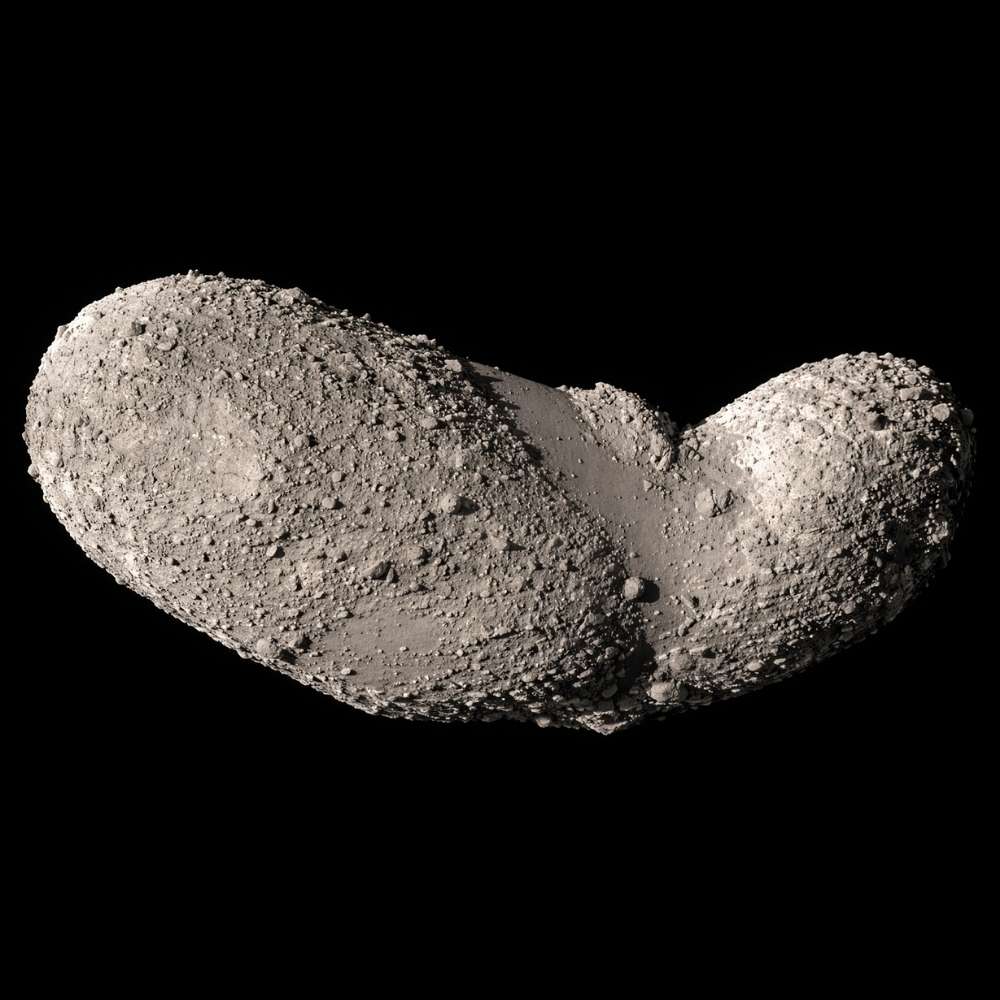
| Shape | Highly irregular, “peanut-shaped” |
| Rotation Period | ~12.1 hours |
| Orbital Period | ~1.52 Earth years |
| Notable Mission | Hayabusa (JAXA) |
| Sample Return | Yes (2010) |
| Structural Type | Rubble-pile asteroid |
Key Insights
- Itokawa was the first asteroid proven to be a rubble pile
- It was the first asteroid from which samples were returned
- Its structure challenged classical asteroid models
- It directly linked meteorites on Earth to specific asteroids
Introduction – A Small Asteroid with a Huge Impact
At first glance, 25143 Itokawa looks insignificant.
It is small, oddly shaped, and lacks dramatic features like rings or moons.
Yet Itokawa permanently changed how scientists understand asteroids.
Before Itokawa, many asteroids were assumed to be solid monolithic rocks.
After Itokawa, that assumption collapsed.
What Is 25143 Itokawa?
25143 Itokawa is a near-Earth asteroid belonging to the Apollo group, meaning its orbit crosses Earth’s orbit around the Sun.
However, its importance does not come from danger or size.
It matters because Itokawa revealed that some asteroids are:
Loosely bound collections of rocks
Held together by weak gravity
Structurally fragile yet dynamically stable
This type of body is known as a rubble-pile asteroid.
Discovery and Naming
Itokawa was discovered in 1998 and later named after Hideo Itokawa, the father of Japanese rocketry.
The naming was symbolic.
Itokawa would become the target of Japan’s first asteroid mission, linking the nation’s space heritage to its future exploration goals.
Orbital Characteristics
Itokawa’s orbit places it firmly in near-Earth space.
Key features include:
Earth-crossing trajectory
Moderate eccentricity
Relatively stable long-term orbit
Although it is classified as a near-Earth asteroid, Itokawa poses no imminent impact threat.
A Shape That Raised Questions
Images from spacecraft revealed an unexpected form.
Itokawa is:
Strongly elongated
Narrow at the center
Resembling two lobes joined together
This “contact binary” shape suggested that Itokawa formed from the gentle re-accumulation of fragments, not from a single solid body.
Surface Without Craters – A Major Clue
Unlike larger asteroids, Itokawa shows:
Very few large craters
Smooth regions mixed with boulder fields
Evidence of surface migration
This implied that impacts do not leave permanent scars in the usual way.
Instead, seismic shaking redistributes material across the surface.
The Rubble-Pile Revelation
Before Itokawa, rubble piles were theoretical.
Itokawa provided direct evidence:
Extremely low bulk density
Internal voids
Weak gravitational binding
It behaves more like a cosmic gravel heap than a rock.
This discovery reshaped:
Impact modeling
Asteroid deflection strategies
Interpretation of meteorites
Why Itokawa Was Chosen as a Mission Target
Itokawa was selected for close study because it:
Was accessible with available propulsion
Represented a common asteroid type
Offered a test case for landing and sampling
It was scientifically ideal — small enough to be manageable, but complex enough to be revealing.
Universe Map Context – Why Itokawa Matters
25143 Itokawa connects multiple Universe Map themes:
Near-Earth asteroids
Small-body structure
Sample return missions
Planetary defense physics
It demonstrates that size does not limit scientific importance.
Hayabusa – Humanity’s First Touchdown on an Asteroid
To understand Itokawa, scientists needed more than images.
They needed direct interaction.
Japan’s Hayabusa mission, launched by JAXA, was designed to do something never done before:
Rendezvous with a near-Earth asteroid
Land on its surface
Collect samples
Return them safely to Earth
Every step involved untested technology and extreme precision.
Approach and Mapping – Seeing a Rubble Pile Up Close
When Hayabusa arrived at Itokawa in 2005, expectations were immediately challenged.
High-resolution imaging revealed:
A surface dominated by boulders
Large blocks tens of meters across
A surprising lack of fine dust in many regions
This confirmed that gravity on Itokawa is so weak that even small disturbances can move surface material globally.
Two Worlds on One Asteroid
Itokawa’s surface showed a striking contrast.
Scientists identified:
Rough regions covered in large boulders
Smooth regions filled with fine regolith
The most famous smooth area, later named Muses Sea, became the primary sampling target.
This distribution suggested global material migration, driven by tiny impacts and rotational shaking.
Why Landing Was Extremely Difficult
Landing on Itokawa was nothing like landing on a planet or Moon.
Challenges included:
Gravity millions of times weaker than Earth’s
No stable “down” direction
Risk of bouncing back into space
Irregular shape and uneven terrain
Hayabusa had to perform controlled contact, not a traditional landing.
Touchdown Attempts – Success Through Persistence
Hayabusa attempted multiple touchdowns in November 2005.
Despite technical problems:
The spacecraft made surface contact
Sampling mechanisms activated
Microscopic particles entered the collection chamber
At the time, engineers were unsure if any material had actually been collected.
The Long Journey Home
After leaving Itokawa, Hayabusa faced severe difficulties:
Reaction wheel failures
Fuel leaks
Temporary loss of communication
Against expectations, the mission recovered.
In 2010, Hayabusa’s return capsule reentered Earth’s atmosphere and landed in Australia.
Inside were thousands of microscopic asteroid grains.
Confirming the Sample – A Scientific First
Laboratory analysis showed that the samples:
Came directly from Itokawa
Matched ordinary chondrite meteorites
Had not been altered by Earth’s atmosphere
This was historic.
For the first time, scientists linked meteorites on Earth to a specific asteroid.
What the Samples Revealed About Itokawa
The returned grains confirmed that:
Itokawa formed from fragments of a larger parent body
That parent body was once melted and differentiated
It was later shattered by a major collision
The debris reassembled into a rubble pile
Itokawa is not primitive — it is recycled planetary material.
Surface Weathering in Microgravity
Sample analysis also showed clear signs of space weathering.
This included:
Darkened grain surfaces
Altered spectral signatures
Differences between fresh and exposed material
This explained why asteroid surfaces often look different from meteorites before atmospheric entry.
Why Hayabusa Changed Mission Design Forever
Hayabusa proved that:
Touch-and-go sampling is feasible
Sample return is possible even from tiny bodies
Small missions can deliver transformative science
Its success directly influenced later missions such as Hayabusa2 and OSIRIS-REx.
Universe Map Perspective – When Contact Matters
Itokawa taught scientists that remote observation is not enough for small bodies.
Understanding asteroid structure, composition, and behavior requires:
Direct contact
Physical samples
In-situ measurements
Hayabusa turned theory into evidence.
Why Itokawa Redefined the Concept of an Asteroid
Before Itokawa, asteroids were often imagined as solid, monolithic rocks drifting through space.
Itokawa destroyed that simplification.
It showed that many asteroids are:
Structurally fragile
Internally porous
Held together by gravity barely stronger than contact forces
This realization forced a rethink of how asteroids form, evolve, and respond to external forces.
Implications for Planetary Defense
Understanding asteroid structure is critical for impact mitigation.
Itokawa demonstrated that:
Applying force to a rubble pile does not behave like hitting a solid rock
Energy is absorbed and redistributed through internal voids
Deflection strategies must account for structural response
This insight directly affects how scientists plan to protect Earth from hazardous asteroids.
Rubble Piles and Asteroid Evolution
Itokawa is now understood as part of a broader population.
Rubble-pile asteroids likely form when:
A large parent body is shattered by collision
Fragments reaccumulate slowly under gravity
Internal voids remain
These objects are common, especially among near-Earth asteroids.
Why Small Asteroids Can Be Geologically Active
Despite its size, Itokawa shows evidence of ongoing surface processes.
These include:
Boulder migration
Regolith pooling in gravitational lows
Surface renewal through seismic shaking
Even tiny bodies can be geologically dynamic when gravity is weak.
The Legacy of Hayabusa and Itokawa
Itokawa’s legacy extends far beyond a single mission.
It influenced:
Hayabusa2’s mission design to Ryugu
OSIRIS-REx’s approach to Bennu
Global confidence in sample return missions
It proved that complex exploration is possible even with limited resources.
Frequently Asked Questions (Expanded)
Is Itokawa dangerous to Earth?
No. While it is a near-Earth asteroid, current orbital solutions show no imminent impact risk.
Why were only tiny grains returned?
Hayabusa’s sampling mechanism was designed for minimal contact. Even microscopic grains were enough to deliver groundbreaking science.
Is Itokawa a contact binary?
Yes. Its shape suggests two lobes gently joined after reaccumulation.
Are most asteroids rubble piles?
Many small asteroids likely are, especially near-Earth ones. Larger asteroids may still be monolithic or layered.
What makes Itokawa more important than larger asteroids?
It provided direct physical samples and structural insight, which size alone cannot replace.
Why Itokawa Matters for Universe Map
25143 Itokawa exemplifies Universe Map’s focus on process over appearance.
It connects:
Small-body physics
Asteroid evolution
Sample return missions
Planetary defense strategy
It shows that even the smallest bodies can carry the biggest lessons.
Related Topics for Universe Map
Near-Earth asteroids
Rubble-pile asteroids
Hayabusa mission
Hayabusa2 and Ryugu
OSIRIS-REx and Bennu
Together, these topics reveal how planetary fragments shape our understanding of the Solar System.
Final Perspective
Itokawa is not impressive because of its size.
It is important because it exposed a hidden truth:
many asteroids are collections of fragments, not solid worlds.
By touching Itokawa and bringing pieces of it home, humanity gained insight into how planets form, how collisions reshape worlds, and how fragile cosmic structures can persist for billions of years.
Itokawa reminds us that in space, strength often comes from structure, not solidity.