










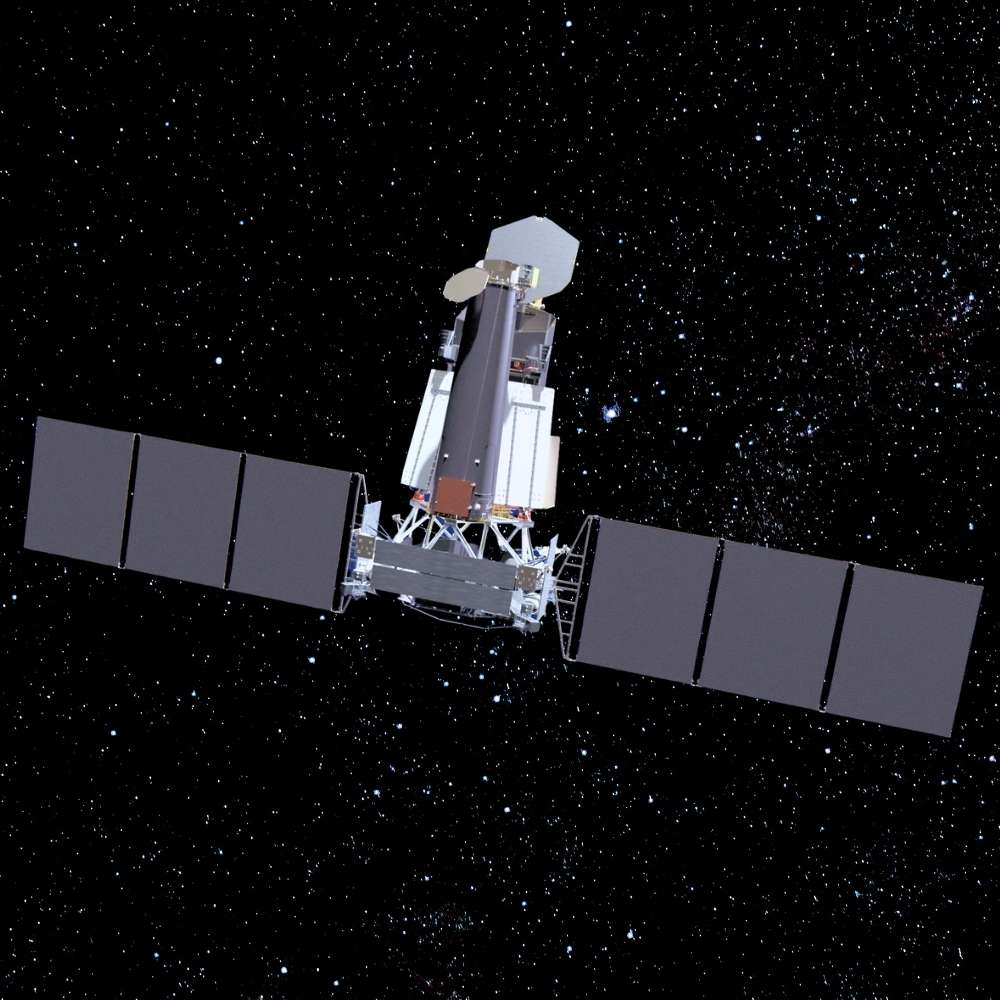
Spektr-RG Observatory
Mapping the High-Energy Universe in X-Rays
Quick Reader
| Attribute | Details |
|---|---|
| Mission Name | SPEKTR-RG |
| Full Name | Spectrum-Roentgen-Gamma |
| Mission Type | Space-based X-ray astronomy observatory |
| Operating Agencies | Roscosmos (Russia), DLR (Germany) |
| Launch Date | 13 July 2019 |
| Launch Vehicle | Proton-M |
| Orbit | Sun–Earth L₂ halo orbit |
| Primary Instruments | eROSITA, ART-XC |
| Wavelength Range | Soft & hard X-rays |
| Main Goal | All-sky X-ray survey |
| Mission Status | Partially operational (eROSITA survey phase completed) |
Why SPEKTR-RG Is Special
SPEKTR-RG is the most sensitive all-sky X-ray survey mission since ROSAT, designed to map the hot and energetic Universe with unprecedented depth.
Its primary strength lies in surveying galaxy clusters, black holes, neutron stars, and the cosmic X-ray background across the entire sky.
Key Insight Snapshot
- Most advanced all-sky X-ray survey of the modern era
- Operating from the ultra-stable Sun–Earth L₂ point
- Key mission for dark matter and dark energy studies
- Bridges classic X-ray astronomy with precision cosmology
- Produced the deepest X-ray map of the entire sky
Introduction — Seeing the Universe’s Hottest Side
Much of the Universe does not shine in visible light.
The most violent and energetic phenomena—
black holes, neutron stars, galaxy clusters, supernova remnants—emit primarily in X-rays, a form of light invisible to human eyes and blocked by Earth’s atmosphere.
To study this extreme Universe, astronomers must go to space.
SPEKTR-RG was built to do exactly that:
to create the most complete X-ray census of the sky ever attempted.
Why X-Rays Matter in Astronomy
X-ray astronomy reveals environments where:
Temperatures reach millions of degrees
Gravity is extreme
Matter is highly ionized
Magnetic fields are intense
X-ray observations allow scientists to study:
Accreting supermassive black holes (AGN)
Hot gas in galaxy clusters
Neutron stars and pulsars
Shock waves from cosmic explosions
In short, X-rays trace energy, gravity, and cosmic structure.
The Mission Concept — Survey First, Study Later
Unlike pointed observatories that focus on individual targets, SPEKTR-RG was designed primarily as a survey mission.
Its strategy:
Scan the entire sky repeatedly
Build up sensitivity over time
Create a uniform, deep X-ray map
This approach allows astronomers to:
Discover new objects in large numbers
Study population statistics, not just individual sources
Use X-ray data as a foundation for follow-up observations
SPEKTR-RG’s strength is completeness.
Why Sun–Earth L₂ Was Chosen
SPEKTR-RG operates from the Sun–Earth L₂ Lagrange point, the same region used by JWST, Gaia, and Planck.
From L₂, the mission benefits from:
Extremely stable thermal conditions
Continuous sky scanning without Earth eclipses
Low background noise for X-ray detectors
Long, uninterrupted observations
This environment is ideal for sensitive, long-term surveys.
Two Telescopes, One Mission
SPEKTR-RG carries two complementary X-ray instruments:
eROSITA — optimized for soft X-rays
ART-XC — optimized for harder X-rays
Together, they cover a broad energy range, allowing scientists to study both:
Diffuse hot gas
Compact, high-energy point sources
This dual-instrument design gives SPEKTR-RG a uniquely balanced view of the X-ray sky.
eROSITA — The Survey Engine
eROSITA is the mission’s primary survey instrument.
Its role:
Perform repeated all-sky scans
Detect millions of X-ray sources
Map large-scale cosmic structures
eROSITA alone increased the number of known X-ray sources by orders of magnitude, transforming X-ray astronomy from sparse catalogs to rich datasets.
What SPEKTR-RG Was Built to Find
Key science targets include:
Galaxy clusters — tracers of dark matter
Active galactic nuclei (AGN) — growing black holes
X-ray binaries — stellar-mass black holes & neutron stars
Supernova remnants — cosmic shock physics
By studying these populations statistically, SPEKTR-RG links astrophysics with cosmology.
Why Galaxy Clusters Are Central to the Mission
Galaxy clusters are the largest gravitationally bound structures in the Universe.
In X-rays, clusters glow due to:
Hot gas trapped in deep gravitational wells
Temperatures of tens of millions of degrees
By counting and mapping clusters across cosmic time, SPEKTR-RG helps answer:
How structure formed in the Universe
How dark matter shapes large-scale structure
How dark energy influences cosmic expansion
This makes SPEKTR-RG a cosmology mission as much as an astronomy mission.
SPEKTR-RG in the Bigger Picture
SPEKTR-RG stands at the intersection of:
High-energy astrophysics
Large-scale structure formation
Dark matter and dark energy studies
Next-generation survey astronomy
It provides the X-ray backbone for multi-wavelength studies involving optical, infrared, and radio observatories.
Inside SPEKTR-RG — Two X-Ray Telescopes, One Survey Vision
SPEKTR-RG is unique because it does not rely on a single instrument.
Instead, it combines two complementary X-ray telescopes, each optimized for a different energy range.
This dual-instrument strategy allows the mission to map both diffuse cosmic structures and compact high-energy sources with exceptional completeness.
eROSITA — The Soft X-Ray Survey Powerhouse
eROSITA (extended ROentgen Survey with an Imaging Telescope Array) is the primary instrument of SPEKTR-RG.
What eROSITA Does Best
Operates in the soft X-ray band
Performs repeated full-sky scans
Detects faint, distant X-ray sources
Maps large-scale cosmic structures
Why eROSITA Is Revolutionary
Compared to its predecessor ROSAT, eROSITA is:
~20–30× more sensitive
Capable of detecting millions of X-ray sources
Designed for long-term uniform sky coverage
This transformed X-ray astronomy from a sparse catalog science into a population-driven discipline.
ART-XC — Probing the Hard X-Ray Universe
ART-XC (Astronomical Roentgen Telescope – X-ray Concentrator) complements eROSITA by observing higher-energy X-rays.
ART-XC Focus Areas
Accreting black holes
Neutron stars and pulsars
Obscured active galactic nuclei
High-energy transients
Hard X-rays penetrate dense gas and dust more effectively, allowing ART-XC to detect sources that appear hidden or faint in softer bands.
Why Two X-Ray Bands Matter
Many cosmic objects emit X-rays across a wide energy range.
Using both instruments together allows scientists to:
Distinguish different physical processes
Identify absorbed vs unobscured sources
Measure temperatures and emission mechanisms
Build more accurate source classifications
This multi-band approach gives SPEKTR-RG a diagnostic advantage over single-instrument missions.
The All-Sky Scanning Strategy Explained
SPEKTR-RG does not point at individual targets for long periods.
Instead, it uses a continuous scanning mode:
The spacecraft slowly rotates
The sky is swept in great circles
Every six months, the entire sky is covered once
Repeated scans build sensitivity over time
This strategy ensures:
Uniform exposure across the sky
Reduction of systematic errors
Long-term monitoring of variable sources
Over multiple years, faint sources emerge from the accumulated data.
What SPEKTR-RG Has Already Discovered
Even early survey data revealed:
Vast numbers of previously unknown AGN
New galaxy clusters at large distances
X-ray activity in unexpected environments
Improved maps of the cosmic X-ray background
These discoveries provide statistical power, not just individual curiosities.
SPEKTR-RG vs Previous X-Ray Missions
Each major X-ray mission was designed with a different scientific priority. Rather than competing directly, these observatories complement one another.
| Mission | Strength | Limitation |
|---|---|---|
| ROSAT | First full-sky X-ray survey | Limited sensitivity |
| Chandra | Ultra-high angular resolution | Narrow field of view |
| XMM-Newton | High photon throughput | Not designed for an all-sky survey |
| SPEKTR-RG | Deep, uniform all-sky coverage | Moderate angular resolution |
SPEKTR-RG does not replace Chandra or XMM-Newton.
Instead, it acts as a discovery engine—identifying the most interesting X-ray sources across the sky and feeding them to high-resolution observatories for deeper, targeted investigation.
Why Survey Missions Are Foundational
Targeted telescopes answer specific questions.
Survey missions reveal what questions to ask.
SPEKTR-RG’s catalogs will remain scientifically valuable for decades, forming the backbone of:
Follow-up observations
Multi-wavelength studies
Statistical cosmology
This is how survey missions quietly shape the future of astronomy.
SPEKTR-RG as a Bridge Mission
SPEKTR-RG sits between eras:
After ROSAT, which mapped the X-ray sky broadly
Before future missions that will probe specific physics
It bridges discovery and precision, offering both breadth and depth.
The Long-Term Legacy of SPEKTR-RG
SPEKTR-RG was designed not just to observe the X-ray sky—but to define it for a generation.
Its greatest contribution is the creation of the deepest, most uniform all-sky X-ray map since ROSAT, but with vastly superior sensitivity and source statistics.
Long after active operations, SPEKTR-RG data will continue to be used for:
Identifying new galaxy clusters
Tracing the growth of supermassive black holes
Studying large-scale cosmic structure
Anchoring multi-wavelength astronomical surveys
Like ROSAT before it, SPEKTR-RG’s catalogs will remain scientifically relevant for decades.
Why SPEKTR-RG Is Crucial for Cosmology
Although it is an X-ray observatory, SPEKTR-RG plays a central role in cosmology.
Galaxy clusters detected by SPEKTR-RG:
Trace the underlying dark matter distribution
Reveal how structure grows over cosmic time
Provide constraints on dark energy models
By counting clusters at different distances and masses, astronomers can test how fast the Universe has expanded and how gravity behaves on the largest scales.
In this way, SPEKTR-RG connects hot gas physics to the fate of the Universe.
Mission Challenges and Limitations
No mission is perfect, and SPEKTR-RG has clear constraints.
Key limitations include:
Moderate angular resolution compared to Chandra
Dependence on follow-up observations for detailed physics
Operational interruptions affecting parts of the mission
Despite these factors, the survey data already collected remains immensely valuable, and much of its core science output is secure.
Frequently Asked Questions
Is SPEKTR-RG still operational?
The spacecraft remains in space at Sun–Earth L₂. Survey operations were completed for key phases, and existing data continues to be analyzed extensively.
How many X-ray sources did SPEKTR-RG detect?
Millions of sources are expected in final catalogs, making it the richest X-ray survey dataset ever assembled.
Does SPEKTR-RG replace Chandra or XMM-Newton?
No. SPEKTR-RG is a survey mission. Chandra and XMM-Newton are precision observatories used for detailed follow-up studies.
Why was L₂ essential for this mission?
L₂ provides thermal stability, low background noise, and uninterrupted sky scanning—critical for sensitive X-ray surveys.
What makes eROSITA so important?
eROSITA dramatically increased the sensitivity and depth of all-sky X-ray surveys, enabling population-level studies rather than isolated detections.
Why SPEKTR-RG Matters Beyond X-Ray Astronomy
SPEKTR-RG’s impact extends beyond a single wavelength.
Its catalogs support:
Optical surveys (Gaia, Euclid, LSST)
Infrared studies (JWST, Spitzer archives)
Radio surveys (LOFAR, SKA precursors)
By acting as the X-ray layer in multi-wavelength astronomy, SPEKTR-RG helps unify our understanding of the Universe across the electromagnetic spectrum.
SPEKTR-RG in the Universe Map Context
Within Universe Map, SPEKTR-RG connects directly to:
X-ray astronomy
Galaxy clusters
Dark matter and dark energy
Sun–Earth L₂ observatories
Large-scale structure of the Universe
It represents the high-energy backbone of modern cosmic cartography.
Final Perspective
SPEKTR-RG does not produce dramatic, iconic images like some space telescopes.
Its power lies elsewhere—in statistics, completeness, and depth.
By quietly scanning the sky again and again, it revealed a Universe filled with hot gas, growing black holes, and massive structures shaped by dark matter. It transformed the X-ray sky from a sparse map into a dense cosmic census.
SPEKTR-RG reminds us that understanding the Universe is not only about looking deeper—but about seeing everything, everywhere, consistently.