



THEMIS Mission
Tracing Earth’s Magnetic Storms from Space
Quick Reader
| Attribute | Details |
|---|---|
| Mission Name | THEMIS |
| Full Form | Time History of Events and Macroscale Interactions during Substorms |
| Mission Type | Magnetospheric science mission |
| Space Agency | NASA |
| Launch Date | 17 February 2007 |
| Spacecraft | 5 identical probes (THEMIS A–E) |
| Primary Target | Earth’s magnetosphere |
| Main Science Goal | Understand magnetospheric substorms |
| Orbit Type | Highly elliptical Earth orbits |
| Extended Mission | ARTEMIS (Moon-orbiting probes) |
| Key Phenomena | Auroras, magnetic reconnection |
Key Insights
- THEMIS used five spacecraft simultaneously
- It solved the long-standing mystery of what triggers auroral substorms
- It directly linked magnetotail reconnection to auroral explosions
- Two probes were later repurposed for lunar science
Introduction – Why Earth’s Auroras Explode Suddenly
Auroras can glow gently for hours.
Then, without warning, they explode into bright, fast-moving curtains of light.
For decades, scientists knew what auroras were — charged particles hitting Earth’s atmosphere —
but not why they suddenly intensify.
THEMIS was designed to answer that exact question.
What Is THEMIS?
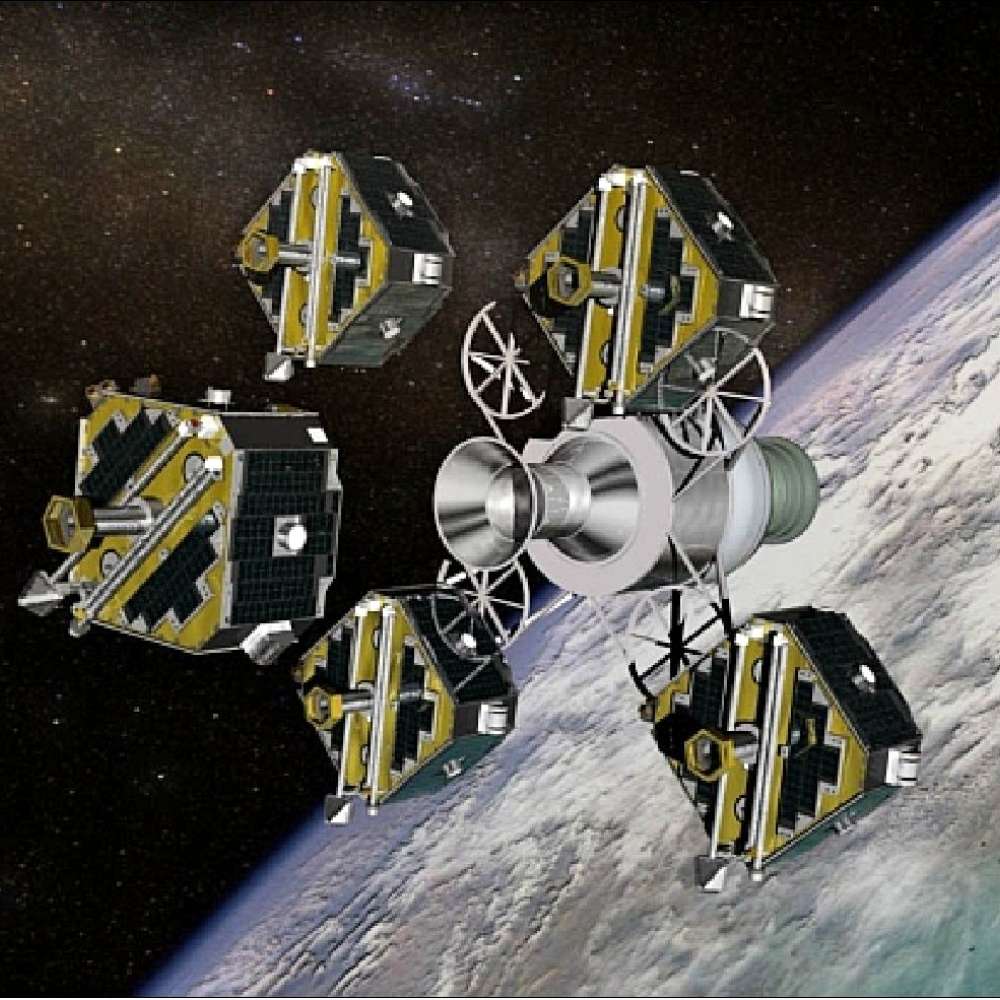
THEMIS is a constellation of five identical spacecraft flying through Earth’s magnetic environment.
Instead of studying space from one point, THEMIS observes:
Multiple locations at the same time
Cause-and-effect relationships
Timing of events across vast distances
This multi-point approach was essential to solving magnetospheric physics problems that single satellites could not.
What Are Magnetospheric Substorms?
A substorm is a sudden release of energy stored in Earth’s magnetosphere.
It involves:
Rapid reconfiguration of magnetic field lines
Acceleration of charged particles toward Earth
Intensification of auroras
Substorms transfer energy from the solar wind into Earth’s upper atmosphere in minutes.
Understanding them is critical for space weather science.
Two Competing Theories Before THEMIS
Before THEMIS, scientists debated two main explanations for substorms.
Near-Earth Current Disruption
Energy release occurs close to Earth
Magnetic currents suddenly collapse
Auroras intensify as a result
Distant Magnetic Reconnection
Energy release begins far down the magnetotail
Magnetic field lines snap and reconnect
Energy propagates toward Earth
Both theories had evidence. Neither was proven.
Why One Spacecraft Was Not Enough
The magnetosphere stretches hundreds of thousands of kilometers behind Earth.
A single spacecraft cannot tell whether:
A disturbance started locally
Or arrived from far away
THEMIS solved this by spacing its probes along the magnetotail, allowing scientists to track where and when substorms begin.
THEMIS Probe Configuration
The five spacecraft were placed in carefully tuned orbits so that:
Some probes sampled near-Earth regions
Others sampled the distant magnetotail
All could observe the same substorm from different locations
This configuration allowed direct testing of cause-and-effect timing.
Instruments – Measuring Invisible Forces
Each THEMIS probe carried instruments to measure:
Magnetic field strength and direction
Electric fields
Plasma density and flow
Energetic particle populations
Together, these instruments reveal how energy moves through near-Earth space.
First Major Breakthrough – Where Substorms Start
THEMIS observations showed that:
Substorms begin with magnetic reconnection
The trigger point lies far down the magnetotail
Energy then propagates rapidly toward Earth
This resolved the debate in favor of the reconnection model.
It was a landmark result in space physics.
Universe Map Context – Why THEMIS Matters
THEMIS connects several Universe Map themes:
Solar wind–Earth interaction
Space weather processes
Plasma physics
Auroral dynamics
It shows how invisible magnetic structures control visible phenomena in Earth’s sky.
Following Energy from Space to the Sky
THEMIS did more than identify where substorms begin.
It tracked how energy moves from deep space all the way to Earth’s upper atmosphere.
By comparing timing between probes, scientists observed a clear sequence:
Magnetic reconnection begins in the distant magnetotail
Energy and plasma flow earthward at high speed
Magnetic field lines snap and dipolarize near Earth
Particles are injected into the auroral regions
For the first time, substorms were mapped as a complete physical process, not isolated events.
Timing Was the Key Scientific Weapon
THEMIS proved that timing is everything in magnetospheric physics.
By measuring:
When reconnection occurred
When magnetic disturbances arrived near Earth
When auroras brightened on the ground
Scientists could establish causality, not just correlation.
This eliminated decades of ambiguity.
THEMIS + Ground Observatories – A Unified System
THEMIS did not work alone.
It was coordinated with a vast network of ground-based instruments, including:
All-sky auroral cameras
Magnetometers
Radar systems
This allowed scientists to link:
Space-based magnetic events
Particle acceleration
Visual auroral explosions
Space and Earth became part of a single observing system.
Auroral Breakup Explained
One of THEMIS’s most important achievements was explaining auroral breakup.
THEMIS data showed that:
Auroral arcs store energy quietly
A sudden magnetic reconfiguration releases that energy
Particles are rapidly funneled into the atmosphere
Auroras brighten, move, and expand
Auroral breakup is not random — it is a predictable outcome of magnetotail physics.
Why Substorms Matter Beyond Auroras
Substorms are not just beautiful light shows.
They can:
Disrupt satellite operations
Induce electrical currents in power grids
Affect radio communication and navigation
Alter radiation belt dynamics
THEMIS helped quantify how and when these effects occur.
From THEMIS to ARTEMIS – A Mission Evolves
After completing its primary Earth mission, two THEMIS probes were repurposed.
This extended mission became ARTEMIS.
The probes were sent to:
Lunar orbit
Earth–Moon Lagrange regions
This transition allowed THEMIS hardware to study:
The Moon’s interaction with the solar wind
Plasma processes in cislunar space
Few missions have achieved such a successful second life.
Why Multi-Spacecraft Missions Changed Space Physics
Before THEMIS, many missions relied on single spacecraft.
THEMIS demonstrated that:
Complex plasma systems cannot be understood from one point
Cause-and-effect requires spatial coverage
Constellation missions reveal system-level behavior
This approach influenced later missions such as MMS and Cluster.
Scientific Questions THEMIS Answered Clearly
THEMIS provided definitive answers to key questions:
Where do substorms start?
Far down the magnetotailWhat triggers auroral explosions?
Magnetic reconnectionHow fast does energy propagate?
Minutes, not hours
These answers reshaped magnetospheric theory.
Universe Map Perspective – Systems, Not Snapshots
THEMIS reinforces a core Universe Map principle:
Space environments must be understood as dynamic systems, not static regions.
Earth’s magnetosphere is alive with motion, energy storage, and release.
THEMIS revealed its rhythm.
THEMIS’s Long-Term Legacy
THEMIS did not just solve a single scientific problem.
It changed how space physics is done.
Its legacy rests on three pillars:
Proof that magnetospheric substorms originate from magnetic reconnection in the distant tail
Demonstration that multi-point measurements are essential for plasma systems
Creation of a data framework that still supports research today
Many modern models of Earth’s space environment are calibrated using THEMIS results.
Why THEMIS Still Matters Today
Even years after its primary mission phase, THEMIS data continues to be used because:
Substorms remain a core space weather driver
Auroral physics is tightly linked to satellite risk
Magnetospheric energy transfer affects modern infrastructure
THEMIS observations remain a reference standard for understanding how energy flows through near-Earth space.
From THEMIS to ARTEMIS – Extending the Mission’s Reach
One of THEMIS’s most remarkable achievements is its transition into ARTEMIS.
Two probes were redirected to study:
The Moon’s plasma environment
Earth–Moon Lagrange regions
Solar wind interactions without a global magnetosphere
This created a scientific bridge between:
Earth’s magnetosphere
The lunar environment
Cislunar space dynamics
Few missions have delivered such value across multiple domains.
THEMIS and Space Weather Forecasting
THEMIS helped refine the understanding of when substorms occur, not just how.
This improved:
Prediction of auroral activity
Understanding of particle injections into radiation belts
Assessment of geomagnetically induced currents
While THEMIS is not an operational forecasting mission, its science underpins many forecasting tools used today.
Why THEMIS Was a Turning Point Mission
THEMIS succeeded because it was designed around the physics problem, not just instrumentation.
It was built to answer:
Where does the energy come from?
When does it move?
How does it reach Earth?
This systems-based design is now standard for major heliophysics missions.
Frequently Asked Questions (Expanded)
Did THEMIS discover auroras?
No. Auroras were known for centuries. THEMIS explained why and when they suddenly intensify.
Is THEMIS still operating?
Parts of the mission continue under ARTEMIS, studying lunar and cislunar plasma environments.
Why were five spacecraft necessary?
Single spacecraft cannot establish causality in large, dynamic systems like the magnetosphere.
Are substorms dangerous?
They are usually mild, but strong substorms can affect satellites, power systems, and navigation.
Did THEMIS replace earlier missions?
No. It complemented them and resolved debates they could not settle alone.
Why THEMIS Matters for Universe Map
THEMIS represents a category Universe Map emphasizes strongly:
Missions that reveal hidden processes behind visible phenomena.
It connects:
Solar wind physics
Magnetospheric dynamics
Auroral science
Space weather impacts
It explains why Earth’s sky sometimes erupts with light — and why that matters technologically.
Related Topics for Universe Map
Earth’s magnetosphere
Magnetic reconnection
Auroras
ARTEMIS mission
Space weather
Together, these topics show how invisible magnetic structures shape Earth’s space environment.
Final Perspective
THEMIS proved that Earth’s magnetosphere is not a passive shield.
It is a dynamic engine — storing energy, releasing it suddenly, and reshaping space around our planet in minutes.
By placing five spacecraft in the right places at the right times, THEMIS turned mystery into mechanism.
It showed that to understand space, we must observe it as a system in motion, not as isolated points.
THEMIS remains one of the clearest demonstrations that timing, geometry, and coordination are as important as instruments in space science.