






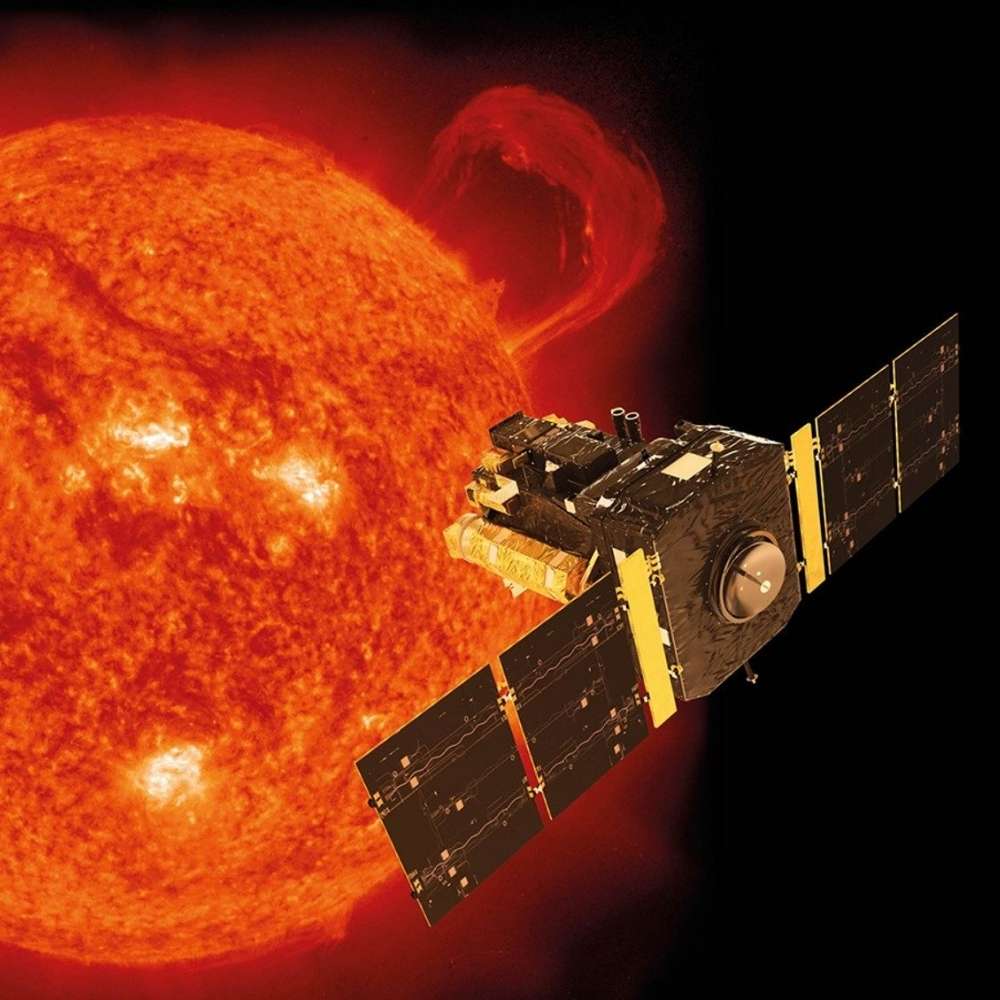
Solar and Heliospheric Observatory (SOHO)
The Mission That Never Stopped Watching the Sun
Quick Reader
| Attribute | Details |
|---|---|
| Mission Name | SOHO |
| Full Form | Solar and Heliospheric Observatory |
| Mission Type | Solar observatory |
| Space Agencies | ESA (Europe) + NASA (USA) |
| Launch Date | 2 December 1995 |
| Operating Location | Sun–Earth L1 |
| Primary Target | The Sun |
| Mission Status | Operational (far beyond design life) |
| Key Science Areas | Solar interior, corona, solar wind |
| Famous For | Continuous Sun monitoring, comet discoveries |
Key Insights
- SOHO has observed the Sun continuously for nearly three decades
- It operates from Sun–Earth L1, giving an uninterrupted solar view
- It revolutionized our understanding of the solar corona and solar wind
- It has discovered thousands of comets incidentally
Introduction – The Sun, Watched Without Blinking
Before SOHO, the Sun was observed in fragments.
Ground-based telescopes faced:
Day–night cycles
Weather interruptions
Atmospheric distortion
SOHO changed everything.
From its stable position in space, SOHO watches the Sun continuously, creating the first long-term, uninterrupted record of solar behavior.
What Is SOHO?
SOHO is a space-based solar observatory designed to study:
The Sun’s interior structure
The solar atmosphere (corona)
The origin of the solar wind
It does not orbit Earth.
It does not orbit the Sun directly.
Instead, it orbits Sun–Earth L₁, a gravitational balance point where it can always face the Sun.
Why Sun–Earth L₁ Is Essential
At Sun–Earth L₁:
The Sun is always in view
Earth never blocks the line of sight
Solar wind reaches the spacecraft before Earth
This makes SOHO ideal for both science and space weather monitoring.
Mission Goals – What SOHO Was Built to Solve
SOHO was designed to answer fundamental questions:
How does energy move inside the Sun?
Why is the solar corona millions of degrees hotter than the surface?
How is the solar wind generated and accelerated?
These were among the biggest unsolved problems in solar physics.
Peering Inside the Sun – Helioseismology
One of SOHO’s greatest achievements is helioseismology.
By observing tiny oscillations on the Sun’s surface, SOHO can:
Map the Sun’s internal layers
Measure rotation at different depths
Track changes across the solar cycle
This is similar to using earthquakes to study Earth’s interior — but applied to a star.
The Solar Corona – A Hidden Atmosphere Revealed
SOHO provided unprecedented views of the solar corona.
It showed that the corona is:
Highly structured
Dynamic and constantly changing
Driven by magnetic fields
These observations were crucial for understanding:
Solar flares
Coronal mass ejections (CMEs)
Space weather events affecting Earth
Solar Wind – From Mystery to Measured Flow
Before SOHO, the solar wind was poorly understood.
SOHO helped determine:
Where different solar wind streams originate
How fast and slow wind differ
How solar activity shapes interplanetary space
This connected solar physics directly to heliophysics.
A Mission That Refused to End
SOHO was designed for a 2-year mission.
It is still operating today.
Its longevity comes from:
Stable orbit
Redundant systems
Exceptional scientific value
SOHO evolved from an experiment into a permanent solar sentinel.
Universe Map Context – Why SOHO Matters
SOHO represents a core Universe Map theme:
Continuous observation changes understanding.
It connects:
Solar interior physics
Solar atmosphere dynamics
Space weather near Earth
The Sun’s influence across the Solar System
SOHO turned the Sun from a periodic target into a constantly monitored system.
SOHO’s Instrument Suite – Seeing the Sun in Every Possible Way
SOHO was designed as a multi-instrument observatory, not a single-purpose probe.
Its 12 scientific instruments observe the Sun across different layers and physical processes, allowing scientists to connect cause and effect from the solar interior to interplanetary space.
Rather than listing instruments mechanically, it is more useful to understand what questions they answer.
Looking Inside the Sun – Helioseismology Instruments
Several SOHO instruments focus on tiny oscillations on the Sun’s surface.
These oscillations reveal:
Internal temperature and density structure
Rotation speed at different depths
Changes across the solar cycle
SOHO showed that:
The Sun does not rotate as a solid body
Its equator rotates faster than its poles
Internal flows evolve with magnetic activity
This was the first time a star’s interior was mapped in such detail.
The Solar Atmosphere – From Surface to Corona
SOHO observes the Sun’s atmosphere in multiple layers:
Photosphere (visible surface)
Chromosphere
Corona (outer atmosphere)
These observations revealed that:
Magnetic fields dominate atmospheric structure
Loops, arcs, and plumes constantly evolve
Energy is transported upward in complex ways
This helped address the long-standing coronal heating problem.
Coronal Mass Ejections – Tracking Solar Explosions
One of SOHO’s most influential contributions is its continuous monitoring of coronal mass ejections (CMEs).
SOHO made it possible to:
Observe CME formation in real time
Track their expansion into space
Measure their speed and direction
This transformed CMEs from rare snapshots into well-characterized physical events.
Why CMEs Matter for Earth
CMEs can:
Trigger geomagnetic storms
Damage satellites
Disrupt power grids
Affect radio and GPS systems
SOHO’s ability to see CMEs early provides:
Hours to days of warning
Critical input for space weather models
This made SOHO an indirect protector of modern technological society.
SOHO and the Birth of Modern Space Weather Forecasting
Before SOHO, space weather prediction was limited and reactive.
SOHO enabled:
Continuous upstream monitoring
Early detection of Earth-directed events
Correlation between solar activity and terrestrial effects
Many operational forecasting techniques today trace their roots to SOHO-era data.
An Unexpected Role – The Greatest Comet Hunter in History
SOHO was not designed to search for comets.
Yet it became the most prolific comet discoverer ever.
Reasons include:
Its constant view of the near-Sun region
Sensitivity to faint objects close to the Sun
Thousands of amateur scientists analyzing SOHO images
SOHO has discovered over 4,000 comets, most of them “sungrazers.”
Why Sungrazing Comets Are Important
Sungrazing comets:
Break apart near the Sun
Reveal information about comet composition
Trace the Sun’s extreme thermal environment
SOHO turned the Sun into a laboratory for studying comet destruction.
SOHO’s Near-Loss and Recovery
In 1998, SOHO was nearly lost due to a series of failures.
For months:
Contact was lost
The spacecraft tumbled
Instruments froze
Against expectations, engineers recovered SOHO, restored control, and returned it to full scientific operation.
This recovery is considered one of the great rescues in spaceflight history.
Why SOHO’s Data Is Still Used Today
SOHO’s value comes from:
Long, uninterrupted datasets
Coverage across multiple solar cycles
Consistent instrumentation
This makes it ideal for:
Long-term trend analysis
Solar cycle comparisons
Model validation
Few missions offer this continuity.
Universe Map Perspective – Watching a Star as a System
SOHO proved that understanding a star requires:
Time
Continuity
Multiple perspectives
It showed that the Sun is not a static ball of plasma, but a dynamic, evolving system that shapes the entire Solar System.
SOHO’s Long-Term Legacy
SOHO was designed for a short mission and became a permanent solar reference.
Its legacy is defined by three enduring contributions:
Continuity: nearly three decades of uninterrupted solar observations
Context: connecting solar interior dynamics to space weather at Earth
Calibration: serving as a baseline for virtually every modern solar mission
SOHO transformed solar physics from episodic observation into continuous system science.
How SOHO Shaped Later Solar Missions
Modern solar missions did not replace SOHO; they built on it.
SOHO’s findings influenced:
SDO (Solar Dynamics Observatory): high-cadence imaging informed by SOHO’s coronal insights
STEREO: multi-viewpoint CME tracking rooted in SOHO-era CME characterization
Solar Orbiter & Parker Solar Probe: source-region questions framed by SOHO’s global context
Together, these missions form a chain—SOHO provides the long-term backbone, others add proximity and resolution.
SOHO and Space Weather Operations Today
Although not an operational forecaster by design, SOHO became indispensable to operations.
Its data supports:
Early identification of Earth-directed CMEs
Model inputs for geomagnetic storm prediction
Cross-validation with upstream monitors at Sun–Earth L₁
Many space weather alerts still rely on SOHO coronagraph observations to assess CME speed and direction.
Why SOHO Still Matters in the Age of New Missions
New missions offer sharper images and closer passes—but none replace SOHO’s strengths:
Longevity across multiple solar cycles
Stable viewing geometry
Consistent instrumentation
This makes SOHO uniquely suited to answer questions like:
How does the Sun change from cycle to cycle?
Which behaviors are rare versus recurrent?
How do long-term trends affect heliospheric conditions?
Frequently Asked Questions (Expanded)
Is SOHO still operational today?
Yes. SOHO continues to return valuable scientific data far beyond its original mission lifetime.
Why is Sun–Earth L₁ better than Earth orbit for solar observation?
L₁ provides an uninterrupted view of the Sun without Earth eclipses, enabling continuous monitoring.
Did SOHO predict solar storms by itself?
No. SOHO provides critical observations that forecasting centers use alongside other data sources.
Why did SOHO discover so many comets?
Its constant, sensitive view of the near-Sun region made it ideal for detecting faint sungrazers.
Has any mission replaced SOHO?
No single mission has. SOHO’s role is foundational and complementary to newer observatories.
Why SOHO Matters for Universe Map
SOHO exemplifies a Universe Map principle:
Infrastructure missions quietly shape entire fields.
It connects:
Solar interior physics
Coronal dynamics
Solar wind generation
Space weather impacts on Earth
SOHO is not just a mission—it is a reference frame for understanding our star.
Related Topics for Universe Map
Sun–Earth L₁
Solar wind
Coronal mass ejections
Helioseismology
Space weather
Together, these topics explain how solar activity propagates from the Sun to Earth and beyond.
Final Perspective
SOHO taught us that to understand a star, you must watch it continuously.
By staying fixed at Sun–Earth L₁ and observing without interruption, SOHO revealed the Sun as a living system—pulsing, erupting, and evolving on timescales from minutes to decades.
Long after many missions have ended, SOHO continues its quiet work, reminding us that in astronomy, patience and persistence can be as powerful as proximity.