



Herschel Space Observatory
Exploring the Cold and Hidden Universe
Quick Reader
| Attribute | Details |
|---|---|
| Mission Name | Herschel Space Observatory |
| Mission Type | Infrared / submillimeter space telescope |
| Space Agency | ESA (European Space Agency) |
| Launch Date | 14 May 2009 |
| Launch Vehicle | Ariane 5 |
| Operating Location | Sun–Earth L2 |
| Primary Wavelengths | Far-infrared & submillimeter |
| Mirror Diameter | 3.5 meters (largest space mirror of its time) |
| Cooling System | Liquid helium cryostat |
| Mission End | 29 April 2013 |
| Primary Targets | Cold gas, dust, star formation, galaxies |
Key Insights
- Herschel studied the coldest objects in the Universe
- It had the largest mirror ever flown in space at launch
- It operated from Sun–Earth L2 for thermal stability
- It revealed how stars and galaxies form from cold gas and dust
Introduction – Seeing the Invisible Universe
Most of the Universe is cold.
Stars are born in frigid clouds.
Galaxies grow inside dust-filled environments.
Planetary systems emerge from icy disks.
Yet these regions are invisible in optical light.
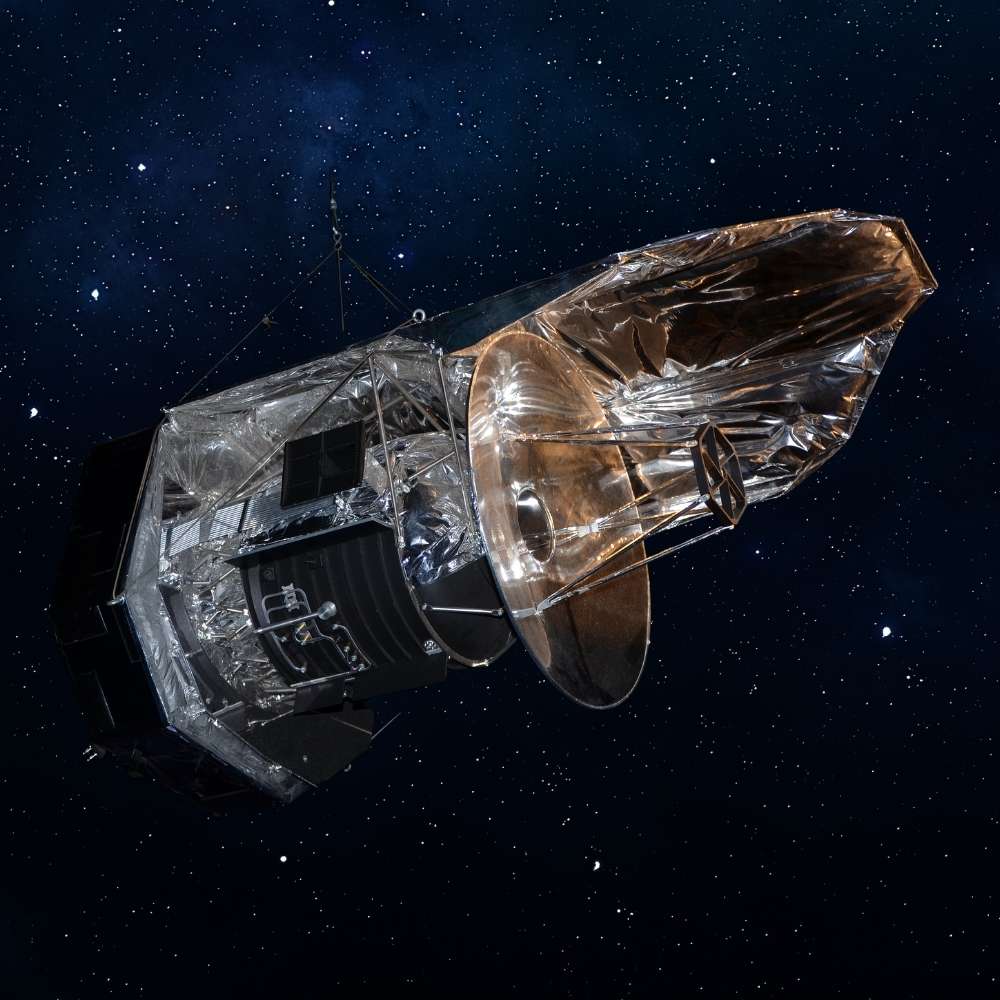
The Herschel Space Observatory was built to see exactly this hidden Universe — not the bright and hot, but the cold and dark.
What Was Herschel Space Observatory?
Herschel was a space telescope designed to observe the Universe in:
Far-infrared wavelengths
Submillimeter radiation
These wavelengths are ideal for detecting:
Cold dust clouds
Molecular gas
Protostars and star-forming regions
Early, dust-obscured galaxies
Herschel did not compete with optical telescopes — it completed them.
Why Infrared and Submillimeter Matter
Cold objects emit very little visible light.
Instead, they radiate energy at longer wavelengths.
Herschel allowed astronomers to:
See star formation inside opaque clouds
Measure the temperature of cosmic dust
Trace molecular chemistry in space
Observe galaxies hidden by dust in the early Universe
Without infrared astronomy, much of cosmic evolution remains invisible.
The Importance of Sun–Earth L₂
Herschel operated at Sun–Earth L₂, about 1.5 million km from Earth.
This location was essential because it provided:
Continuous darkness and stable thermal conditions
Minimal interference from Earth’s heat
Efficient cooling for sensitive infrared detectors
For infrared telescopes, cold surroundings are as important as optics.
The Largest Space Telescope Mirror of Its Time
Herschel carried a 3.5-meter primary mirror, the largest ever flown in space at the time.
This large mirror allowed:
High sensitivity to faint, cold objects
Improved spatial resolution at long wavelengths
Deep surveys of star-forming regions and galaxies
The mirror was made of silicon carbide to remain stable at low temperatures.
Why Herschel Needed Extreme Cooling
Infrared telescopes must be extremely cold.
If the telescope itself is warm, it overwhelms faint cosmic signals.
Herschel used:
A large liquid helium cryostat
Passive cooling from deep space
Carefully designed thermal shielding
Once the helium was exhausted, the mission had to end — even though the telescope itself still worked.
What Questions Was Herschel Built to Answer?
Herschel targeted some of the most fundamental questions in astronomy:
How do stars form from cold gas clouds?
How do planets emerge from protoplanetary disks?
How did galaxies grow and evolve in the early Universe?
What role does dust play in shaping cosmic history?
These are questions about origins, not appearances.
Herschel’s Place Among Space Telescopes
Herschel complemented missions like:
Hubble (optical / ultraviolet)
Spitzer (mid-infrared)
Where Hubble showed structure and beauty,
Herschel revealed mass, temperature, and chemistry.
Together, they provided a complete picture of cosmic evolution.
Universe Map Context – Why Herschel Matters
Herschel represents a Universe Map core theme:
The Universe is shaped by what we cannot see directly.
It connects:
Cold interstellar matter
Star and planet formation
Galaxy evolution
Infrared astronomy
Herschel mapped the raw material of creation.
Herschel’s Instruments – Turning Cold Light into Knowledge
Herschel carried three highly specialized instruments, each designed to decode a different aspect of the cold Universe.
Rather than overlapping, these instruments worked together to answer where matter is, how cold it is, and what it is made of.
PACS – Imaging and Spectroscopy of Star Birth
PACS (Photodetector Array Camera and Spectrometer) focused on far-infrared imaging and spectroscopy.
PACS allowed astronomers to:
Image cold dust clouds in high detail
Identify newborn protostars hidden from optical view
Measure temperatures of star-forming regions
Detect key cooling lines of gas
PACS revealed that star formation is highly structured, occurring in filaments rather than uniform clouds.
SPIRE – Mapping the Coldest Dust
SPIRE (Spectral and Photometric Imaging Receiver) was optimized for longer wavelengths.
SPIRE excelled at:
Mapping large regions of cold dust
Measuring dust mass in galaxies
Detecting distant, dusty galaxies in the early Universe
SPIRE surveys showed that the early Universe was far more active in star formation than previously thought — much of it hidden behind dust.
HIFI – Molecular Fingerprints in Space
HIFI (Heterodyne Instrument for the Far Infrared) provided ultra-high spectral resolution.
This allowed Herschel to:
Identify specific molecules in space
Measure gas motion and turbulence
Trace chemical evolution in star-forming regions
HIFI detected water vapor, oxygen, carbon compounds, and complex molecules — showing that chemistry begins early in star formation.
Star Formation – From Clouds to Stars
One of Herschel’s most transformative discoveries was how stars actually form.
Herschel revealed that:
Interstellar clouds are threaded with filamentary structures
Stars form preferentially along these filaments
Dense knots within filaments collapse into protostars
This replaced older models of random, spherical collapse with a network-based view of star birth.
The Role of Cold Dust – Not Just Obscuration
Before Herschel, dust was often treated as a nuisance that blocked light.
Herschel showed that dust is:
A major reservoir of mass
A regulator of temperature
A catalyst for molecular formation
Dust is not passive — it controls how and where stars form.
Protoplanetary Disks – Building Planetary Systems
Herschel observed disks around young stars and found:
Large amounts of cold gas remained longer than expected
Water vapor was present even in cold outer regions
Disk chemistry varied strongly with stellar environment
These results reshaped models of planet formation timelines and water delivery to planets.
Galaxies in the Early Universe – Hidden Starbursts
Herschel uncovered a population of galaxies that were:
Extremely active in star formation
Heavily obscured by dust
Almost invisible in optical surveys
These galaxies contributed a major fraction of cosmic star formation — previously underestimated.
Herschel showed that the history of galaxy growth was incomplete without infrared data.
Cold Gas as the Engine of Galaxy Evolution
Herschel demonstrated that:
Star formation rates track cold gas availability
Dust temperature correlates with galaxy activity
Galaxy evolution is driven by gas supply, not just mergers
This linked small-scale star formation to large-scale cosmic structure.
Universe Map Perspective – Structure Before Light
Herschel revealed a Universe where:
Structure forms before brightness
Cold matter shapes visible outcomes
Creation begins in darkness
Stars, planets, and galaxies all begin their lives cold, hidden, and dusty.
The End of the Mission – When Cold Ran Out
Herschel did not fail.
It simply ran out of coolant.
On 29 April 2013, Herschel’s liquid helium supply was exhausted. Without it:
Instruments could no longer remain cold enough
Infrared background noise overwhelmed faint cosmic signals
Scientific observations had to stop
This end was planned and expected.
Herschel completed its mission exactly as designed.
Why Herschel’s Data Is Still Scientifically Alive
Although Herschel stopped observing in 2013, its scientific output did not end.
Herschel data remains powerful because:
Many surveys covered huge regions of the sky
Data spans a wide range of wavelengths
Cold-Universe observations are not time-critical
Re-analysis continues with improved models and techniques
Even today, new papers are still published using Herschel observations.
Herschel as the Foundation for JWST
Herschel and JWST are often compared, but their roles are different.
Herschel mapped where cold material exists
JWST examines specific regions in extreme detail
Herschel provided:
Target catalogs
Context for dusty environments
Global understanding of cold matter distribution
JWST follows Herschel’s roadmap, zooming in on regions Herschel revealed.
Why Herschel Has Not Been Replaced
No mission has fully replaced Herschel because:
Far-infrared astronomy from space is technically difficult
Large cryogenic telescopes are expensive and complex
Earth’s atmosphere blocks these wavelengths
Some future concepts aim to build on Herschel’s legacy, but Herschel remains unique in wavelength coverage and sky area.
Herschel’s Impact Beyond Astronomy
Herschel influenced more than just astrophysics.
Its technologies advanced:
Cryogenic engineering
Large lightweight space mirrors
Precision far-infrared detectors
These technologies feed into future space observatories and planetary missions.
Frequently Asked Questions (Expanded)
Why couldn’t Herschel observe forever like optical telescopes?
Because infrared instruments require extreme cooling. Once the helium was gone, sensitivity was lost.
Did Herschel take pictures like Hubble?
Not in visible light. Herschel images represent temperature, dust emission, and gas — not what human eyes see.
Was Herschel better than Spitzer?
They were complementary. Spitzer covered mid-infrared; Herschel covered longer, colder wavelengths.
Could Herschel see planets?
Yes, but its main focus was cold dust, gas, and distant star-forming regions.
Will there ever be another Herschel?
Possibly, but no mission currently duplicates its full capabilities.
Why Herschel Matters for Universe Map
Herschel embodies a key Universe Map philosophy:
To understand the Universe, you must understand its cold phase.
It connects:
Interstellar medium
Star and planet formation
Dust-obscured galaxies
Infrared and submillimeter astronomy
Herschel mapped the material that builds everything else.
Related Topics for Universe Map
Infrared telescopes
Sun–Earth L₂
Star formation
Protoplanetary disks
Galaxy evolution
James Webb Space Telescope
Together, these topics explain how cosmic structures emerge from cold matter.
Final Perspective
Herschel did not show the Universe as bright and dramatic.
It showed it as quiet, cold, and patient.
By observing dust clouds, icy disks, and hidden galaxies, Herschel revealed the slow processes that create stars, planets, and galaxies long before they shine.
Herschel reminds us that the most important stages of cosmic creation happen before light becomes visible.
In the story of the Universe, Herschel uncovered the first chapters — written in cold dust and gas.