









Planck Space Observatory
Mapping the Oldest Light in the Universe
Quick Reader
| Attribute | Details |
|---|---|
| Mission Name | Planck |
| Operating Agency | ESA (European Space Agency) |
| Mission Type | Cosmic microwave background observatory |
| Launch Date | 14 May 2009 |
| Launch Vehicle | Ariane 5 |
| Operational Orbit | Sun–Earth L₂ halo orbit |
| Observation Period | 2009–2013 (science phase) |
| Wavelength Range | Microwave to submillimeter |
| Primary Goal | High-precision mapping of the cosmic microwave background (CMB) |
| Mission Status | Completed |
Why Planck Is Special
Planck produced the most accurate, detailed, and complete map of the cosmic microwave background ever created.
Its data reshaped modern cosmology by fixing the fundamental parameters of the Universe with unprecedented precision.
Key Insight Snapshot
- Most precise measurement of the Universe’s age, composition, and geometry
- Final and definitive CMB mission of the classical observational era
- Confirmed the standard cosmological model with high confidence
- Revealed subtle anomalies that continue to challenge theoretical models
- Provides a permanent reference dataset for cosmology
Introduction — Looking Back Almost to the Beginning
The cosmic microwave background is the oldest light we can observe.
It was emitted when the Universe was only about 380,000 years old, long before stars, galaxies, or planets existed. This light fills the entire sky and carries a frozen imprint of the early Universe’s conditions.
Planck was designed to answer a simple but profound question:
What exactly did the Universe look like at the moment it became transparent?
What the Cosmic Microwave Background Really Is
The CMB is not radiation from stars or galaxies.
It is:
The afterglow of the Big Bang
Light released when electrons and protons first formed neutral atoms
A nearly uniform background with tiny temperature variations
Those tiny variations—at the level of one part in 100,000—contain information about:
The Universe’s age
Its expansion rate
The amount of dark matter
The amount of dark energy
The geometry of spacetime
Planck’s job was to measure these variations better than ever before.
Why Planck Was Necessary After COBE and WMAP
Planck was not the first CMB mission.
Its predecessors include:
COBE — discovered CMB anisotropies
WMAP — mapped them with high precision
Planck went further.
Compared to WMAP, Planck offered:
Higher angular resolution
Broader frequency coverage
Better foreground separation
Much higher sensitivity
Planck was designed to be the final word on temperature anisotropies.
Why Sun–Earth L₂ Was Essential
Planck operated from Sun–Earth L₂, far from Earth’s thermal and radio interference.
From this location:
The Sun, Earth, and Moon stayed on one side
The telescope experienced extreme thermal stability
Microwave background noise was minimized
Full-sky scanning was uninterrupted
CMB observations require absolute stability—and L₂ provides exactly that.
The Mission Design Philosophy
Planck followed a strict philosophy:
Survey the entire sky repeatedly
Avoid pointing bias
Build sensitivity over time
Separate cosmic signal from foreground contamination
It rotated slowly, sweeping the sky in precise patterns, allowing each region to be observed multiple times under different conditions.
This approach maximized data reliability and minimized systematic errors.
Two Instruments, One Cosmic Map
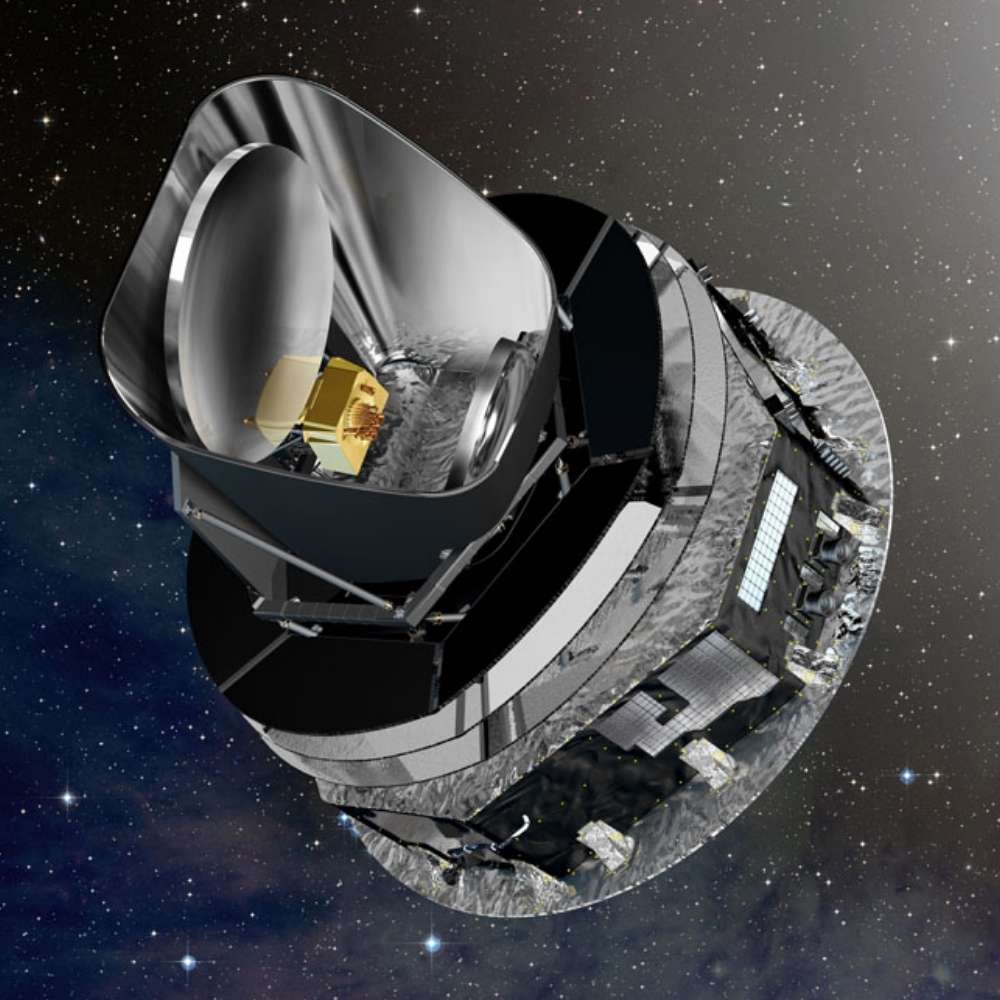
Planck carried two complementary instruments:
LFI (Low Frequency Instrument)
HFI (High Frequency Instrument)
Together, they covered a wide frequency range, allowing scientists to:
Isolate true CMB signal
Remove emission from dust and gas
Cross-check results internally
This dual-instrument design was critical for accuracy.
What Planck Was Built to Measure
Planck targeted:
Temperature fluctuations in the CMB
Polarization patterns
Angular power spectra
Statistical properties of early-Universe density variations
From these measurements, cosmologists could derive the Universe’s fundamental parameters.
Planck was not about discovery through surprise—it was about measurement through precision.
Why Precision Matters in Cosmology
In cosmology, small errors lead to big misunderstandings.
A tiny uncertainty in:
Expansion rate
Matter density
Curvature
Can radically change conclusions about the Universe’s past and future.
Planck reduced these uncertainties to levels never achieved before.
Planck in the Bigger Scientific Context
Planck stands at the intersection of:
Cosmology
Particle physics
General relativity
Early-Universe theory
Its data connects the largest observable scales to the smallest physical processes.
Inside Planck — Two Instruments, One Cosmic Standard
Planck achieved its precision by combining two independent instruments that observed the sky at different microwave frequencies. This redundancy was not optional—it was essential.
LFI — Low Frequency Instrument
LFI operated at lower microwave frequencies and was optimized for:
Measuring large-scale temperature variations
Monitoring polarization at broad angular scales
Cross-checking systematic effects
LFI used ultra-stable radiometers and provided long-term consistency across the mission.
HFI — High Frequency Instrument
HFI was Planck’s high-sensitivity engine.
It was designed to:
Measure small-scale temperature fluctuations
Detect faint polarization signals
Separate cosmic signal from galactic dust
HFI achieved sensitivities far beyond previous missions—but at a cost: it required extreme cooling.
Why Planck Had to Be Incredibly Cold
To detect the faint CMB signal, Planck’s instruments had to be colder than space itself.
Key facts:
HFI detectors operated at 0.1 Kelvin
This made them among the coldest objects in the Universe
Thermal noise was reduced to near-zero
Cooling was achieved through a multi-stage cryogenic system, combining passive radiators and active coolers.
Without this, Planck’s measurements would have been drowned in instrument noise.
Foregrounds — The Biggest Challenge
The CMB is not observed in isolation.
Between us and the early Universe lies:
Galactic dust
Synchrotron radiation
Free–free emission
Emission from distant galaxies
Planck’s wide frequency coverage allowed scientists to:
Identify foreground emissions
Model their spectral behavior
Subtract them accurately
This separation process was one of the mission’s greatest technical achievements.
How Planck Scanned the Sky
Planck followed a carefully designed scanning strategy:
The spacecraft rotated slowly
The telescope swept great circles across the sky
The spin axis was adjusted gradually
The entire sky was covered repeatedly
This approach ensured:
Uniform coverage
Multiple observations per sky pixel
Strong control over systematic errors
Over time, faint structures emerged with exceptional clarity.
The Angular Power Spectrum — Cosmology in One Curve
One of Planck’s most important products is the CMB angular power spectrum.
This spectrum encodes:
Density fluctuations in the early Universe
Acoustic oscillations in primordial plasma
The imprint of dark matter and dark energy
Planck measured this spectrum with unmatched precision, turning cosmology into a high-accuracy science.
Key Results That Changed Cosmology
From Planck data, scientists determined:
The Universe is 13.8 billion years old
Ordinary matter makes up ~5%
Dark matter makes up ~27%
Dark energy makes up ~68%
Space is very close to geometrically flat
These numbers are now the standard reference values in cosmology.
Planck vs WMAP — A Clear Advance
Planck was designed as a direct successor to WMAP, not to replace its conclusions but to refine them with far greater precision and completeness.
| Aspect | WMAP | Planck |
|---|---|---|
| Angular Resolution | Moderate | High |
| Frequency Coverage | Limited | Broad |
| Sensitivity | High | Exceptional |
| Foreground Separation | Good | Excellent |
| Parameter Precision | Strong | Definitive |
Planck did not overturn the results of WMAP.
Instead, it refined, tightened, and effectively locked in the standard cosmological model—turning a well-supported framework into a precision-tested description of the Universe.
Anomalies — Subtle Puzzles Remain
Despite its success, Planck revealed features that remain unexplained:
Large-scale temperature asymmetries
Alignment anomalies at low multipoles
Slight tensions with local measurements of the Hubble constant
These are not errors—but clues that future theories may need to explain.
Why Planck Is Considered Definitive
For temperature anisotropies, Planck reached:
Theoretical limits set by cosmic variance
Precision beyond which no major improvement is possible
This is why Planck is often described as the final classical CMB mission.
Why the Planck Mission Ended — Physics, Not Failure
Planck did not stop because it broke.
It stopped because it had reached the fundamental limits of what the cosmic microwave background can reveal.
Key reasons the mission ended:
The cryogenic system (especially for HFI) exhausted its coolant
Temperature anisotropies reached the cosmic variance limit
Further observations could not significantly improve precision
In cosmology, this is rare.
Planck ended not at the edge of engineering—but at the edge of physics itself.
The Long-Term Legacy of Planck
Planck’s legacy is not just data—it is definition.
Because of Planck:
The standard cosmological model became tightly constrained
Cosmological parameters were fixed with percent-level accuracy
Competing models were ruled out decisively
Precision cosmology became the norm, not the exception
For modern cosmology, Planck serves as the absolute reference baseline.
Any new theory must agree with Planck—or clearly explain why it does not.
Planck and the Hubble Tension
One of Planck’s most important consequences was revealing a serious tension.
Planck’s measurement of the Hubble constant (H₀):
Is lower than values measured from local galaxies
Is internally consistent within early-Universe physics
Conflicts with late-Universe distance measurements
This discrepancy, known as the Hubble tension, is now one of the most important open problems in cosmology.
Planck did not create the tension.
It exposed it with enough precision that it could no longer be ignored.
Why Planck Still Matters Today
Even years after operations ended, Planck data remains essential.
It is used to:
Calibrate other cosmological surveys
Test inflationary models
Constrain neutrino masses
Study large-scale anomalies
No newer mission has replaced Planck’s role in full-sky CMB temperature mapping—and none are expected to.
Frequently Asked Questions
Did Planck prove the Big Bang?
Planck did not prove the Big Bang by itself, but it provided the strongest observational support for a hot, dense early Universe.
Is there a better CMB mission than Planck?
For temperature anisotropies, no. Planck reached the cosmic variance limit. Future missions focus on polarization and secondary effects.
Why not keep observing longer?
Beyond a certain point, more data does not improve precision due to fundamental statistical limits.
Did Planck detect inflation directly?
No. Planck strongly constrained inflation models but did not detect primordial gravitational waves.
Can Planck data still change?
The raw data is fixed, but interpretation continues to evolve as theory improves.
Planck vs Future CMB Missions
Planck closed one chapter—but opened another.
Future missions focus on:
CMB polarization (especially B-modes)
Gravitational lensing of the CMB
Neutrino physics
Primordial gravitational waves
Planck is the foundation upon which all of these efforts are built.
Planck in the Universe Map Context
Within Universe Map, Planck connects directly to:
Cosmic microwave background
Big Bang cosmology
Dark matter and dark energy
Inflation theory
Sun–Earth L₂ observatories
Planck anchors the entire early-Universe section of Universe Map with definitive, high-authority data.
Final Perspective
Planck did not show us stars, galaxies, or planets.
It showed us something far older.
It revealed the Universe when it was still smooth, hot, and young—before structure, before light from stars, before complexity. In doing so, it allowed humanity to measure the age, composition, and shape of everything that exists with unprecedented clarity.
Planck reminds us of a profound truth:
To understand the Universe today,
we must first understand its first light.