







Lunar Reconnaissance Orbiter (LRO)
Mapping the Moon for Science and Human Return
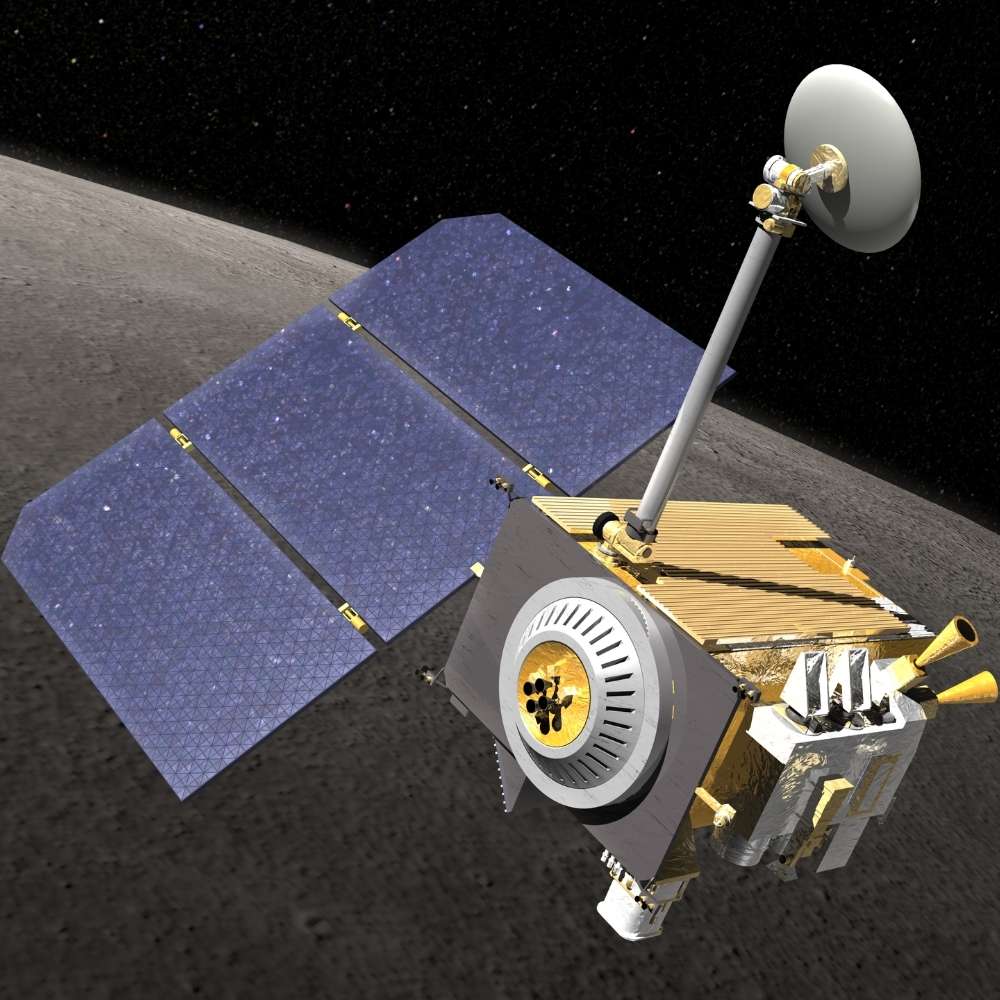
Quick Reader
| Attribute | Details |
|---|---|
| Mission Name | Lunar Reconnaissance Orbiter (LRO) |
| Space Agency | NASA |
| Launch Date | 18 June 2009 |
| Launch Vehicle | Atlas V 401 |
| Mission Type | Lunar orbital reconnaissance |
| Primary Orbit | Low polar lunar orbit (~50 km nominal) |
| Mission Status | Operational (extended mission) |
| Primary Targets | Lunar surface, poles, radiation environment |
| Key Instruments | LROC, LOLA, LEND, Diviner, CRaTER, Mini-RF |
| Core Objective | Prepare for future human & robotic lunar missions |
Scientific Significance
LRO is the most comprehensive lunar mapping mission ever flown, delivering meter-scale imagery, global topography, temperature maps, and radiation measurements essential for both science and human exploration.
Why It Matters
LRO transformed the Moon from a historically explored world into a precision-mapped destination, enabling safe landing site selection, resource assessment, and long-term exploration planning.
Introduction – Why LRO Changed Lunar Exploration
Before LRO, much of the Moon was known only at regional scales. Landing site maps were coarse, polar regions were poorly understood, and potential resources—especially water ice—were largely speculative.
LRO changed this permanently.
By combining high-resolution imaging, laser altimetry, radar, thermal mapping, and radiation measurements, LRO created the first mission-grade, exploration-ready atlas of the Moon. It bridged the gap between Apollo-era exploration and future sustained lunar presence.
Mission Goals – From Science to Human Return
LRO was designed with a dual mandate:
Primary Exploration Goals
Identify safe and scientifically valuable landing sites
Characterize terrain hazards at human-scale resolution
Assess environmental conditions affecting astronauts
Scientific Goals
Understand lunar geology and surface processes
Map global topography and crustal structure
Investigate permanently shadowed polar regions
Unlike earlier lunar orbiters, LRO was not just about discovery—it was about operational readiness.
Orbit Design – Why a Low Polar Orbit Matters
LRO operates in a near-polar, low-altitude orbit, allowing it to:
Pass over nearly every point on the Moon
Repeatedly image polar regions under varying lighting
Build ultra-precise elevation models
This orbit enables:
Global coverage over time
Consistent resolution across latitudes
Direct comparison of terrain from equator to poles
The result is a Moon mapped with a level of precision comparable to Earth’s best global datasets.
LROC – Seeing the Moon at Human Scale
The Lunar Reconnaissance Orbiter Camera (LROC) is one of LRO’s most influential instruments.
It provides:
Meter-scale images of the lunar surface
Detailed views of craters, boulders, slopes, and faults
Repeated imaging to track surface changes
LROC famously imaged:
Apollo landing sites
Astronaut tracks and hardware
New impact craters formed during the mission
These observations confirmed that the Moon is still changing, even today.
LOLA – Building the Moon’s 3D Shape
The Lunar Orbiter Laser Altimeter (LOLA) mapped the Moon’s topography with unprecedented accuracy.
Key contributions:
Global elevation models
Precise slope and roughness data
Identification of permanently shadowed regions
LOLA data revealed that:
Lunar poles contain deep, cold traps
Some regions never receive direct sunlight
These environments can preserve volatile compounds for billions of years
This made the lunar poles prime targets for future missions.
Why the Lunar Poles Became Central After LRO
One of LRO’s most important impacts was shifting attention toward the poles.
LRO showed that:
Permanently shadowed craters are common
Temperatures can drop below −200°C
Conditions allow water ice to remain stable
This transformed the Moon from a dry, inert body into a potential resource-rich destination, especially for sustained human presence.
From Mapping to Mission Planning
LRO data is now embedded in:
Artemis program planning
Robotic lander site selection
Hazard avoidance systems
Scientific targeting strategies
In practical terms, LRO acts as the Moon’s navigation, safety, and reconnaissance backbone.
Searching for Water – The Polar Ice Question
One of LRO’s most transformative roles has been investigating whether the Moon contains stable water ice.
For decades, water on the Moon was uncertain. LRO provided the first mission designed to test this question systematically.
LRO focused on the lunar poles because:
The Moon’s axial tilt is very small
Some craters never receive sunlight
Extremely low temperatures allow volatiles to survive
These permanently shadowed regions became prime scientific targets.
LEND – Detecting Hydrogen from Orbit
The Lunar Exploration Neutron Detector (LEND) measures neutrons emitted from the lunar surface.
Why this matters:
Hydrogen-rich material absorbs neutrons
Reduced neutron counts indicate hydrogen presence
Hydrogen is often associated with water ice
LEND data showed:
Elevated hydrogen concentrations near the poles
Strong correlations with shadowed regions
While not direct proof of ice, these measurements strongly suggested water-related materials beneath the surface.
Mini-RF – Radar Evidence from the Shadows
The Mini-RF radar instrument probed areas that sunlight cannot reach.
Radar can:
Penetrate shadowed craters
Detect reflective signatures consistent with ice
Distinguish rough rock from icy regolith
Mini-RF observations revealed:
Radar-bright features in some polar craters
Signals consistent with ice mixed into the soil
These findings strengthened the case that the Moon’s poles are not dry wastelands.
Diviner – Mapping Lunar Temperatures
The Diviner Lunar Radiometer measured surface and subsurface temperatures globally.
Key discoveries:
Permanently shadowed craters are among the coldest places in the Solar System
Temperatures remain low enough to preserve ice for billions of years
Thermal environments vary dramatically across short distances
Diviner confirmed that the Moon possesses long-term cold traps, a critical condition for volatile preservation.
Confirming the Ice Hypothesis
Individually, LEND, Mini-RF, and Diviner each provided partial evidence.
Together, they formed a coherent picture:
Hydrogen is present
Radar signatures are ice-consistent
Thermal conditions allow stability
This multi-instrument agreement elevated lunar ice from hypothesis to high-confidence scientific conclusion.
CRaTER – Measuring Radiation for Human Safety
Beyond resources, LRO addressed a crucial human factor: radiation exposure.
The Cosmic Ray Telescope for the Effects of Radiation (CRaTER) measures:
Galactic cosmic rays
Solar energetic particles
Secondary radiation produced in lunar regolith
Findings showed:
Radiation levels are significantly higher than on Earth
The Moon lacks atmospheric and magnetic shielding
Long-term human stays require protection strategies
These measurements directly inform:
Habitat design
Mission duration planning
Astronaut health protocols
Understanding Surface Hazards at Human Scale
LRO’s high-resolution datasets revealed hazards invisible in earlier missions.
Identified risks include:
Steep slopes near crater rims
Boulder fields capable of damaging landers
Regolith variability affecting mobility
This knowledge allows:
Precise landing ellipse design
Safer rover navigation
Reduced mission risk
LRO shifted lunar exploration from general reconnaissance to engineering-level precision.
How LRO Changed Lunar Resource Science
Before LRO:
The Moon was viewed as resource-poor
Human return was scientifically interesting but logistically difficult
After LRO:
Water ice became a realistic in-situ resource
Polar regions emerged as strategic hubs
The Moon became a stepping stone for deeper space missions
LRO reframed the Moon as an operational outpost, not just a destination.
LRO’s Long-Term Legacy – A Mission That Never Stopped Giving
More than a decade after launch, LRO remains one of NASA’s most productive planetary missions.
Its longevity is not accidental. LRO was designed with:
Redundant systems
Flexible orbital strategies
Instruments capable of long-term monitoring
As a result, LRO evolved from a reconnaissance mission into a permanent lunar reference platform.
How LRO Supports Artemis and Future Missions
LRO data is foundational to the Artemis program.
It directly supports:
Candidate landing site evaluation
Terrain hazard analysis
Illumination and shadow modeling
Communication and navigation planning
In practice, Artemis mission planners use LRO datasets to answer questions such as:
Where can astronauts land safely?
Which regions receive long-duration sunlight?
Where can surface operations be sustained?
Without LRO, modern lunar mission design would rely on far less precise assumptions.
Why LRO Is Still Scientifically Active
Even after years in orbit, LRO continues to produce new science.
Ongoing contributions include:
Monitoring new impact craters
Tracking surface changes over time
Refining models of regolith evolution
Improving polar illumination maps
These long-baseline observations allow scientists to study active lunar processes, something earlier missions could not do.
LRO and the Moon as an Engineering Environment
One of LRO’s most important roles is redefining the Moon as an engineering problem, not just a scientific one.
LRO helps answer:
How steep is too steep for landers?
How rough is the regolith at human scale?
Where do thermal extremes threaten equipment?
This shift—from exploration to operations—marks a new phase in lunar history.
Frequently Asked Questions (FAQ)
Is LRO still operating today?
Yes. LRO remains operational as part of NASA’s extended mission program.
Did LRO directly detect liquid water on the Moon?
No. LRO detected strong evidence for water ice and hydrogen-rich materials, primarily in permanently shadowed regions.
Why are the lunar poles more important than the equator?
The poles contain cold traps, stable temperatures, and regions with long-duration sunlight—ideal for sustained exploration.
Can LRO see objects left by Apollo astronauts?
Yes. LRO imaged Apollo landing sites, including hardware and astronaut tracks, confirming their locations and preservation.
How accurate are LRO’s maps?
In many regions, LRO provides meter-scale imagery and highly precise elevation data suitable for mission planning.
Will future missions replace LRO?
Future orbiters may expand capabilities, but LRO’s dataset will remain a foundational reference for decades.
Why LRO Matters Beyond the Moon
LRO’s impact extends beyond lunar science.
It demonstrated that:
Exploration-grade mapping is essential before human return
Robotic orbiters can serve as long-term infrastructure
Data continuity is as important as discovery
This model is now being applied to:
Mars
Asteroids
Icy moons
LRO set the standard for how planetary exploration should be done.
LRO in the Context of Solar System Exploration
LRO connects multiple domains:
Planetary geology
Human spaceflight
Resource science
Engineering and safety
Few missions bridge science and exploration so completely.
By turning the Moon into a mapped, measurable, and manageable environment, LRO made humanity’s return not just possible—but practical.
Related Topics for Universe Map
Moon
Lunar Poles
Artemis Program
Permanent Shadowed Regions
Water Ice in the Solar System
Planetary Reconnaissance Orbiters
These topics together explain why the Moon is no longer a mystery world, but a prepared destination.
Final Perspective
LRO did not discover the Moon—it prepared it.
Prepared it for landers, for astronauts, for sustained presence, and for a future where the Moon is part of humanity’s working space environment.
By mapping every crater, measuring every shadow, and quantifying every risk, LRO transformed lunar exploration from ambition into capability.
The modern era of lunar return begins not with rockets—but with maps.