



Kordylewski Cloud at Earth–Moon L₄
A Proposed Dust Concentration Near Earth–Moon L4
Quick Reader
| Attribute | Details |
|---|---|
| Object Name | Kordylewski Cloud |
| Object Type | Transient dust cloud |
| Location | Earth–Moon L₄ Lagrange Point |
| Discovered By | Kazimierz Kordylewski |
| First Detection | 1956 (photographic plates) |
| Confirmation | 2018 (modern imaging & polarimetry) |
| Composition | Microscopic dust particles |
| Visibility | Extremely faint, near-invisible |
| Gravitational Control | Earth–Moon system |
| Stability | Semi-stable, constantly changing |
The Kordylewski Cloud is not a solid object or satellite.
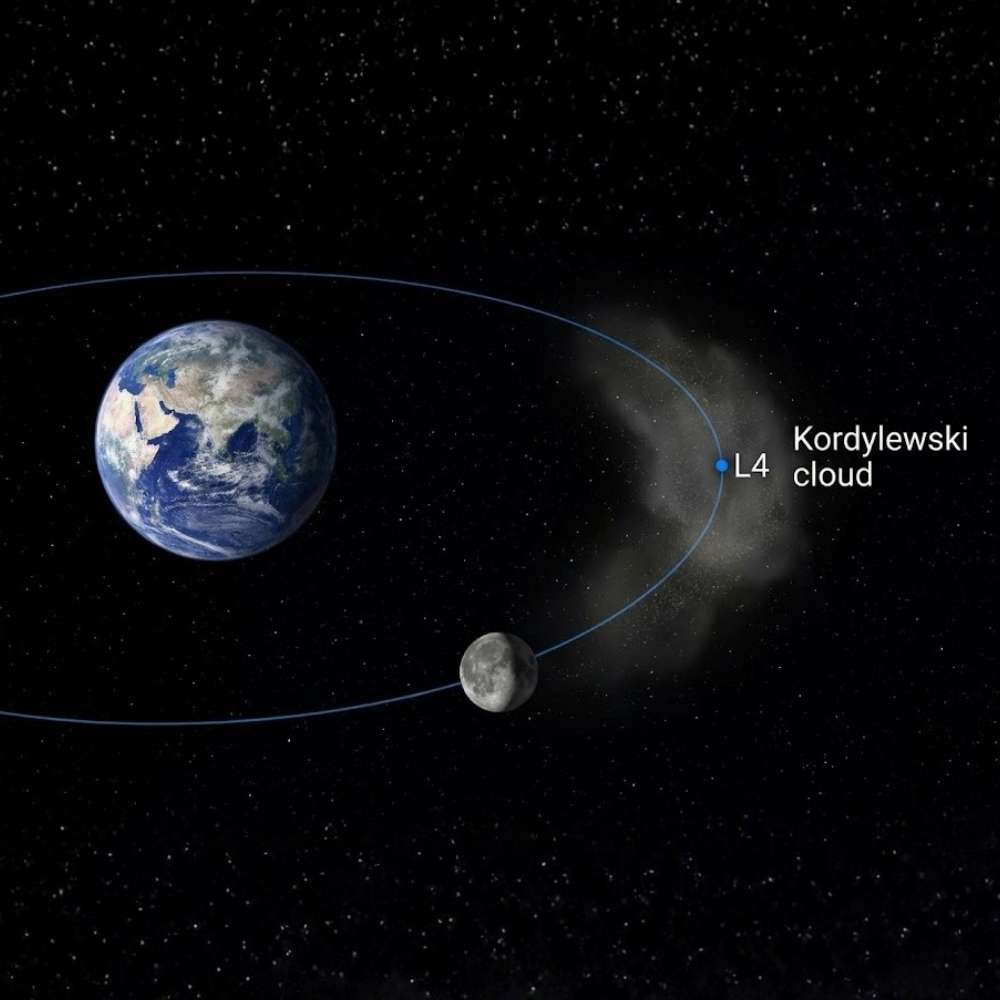
It is a gravitationally trapped dust accumulation located near the Earth–Moon L₄ Lagrange point, making it one of the most elusive structures in near-Earth space.
Introduction – A Cloud Where No Moon Exists
When people think of companions to the Moon, they imagine solid bodies.
The Kordylewski Cloud challenges that intuition.
At the Earth–Moon L₄ point—where gravity and orbital motion balance—dust can linger, forming a faint, ghost-like cloud. It has no sharp edge, no fixed shape, and no permanent form, yet it exists as a real gravitational phenomenon.
For decades, its very existence was debated.
What Is the Kordylewski Cloud?
The Kordylewski Cloud is:
A diffuse cloud of dust
Held near a Lagrange point by gravitational balance
Continuously reshaped by solar radiation and lunar motion
Unlike asteroids or moons, it is:
Not solid
Not permanent
Not easily observable
It behaves more like a dynamic structure than a classical celestial body.
Understanding Earth–Moon L₄
The Earth–Moon system has five Lagrange points.
L₄ lies:
60° ahead of the Moon in its orbit
At a point where gravitational and centrifugal forces balance
In theory, L₄ is a stable region, allowing material to remain nearby.
In practice, solar gravity and radiation pressure constantly disturb that balance—making any accumulation fragile.
The Kordylewski Cloud exists in this delicate zone.
Discovery – A Claim Ahead of Its Time
In 1956, Polish astronomer Kazimierz Kordylewski reported faint dust concentrations near Earth–Moon L₄ and L₅ using photographic techniques.
At the time:
The signal was extremely weak
Atmospheric scattering complicated observations
Instrument sensitivity was limited
As a result, many astronomers remained skeptical.
For decades, the Kordylewski Cloud existed in scientific limbo—proposed but unconfirmed.
Why the Cloud Is So Hard to See
Several factors make detection difficult:
The dust reflects very little light
It is spread over a large area
Earth’s atmosphere scatters background light
The cloud constantly changes shape
Even under ideal conditions, the cloud is far fainter than zodiacal light.
This is why modern confirmation required polarimetric imaging, not simple photography.
Confirmation in the Modern Era
In 2018, a Hungarian research team used advanced imaging and polarization analysis to confirm dust concentrations near Earth–Moon L₄.
This study showed:
Dust scattering consistent with theoretical predictions
Spatial structure matching Lagrange-point trapping
Time-variable behavior expected from simulations
The Kordylewski Cloud moved from speculation to observational reality.
Is the Cloud Stable?
The answer is subtle.
The cloud is:
Stable as a phenomenon
Unstable as a structure
Dust particles:
Drift in and out
Are pushed by sunlight
Are perturbed by the Moon’s orbit
Yet the L₄ region continually re-collects dust, maintaining the cloud over long timescales.
Why the Kordylewski Cloud Matters
This cloud is important because it:
Demonstrates that Lagrange points can trap diffuse matter
Shows how non-solid structures exist in orbital dynamics
Provides insight into dust behavior in multi-body systems
Helps validate numerical models of gravitational stability
It expands our understanding of what “objects” in space can be.
Common Misconceptions
The Kordylewski Cloud is not:
A moon
A Trojan asteroid
A permanent structure
A dense or hazardous region
It is best described as a gravitational dust phenomenon, not a body.
Kordylewski Cloud vs Trojan Objects
At first glance, the Kordylewski Cloud might sound similar to Trojan asteroids found near Lagrange points. In reality, the two are fundamentally different.
Trojan asteroids are solid, coherent bodies that orbit stably for billions of years. The Kordylewski Cloud is a diffuse dust structure, constantly forming and dispersing.
Key Differences
| Feature | Trojan Asteroids | Kordylewski Cloud |
|---|---|---|
| Physical Nature | Solid objects | Microscopic dust |
| Stability | Long-term (billions of years) | Transient, dynamic |
| Shape | Well-defined | Irregular and diffuse |
| Visibility | Directly observable | Near-invisible |
| Population | Discrete bodies | Continuously replenished dust |
This distinction explains why the Kordylewski Cloud remained controversial for so long.
Why Earth–Moon L₄ and L₅ Are Different from Jupiter’s
Jupiter’s L₄ and L₅ points host thousands of asteroids because:
Jupiter’s mass dominates the local gravity
Solar perturbations are relatively weaker
The system is dynamically deep and stable
In the Earth–Moon system:
Solar gravity is comparatively strong
Radiation pressure affects small particles
The gravitational well is shallow
As a result, only dust, not solid bodies, can persist near L₄ and L₅.
The Role of Solar Radiation Pressure
For microscopic particles, sunlight is not just illumination—it is a force.
Solar radiation pressure:
Pushes dust away from the Sun
Alters particle orbits over time
Competes directly with gravitational trapping
This effect explains why:
Large objects cannot remain at Earth–Moon L₄
Dust clouds are constantly reshaped
The Kordylewski Cloud never settles into a fixed form
The cloud survives because particles are continuously replaced, not because they remain forever.
Dust Sources Feeding the Cloud
The dust in the Kordylewski Cloud likely originates from:
Micrometeoroid impacts on the Moon
Interplanetary dust drifting through the Earth–Moon system
Debris from minor collisions in near-Earth space
Once released, some particles become temporarily trapped near L₄, contributing to the cloud.
What Simulations Reveal
Numerical models show that:
Dust particles can remain near L₄ for weeks to months
Some trajectories allow longer residence times
Solar perturbations eventually remove individual grains
However, simulations also demonstrate that the overall cloud structure persists, supported by constant dust input.
This aligns closely with modern observations.
Why the Cloud Is Irregular and Patchy
The Kordylewski Cloud does not form a smooth sphere.
Instead, it appears:
Clumpy
Elongated
Time-variable
These features result from:
The Moon’s eccentric orbit
Changing solar illumination angles
Gravitational nudges from Earth and Moon
What observers see is a snapshot of an evolving system, not a static object.
Is the Kordylewski Cloud Dangerous?
No.
The cloud:
Is extremely diffuse
Contains negligible mass
Poses no risk to spacecraft
A spacecraft passing through would encounter far less material than in Earth’s upper atmosphere.
Why the Kordylewski Cloud Was Long Doubted
Scientific skepticism was reasonable.
Earlier observations suffered from:
Atmospheric scattering
Light pollution
Instrument limitations
Human pattern recognition bias
Only modern polarization techniques could isolate the cloud’s faint signal from background noise.
Broader Implications for Orbital Dynamics
The Kordylewski Cloud demonstrates that:
Lagrange points can trap non-solid matter
Stability is not binary but statistical
Dust dynamics differ radically from asteroid dynamics
These lessons apply not only to Earth–Moon space, but also to:
Planet–ring systems
Protoplanetary disks
Exoplanetary debris structures
The Long-Term Fate of the Kordylewski Cloud
The Kordylewski Cloud is not a permanent structure, but it is also not temporary in the usual sense.
Individual dust particles:
Remain trapped for limited periods
Eventually drift away under solar radiation pressure
Are replaced by newly supplied dust
Because of this continuous cycle, the cloud persists as a phenomenon, even though its individual components do not.
As long as the Earth–Moon system exists and dust is supplied, the cloud can continue to re-form.
Could the Kordylewski Cloud Ever Disappear?
Complete disappearance is unlikely under current conditions.
The cloud would only vanish if:
Dust sources were cut off
The Earth–Moon orbital configuration changed significantly
Solar radiation pressure dominated completely
None of these scenarios are expected in the foreseeable future.
The cloud is therefore semi-permanent on astronomical timescales.
Why the Kordylewski Cloud Matters for Space Exploration
Although it poses no danger, the cloud is scientifically valuable.
It helps researchers:
Test models of dust dynamics
Understand low-density matter trapping
Improve predictions for spacecraft navigation near Lagrange points
Future missions operating near Earth–Moon Lagrange points can use the cloud as a natural laboratory for studying weak gravitational environments.
Frequently Asked Questions
Is the Kordylewski Cloud visible to the naked eye?
No. It is far too faint and diffuse to be seen without specialized instruments.
Is it a real object or just a visual illusion?
It is a real physical dust concentration, confirmed by modern polarimetric observations.
Does the cloud orbit the Earth or the Moon?
It does not orbit either body directly. It exists near the Earth–Moon L₄ point due to gravitational balance.
Could it affect satellites or astronauts?
No. Its density is far too low to have any physical impact.
Is there also a cloud at Earth–Moon L₅?
Yes. Similar dust concentrations are believed to exist near both L₄ and L₅.
Why was it confirmed so late?
Because its signal is extremely weak and difficult to distinguish from atmospheric and background light.
Kordylewski Cloud in the Context of Celestial Mechanics
The Kordylewski Cloud occupies a unique place in celestial mechanics.
It shows that:
Stability can be statistical rather than absolute
Gravitational equilibrium points host more than solid bodies
Dust behaves differently from larger objects in orbital systems
This challenges simplified views of orbital stability and expands the definition of what constitutes a “structure” in space.
Related Topics for Universe Map
Earth–Moon Lagrange Points
Trojan Asteroids
Interplanetary Dust
Solar Radiation Pressure
Three-Body Problem
Together, these topics explain how delicate gravitational balances shape the near-Earth environment.
Final Perspective
The Kordylewski Cloud is a reminder that space is not empty, even where nothing seems to exist.
Invisible to the eye, fragile in structure, and constantly changing, it survives not through permanence, but through balance and renewal.
In a region where no moon or asteroid can remain, dust itself finds a way to linger—quietly tracing the invisible geometry of gravity.