




Moon
Earth’s Only Natural Satellite and the Foundation of Planetary Science
Quick Reader
| Attribute | Details |
|---|---|
| Object Name | Moon |
| Object Type | Natural satellite |
| Parent Body | Earth |
| Mean Distance from Earth | ~384,400 km |
| Diameter | 3,474 km |
| Mass | ~7.35 × 10²² kg |
| Gravity | ~1/6 of Earth |
| Orbital Period (Sidereal) | 27.3 days |
| Synodic Period (Phases) | 29.5 days |
| Rotation | Tidally locked |
| Atmosphere | Extremely thin exosphere |
| Average Surface Temperature | −173°C to +127°C |
| Surface Age | Up to ~4.4 billion years |
| Origin Model | Giant Impact Hypothesis |
In two sentences
The Moon is Earth’s only natural satellite and the closest large celestial body to our planet. It preserves an ancient record of Solar System history that Earth itself can no longer show.
Key takeaway
To understand Earth’s past, the evolution of rocky planets, and humanity’s future in space, scientists begin with the Moon.
Best for
Planetary science students, space exploration research, astronomy enthusiasts, and future mission planners.
Introduction – The Moon Is Not Just a Night Sky Object
The Moon feels familiar. It rises and sets, controls tides, marks months, and lights the night sky.
Scientifically, however, the Moon is one of the most important objects in the Solar System.
Unlike Earth, the Moon has no weather, no oceans, and no plate tectonics. Its surface has remained largely unchanged for billions of years. This makes the Moon a geological archive—a preserved record of violent impacts, volcanic activity, and early planetary formation processes.
In planetary science, the Moon is not secondary to Earth.
It is foundational.
What Exactly Is the Moon?
The Moon is a rocky, differentiated body that:
Formed early in Solar System history
Orbits Earth in a stable gravitational relationship
Influences Earth’s rotation, tides, and long-term stability
It is large compared to its parent planet. In fact, the Earth–Moon system is sometimes described as a double-planet system, rather than a simple planet–satellite pair.
The Earth–Moon System – A Unique Partnership
Earth and the Moon do not behave like a simple planet and satellite.
Both bodies orbit a shared barycenter (center of mass), located inside Earth but offset from its center. This configuration:
Stabilizes Earth’s axial tilt
Produces predictable ocean tides
Slows Earth’s rotation over time
Without the Moon, Earth’s axis could vary chaotically, leading to extreme climate instability.
In this sense, the Moon has played a direct role in Earth’s habitability.
Why the Moon Always Shows the Same Face
The Moon is tidally locked to Earth.
This means:
One lunar rotation equals one lunar orbit
The same hemisphere always faces Earth
Tidal locking occurred because Earth’s gravity gradually slowed the Moon’s rotation over billions of years. This process is common in close gravitational systems and provides a key reference for understanding exoplanets and moons elsewhere in the universe.
The Moon’s far side is not dark—it simply never faces Earth.
Lunar Surface – A Record Written in Stone
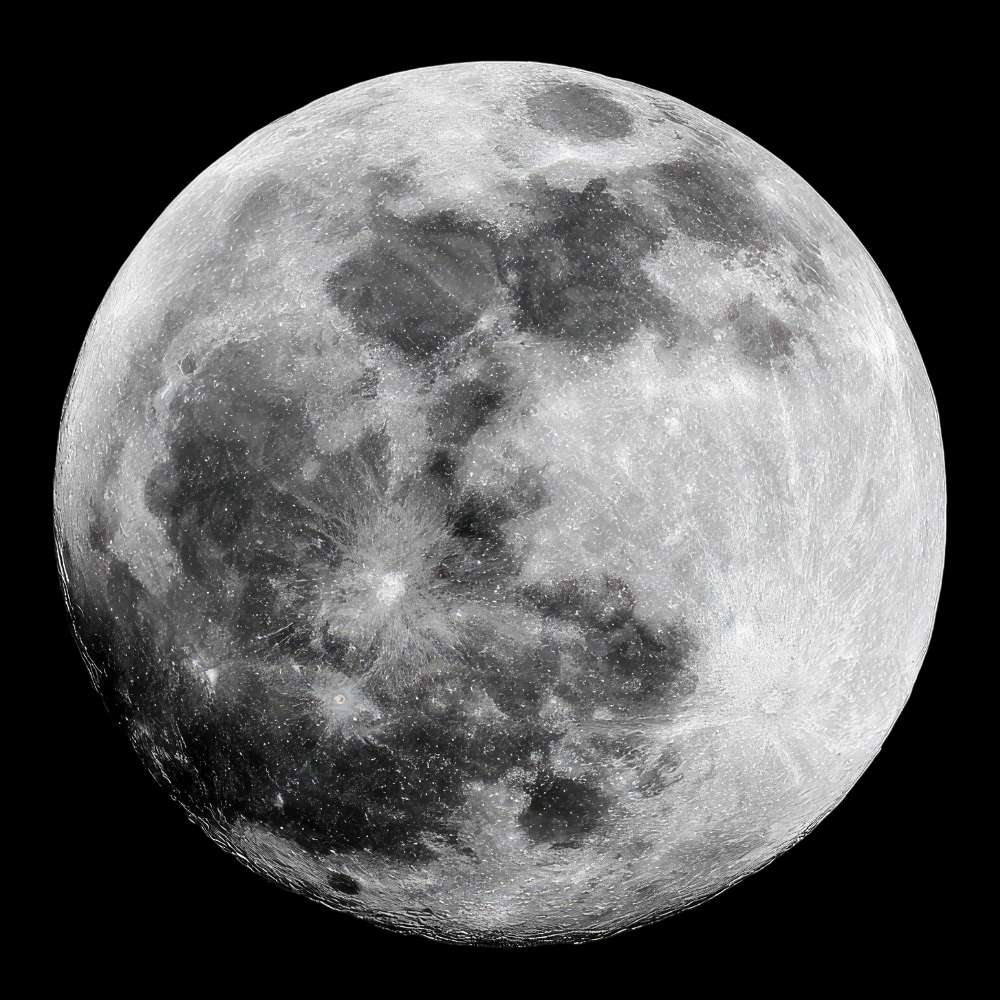
The Moon’s surface is dominated by two major terrains:
Lunar Highlands
Bright, heavily cratered regions
Among the oldest surfaces in the Solar System
Preserve impacts from early planetary bombardment
Lunar Maria
Dark basaltic plains
Formed by ancient volcanic lava flows
Concentrated mainly on the near side
Because the Moon lacks erosion and tectonics, these features remain visible today, allowing scientists to reconstruct events from over four billion years ago.
Near Side vs Far Side – A Fundamental Asymmetry
One of the Moon’s most striking features is the difference between its two hemispheres.
The near side contains most of the maria, while the far side is dominated by thick highlands. This asymmetry likely results from:
Differences in crust thickness
Early internal heating patterns
Long-term gravitational interaction with Earth
This contrast makes the Moon an important case study in planetary differentiation.
How the Moon Formed – The Giant Impact Hypothesis
The leading explanation for the Moon’s origin is the Giant Impact Hypothesis.
According to this model:
A Mars-sized protoplanet collided with early Earth
The impact ejected vast amounts of material
Debris formed a disk around Earth
The Moon accreted from this debris
This theory explains:
The Moon’s low iron content
Its similar isotopic composition to Earth
The angular momentum of the Earth–Moon system
No alternative model explains all observations as successfully.
Why the Moon Has Almost No Atmosphere
The Moon’s gravity is too weak to retain a thick atmosphere.
As a result:
Gases escape easily into space
Only a thin exosphere exists
Temperature varies dramatically between day and night
These conditions make the Moon an ideal reference for studying airless bodies such as Mercury and many asteroids.
Why the Moon Is Central to Planetary Science
The Moon matters because it:
Preserves early Solar System history
Serves as a benchmark for crater dating
Helps interpret surfaces across Mars, Mercury, and icy moons
Acts as a testbed for exploration technologies
In planetary science, the Moon is not an afterthought—it is the starting point.
Inside the Moon – Internal Structure and Thermal Evolution
Although the Moon appears quiet today, its interior preserves evidence of a once-active world.
Current models indicate four main layers:
Core:
A small, iron-rich core (partly molten), far smaller than Earth’s relative core size.Core–Mantle Boundary:
A partially molten layer that suggests limited internal heat persists.Mantle:
Composed mainly of silicate rock; it cooled rapidly compared to Earth’s mantle.Crust:
Thick, ancient, and rigid—especially on the far side.
Because the Moon lost its internal heat early, it never developed plate tectonics. This early cooling is the reason lunar geology is frozen in time.
Moonquakes – What Apollo Seismology Revealed
Apollo astronauts deployed seismometers that operated for years.
They detected several types of moonquakes:
Deep moonquakes:
Caused by tidal stress from Earth.Shallow moonquakes:
Rare but surprisingly strong.Thermal quakes:
Triggered by extreme temperature changes at sunrise and sunset.
Unlike Earth, where seismic waves dissipate quickly, the Moon’s dry, fractured interior causes vibrations to last much longer. This revealed a body that is rigid, brittle, and water-poor compared to Earth.
Distance from Earth – A Dynamic Relationship
The average Earth–Moon distance is:
~384,400 km
However, the orbit is elliptical:
Perigee (closest): ~363,300 km
Apogee (farthest): ~405,500 km
Crucially, the Moon is slowly drifting away from Earth at about 3.8 cm per year, driven by tidal energy transfer. Over billions of years, this has lengthened Earth’s day and reshaped the Earth–Moon system.
How Long Does It Take to Reach the Moon?
Travel time depends on mission design and propulsion.
Historical missions:
Apollo missions: ~3 days (direct trajectory)
Modern and future profiles:
Fast crewed missions: ~3 days
Low-energy trajectories: 5–7 days
Cargo or fuel-efficient transfers: Weeks
In spaceflight terms, the Moon is close enough for routine access, yet far enough to require full life-support and mission autonomy.
Why the Moon Is a Strategic Gateway
The Moon is not just a destination—it is a logistics node.
Key advantages:
Escape velocity is only ~2.4 km/s
Launching from the Moon requires far less fuel than from Earth
No atmosphere simplifies landing and launch systems
From a lunar base, missions to Mars, asteroids, and deep space become significantly more energy-efficient.
Water Ice and Lunar Resources
One of the most important discoveries of recent decades is water ice at the lunar poles.
Permanently shadowed craters contain:
Water ice
Carbon dioxide
Ammonia and other volatiles
These resources enable:
Drinking water
Oxygen extraction
Rocket fuel production
This transforms the Moon from a barren rock into a resource-supported outpost.
The Moon as a Scientific Platform
The Moon offers unique conditions for science:
Far side radio silence:
Perfect for low-frequency radio astronomy.Stable surface:
Ideal for long-duration observatories.Minimal atmosphere:
Enables ultra-precise measurements.
Future lunar observatories could study:
The cosmic dark ages
Early galaxy formation
Signals impossible to detect from Earth
Why Humans Are Returning to the Moon
Global space agencies now align on a shared conclusion:
The Moon is the next permanent step for humanity.
Reasons include:
Testing life-support systems
Learning long-duration off-Earth living
Developing construction techniques
Establishing fuel and logistics hubs
The Moon is where humanity learns to stay, not just visit.
Earth–Moon Co-Evolution
Earth and Moon continue to shape each other.
The Moon:
Stabilizes Earth’s axial tilt
Regulates tides and climate rhythms
Influences biological cycles
Without the Moon, Earth’s long-term habitability would be far less certain.
The Moon as Humanity’s First Permanent Off-World World
The Moon marks a transition in human history:
from exploration to presence, and from presence to infrastructure.
Unlike Mars, the Moon is close enough for rapid return, continuous resupply, and real-time coordination with Earth. This makes it the training ground and staging base for long-term space civilization.
What happens on the Moon over the next two centuries will shape how humanity spreads into the Solar System.
The Moon in 2050 – Sustained Human Presence
By mid-century, human activity on the Moon is expected to move beyond short missions.
Likely developments by 2050 include:
Permanently crewed or semi-permanent lunar bases
Concentration near the lunar south pole
Routine cargo and crew transport from Earth
Continuous power generation using solar arrays
Water ice extraction for life support
Human presence at this stage will still be limited in population, but continuous rather than temporary.
The Moon becomes Earth’s first true off-world outpost.
What Humans Will Do on the Moon (2050 Phase)
Activities will focus on survival, learning, and preparation:
Scientific research on lunar geology and early Solar System history
Testing closed-loop life support systems
Learning to build structures using lunar regolith
Practicing long-duration off-Earth living
Preparing logistics for deeper space missions
At this stage, the Moon is not a city—it is a laboratory for civilization.
The Moon in 2100 – Industrial and Scientific Expansion
By the end of the 21st century, lunar activity is expected to scale significantly.
By 2100, likely changes include:
Larger, modular settlements partially underground
Population in the hundreds to low thousands
Mature use of lunar resources
Industrial-scale oxygen and fuel production
Lunar-based launch infrastructure
The Moon transitions from an outpost to a functional node in the Solar System economy.
Lunar Industry and Economy (2100 Phase)
Economic activity on the Moon may include:
Exporting fuel to orbital depots
Manufacturing components in low gravity
Supporting Mars and asteroid missions
Hosting large astronomical observatories
Operating as a construction and assembly site
The Moon’s value lies not in luxury or tourism, but in infrastructure and energy efficiency.
The Moon in 2200 – A Mature Lunar Civilization Node
By the 23rd century, assuming continued technological progress, the Moon’s role could be transformative.
By 2200, plausible developments include:
Self-sustaining lunar settlements
Multi-generational human presence
Extensive underground habitats
A lunar-Earth economic system
The Moon as the main gateway to deep space
At this stage, the Moon is no longer an extension of exploration—it is part of human civilization’s geography.
How the Moon Changes Humanity’s Relationship with Space
A permanent Moon presence alters fundamental assumptions:
Space is no longer “far away”
Earth is no longer the sole human habitat
Launching to deep space becomes routine
Human survival becomes multi-world
The Moon represents the moment humanity becomes a spacefaring species, not just a visiting one.
Ethical and Environmental Considerations
As activity increases, new challenges emerge:
Protecting scientifically valuable sites
Preserving permanently shadowed regions
Preventing uncontrolled exploitation
Defining ownership and governance
The Moon forces humanity to confront questions of responsibility beyond Earth.
Who Will Govern the Moon?
No single nation owns the Moon.
Future governance may involve:
International treaties
Multinational lunar authorities
Shared resource frameworks
Strict environmental protection zones
How the Moon is governed may set the precedent for all future off-world settlements.
Why the Moon Remains Central—Even in a Mars-Focused Future
Even if Mars becomes humanity’s next major destination, the Moon will remain essential because it:
Supports Mars missions
Trains crews and technologies
Provides fuel and logistics
Acts as a safety and recovery hub
Mars is the frontier.
The Moon is the foundation.
Moon in the Long View of Cosmic History
From a cosmic perspective, the Moon has played three critical roles:
Stabilizing Earth and enabling life
Preserving the Solar System’s early history
Becoming humanity’s first step beyond Earth
Few celestial bodies influence both planetary evolution and human destiny so directly.
Frequently Asked Questions (FAQ) – Moon
1. How far is the Moon from Earth?
The average distance between Earth and the Moon is about 384,400 kilometers.
Because the Moon’s orbit is elliptical, this distance varies from roughly 363,000 km at perigee to 405,500 km at apogee.
2. How long does it take to travel from Earth to the Moon?
With modern chemical rockets, a spacecraft typically reaches the Moon in about three days.
Slower, fuel-efficient trajectories can take five to seven days or longer, depending on mission design.
3. Why does the Moon always show the same face to Earth?
The Moon is tidally locked to Earth.
Over billions of years, Earth’s gravity slowed the Moon’s rotation until one rotation matched one orbit, causing the same hemisphere to always face Earth.
4. Does the Moon have an atmosphere?
The Moon does not have a true atmosphere.
It has an extremely thin exosphere made of trace gases that escape easily due to the Moon’s low gravity.
5. Is there water on the Moon?
Yes.
Water ice exists in permanently shadowed craters near the lunar poles, where temperatures are low enough to preserve ice for billions of years.
6. Why is the Moon important for future human space exploration?
The Moon serves as a strategic gateway for deep-space missions.
Its proximity to Earth, low gravity, and available resources make it ideal for testing technologies, producing fuel, and supporting missions to Mars and beyond.
7. Can humans live permanently on the Moon in the future?
In principle, yes.
With proper radiation shielding, life-support systems, and use of local resources, long-term human habitats on the Moon are considered feasible within the next century.
Related Topics for Universe Map
Earth–Moon System
Lagrange Points
Lunar Water Ice
Mars Exploration
Space Colonization
Interplanetary Infrastructure
These topics together describe how the Moon anchors humanity’s expansion into space.
Final Perspective
The Moon began as debris from a planetary collision.
It became Earth’s stabilizer, timekeeper, and companion.
Now, it is becoming humanity’s first permanent foothold beyond Earth.
In the centuries ahead, historians may not remember the first Mars landing as the true beginning of space civilization. They may look back to the moment humans chose to stay on the Moon.