



Auroras
Earth’s Living Light Show Driven by the Sun
Quick Reader
| Attribute | Details |
|---|---|
| Phenomenon Name | Auroras |
| Common Names | Aurora Borealis (North), Aurora Australis (South) |
| Primary Cause | Solar wind interaction with Earth’s magnetosphere |
| Energy Source | Charged particles from the Sun |
| Typical Altitude | ~80–500 km above Earth |
| Dominant Colors | Green, red, purple, blue |
| Best Visibility Zones | High latitudes (auroral ovals) |
| Host Planets | Earth, Jupiter, Saturn, Mars (weak) |
| Scientific Fields | Space weather, magnetospheric physics |
Scientific Role
Auroras visualize the invisible interaction between the Sun and Earth’s magnetic shield, turning space weather into observable light.
Why It Matters
Auroras are not just beautiful—they are diagnostic tools that reveal how solar activity affects satellites, power grids, and radio communication.
Introduction – What an Aurora Really Is
An aurora is not reflected sunlight, atmospheric glow, or weather.
It is space energy made visible.
When charged particles from the Sun reach Earth, they are guided by the planet’s magnetic field toward the polar regions. There, they collide with atmospheric gases, releasing energy as light. What we see in the sky is the final step of a long solar–terrestrial chain reaction.
The Solar Origin – Where Auroras Begin
Auroras begin at the Sun.
Key drivers include:
Solar wind – A constant stream of charged particles
Coronal Mass Ejections (CMEs) – Powerful solar eruptions
Solar flares – Sudden energy releases
When these particles reach Earth:
They compress and energize the magnetosphere
Magnetic field lines funnel particles poleward
Energy is transferred into the upper atmosphere
Auroras intensify during periods of high solar activity.
Earth’s Magnetosphere – The Gatekeeper
Earth’s magnetic field acts as both a shield and a guide.
It:
Deflects most solar particles away from Earth
Traps some particles in magnetic field lines
Channels energetic particles toward the poles
This is why auroras:
Rarely appear near the equator
Are common near the Arctic and Antarctic circles
Form ring-shaped zones called auroral ovals
The magnetosphere determines where auroras appear.
Atmospheric Collisions – How Light Is Produced
Auroral light is produced when energetic particles collide with atoms and molecules in the upper atmosphere.
Key Gas Interactions
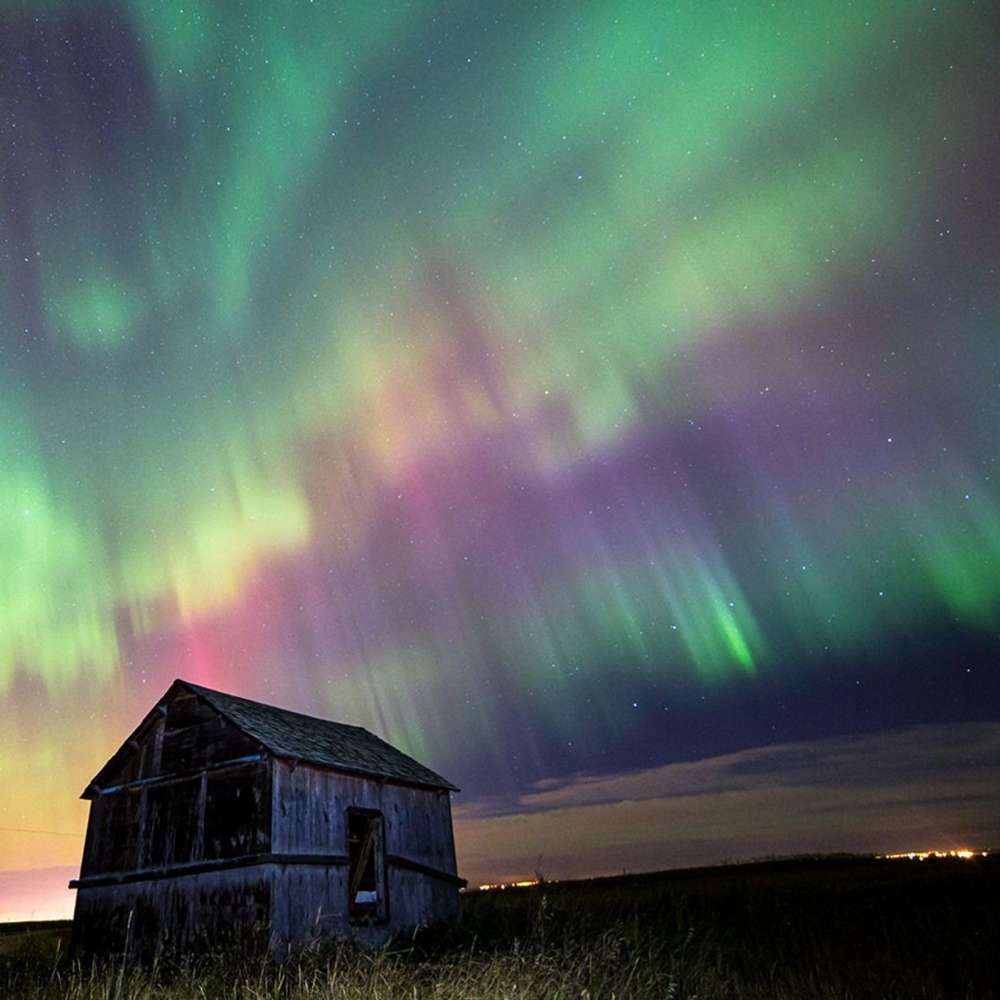
Oxygen (100–300 km) → Green light
Oxygen (above 300 km) → Red light
Nitrogen → Blue, purple, and pink tones
The color depends on:
Gas type
Collision energy
Altitude of interaction
Auroras are therefore altitude-coded light emissions.
Why Auroras Move and Ripple
Auroras are dynamic because:
Solar wind conditions fluctuate
Magnetic field lines shift and reconnect
Particle energy varies rapidly
This creates:
Curtains
Arcs
Spirals
Pulsating patches
What appears as motion is actually energy flowing along magnetic field lines, constantly reshaping the emission regions.
Aurora Borealis vs Aurora Australis
There are two main auroral systems:
Aurora Borealis – Northern Hemisphere
Aurora Australis – Southern Hemisphere
They are:
Physically identical
Magnetically linked
Often mirror each other during strong solar events
However, the southern aurora is less observed due to fewer landmasses at high southern latitudes.
Why Auroras Are Stronger During Solar Maximum
The Sun follows an approximately 11-year solar cycle.
During solar maximum:
More sunspots appear
Solar flares and CMEs increase
Auroras become more frequent and intense
This is why auroras:
Occasionally appear at mid-latitudes
Can be seen far from the poles during strong storms
Auroras track the Sun’s long-term rhythm.
Why Auroras Matter Scientifically
Auroras matter because they:
Reveal space weather conditions in real time
Indicate magnetospheric stress
Help predict geomagnetic storms
These storms can:
Disrupt satellites
Damage power grids
Affect navigation and radio signals
Auroras are the visible warning lights of space weather.
Auroral Structures – Why the Sky Forms Curtains and Arcs
Auroras are not random glows. Their shapes reflect magnetic field geometry and particle motion.
Common auroral forms include:
Arcs – Long, smooth bands aligned east–west
Curtains – Vertical sheets with rippling motion
Rays – Narrow columns extending upward
Spirals – Twisting structures during strong disturbances
Patches – Diffuse, cloud-like regions
These forms occur because:
Charged particles spiral along magnetic field lines
Different energies penetrate to different altitudes
Magnetic reconnection injects bursts of particles
Auroras are effectively magnetic field lines made visible.
Discrete vs Diffuse Auroras
Auroras fall into two broad physical categories.
Discrete Auroras
Bright, sharply defined
Structured arcs and curtains
Caused by focused particle beams
Common during geomagnetic activity
Diffuse Auroras
Faint, spread-out glow
Less structured
Caused by scattered particles
More persistent but less dramatic
Both are important for understanding energy transfer in near-Earth space.
Geomagnetic Storms – When Auroras Expand
During powerful solar events, auroras behave differently.
A geomagnetic storm occurs when:
A CME or strong solar wind hits Earth
The magnetosphere compresses
Large-scale magnetic reconnection occurs
Consequences include:
Auroral ovals expand toward the equator
Auroras become brighter and faster
Unusual colors and shapes appear
This is why auroras are sometimes seen far from polar regions during major storms.
Auroras as Space Weather Indicators
Auroras are directly linked to space weather conditions.
They signal:
Increased particle energy entering Earth’s atmosphere
Stress on the magnetosphere
Potential risk to technological systems
Strong auroral activity often coincides with:
Satellite anomalies
GPS signal degradation
Power grid disturbances
In this sense, auroras act as natural space weather displays, visible without instruments.
Auroras and the Ionosphere
Auroral activity strongly affects the ionosphere, the electrically charged layer of Earth’s atmosphere.
Effects include:
Increased ionization
Changes in radio wave propagation
Disruption of HF communication
Navigation signal errors
This is why:
Aviation routes near the poles are affected
Radio operators track auroral conditions
Space weather forecasts include auroral indices
Auroras link space physics directly to human technology.
Auroras on Other Planets
Auroras are not unique to Earth.
Jupiter
The most powerful auroras in the Solar System
Driven by both solar wind and its moon Io
Constant and extremely energetic
Saturn
Large-scale auroral ovals
Strongly influenced by solar activity
Mars
Weak, patchy auroras
Due to lack of a global magnetic field
Uranus and Neptune
Highly unusual auroras
Strongly tilted magnetic fields create complex patterns
Auroras reveal the magnetic personality of each planet.
Why Earth’s Auroras Are Special
Earth’s auroras are unique because:
They are strong but not destructive
They occur within a protective magnetosphere
They are accessible to ground-based observation
This makes Earth an ideal natural laboratory for studying:
Plasma physics
Magnetic reconnection
Solar–planetary interactions
How Scientists Study Auroras
Auroras are studied using:
Ground-based all-sky cameras
Magnetometers
Radar systems
Satellites monitoring solar wind and magnetospheres
By combining these tools, scientists:
Track energy flow from the Sun to Earth
Predict geomagnetic storms
Improve space weather forecasting
Auroras bridge observational beauty and quantitative science.
Aurora Forecasting – Predicting the Sky’s Response
Auroras can be predicted, but not with the precision of ordinary weather.
Forecasting relies on:
Monitoring solar activity (flares, CMEs)
Measuring solar wind speed and density
Tracking the orientation of the interplanetary magnetic field (IMF)
When conditions align:
Energetic particles enter Earth’s magnetosphere
Auroral activity intensifies
Visibility expands toward lower latitudes
Forecasts are usually accurate hours to days ahead, not weeks.
Key Indices Used in Aurora Prediction
Scientists use standardized indices to quantify geomagnetic activity.
Important Measures
Kp Index – Global geomagnetic activity (0–9)
Dst Index – Strength of geomagnetic storms
AE Index – Auroral electrojet intensity
Higher values generally mean:
Brighter auroras
Faster motion
Wider geographic visibility
These indices connect satellite data to ground-based forecasts.
When and Where Auroras Are Best Seen
Auroras depend on both space and local conditions.
Best Locations
High latitudes near the auroral ovals
Northern Canada, Alaska, Scandinavia
Antarctica and southern oceans
Best Conditions
Dark skies
Clear weather
Active solar conditions
Auroras are more frequent around:
Equinoxes
Solar maximum phases
Common Myths About Auroras
“Auroras make sounds.”
Rare reports exist, but no strong scientific confirmation supports audible auroras.
“Auroras are dangerous.”
The light itself is harmless. The associated space weather can affect technology, not people on the ground.
“Auroras are rare.”
They occur constantly—visibility depends on location and conditions.
“Auroras only happen at night.”
They occur day and night; daylight simply hides them from view.
Auroras and Human Technology
Auroras are visible markers of deeper space weather effects.
Strong auroral activity can coincide with:
Satellite drag increases
GPS accuracy degradation
Radio communication blackouts
Power grid stress
Understanding auroras helps mitigate these risks.
Why Auroras Matter Beyond Beauty
Auroras matter because they:
Visualize invisible space processes
Reveal magnetospheric dynamics
Provide early warning of geomagnetic storms
Connect solar physics with Earth systems
They are both scientific instruments and natural art.
Frequently Asked Questions (FAQ)
Can auroras be seen from space?
Yes. Astronauts and satellites observe auroras from above as glowing rings around the poles.
Do auroras affect climate?
They influence the upper atmosphere but have minimal direct impact on long-term climate.
Can auroras occur on exoplanets?
Yes, if the planet has an atmosphere and magnetic field. Detecting them could reveal planetary magnetism.
Why are green auroras most common?
Because oxygen emissions at ~100–150 km are most efficient at producing visible light.
Auroras in the Broader Solar System Context
Auroras help scientists:
Compare planetary magnetic fields
Study plasma interactions across planets
Understand star–planet interactions
They are a universal phenomenon wherever magnetic fields and charged particles meet.
Related Topics for Universe Map
Space Weather
Solar Wind
Magnetosphere
Coronal Mass Ejections
Ionosphere
Planetary Auroras
Together, these topics explain how the Sun interacts with planets across space.
Final Perspective
Auroras are the moment when space touches Earth.
They transform invisible forces—solar wind, magnetic fields, charged particles—into motion and color that anyone can witness.
Beyond their beauty, they remind us that Earth exists within a dynamic cosmic environment, constantly shaped by the Sun.
Auroras are not just lights in the sky.
They are the Sun writing its signature on Earth’s magnetic shield.