



Hubble
The Eye That Changed How Humanity Sees the Universe
Quick Reader
| Attribute | Details |
|---|---|
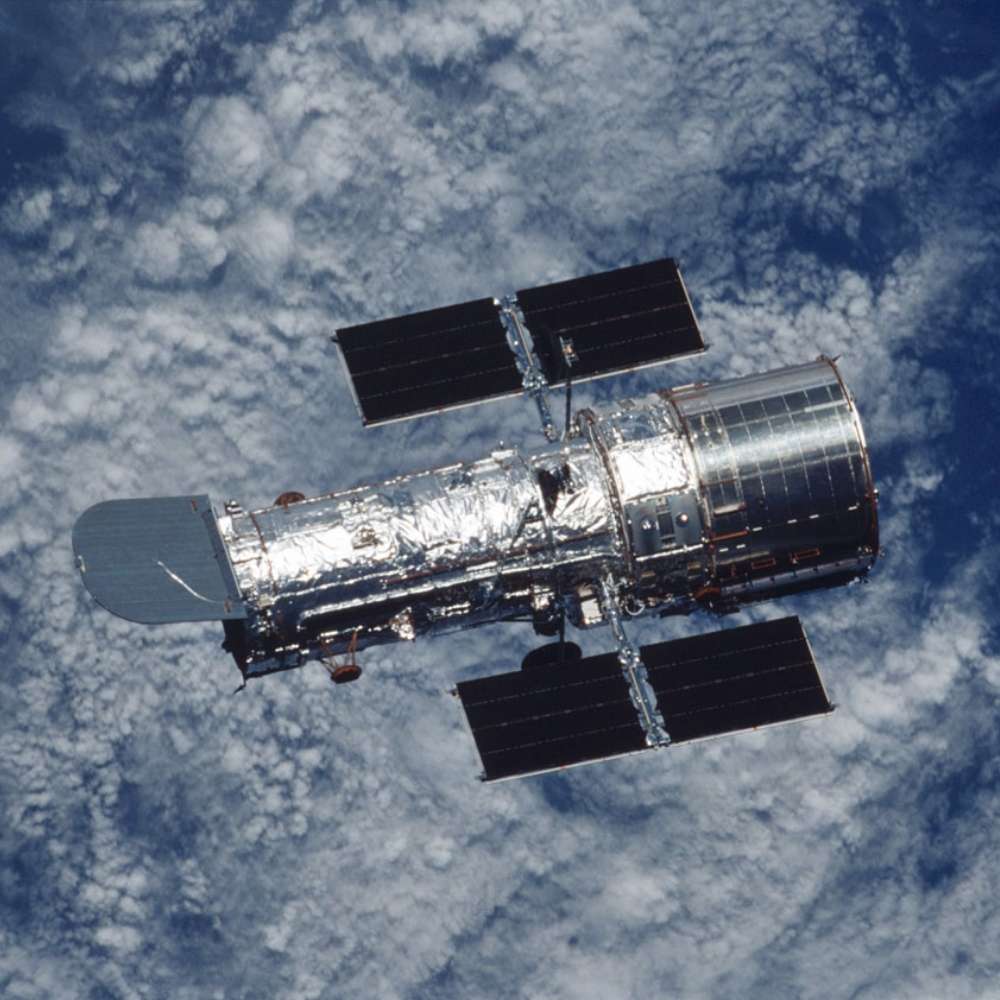
| Official Name | Hubble Space Telescope (HST) |
| Operator | NASA / ESA |
| Launch Date | 24 April 1990 |
| Launch Vehicle | Space Shuttle Discovery (STS-31) |
| Orbit Type | Low Earth Orbit (LEO) |
| Orbital Altitude | ~540 km |
| Primary Mirror | 2.4 meters |
| Wavelength Range | Ultraviolet, Visible, Near-Infrared |
| Mission Status | Operational (aging but active) |
| Service Missions | 5 Space Shuttle missions |
Scientific Role
Hubble is a general-purpose space observatory that revolutionized astronomy by delivering high-resolution images and spectra above Earth’s atmosphere.
Why It Matters
Hubble transformed astronomy from data-limited science into a precision, image-driven exploration of the Universe.
Introduction – Why Hubble Was Revolutionary
Before Hubble, even the largest ground-based telescopes faced a fundamental problem:
Earth’s atmosphere blurs the Universe.
Hubble solved this by moving the telescope above the atmosphere, where:
No atmospheric distortion exists
Ultraviolet light becomes accessible
Long, uninterrupted observations are possible
The result was not incremental improvement—but a qualitative leap in astronomical clarity.
The Vision Behind Hubble
Hubble was designed with a bold goal:
Build one telescope that could serve nearly every branch of astronomy.
Instead of focusing on a single mission, Hubble was built to:
Observe planets, stars, nebulae, galaxies, and the deep Universe
Be upgraded with new instruments
Remain scientifically relevant for decades
This philosophy made Hubble a living observatory, not a disposable spacecraft.
How Hubble Sees Differently
Hubble’s power comes from three advantages:
1. Above the Atmosphere
No atmospheric turbulence
No absorption of ultraviolet light
Sharper images than ground telescopes of similar size
2. Stable Long Observations
Hours-long exposures
High signal-to-noise imaging
Precision photometry and spectroscopy
3. Instrument Flexibility
Cameras and spectrographs swapped over time
Technology upgraded without relaunch
This combination made Hubble unique—and still competitive decades later.
The Famous Early Problem – And Why It Matters
Shortly after launch, Hubble faced a crisis:
Its primary mirror had a spherical aberration
Images were blurred
The mission was widely criticized
But this failure led to one of the greatest recoveries in scientific history.
In 1993:
Astronauts installed corrective optics
Hubble achieved its full designed resolution
This moment proved that servicing space telescopes works, changing how future missions were planned.
Hubble’s Orbit – Why LEO Was Chosen
Hubble orbits Earth roughly every 96 minutes.
LEO allows:
Regular servicing by astronauts
High data downlink rates
Thermal stability
The trade-off:
Earth blocks part of the sky
Day–night cycles interrupt observations
Despite this, LEO enabled Hubble’s unprecedented longevity.
Core Instruments – Hubble’s Scientific Tools
Over time, Hubble carried many instruments. The most important include:
Wide Field and Planetary Camera (WFPC / WFPC2)
Advanced Camera for Surveys (ACS)
Wide Field Camera 3 (WFC3)
Cosmic Origins Spectrograph (COS)
Space Telescope Imaging Spectrograph (STIS)
Each upgrade expanded Hubble’s scientific reach rather than replacing it.
What Hubble Observes Best
Hubble excels at:
Star formation regions
Nebulae and supernova remnants
Galaxy structure and evolution
Deep-field cosmology
Ultraviolet astronomy
It bridges the gap between:
Planetary science
Stellar astrophysics
Extragalactic astronomy
Few instruments in history have been this versatile.
Why Hubble Matters to Universe Map
Hubble provides:
Benchmark imagery used across astronomy
Reference observations for newer telescopes
Visual anchors for complex astrophysical concepts
Many modern discoveries are best understood in context with Hubble data.
Hubble’s Greatest Discoveries – Science That Redefined Reality
Hubble did not just improve images; it rewrote textbooks.
1. Measuring the Expansion Rate of the Universe
Hubble provided the most precise early measurements of the Hubble constant, refining the Universe’s age and scale.
Impact:
Narrowed the age of the Universe to ~13.8 billion years
Anchored modern cosmology
Exposed tensions that still drive research today
2. The Hubble Deep Fields – Looking Back in Time
By staring at “empty” regions of sky for days, Hubble revealed:
Thousands of galaxies in tiny patches
Galaxies at different evolutionary stages
A Universe filled with structure everywhere
Key deep surveys:
Hubble Deep Field (HDF)
Hubble Ultra Deep Field (HUDF)
eXtreme Deep Field (XDF)
These images showed that the early Universe was already rich and complex.
3. Dark Energy – The Accelerating Universe
Hubble observations of distant Type Ia supernovae helped confirm that:
The expansion of the Universe is accelerating
An unknown component—dark energy—dominates cosmic dynamics
This discovery:
Changed the fate of cosmology
Led to a Nobel Prize
Made dark energy a central mystery of physics
4. Black Holes in Galaxy Centers
Hubble provided direct evidence that:
Supermassive black holes exist in most large galaxies
Black hole mass correlates with galaxy properties
This revealed:
Galaxies and black holes evolve together
Black holes are not rare anomalies
Hubble turned black holes from theory into observational reality.
5. Star Formation and Stellar Life Cycles
Hubble mapped:
Stellar nurseries like the Eagle Nebula
Protostellar jets
Supernova remnants
These observations showed:
How stars are born from gas and dust
How massive stars shape galaxies
How elements are recycled across generations
Star formation became a visual, testable process.
Iconic Images – Beauty With Scientific Purpose
Hubble’s famous images are not just art.
Each iconic image encodes data:
Gas composition
Temperature structure
Shock fronts
Radiation fields
Examples:
Pillars of Creation
Carina Nebula
Sombrero Galaxy
Ring Nebula
Hubble images are multi-wavelength science translated into human vision.
Hubble’s Role in Exoplanet Science
Before dedicated planet missions, Hubble:
Detected atmospheric signatures in exoplanets
Measured water vapor and hazes
Demonstrated transit spectroscopy
This laid the groundwork for:
TESS target selection
JWST atmospheric studies
Hubble proved that exoplanet atmospheres were observable.
Hubble vs JWST – Complementary, Not Competing
| Aspect | Hubble | JWST |
|---|---|---|
| Orbit | Low Earth Orbit | Sun–Earth L₂ |
| Wavelengths | UV–Visible–Near IR | Near–Mid IR |
| Strength | Sharp optical imaging | Deep infrared sensitivity |
| Role | Benchmark & legacy | Frontier exploration |
Hubble remains unmatched in:
- Ultraviolet astronomy
- Optical-resolution imaging
- Long-term monitoring
Together, they form a continuum of discovery, not a replacement.
Why Hubble Data Keeps Giving
Hubble’s archive contains:
Millions of observations
Decades of sky coverage
Uniform, calibrated datasets
Scientists continue to:
Reanalyze old data
Discover new objects
Compare long-term changes
Hubble is a time machine stored in data.
Servicing Hubble – When Humans Repaired the Universe’s Eye
Hubble is unique among major space observatories because it was designed to be serviced by astronauts.
Between 1993 and 2009, five Space Shuttle missions:
Corrected the mirror flaw
Replaced failed components
Installed new cameras and spectrographs
Extended Hubble’s scientific life by decades
These missions transformed Hubble from a risky experiment into:
A reliable, evolving observatory
Proof that complex space hardware can be maintained
A model for modular spacecraft design
No other space telescope has benefited so directly from human intervention.
Why Servicing Changed Space Science Forever
Hubble’s repair success:
Restored public and political confidence
Justified long-term investment in space observatories
Influenced the design philosophy of later missions
Although JWST is not serviceable, its risk management and testing culture was shaped by lessons learned from Hubble.
Hubble’s Aging Challenges
Hubble is now well beyond its original design life.
Current challenges include:
Aging gyroscopes
Limited onboard redundancy
Gradual orbital decay due to atmospheric drag
Despite this, Hubble continues to:
Produce frontline science
Support time-domain studies
Provide ultraviolet capability unavailable elsewhere
Its endurance is a testament to conservative engineering and careful operations.
How Long Can Hubble Keep Working?
With careful management:
Hubble can continue limited operations into the late 2020s
Scientific output depends on remaining gyroscopes and power systems
Even after the end of operations:
Hubble’s data archive will remain invaluable
Its scientific influence will continue indefinitely
The telescope may stop observing—but it will never stop contributing.
Frequently Asked Questions (FAQ)
Is Hubble still making discoveries?
Yes. Hubble continues to publish cutting-edge results across cosmology, stellar physics, and planetary science.
Why not replace Hubble with a new optical telescope?
Cost, complexity, and risk are high. JWST covers different wavelengths, and future missions may eventually restore optical capability.
Can Hubble see farther than JWST?
In visible light and ultraviolet, yes. In infrared, JWST goes much deeper.
Will Hubble be safely deorbited?
Yes. Plans exist to ensure controlled reentry or safe disposal to avoid space debris risks.
Hubble’s Role in the JWST Era
Hubble did not become obsolete when JWST launched.
Instead:
Hubble provides ultraviolet and optical context
JWST explores dust-shrouded and infrared-dominated targets
Combined observations yield fuller physical understanding
Many of JWST’s most celebrated results are built on Hubble foundations.
Why Hubble’s Legacy Is Unmatched
Hubble’s legacy includes:
Fundamental discoveries about the Universe’s age, structure, and fate
Proof that space telescopes transform science
A generation of astronomers trained on its data
Public engagement on a global scale
No single instrument has:
Influenced so many fields
Operated for so long
Been so deeply embedded in scientific culture
What We Would Not Know Without Hubble
Without Hubble:
The scale of the Universe would be less certain
Dark energy might have remained hidden longer
Black holes would be harder to link to galaxies
The deep Universe would remain abstract
Hubble turned cosmic theory into observable reality.
Related Topics for Universe Map
James Webb Space Telescope (JWST)
Space Telescopes
Deep Field Observations
Dark Energy
Galaxy Evolution
Ultraviolet Astronomy
Together, these topics show how space observatories shape our cosmic understanding.
Final Perspective
Hubble did more than observe the Universe.
It taught humanity how to look.
By lifting our vision above Earth’s atmosphere, Hubble revealed a cosmos richer, deeper, and more dynamic than anyone imagined. It bridged generations, inspired missions, and turned astronomy into a shared human experience.
Long after its final image is taken, Hubble will remain what it has always been:
The telescope that changed how we see everything.