





WISE
Mapping the Hidden Universe in Infrared
Quick Reader
| Attribute | Details |
|---|---|
| Mission Name | WISE (Wide-field Infrared Survey Explorer) |
| Space Agency | NASA |
| Mission Type | Infrared space telescope |
| Launch Date | 14 December 2009 |
| Launch Vehicle | Delta II |
| Orbit Type | Sun-synchronous Low Earth Orbit |
| Primary Wavelengths | Infrared (3.4, 4.6, 12, 22 μm) |
| Survey Coverage | Entire sky (multiple passes) |
| Cryogenic Phase | 2010–2011 |
| Extended Mission | NEOWISE |
| Mission Status | Completed (science archive active) |
In two sentences
WISE was an all-sky infrared survey mission that revealed objects invisible in visible light, from cold asteroids to distant galaxies. It fundamentally expanded our census of the Solar System and the infrared universe.
Key takeaway
WISE showed that much of the universe is cold, dusty, and hidden—and infrared light is the key to seeing it.
Best for
Infrared astronomy, asteroid discovery, brown dwarfs, galaxy evolution, and Solar System surveys.
Introduction – Seeing the Universe Beyond Visible Light
What we see with our eyes is only a fraction of reality.
Most cosmic objects emit little visible light but glow strongly in infrared.
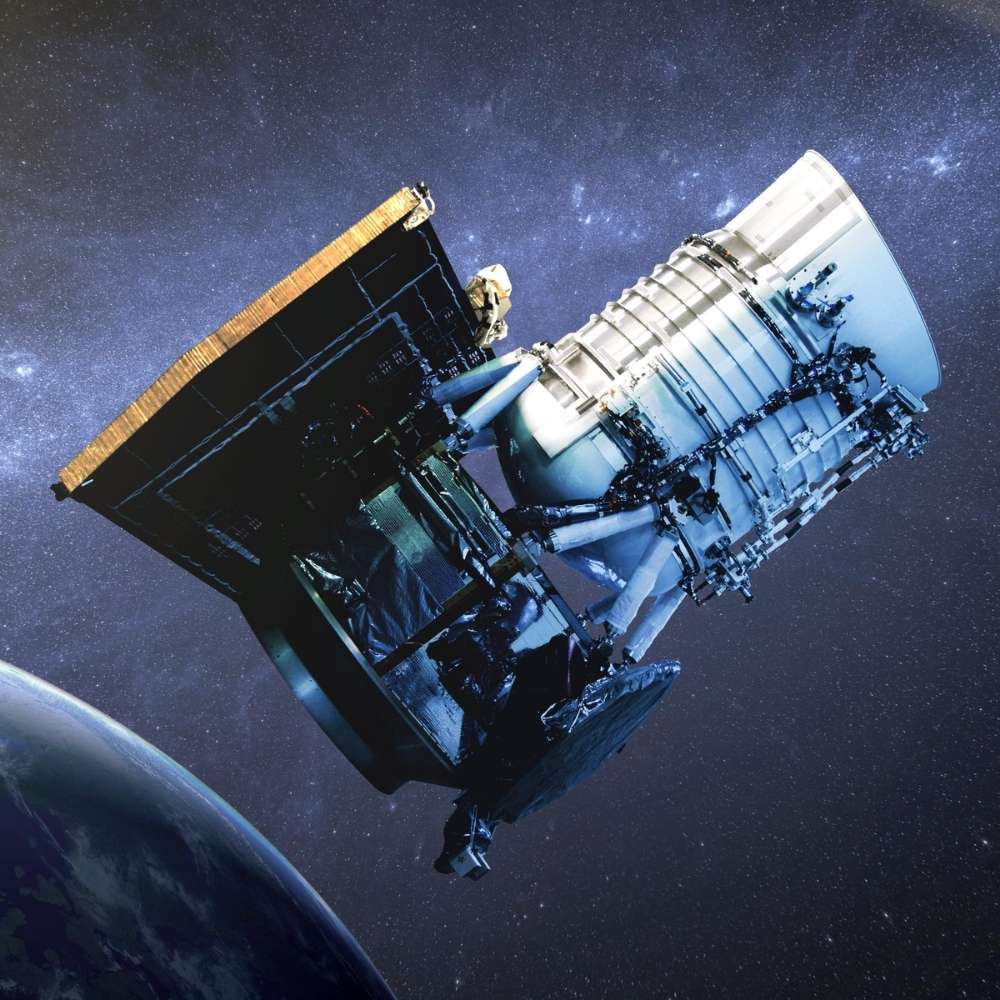
WISE was designed to reveal this hidden universe by scanning the entire sky in infrared wavelengths—detecting heat rather than light. In doing so, it uncovered millions of objects that optical telescopes could not easily find.
What Is WISE?
WISE is a space-based infrared survey telescope built to:
Map the entire sky in infrared
Detect cold and dusty objects
Identify nearby and distant sources uniformly
Unlike pointed observatories, WISE was a survey mission, optimized to catalog everything it could see rather than focus on individual targets.
Why Infrared Astronomy Matters
Infrared light is emitted by:
Cool stars and brown dwarfs
Dust clouds where stars form
Asteroids warmed by sunlight
Distant galaxies obscured by dust
Infrared observations allow scientists to:
See through dust clouds
Detect low-temperature objects
Measure thermal properties directly
WISE made infrared astronomy systematic and global.
Mission Design – Built for an All-Sky Census
WISE used a simple but powerful strategy:
Continuous scanning of the sky
Four infrared detectors operating simultaneously
Highly stable sun-synchronous orbit
Each region of the sky was observed multiple times, improving reliability and enabling motion detection for nearby objects.
Cryogenic Cooling – Why It Was Essential
Infrared detectors must be kept extremely cold to avoid detecting their own heat.
WISE used:
Solid hydrogen cryogen
Passive cooling systems
This allowed the telescope to detect faint infrared signals with high sensitivity during its prime mission phase.
Survey Performance and Scale
WISE achieved:
Full-sky coverage in less than one year
Hundreds of millions of detected sources
Uniform data quality across the sky
It became one of the most productive astronomical survey missions ever flown.
What WISE Could See That Others Missed
WISE excelled at detecting:
Near-Earth asteroids and comets
Brown dwarfs too cool to shine visibly
Dusty star-forming regions
Infrared-bright galaxies
Many of these objects were previously unknown or poorly characterized.
WISE and the Solar System
WISE had a major impact on Solar System science by:
Discovering and characterizing asteroids
Measuring asteroid sizes using thermal emission
Improving estimates of asteroid population statistics
This directly contributed to planetary defense and Solar System modeling.
Why WISE Was a Turning Point
Before WISE:
Infrared surveys were partial or region-specific
After WISE:
The infrared sky became fully mapped and publicly accessible
Statistical astronomy in infrared became possible
WISE provided a foundation for nearly all modern infrared population studies.
Brown Dwarfs – WISE’s Signature Discovery
One of WISE’s most celebrated achievements was the discovery of brown dwarfs—objects too small to be stars and too large to be planets.
WISE revealed:
Hundreds of previously unknown brown dwarfs
The coldest known brown dwarfs, including Y-dwarfs
Objects with temperatures similar to Earth’s surface
These discoveries reshaped the stellar population map of the solar neighborhood.
The Closest Hidden Neighbors
WISE discovered some of the Sun’s nearest neighbors, including:
Brown dwarfs only a few light-years away
Objects invisible to optical surveys
These findings showed that our stellar neighborhood was far from fully cataloged before WISE.
Star Formation and Dusty Regions
Infrared vision allowed WISE to peer into:
Dense molecular clouds
Stellar nurseries
Dust-enshrouded star-forming regions
WISE provided a comprehensive view of how stars form inside dusty environments that block visible light.
Galaxies Seen in Infrared
WISE mapped millions of galaxies, revealing:
Dusty starburst galaxies
Active galactic nuclei hidden by dust
Large-scale cosmic structure in infrared light
This data helped connect galaxy evolution with dust and star formation processes.
The NEOWISE Mission – Asteroid Hunter
After its cryogen was exhausted, WISE was repurposed as NEOWISE.
NEOWISE focused on:
Near-Earth objects (NEOs)
Asteroid size and albedo measurement
Comet detection
By observing thermal emission, NEOWISE provided more accurate asteroid size estimates than visible-light surveys.
Why Infrared Is Ideal for Asteroids
Visible brightness depends on reflectivity.
Infrared brightness depends on actual size and temperature.
NEOWISE could:
Distinguish small bright objects from large dark ones
Reduce uncertainty in impact risk assessment
Improve population statistics for planetary defense
This made NEOWISE a critical tool for understanding asteroid hazards.
Comets and Dust Trails
WISE detected:
Cometary dust trails
Previously unknown comets
Thermal properties of comet nuclei
These observations improved understanding of comet structure and evolution.
Unexpected Discoveries
Because WISE surveyed the entire sky uniformly, it uncovered:
Rare infrared-bright objects
Unusual stellar systems
Transient infrared sources
Survey missions excel at discovering the unexpected, and WISE was no exception.
WISE Data and Modern Astronomy
WISE data became a cornerstone for:
Target selection for JWST
Cross-matching with optical and radio surveys
Statistical studies across astrophysics
Few missions have produced datasets with such broad and lasting impact.
WISE vs Other Infrared Missions
| Mission | Strength | Limitation |
|---|---|---|
| WISE | Full-sky infrared survey | Limited angular resolution |
| Spitzer | Deep pointed observations | Partial sky coverage |
| JWST | Ultra-deep sensitivity | Narrow field of view |
WISE provided the context, while other missions delivered depth.
WISE’s Long-Term Legacy
WISE permanently changed how astronomers study the infrared universe.
Its lasting contributions include:
The first uniform, all-sky infrared catalog
Discovery of the coldest nearby substellar objects
Precise thermal characterization of asteroids
A foundational dataset for countless follow-up missions
WISE turned infrared astronomy into population science, not isolated discovery.
WISE and Planetary Defense
Through its NEOWISE mission, WISE became a key player in planetary defense.
It contributed by:
Detecting thousands of near-Earth objects
Measuring asteroid diameters and albedos
Improving impact-risk models
NEOWISE demonstrated that infrared surveys are essential for understanding asteroid hazards.
Why WISE Data Is Still Used Today
WISE remains relevant because:
Infrared sky does not change quickly
Large datasets gain value over time
Many objects discovered by WISE have not been fully studied
WISE data continues to support new discoveries years after the mission ended.
WISE’s Influence on Future Missions
WISE shaped the design philosophy of later missions by proving that:
All-sky surveys deliver disproportionate scientific return
Uniform datasets enable cross-disciplinary research
Small-to-medium missions can have massive impact
Its success informs planning for future infrared survey telescopes.
Frequently Asked Questions (FAQ)
What made WISE different from earlier infrared telescopes?
WISE mapped the entire sky uniformly in infrared, rather than targeting selected regions, enabling statistical studies across astronomy.
Why was WISE repurposed as NEOWISE?
After the cryogenic phase ended, the telescope remained functional in shorter infrared wavelengths, ideal for asteroid detection and characterization.
How many objects did WISE discover?
WISE detected hundreds of millions of infrared sources and discovered thousands of new asteroids, comets, and brown dwarfs.
Is WISE still operating?
The original WISE mission is complete. NEOWISE continued operations for years, and all data remains publicly available.
Can WISE detect planets?
WISE cannot directly image exoplanets, but it detects brown dwarfs and debris disks that inform planetary system studies.
Why is infrared important for cold objects?
Cold objects emit most of their energy in infrared wavelengths, making visible-light observations ineffective.
Why is WISE important for Universe Map readers?
WISE connects Solar System science, stellar populations, and galaxy evolution by revealing what the visible universe hides.
WISE in the Context of Modern Astronomy
WISE showed that:
The universe is rich in cold, faint objects
Dust plays a central role in cosmic evolution
Infrared surveys are essential complements to optical astronomy
It provided the missing thermal dimension to our view of the cosmos.
Related Topics for Universe Map
Infrared Astronomy
Brown Dwarfs
Near-Earth Objects
NEOWISE
Asteroid Thermal Modeling
Galaxy Evolution
Together, these topics explain how infrared light reveals hidden structure.
Final Perspective
WISE did not capture dramatic, colorful images.
It did something more transformative.
By measuring heat across the entire sky, WISE revealed a universe filled with cold stars, warm asteroids, and dust-shrouded galaxies—objects that quietly shape cosmic history.
WISE reminds us that to understand the universe, we must look beyond what our eyes can see.