











Acrux
The Southern Sky’s Twin Jewel at the Heart of the Southern Cross
Quick Reader
| Attribute | Details |
|---|---|
| Name | Acrux |
| Bayer Designation | Alpha Crucis |
| Star System Type | Multiple star system (at least 3 components) |
| Constellation | Crux (Southern Cross) |
| Distance from Earth | ~320 light-years |
| Apparent Magnitude | Combined: ~+0.76 (brightest in Crux) |
| Spectral Types | B0.5 IV + B1 V (dominant pair) |
| Temperatures | ~28,000 K and ~26,000 K |
| Mass | ~17 M☉ + ~15 M☉ (primary pair) |
| Luminosity | Tens of thousands of times the Sun |
| Notable Features | Brightest star in Crux, prominent in Southern Hemisphere navigation |
| Best Viewing Season | March–August (Southern Hemisphere) |
Introduction – A Faint, Nearby Relic of a Dead Sun-like Star
Van Maanen’s Star, also known as Van Maanen 2, is one of the closest white dwarfs to Earth and one of the faintest stars visible in the Sun’s neighborhood. At only 14.1 light-years away, it is the third-closest white dwarf after Sirius B and Procyon B.
Unlike bright, massive stars or colorful giants, Van Maanen’s Star appears extremely dim. It is a stellar remnant—the collapsed core of a Sun-like star that has already completed its full life cycle. What remains is an Earth-sized object with nearly the mass of the Sun, supported not by nuclear fusion, but by electron degeneracy pressure.
This quiet, faded star offers astronomers a valuable look into:
The long-term future of Sun-like stars
The physics of degenerate matter
Cooling ages in the solar neighborhood
Heavy metal pollution in white dwarf atmospheres (rare and scientifically important)
Van Maanen’s Star is one of the best-studied nearby remnants of stellar evolution, revealing what stars become billions of years after their nuclear reactions cease.
Physical Characteristics of Acrux
A Multiple Star System
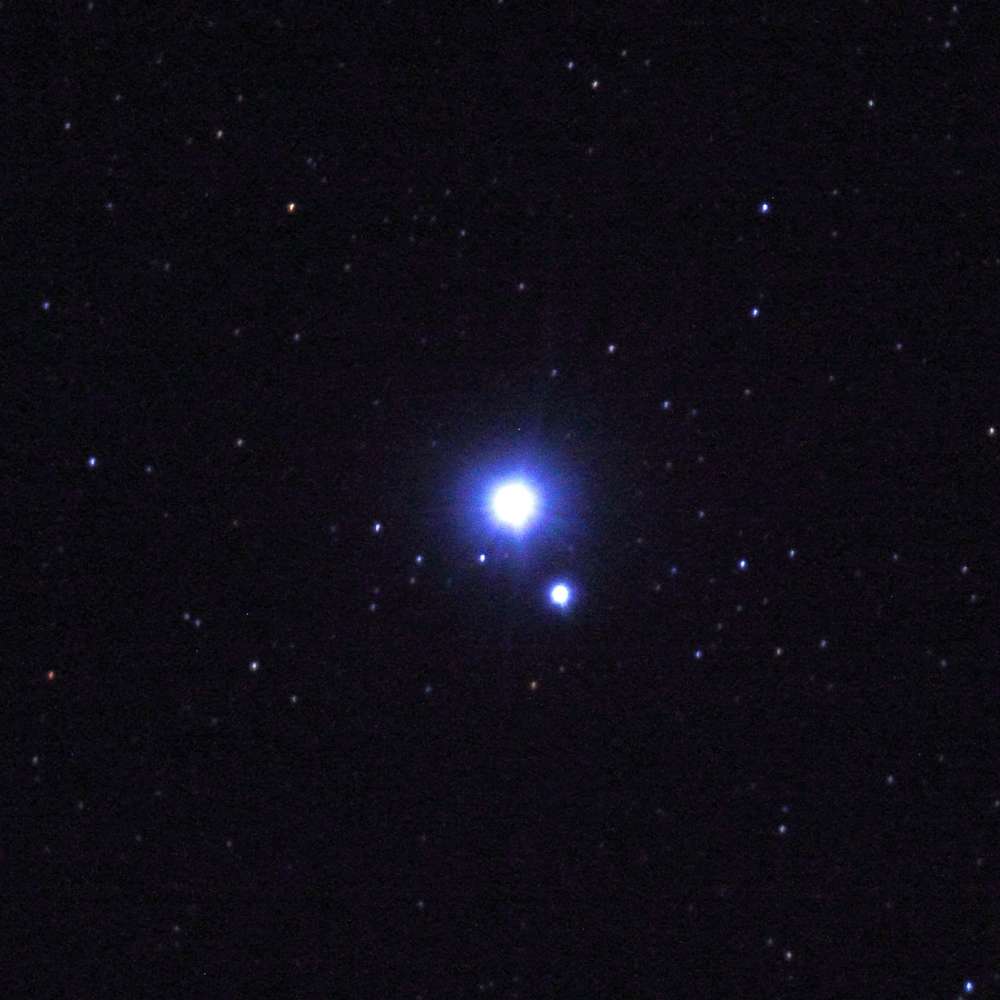
Acrux appears as a single bright star to the naked eye, but telescopes reveal that it is part of a three-star system:
Acrux A – Spectral type B0.5 IV
Acrux B – Spectral type B1 V
Acrux C – Fainter, likely gravitationally bound
The two brightest stars, Acrux A and Acrux B, form a close binary system with a separation of roughly 4 arcseconds, easily resolved in amateur telescopes.
Spectral Types and Surface Temperatures
Both primary components are hot blue-white stars with extreme temperatures:
Acrux A: ~28,000 K
Acrux B: ~26,000 K
These temperatures explain their:
Blue-white color
Strong ultraviolet emission
High luminosity
Compared to the Sun’s 5,780 K, Acrux’s components are scorching, massive stars with tremendous radiative output.
Mass and Luminosity
The Acrux pair includes two very massive stars:
Acrux A: ~17 times the Sun’s mass
Acrux B: ~15 times the Sun’s mass
Both stars are tens of thousands of times more luminous than the Sun. Massive stars burn hot and fast, meaning they have short lifespans measured in only a few million years.cc
Acrux in the Constellation Crux
The Anchor of the Southern Cross
Crux, the Southern Cross, is one of the most recognizable constellations in the Southern Hemisphere. Acrux sits at the base of the cross, anchoring the constellation with its brilliant light.
Crux is notable for:
Its compact shape
Its role as a southern navigation marker
Its cultural significance across Australia, New Zealand, South America, and Polynesia
Acrux, the brightest star in Crux, plays a central role in forming this celestial landmark.
Navigation and the Southern Celestial Pole
For centuries, Acrux and the stars of Crux have been used to locate the South Celestial Pole.
By extending the long axis of the Southern Cross, navigators could:
Determine south direction at sea
Estimate latitude
Orient themselves during travels
Acrux, at the base, provides one of the anchor points for this method.
Acrux’s Role in Distance and Stellar Modeling
Massive stars like Acrux provide crucial insight into:
Stellar evolution in high-mass stars
Nuclear fusion rates
Supernova progenitors
Stellar cluster formation
Acrux is part of the Scorpius–Centaurus OB association, the nearest massive star-forming region to Earth. Studying these stars helps astronomers model:
Early stellar life
High-energy radiation environments
The distribution of heavy elements seeded by supernovae
Evolutionary Future – A System Destined for Catastrophe
Acrux’s massive stars have short lifetimes. Their futures will be dramatic.
Expected Evolution
Each component star will:
Exhaust hydrogen in the core within a few million years.
Expand into a supergiant.
Undergo core collapse.
Explode as a Type II supernova.
Leave behind neutron stars or black holes depending on final mass.
Massive binary stars may also:
Transfer mass
Merge
Interact in complex, violent ways
These processes significantly affect their supernova outcomes.
Possible End States
Depending on mass loss and interaction:
Acrux A may become a black hole.
Acrux B may become a neutron star.
Acrux C’s fate is less certain but may also end in collapse.
The Acrux system could produce gravitational waves in the far future when remnants interact.
Color, Variability, and Observational Features
Color
Acrux’s blue-white color is one of its most striking features. It stands out even among other bright southern stars due to:
Its temperature
Its young age
Its purity of light (minimal reddening)
Variability
Acrux A and B may show slight spectroscopic or photometric variability due to:
Stellar winds
Rotation
Pulsations
Interaction between components
These variations are small and not noticeable to naked-eye observers.
Cultural Importance Across Civilizations
Indigenous Australian Astronomy
The Southern Cross, including Acrux, is deeply integrated into Aboriginal sky lore, representing:
Emu tracks
Spiritual markings
Seasonal markers
Polynesian Navigation
Acrux served as:
A directional anchor for long-distance ocean voyages
A marker of southern latitudes
South American Significance
In Brazil, Chile, and Argentina, Crux is a symbol of:
National identity
Regional folklore
Cultural festivals
Acrux, the brightest star, is central to these cultural narratives.
Internal Structure of Acrux’s Massive Stars
Acrux A and Acrux B are among the most massive and luminous stars visible to the naked eye. Their internal physics differ dramatically from Sun-like stars due to their tremendous mass, high temperatures, and rapid evolution.
Core Fusion Processes
Both primary components of Acrux fuse hydrogen through the CNO (carbon–nitrogen–oxygen) cycle, not the proton–proton chain used by stars like the Sun.
Key features of the CNO cycle:
Dominates in stars above ~1.3 solar masses
Requires higher core temperatures (~15 million K and above)
Produces vastly more energy per unit time
This leads to:
Extremely high luminosity
Rapid fuel consumption
Short stellar lifetimes (only a few million years)
Radiative and Convective Zones
Inside Acrux A and B:
The core is convective due to intense fusion rates
The outer envelope is radiative
Energy escapes rapidly via high-energy photons
This radiative envelope contributes to:
Powerful stellar winds
Surface temperature uniformity
Intense ultraviolet emission
Stellar Winds and Mass Loss
Massive hot stars like Acrux lose material continuously through strong stellar winds.
Characteristics of Acrux’s Stellar Winds
Velocity: Thousands of km/s
Composition: Ionized gas, UV-driven streams
Effects: Mass stripping, environmental enrichment
Over their short lifetimes, the Acrux stars shed significant mass, contributing to the chemical enrichment of the Scorpius–Centaurus region.
Consequences of Mass Loss
Mass loss affects:
Stellar evolution – decreasing mass modifies lifespan and supernova outcome
Binary interactions – wind material may be absorbed by a companion star
Ionization of nearby gas – creating emission regions or cavities
Supernova precursors – determining whether the final core produces a neutron star or black hole
Acrux is a prime case study for wind physics in massive stars.
Dynamics of the Acrux Multiple-Star System
Acrux is not a simple pair—it is a multi-star system, and its dynamics are highly instructive for astrophysicists.
Primary Binary (Acrux A + Acrux B)
The two brightest stars:
Have a separation of ~4 arcseconds
Are gravitationally bound
Likely orbit each other with periods on the order of hundreds of years
Their masses (17 + 15 M☉) create strong gravitational interactions.
Acrux C
A third, fainter star—Acrux C—is:
Likely a physical companion
Positioned slightly farther from the main pair
Possibly a B- or early A-type star
Its gravitational orbit is still being refined through radial velocity measurements.
Orbital and Evolutionary Implications
The presence of three massive stars increases the likelihood of:
Mass transfer events
Orbital tightening
Dynamical instability
Future interactions between their remnants (neutron stars or black holes)
As the stars evolve, their orbits may be altered by mass loss, potentially widening the system.
Acrux in the Scorpius–Centaurus OB Association
The Scorpius–Centaurus OB association (Sco–Cen) is the closest region of massive star formation to Earth. Acrux belongs to one of its subgroups.
Why Sco–Cen Matters
Sco–Cen provides astronomers with:
A laboratory for studying high-mass stellar evolution
Data on massive star clustering
Insight into the origins of local supernova remnants
Acrux, being one of the most massive stars in the association, helps trace:
Star formation history
Supernova enrichment
The movement of young massive stars across the galaxy
Acrux Compared to Other Southern Cross Stars
Acrux vs. Mimosa (Beta Crucis)
| Feature | Acrux | Mimosa |
|---|---|---|
| Spectral Type | B0.5 IV + B1 V | B0.5 III |
| Brightness | Slightly brighter | Slightly dimmer |
| Temperature | ~26,000–28,000 K | ~27,000 K |
| Evolution | More massive binary | Giant nearing the next phase |
Mimosa is also extremely hot and luminous but is more evolved toward the giant stage.
Acrux vs. Gacrux (Gamma Crucis)
| Feature | Acrux | Gacrux |
|---|---|---|
| Color | Blue-white | Deep orange-red |
| Type | Massive B-type | Red giant |
| Distance | ~320 ly | ~88 ly |
| Temperature | ~28,000 K | ~3,600 K |
| Mass | ~17–15 M☉ | ~1.5 M☉ |
Gacrux is much closer and cooler, offering a beautiful temperature contrast with Acrux.
Acrux vs. Delta Crucis and Epsilon Crucis
- Delta Crucis – a blue giant
- Epsilon Crucis – an orange giant
Together, they form one of the most iconic sky patterns in human culture.
Cultural and Historical Significance
Navigation Across the Southern Oceans
For centuries, sailors used Acrux and the Southern Cross to:
Determine direction
Locate the South Celestial Pole
Navigate between continents in the Southern Hemisphere
Acrux is the anchor point that makes this method reliable.
National Flags and Identity
Crux—including Acrux—appears on the national flags of:
Australia
New Zealand
Papua New Guinea
Brazil (where Acrux represents a Brazilian state)
Samoa
Acrux symbolizes southern identity, exploration, and heritage.
Indigenous Knowledge Systems
Across Australia, Polynesia, and South America, Acrux:
Marks seasonal changes
Tells ancestral stories
Serves as a sky compass for traditional navigation
Represents important mythological figures
Cultural astronomy has preserved centuries of knowledge around this sacred star.
The Future of Acrux – A System Destined for Explosive Endings
Massive stars like those in the Acrux system live fast and die violently. Their immense mass and high rates of fusion guarantee short stellar lifespans, and Acrux is on a trajectory toward multiple supernova events.
Lifespan of Acrux A and Acrux B
Massive B-type stars evolve rapidly:
Total lifespan: roughly 9–12 million years
Acrux A and B are likely midway or slightly past halfway through their main-sequence phase
Both stars will exhaust hydrogen in their cores in a few million years
Evolution into Supergiants
As Acrux A and B evolve:
They will expand into blue or red supergiants
Their luminosity will increase dramatically
Their stellar winds will intensify
They will lose significant mass before collapsing
These transitions will make them more unstable and variable.
The Supernova Events
Eventually, each of the massive components will undergo core collapse, resulting in a Type II supernova.
Expected outcomes:
Acrux A: likely to produce a black hole
Acrux B: may collapse into a neutron star
Their explosions will enrich the Sco–Cen region with heavy elements
If the remnants remain gravitationally bound, they may form an exotic binary of:
A neutron star and a black hole
Or possibly a future gravitational-wave source
The explosions will pose no threat to Earth, as Acrux is much too far away.
Observing Acrux – A Guide for Amateur Astronomers
Acrux is one of the finest southern-sky targets and is best observed between March and August.
Naked-Eye Viewing
To the naked eye, Acrux appears:
As the brightest star in the Southern Cross
With a brilliant blue-white hue
Low on the horizon for observers near the equator
Always invisible from most of Europe and North America due to its southern position
Under dark skies, Acrux helps pinpoint the axis used to locate the South Celestial Pole.
Binoculars
With binoculars:
Acrux appears sharper and even more intensely blue
The surrounding stars of Crux become beautifully apparent
You can use Acrux as a guide to explore the nearby Coalsack Nebula
Telescopes
Small to medium telescopes reveal that Acrux is not a single star:
The primary pair (A and B) is easily split with modest magnification
Their contrasting brightness and identical blue-white color are striking
Acrux C may also be detectable under excellent seeing conditions
Acrux is a perfect example of a bright, colorful binary system.
Astrophotography
Acrux is a prime target for wide-field imaging:
It anchors the unmistakable shape of the Southern Cross
It sits near dark nebulae and star fields in Centaurus
Its rich blue color adds dramatic contrast
Long exposures can capture the broader Crux–Coalsack region, one of the most photographed skies in the southern hemisphere.
Frequently Asked Questions (FAQ)
Why is Acrux blue-white?
Because its surface temperature is extremely high (~28,000 K), causing it to emit intense blue and ultraviolet light.
Is Acrux a single star?
No. It is a multiple star system—at least three stars, with two massive B-type stars dominating the brightness.
How far away is Acrux?
Approximately 320 light-years, based on refined distance measurements.
Can Acrux go supernova?
Yes. The primary stars are massive enough to explode as supernovae, but this will occur millions of years from now.
Why is Acrux only visible from the Southern Hemisphere?
Because it lies far south of the celestial equator. Observers north of latitude ~27° cannot see it.
Does Acrux help with navigation?
Yes. It forms the base of the Southern Cross, traditionally used to locate the South Celestial Pole.
Is Acrux part of a star-forming region?
It belongs to the Scorpius–Centaurus OB association, the nearest massive star formation region to Earth.
Final Scientific Overview
Acrux stands as one of the most important and iconic southern-sky stars—both culturally and scientifically. Located within the Southern Cross, it has guided sailors, travelers, and astronomers for centuries. Its brilliant blue-white glow is a signature of its extreme temperature and youth, and its multiple-star nature provides rich insight into high-mass stellar evolution.
Key scientific highlights:
A multiple-star system with incredibly massive B-type stars
Part of the nearest OB association to the Solar System
A powerful source of ultraviolet radiation and stellar winds
Destined for dramatic supernova explosions in the far future
A key navigational anchor of the Southern Hemisphere skies
Acrux is not just a star—it is a cosmic beacon illuminating the structure, evolution, and destiny of massive stars in our galaxy.