







Akatsuki
Japan’s Persistent Mission to Unveil Venus
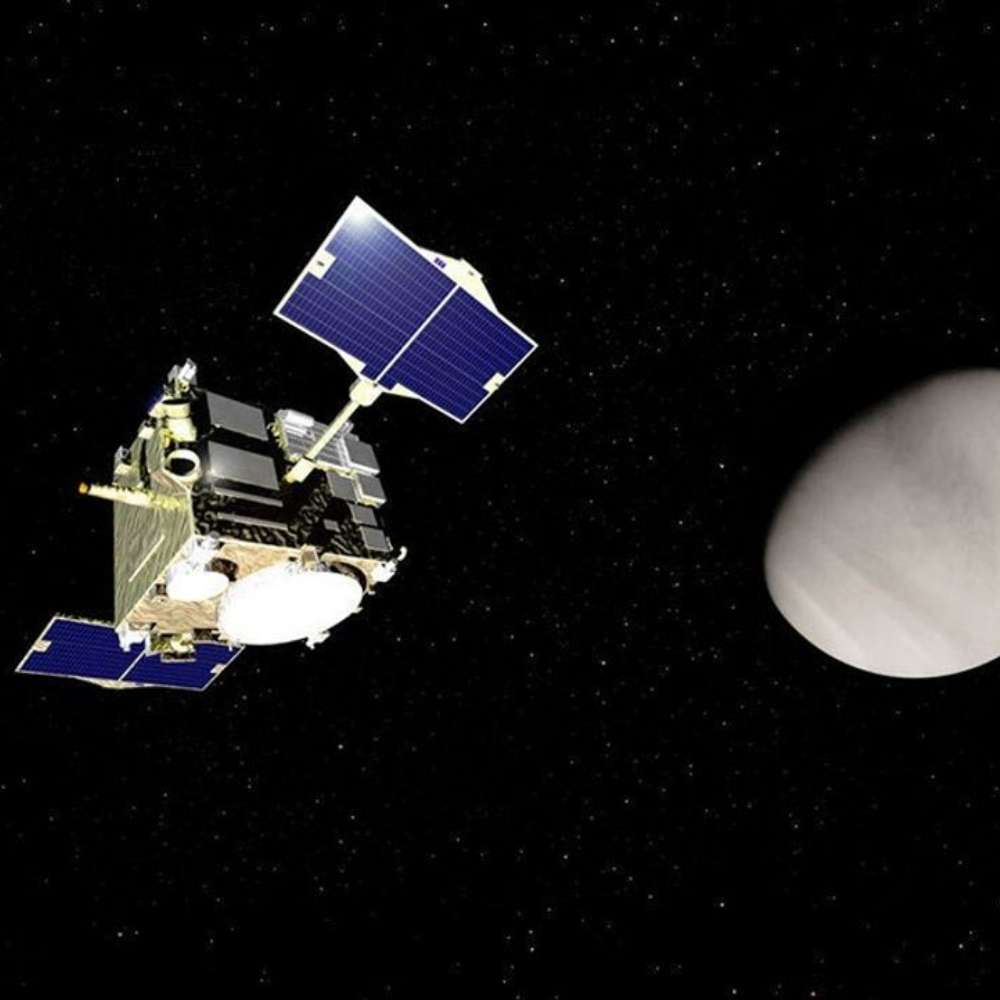
Quick Reader
| Attribute | Details |
|---|---|
| Mission Type | Planetary orbiter |
| Target | Venus |
| Operating Agency | JAXA (Japan Aerospace Exploration Agency) |
| Launch Date | 20 May 2010 |
| Primary Goal | Study Venusian atmosphere and climate |
| Initial Orbital Insertion | Failed in 2010 |
| Successful Orbital Capture | 7 December 2015 |
| Current Orbit Type | Highly elliptical Venus orbit |
| Mission Status | Operational (extended mission) |
| Key Instruments | IR cameras, UV imager, lightning detector |
| Unique Focus | Atmospheric dynamics and super-rotation |
| Mission Name Meaning | “Akatsuki” = Dawn (Japanese) |
Key Highlights
- First dedicated Japanese mission to Venus
- Survived a major engine failure and later succeeded
- Focuses on Venus’ atmosphere, not surface mapping
- Provided unprecedented views of cloud motion and waves
- One of the most resilient planetary missions ever flown
Introduction – A Mission That Refused to Fail
Akatsuki is not just a Venus mission.
It is a lesson in persistence.
Originally designed to enter Venus orbit in 2010, Akatsuki suffered a catastrophic engine failure that left it drifting helplessly around the Sun. For most missions, that would have been the end.
Akatsuki did not end.
Five years later, using only small attitude-control thrusters and careful orbital mechanics, JAXA engineers salvaged the mission and successfully inserted Akatsuki into Venus orbit in 2015.
Akatsuki became a symbol of engineering resilience and scientific determination.
Why Venus Needed Akatsuki
Venus is Earth’s twin in size—but not in behavior.
It has:
A dense, toxic atmosphere
Surface temperatures hot enough to melt lead
A global cloud system rotating faster than the planet itself
Despite decades of study, Venus’ atmosphere remains poorly understood, especially:
Why it super-rotates
How energy is transported vertically
How cloud layers interact dynamically
Akatsuki was designed specifically to answer these questions.
Mission Objectives – Understanding Venus from the Inside Out
Akatsuki focuses almost entirely on atmospheric science.
Primary goals include:
Studying cloud motion at multiple altitudes
Investigating Venus’ super-rotation
Detecting atmospheric waves and tides
Searching for lightning and airglow
Understanding heat transport mechanisms
Unlike radar mappers, Akatsuki looks at how Venus moves, not how it looks on the ground.
The 2010 Failure – What Went Wrong
During its initial Venus orbit insertion attempt:
A fuel valve malfunctioned
The main engine overheated and shut down
Akatsuki failed to slow down enough
The spacecraft entered a heliocentric orbit instead
This was considered a mission-ending failure.
However:
The spacecraft itself remained healthy
Most scientific instruments survived
Engineers began planning an unprecedented recovery
Akatsuki became a spacecraft without a planet—but not without hope.
Five Years in Solar Orbit – A Waiting Game
From 2010 to 2015, Akatsuki orbited the Sun.
During this time:
Engineers redesigned the mission profile
Fuel was conserved meticulously
Orbital geometry was recalculated
Backup thrusters were repurposed for main maneuvers
This period transformed Akatsuki from a standard mission into a masterclass in orbital mechanics.
The 2015 Recovery – An Unprecedented Comeback
On 7 December 2015:
Akatsuki performed a delicate braking maneuver
Used reaction control thrusters instead of the main engine
Entered a highly elliptical orbit around Venus
This was the first successful planetary orbit insertion using only attitude-control thrusters.
Akatsuki was back—changed, but alive.
Orbit Characteristics – Different, but Effective
Akatsuki’s recovered orbit is not what was originally planned.
Key features:
Highly elongated orbit
Long orbital period
Variable observation distances
While limiting some observations, this orbit still allows:
Global atmospheric monitoring
Long-duration cloud tracking
Repeated views of the same regions
Akatsuki adapted—and so did its science goals.
Why Akatsuki Matters
Akatsuki matters because it proves that:
Mission failure is not always final
Planetary science benefits from persistence
Venus still holds unanswered questions
Atmospheric dynamics can dominate planetary behavior
It is a mission defined not by perfection—but by recovery.
Scientific Payload – Seeing Venus in Motion
Akatsuki was built with a focused philosophy: observe Venus’ atmosphere simultaneously at multiple wavelengths to capture motion, structure, and energy flow.
Core Instruments
| Instrument | Purpose |
|---|---|
| IR1 (1 µm Infrared Camera) | Surface and lower cloud imaging through atmospheric windows |
| IR2 (2 µm Infrared Camera) | Night-side cloud tracking, lower atmosphere dynamics |
| UVI (Ultraviolet Imager) | Cloud-top structure, sulfur dioxide distribution |
| LIR (Longwave Infrared Camera) | Cloud-top temperature mapping (day and night) |
| LAC (Lightning and Airglow Camera) | Search for lightning, observe upper-atmosphere glow |
This multi-layer approach allows Akatsuki to track Venus’ atmosphere in three dimensions, not as a single flat layer.
Super-Rotation – Venus’ Greatest Mystery
One of Akatsuki’s central targets is atmospheric super-rotation.
Key fact:
Venus’ atmosphere circles the planet in ~4 Earth days
The planet itself rotates once every ~243 Earth days
This means the atmosphere moves 60 times faster than the surface.
Akatsuki revealed that:
Super-rotation speed varies with altitude and latitude
Momentum is transferred vertically, not just horizontally
Wave activity plays a major role in sustaining fast winds
Super-rotation is not uniform—it is actively maintained.
Discovery of a Planetary-Scale Gravity Wave
One of Akatsuki’s most striking discoveries was a giant stationary wave stretching across Venus’ cloud tops.
Characteristics:
Spans thousands of kilometers
Fixed relative to Venus’ surface
Visible in cloud brightness and temperature
Interpretation:
Generated by surface topography
Propagates upward into the atmosphere
Transfers energy and momentum
This was direct evidence that Venus’ surface influences its upper atmosphere, despite the thick cloud cover.
Before Akatsuki, this connection was only theoretical.
Cloud Dynamics – A Living System
Akatsuki showed that Venus’ clouds are:
Highly structured
Constantly evolving
Filled with waves, vortices, and shear zones
Findings include:
Differences between day-side and night-side circulation
Vertical coupling between cloud layers
Localized jet acceleration regions
Venus’ clouds behave less like a static blanket and more like a global weather engine.
Thermal Mapping – Heat Transport on Venus
Using the Longwave Infrared Camera (LIR), Akatsuki mapped cloud-top temperatures globally.
Key insights:
Strong temperature contrasts between equator and poles
Efficient heat redistribution
Polar regions exhibit complex circulation patterns
Despite receiving uneven solar heating, Venus maintains a remarkably balanced thermal structure, thanks to atmospheric motion.
Lightning on Venus – A Question Revisited
Lightning on Venus has been controversial for decades.
Akatsuki’s findings:
No definitive optical lightning flashes detected
Upper-atmosphere airglow observed
Electrical activity remains possible but unconfirmed
This suggests that:
Venus’ clouds may be less electrically active than Earth’s
Or lightning occurs in forms difficult to detect optically
Akatsuki did not close the case—but it refined the debate.
Night-Side Observations – A New Perspective
Unlike many missions, Akatsuki excels at night-side imaging.
Using infrared windows, it observed:
Lower cloud layers
Heat flow from the surface
Subtle atmospheric motions invisible on the day side
These observations are critical because:
They bypass reflective cloud interference
They reveal internal atmospheric processes
They help track long-lived circulation patterns
Venus at night tells a different story than Venus by day.
How Akatsuki Changed Venus Science
Akatsuki’s contributions include:
Direct observation of momentum transfer mechanisms
Confirmation of surface–atmosphere coupling
Long-term monitoring of cloud evolution
Multi-wavelength, synchronized atmospheric views
Rather than isolated snapshots, Akatsuki provided contextual continuity—something earlier missions lacked.
Mission Challenges – Science Under Constraint
Akatsuki’s greatest achievement came with unavoidable limitations.
Because of the failed main engine, the spacecraft operates in a highly elliptical orbit, which results in:
Variable resolution across observations
Limited continuous coverage of specific regions
Reduced fuel margin for orbital adjustments
Despite this, Akatsuki’s instrument suite was flexible enough to:
Adjust observation timing
Exploit night-side infrared windows
Focus on global-scale atmospheric processes
Akatsuki demonstrates that scientific return depends more on strategy than perfection.
Akatsuki vs Previous Venus Missions
Akatsuki was not the first to study Venus—but it studied Venus differently.
Comparative Mission Context
| Mission | Primary Focus | Key Contribution |
|---|---|---|
| Venera (USSR) | Surface & atmosphere | Direct surface data |
| Magellan (NASA) | Radar mapping | Global surface map |
| Venus Express (ESA) | Atmosphere | Polar vortices, chemistry |
| Akatsuki (JAXA) | Atmospheric dynamics | Super-rotation, waves, coupling |
Akatsuki filled a critical gap:
continuous, multi-wavelength tracking of atmospheric motion.
Complementing Future Venus Missions
Akatsuki’s discoveries directly inform upcoming missions, including:
VERITAS – Surface and interior
DAVINCI – Atmospheric composition and descent
EnVision – Surface–atmosphere interaction
Akatsuki provides:
Baseline atmospheric behavior
Long-term variability context
Dynamic targets for future probes
Future Venus missions will not start from scratch—they start from Akatsuki’s framework.
What Akatsuki Taught Planetary Science
Beyond Venus, Akatsuki reshaped understanding in broader areas:
Atmospheric super-rotation on slow rotators
Vertical momentum transfer in dense atmospheres
Surface-driven wave propagation
Climate stability under extreme greenhouse conditions
These lessons apply to:
Early Earth models
Exoplanets with thick atmospheres
Slow-rotating terrestrial worlds
Akatsuki made Venus a reference planet, not an anomaly.
Frequently Asked Questions (FAQ)
Is Akatsuki still operational?
Yes. It continues to return valuable atmospheric data.
Did Akatsuki study Venus’ surface directly?
Only indirectly through infrared windows—not through radar mapping.
Why was Akatsuki focused on atmosphere only?
Because Venus’ climate and circulation remain its greatest unsolved problems.
Was Akatsuki a failure at launch?
No. It was a partial failure that became a long-term success.
What makes Akatsuki unique?
Its recovery, persistence, and exclusive focus on atmospheric dynamics.
Akatsuki’s Long-Term Legacy
Akatsuki will be remembered for:
Proving that mission recovery is possible
Revealing how Venus’ atmosphere truly behaves
Establishing a new standard for atmospheric observation
Inspiring risk-tolerant mission design
It changed how space agencies think about failure, resilience, and recovery.
Final Perspective
Akatsuki did not reach Venus the first time.
It waited.
It adapted.
It returned.
In doing so, it delivered one of the most detailed portraits of a planetary atmosphere ever assembled. Venus, long hidden behind opaque clouds, finally revealed its motion, rhythm, and energy pathways.
Akatsuki teaches a lesson beyond science:
Exploration is not defined by flawless execution—but by the refusal to stop when things go wrong.