




Aldebara
The Red Supergiant on the Edge of Cataclysm
Quick Reader
| Attribute | Details |
|---|---|
| Name | Betelgeuse |
| Alternative Names | Alpha Orionis, Betelgeux |
| Star Type | Red Supergiant (M1–M2 Ia–ab) |
| Constellation | Orion |
| Distance from Earth | ~548 light-years (Gaia DR3 refined estimate) |
| Apparent Magnitude | Variable: +0.0 to +1.6 |
| Radius | ~900–1,000 times the Sun |
| Mass | ~15–20 solar masses |
| Temperature | ~3,500 K |
| Luminosity | ~90,000–120,000 times the Sun |
| Age | ~8–10 million years |
| Evolutionary Stage | Near end-of-life; will explode as a Type II supernova |
| Notable Features | Extreme variability, massive convection cells, dramatic dimming events |
| Best Viewing Season | December–February |
Introduction – A Faint, Nearby Relic of a Dead Sun-like Star
Van Maanen’s Star, also known as Van Maanen 2, is one of the closest white dwarfs to Earth and one of the faintest stars visible in the Sun’s neighborhood. At only 14.1 light-years away, it is the third-closest white dwarf after Sirius B and Procyon B.
Unlike bright, massive stars or colorful giants, Van Maanen’s Star appears extremely dim. It is a stellar remnant—the collapsed core of a Sun-like star that has already completed its full life cycle. What remains is an Earth-sized object with nearly the mass of the Sun, supported not by nuclear fusion, but by electron degeneracy pressure.
This quiet, faded star offers astronomers a valuable look into:
The long-term future of Sun-like stars
The physics of degenerate matter
Cooling ages in the solar neighborhood
Heavy metal pollution in white dwarf atmospheres (rare and scientifically important)
Van Maanen’s Star is one of the best-studied nearby remnants of stellar evolution, revealing what stars become billions of years after their nuclear reactions cease.
Physical Characteristics of Betelgeuse
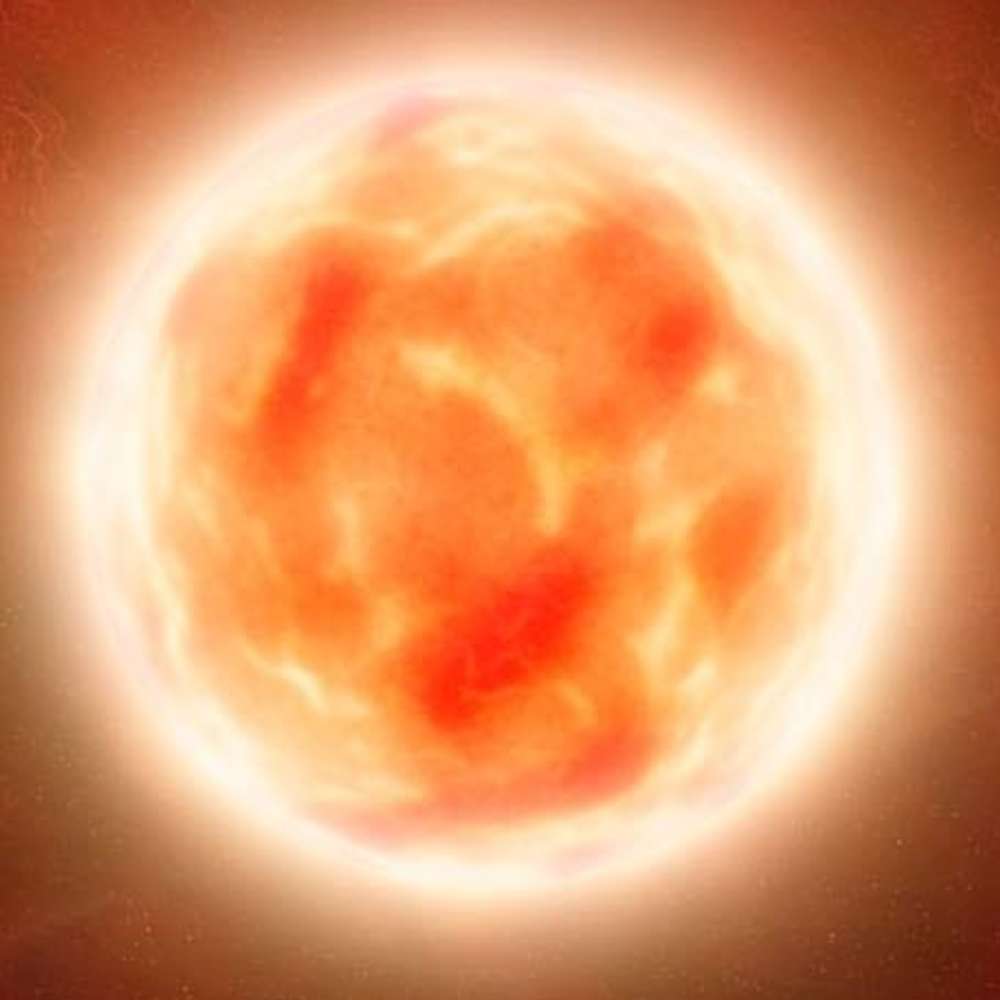
A Colossal Red Supergiant
Betelgeuse is one of the largest stars known that we can actually observe directly. While its size fluctuates due to pulsations and atmospheric instability, most measurements place its radius between:
900 and 1,000 solar radii
This vast size, combined with a low surface temperature (~3,500 K), gives Betelgeuse its deep red-orange hue.
Luminosity and Temperature
Betelgeuse is:
~100,000 times more luminous than the Sun
Considerably cooler, leading to a red spectral appearance
A powerful infrared emitter due to its extended atmosphere and dust production
Its brightness variability is driven by:
Pulsations
Massive convection cells
Surface waves
Temperature shifts
Occasional dust production events
Mass and Age
Betelgeuse began its life as a massive blue-white star around:
~15–20 solar masses
It evolved quickly due to its immense mass and is now approximately:
8–10 million years old
Massive stars live fast and die young, making Betelgeuse a prime supernova candidate.
Betelgeuse’s Atmosphere – A Turbulent Outer Shell
Betelgeuse’s atmosphere is not smooth or uniform. Instead, it is characterized by violent convection and enormous granules.
Giant Convection Cells
Unlike the Sun, whose convection cells are small and numerous, Betelgeuse’s surface is dominated by only a few:
Gigantic convection cells
Each potentially comparable to our entire Solar System in scale
These supercells:
Transport heat from deep inside
Cause surface brightness variations
Contribute to unpredictable photometric changes
Stellar Winds and Mass Loss
Betelgeuse is shedding enormous amounts of mass. Its stellar wind forms:
Multiple shells of dust and gas
A bow shock as it moves through the interstellar medium
A complex circumstellar envelope detectable in infrared
This mass loss is a precursor to its eventual supernova.
The Great Dimming Event (2019–2020)
During this period, Betelgeuse faded by nearly 60 percent. The cause was a combination of:
A surface cooling event
A convection-driven outburst
Formation of a dust cloud that temporarily obscured part of the star
The event became a global astronomical phenomenon and demonstrated how dynamic and fragile red supergiants truly are.
Betelgeuse’s Position in the Orion Constellation
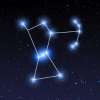
Betelgeuse sits prominently at the upper-left corner of the constellation Orion, making it one of the most recognizable stars in the night sky.
A Cornerstone of Winter Skies
In many cultures, Betelgeuse and Orion have been markers of:
Seasonal change
Navigation
Mythological symbolism
Its bright red glow contrasts strongly with the blue-white brilliance of Rigel, Orion’s opposite foot.
Motion Through Space
Betelgeuse is a runaway star, moving at high velocity:
Away from the Orion OB association
Creating a bow shock as it plows through interstellar gas
This rapid movement supports models that Betelgeuse may have been ejected after gravitational interactions or a past companion’s supernova.
Betelgeuse’s Evolution Toward Supernova
Betelgeuse is nearing the end of its nuclear-burning lifecycle. It has already exhausted most of its hydrogen and helium and is now fusing heavier elements in successive shells.
What Stage Is Betelgeuse In?
Current models indicate that Betelgeuse is:
Fusing helium into carbon
Possibly starting carbon fusion
Experiencing rapid structural changes
The star is unstable, and these stages can lead to:
Pulsational instability
Enhanced mass loss
Increasing luminosity variability
When Will Betelgeuse Explode?
The star is expected to explode as a Type II supernova, but predictions range from:
Tomorrow
To 100,000 years from now
Astronomically, that is “imminent,” but for humans it remains unpredictable.
What Will the Supernova Look Like?
When it occurs:
Betelgeuse will glow as bright as the half-moon
May even be visible during the day
Will outshine the rest of Orion
Will be visible for months or years
Will eventually fade into a supernova remnant
Earth will not be harmed, as Betelgeuse is too far away for the explosion to pose any danger.
The Cooling Process of a White Dwarf
Van Maanen’s Star is a textbook example of how white dwarfs cool over time. After a star becomes a white dwarf, it no longer produces energy through nuclear fusion. Instead, it radiates away stored thermal energy from its earlier evolutionary phases.
In the case of Van Maanen’s Star:
Its current temperature of ~6,200 K
Its low luminosity (~0.00017 L☉)
Its cooling age of around 3 billion years
…indicate that it has spent a long time fading from its much hotter origin. Newly formed white dwarfs begin at temperatures above 100,000 K, then cool steadily over billions of years. Van Maanen’s Star is already well along this cooling pathway.
Ultimately, in trillions of years, it will cool so much that it becomes a black dwarf—a hypothetical stage that has not yet occurred anywhere in the universe because the universe is not old enough.
Internal Structure of Betelgeuse – A Star in Its Final Phases
Betelgeuse’s internal structure reflects a massive star in the late stages of stellar evolution. Unlike main-sequence stars such as the Sun, Betelgeuse is burning heavier elements in multiple shells, creating a layered interior similar to an onion.
Shell Burning – The Multi-Layered Fusion Engine
Inside Betelgeuse, fusion occurs in concentric shells:
Core: Fusing helium and possibly beginning carbon fusion
Inner Shell: Hydrogen shell burning around the core
Outer Shells: Partial helium shells
Extended Envelope: Extremely large, convective, and loosely bound
The star’s enormous size is due to:
The expansion of outer layers
Heat from shell burning
Decreasing gravitational binding
These processes cause instability and strong variability.
An Unstable Fusion Cycle
As Betelgeuse fuses heavier elements:
Each new fusion stage becomes shorter
Instability increases
Core structure becomes increasingly layered and fragile
Massive stars like Betelgeuse evolve rapidly:
Hydrogen burning: millions of years
Helium burning: hundreds of thousands of years
Carbon burning: hundreds of years
Neon/oxygen burning: months
Silicon burning: days
Betelgeuse is likely in the helium-burning or early carbon-burning stage, meaning the star still has time before collapse.
Why Red Supergiants Are So Unstable
Betelgeuse’s instability arises from several physical processes that dominate its outer envelope and core.
Enormous Convection Cells
Betelgeuse’s surface is not smooth. Instead, it contains:
A small number of super-sized convection cells
Each spanning a significant portion of the star’s radius
Rising and falling hot plasma
Dramatic temperature variations
These convection cells create:
Bright and dark patches
Photometric variability
Irregular dimming
Shock waves in the outer atmosphere
Their chaotic behavior is one of the most important contributors to Betelgeuse’s variability.
Pulsation and Radial Expansion
Betelgeuse is a semi-regular variable star, meaning:
It expands and contracts
Its diameter changes
Its brightness fluctuates in cycles of ~400 days and ~1,800 days
These pulsations can lead to:
Cooling events
Outbursts
Dust condensation
Increasing mass loss
Mass Loss and the Circumstellar Environment
Betelgeuse is shedding mass at an enormous rate, creating a complex environment of dust, gas, and shock fronts surrounding the star.
Stellar Wind Strength
Betelgeuse’s stellar wind is:
Thousands of times stronger than the Sun’s wind
Capable of ejecting Earth-mass quantities of gas over centuries
Creating extended shells and arcs of material
Bow Shock
As Betelgeuse moves rapidly through interstellar space (~30 km/s), it creates a bow shock:
A curved arc of compressed gas and dust
Visible in infrared images
A sign of high-speed motion and intense wind pressure
This bow shock helps scientists estimate Betelgeuse’s mass-loss rate and age.
Dust Formation
Betelgeuse ejects huge masses of dust that eventually:
Form shells several light-years across
Obscure parts of the star
Influence brightness measurements
The 2019–2020 Great Dimming incident was caused partly by a dust cloud formed by one of these massive ejections.c
Betelgeuse and the Path to Supernova
Betelgeuse will eventually explode as a core-collapse (Type II) supernova. Understanding the path to that explosion provides insight into the star’s current behavior.
The Final Fusion Stages
Once carbon fusion is complete, Betelgeuse will burn:
Neon
Oxygen
Silicon
Each stage grows shorter, preparing the star for collapse. Silicon fusion produces iron in the core. Since iron cannot release energy through fusion:
The core becomes unstable
It collapses under its own gravity
A neutron star or black hole forms almost instantly
The outer layers rebound in a powerful shockwave, causing the supernova.
What Will Remain After the Explosion?
Betelgeuse will leave behind:
Most likely a neutron star (if mass < ~20 solar masses)
A supernova remnant expanding for thousands of years
Possibly a compact black hole (if mass > ~20 solar masses)
Betelgeuse’s mass estimates place it near the border between neutron star and black hole formation.
Comparison with Other Famous Red Supergiants
Betelgeuse is part of a rare category of massive, dying stars. Comparing it to other well-known red supergiants highlights its significance.
Betelgeuse vs. Antares (Alpha Scorpii)
| Attribute | Betelgeuse | Antares |
|---|---|---|
| Spectral Type | M1–M2 Ia–ab | M1.5 Iab |
| Distance | ~548 ly | ~550 ly |
| Mass | ~15–20 M☉ | ~12–15 M☉ |
| Temperature | ~3,500 K | ~3,400 K |
| Size | ~900–1,000 R☉ | ~700–800 R☉ |
Both stars are supergiants nearing the ends of their lives, but Betelgeuse is larger and more variable.
Betelgeuse vs. Mu Cephei (The Garnet Star)
- Cooler
- Redder
- Possibly larger
- Much farther away
Betelgeuse is brighter and more easily studied due to proximity.
Betelgeuse vs. VY Canis Majoris
- One of the largest known stars
- A hypergiant
- Far more massive
Betelgeuse is still much more important observationally because of its closeness to Earth.
Betelgeuse’s Movement Through Space
Betelgeuse is a runaway star, likely ejected from its birthplace.
Possible Origin Story
Betelgeuse may have been:
Part of a larger multiple-star system
Ejected after gravitational interactions
Given high velocity by the supernova of a former companion
Its current trajectory carries it away from the Orion OB1 association.
The Bow Shock as Evidence
Infrared images reveal:
A curved arc of shock-heated gas ahead of Betelgeuse
Material stripped by stellar winds
A past history of strong mass loss
This bow shock confirms Betelgeuse’s rapid space motion.
What Will Happen When Betelgeuse Goes Supernova?
Betelgeuse’s future supernova is one of the most anticipated astronomical events. Although it could happen tomorrow or tens of thousands of years from now, astronomers understand well what the explosion will look like.
Visibility from Earth
When Betelgeuse explodes:
It will shine as bright as the half-moon.
It may even be visible in daylight for weeks.
For several months, it will dominate the night sky.
The constellation Orion will appear dramatically altered.
Despite the brightness, Betelgeuse is far enough away to pose no danger to Earth.
Timeline of the Explosion
Core Collapse
When the iron core exceeds its limit, it collapses in less than a second.Shockwave and Rebound
The rebound creates a powerful shockwave that blows the outer layers into space.Neutrino Burst
A massive neutrino burst reaches Earth hours before the visible explosion.Optical Peak
The visible supernova brightens rapidly and reaches peak brightness in days.Afterglow
It gradually fades over months and years, leaving a stunning supernova remnant.
Remnant Object
Depending on the final mass of Betelgeuse’s core, it will form either:
A neutron star
Or potentially a stellar-mass black hole
Current models favor a neutron star outcome.
Will Betelgeuse’s Supernova Affect Earth?
Betelgeuse is approximately 548 light-years away—far beyond the danger zone for harmful radiation.
Why Earth Is Safe
Harmful gamma rays weaken with distance.
The critical danger distance is within ~30 light-years.
Betelgeuse is nearly 20 times farther than required for risk.
Earth will witness a spectacular celestial event, but not a dangerous one.
What Earth may experience:
Increased night-sky brightness
A visible supernova remnant for centuries
An exciting neutrino detection event for observatories
What Earth will not experience:
Ozone depletion
Surface radiation
Climate impact
Betelgeuse is spectacular, not hazardous.
Observing Betelgeuse from Earth
Betelgeuse is one of the easiest and most rewarding stars to observe, even for beginners.
Naked-Eye Observation
Betelgeuse appears:
Bright red-orange
As Orion’s right shoulder
Very different from the blue-white Rigel on Orion’s opposite side
Because Betelgeuse is variable, you may notice brightness changes from season to season.
Binocular Viewing
With binoculars:
The star’s warm color becomes more vivid.
Betelgeuse contrasts beautifully with nearby Orion stars.
Good binoculars help locate faint stars in Orion’s belt and sword as well.
Small Telescopes
Even small telescopes cannot resolve Betelgeuse’s surface because stars appear point-like, but:
You can study its color more precisely.
You can observe surrounding star fields in Orion.
Telescopes reveal the nebulae near Orion’s belt (indirectly tied to the region where Betelgeuse originated).
Betelgeuse is also a calibration target for testing light sensitivity and color filters.
Astrophotography
Astrophotographers use Betelgeuse for:
Color balancing (its red hue is a helpful reference)
Wide-field Orion constellation imaging
Timelapse sequences showing variable brightness
Although the star saturates quickly in long exposures, it is an excellent anchor point for astrophotographic compositions.
Frequently Asked Questions (FAQ)
Why does Betelgeuse look red?
Because its surface temperature is low (~3,500 K), causing it to emit more red and infrared light.
Is Betelgeuse larger than the Sun?
Enormously larger. Its radius is about:
900–1,000 times the Sun’s radius
If placed at the center of the Solar System, it would engulf:
Mercury
Venus
Earth
Mars
And possibly Jupiter
Why is Betelgeuse unstable?
Due to:
Advanced fusion stages
Large convection cells
Pulsation cycles
Intense mass loss
These make the star’s brightness highly variable.
What caused the Great Dimming?
A combination of:
A large convection-driven outburst
Local cooling on the stellar surface
Dust formation that temporarily blocked light
It was not a sign of imminent supernova.
Could Betelgeuse go supernova soon?
Astronomically, yes—it’s in the final stages.
Humanly, probably not.
The explosion could occur anytime between now and the next 100,000 years.
Will a supernova destroy Orion?
It will dramatically change Orion’s appearance.
Betelgeuse will vanish, leaving a temporary supernova glow and a long-lasting remnant.
Final Scientific Overview
Betelgeuse stands as one of the most extraordinary stars in the sky—a swollen, trembling red supergiant nearing the end of its existence. Its colossal size, extreme variability, and rapid mass loss make it an unparalleled laboratory for studying late-stage stellar evolution.
Key qualities:
One of the largest and brightest stars visible from Earth
A runaway star with a dramatic bow shock
A star with a complex, turbulent atmosphere
A future supernova, likely leaving behind a neutron star
A vital target for modern astrophysics, interferometry, and infrared studies
From its origin in the Orion OB association to its destiny as a brilliant supernova, Betelgeuse continues to shape our understanding of massive stars and cosmic evolution.