








Alpha Centauri A
The Sunlike Primary of the Nearest Star System
Quick Reader
| Attribute | Details |
|---|---|
| Name | Alpha Centauri A |
| Other Designations | Rigil Kentaurus, α Cen A, HD 128620 |
| Star Type | Main-sequence (solar-type) |
| Spectral Class | G2 V |
| Constellation | Centaurus |
| Distance from Earth | ~4.37 light-years |
| Mass | ~1.10 M☉ |
| Radius | ~1.22 R☉ |
| Luminosity | ~1.52 L☉ |
| Temperature | ~5,790 K |
| Metallicity | Slightly above solar |
| Companions | Alpha Centauri B, Proxima Centauri |
| Notable Features | Closest Sunlike star, stable habitable zone, high metallicity |
| Best Viewing Months | April to July (Southern Hemisphere) |
Introduction – Our Nearest Sunlike Neighbor
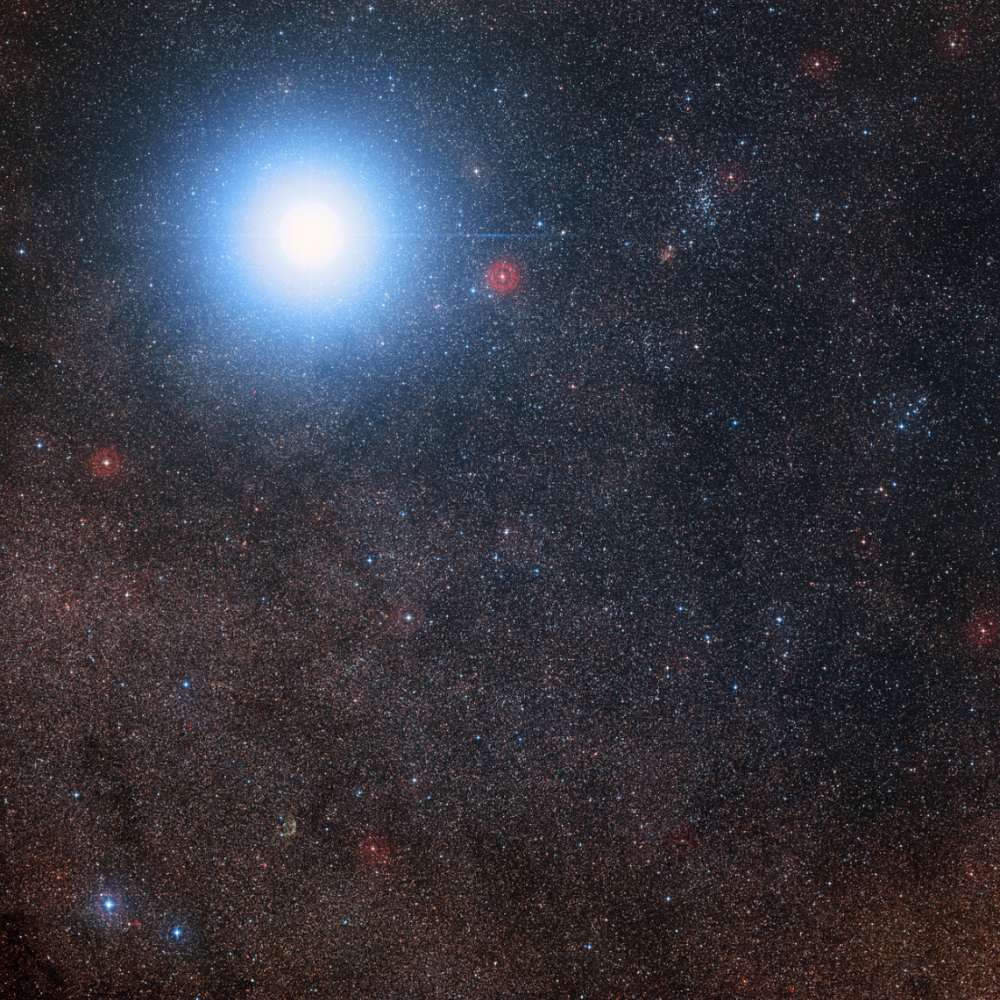
Alpha Centauri A is the primary star of the closest star system to Earth, only 4.37 light-years away. It forms a tight binary with Alpha Centauri B, and a wide, distant association with Proxima Centauri.
Among all stars in the galaxy, Alpha Centauri A is the most similar to our Sun in:
Temperature
Composition
Luminosity
Magnetic behavior
Because of its proximity, Alpha Centauri A is the best candidate for discovering Earth-like planets outside our Solar System. Its brightness and stability allow extremely precise measurements of stellar activity, motion, and potential planetary signatures.
It is, in many ways, our nearest stellar mirror.
Physical Characteristics – A Close Match to the Sun
Alpha Centauri A is classified as G2 V, exactly the same spectral type as our Sun, but with slightly higher:
Mass
Radius
Brightness
Key properties:
Temperature: ~5,790 K
Color: Yellow-white
Luminosity: ~1.52× the Sun
Density: Slightly lower than the Sun
Age: ~5.0–6.0 billion years (slightly older than the Sun)
Because of its higher mass, Alpha Centauri A burns hydrogen somewhat faster and will leave the main sequence earlier than the Sun—but still billions of years from now.
Magnetic Activity – A Calm, Predictable Stellar Environment
Alpha Centauri A exhibits:
Regular starspot cycles
Mild chromospheric activity
Even lower flare frequency than the Sun
Stable radiation output
These characteristics provide an environment ideal for long-term planetary stability and habitability.
Its activity level resembles:
A slightly older, calmer Sun
Lower ultraviolet spikes
gentler oscillations in luminosity
This is one reason why astronomers consider Alpha Centauri A a prime environment for an Earth-like planet.
The Alpha Centauri AB Binary System – Gravitational Harmony
Alpha Centauri A and B orbit each other with:
A period of ~79.9 years
A separation varying from 11 AU to 35 AU
A stable gravitational relationship
Effects on planetary stability
Planets can survive around each star individually as long as they orbit:
Within ~3 AU of the host star
Well inside the gravitational stability limit
For Alpha Centauri A, the habitable zone lies between 1.2 and 1.8 AU, comfortably inside the stable region.
Thus, Alpha Centauri A could host:
Earth-like planets
Super-Earths
Possibly multiple inner rocky worlds
All without significant orbital disruption from Alpha Centauri B.
Potential for Earthlike Planets – The Best Candidate in the Sky
Because Alpha Centauri A is so similar to the Sun, its habitable zone would allow climates nearly identical to Earth’s.
Habitable Zone Range:
1.2 AU – 1.8 AU
Within this region, an Earth-like planet would experience:
Mild sunlight
Stable temperatures
Predictable climate cycles
Safe levels of UV radiation
Alpha Centauri A is one of the most promising stars for:
Atmospheric spectroscopy
Direct imaging
Future interstellar missions
Biosignature detection
If an Earth-like world exists anywhere nearby, this is the place astronomers expect to find it.
Why It Is So Important in Exoplanet Research
Alpha Centauri A allows:
Ultra-precise radial velocity monitoring
High-resolution imaging due to its brightness
Direct comparison with the Sun
Calibration of stellar and planetary models
Tests of habitable zone climate physics
Searches for biosignatures within a reachable distance
For these reasons, Alpha Centauri A is at the center of multiple current and upcoming exoplanet projects.
Interior Structure – A Sunlike Engine Operating at Higher Power
Alpha Centauri A shares the same internal architecture as the Sun:
A hydrogen-fusing core
A radiative zone transporting energy outward
A convective outer layer driving starspots and magnetic cycles
But because it is slightly more massive, the internal pressures and temperatures are higher, producing:
Faster fusion rates
Higher luminosity
Slightly shorter main-sequence lifespan
Models place its age between 5–6 billion years, meaning Alpha Centauri A is just entering a quieter, more stable phase of its life.
Magnetic Cycles – A Gentler, Older Sun
Alpha Centauri A undergoes magnetic cycles similar to the Sun’s 11-year cycle, but with:
Lower flare frequency
More stable irradiance
Smaller starspots
Reduced high-energy output
These patterns make Alpha Centauri A an excellent host for life-supporting environments, as extreme magnetic storms are rare.
Its measured X-ray output is lower than the Sun’s, reinforcing its status as a calm and predictable main-sequence star.
Habitability in Detail – Climate and Light Similar to Earth
The habitable zone of Alpha Centauri A lies between 1.2 and 1.8 AU, where an Earth-like planet would receive a climate very similar to our own.
Benefits of an Earth-like orbit here:
Regular day–night cycles
No tidal locking
Mild UV environment
Stable annual seasons
Long-term orbital stability
Climate models show that even small variations in atmospheric composition would yield temperatures compatible with liquid water.
If a rocky planet exists here, it would likely have:
Earthlike atmospheric retention
A magnetosphere capable of shielding life
Solar energy input suitable for photosynthesis-like processes
This makes Alpha Centauri A one of the most compelling targets in the search for life.
The Challenge of Detecting Planets Around Alpha Centauri A
Despite being the closest Sunlike star, no planet has yet been confirmed around Alpha Centauri A.
Reasons why detection is difficult:
The star is bright, producing noise in radial velocity measurements
The presence of Alpha Centauri B introduces subtle dynamical influences
Precision required is extremely high (centimeter-per-second sensitivity)
Past planet claims have been retracted due to noise modeling issues
But the situation is changing
Modern instruments—such as ESPRESSO, HARPS, NEID, and the upcoming ELT—can achieve unprecedented sensitivity, making small, Earth-size planets detectable.
Several missions are now dedicated specifically to this star.
Dedicated Exoplanet Missions Targeting Alpha Centauri A
TOLIMAN Mission
A space telescope designed exclusively to:
Measure tiny stellar wobbles
Detect Earth-mass planets around Alpha Centauri A and B
Use advanced diffractive optics for extreme precision
Breakthrough Watch
A project aiming to directly image planets around Alpha Centauri using:
Custom coronagraphs
Thermal infrared imaging
High contrast imaging near 10 microns
JWST Prospects
The James Webb Space Telescope may detect:
Warm dust
Planetary signatures in thermal bands
Variability associated with exoplanets
Alpha Centauri A is one of JWST’s most promising nearby targets.
Binary Dynamics – Why the System Remains Stable for Planet Formation
Although Alpha Centauri A and B orbit each other, their wide, 80-year orbit allows:
Stable inner systems up to ~3 AU
Long-term gravitational equilibrium
No catastrophic perturbations of habitable-zone orbits
Simulations show that Earthlike planets in the habitable zone of Alpha Centauri A would remain stable for billions of years.
This is a key reason the system continues to be at the center of interstellar science discussions.
Comparative View – A, B, and the Sun
| Property | Alpha Centauri A | Alpha Centauri B | Sun |
|---|---|---|---|
| Spectral Type | G2 V | K1 V | G2 V |
| Temperature | ~5,790 K | ~5,260 K | ~5,778 K |
| Mass | 1.10 M☉ | 0.91 M☉ | 1.00 M☉ |
| Luminosity | 1.52 L☉ | 0.50 L☉ | 1.00 L☉ |
| Activity Level | Low | Very low | Moderate |
| Habitable Zone | 1.2–1.8 AU | 0.5–0.9 AU | 0.95–1.4 AU |
Alpha Centauri A is the closest known near-solar twin, while B is a cooler, quieter K-dwarf.
Long-Term Evolution – The Future of Our Nearest Sunlike Star
Alpha Centauri A is slightly older and more massive than the Sun, meaning it evolves faster along the main sequence.
Over the next several billion years:
Gradual Brightening
It will slowly increase in luminosity.
Habitable zones will shift outward, just as in the Sun’s future.
End of Main Sequence
After ~6–7 billion more years, it will exhaust hydrogen in its core.
It will expand into a red giant similar to what the Sun will become.
Outer Layers Shed
It will release material into space, enriching the surrounding region.
Final State
It will become a white dwarf, cooling for trillions of years.
Alpha Centauri A’s evolution offers a direct comparison to what awaits our own Sun.
Scientific Importance – A Benchmark for Stellar and Planetary Studies
Because Alpha Centauri A is so similar to the Sun yet slightly more massive and older, it serves as a critical reference point.
What scientists learn from this star:
Predictive models for the Sun’s future
Fine calibration of stellar evolution tracks
Behavior of G-type stars in binary environments
Stability of habitable zones around Sunlike stars
Influence of companion stars on planet formation
Alpha Centauri A is one of the most thoroughly studied stars outside the Solar System for these reasons.
The Quest for Earthlike Planets Around Alpha Centauri A
Detecting an Earth-like planet around Alpha Centauri A is a top global priority because:
Its proximity allows high-resolution measurements
Its brightness enables atmospheric spectroscopy
Any discovered planet could be visited by future probes
It offers the only realistic interstellar exploration target within our lifetime
What would such a planet look like?
If located at ~1.3–1.5 AU, an Earth-sized planet would:
Have a solar-like day/night cycle
Maintain moderate temperatures
Receive ~10–20% more starlight than Earth
Potentially support liquid water and stable climates
Discovering such a planet would revolutionize astronomy and planetary science.
Interstellar Exploration – Humanity’s First Destination
Alpha Centauri A is one of the prime candidates for humanity’s first interstellar mission.
Breakthrough Starshot
Proposes sending gram-scale probes at ~20% the speed of light to:
Capture images of planets
Measure atmospheres
Analyze biosignatures
Map surface features
Send data back within decades
Because Alpha Centauri A is so close, even small steps in propulsion technology could make interstellar travel feasible.
Frequently Asked Questions (FAQ)
Why is Alpha Centauri A considered the most important Sunlike star?
Because it is the closest Sunlike star and nearly identical in temperature, structure, and composition.
Why haven’t we found planets around it yet?
The required radial velocity precision is extremely high, but new instruments are improving detection limits rapidly.
Could there be Earth-sized planets in the habitable zone?
Yes. Simulations strongly support the stability of such orbits.
Is Alpha Centauri A dangerous for life?
No. It has a stable, calm magnetic environment with predictable radiation.
Will Alpha Centauri A and B ever collide?
No. Their orbit is stable and well-separated.
Comparison of All Three Stars in the Alpha Centauri System
| Property | Alpha Cen A | Alpha Cen B | Proxima Cen |
|---|---|---|---|
| Type | G2 V | K1 V | M5.5 V |
| Temperature | ~5,790 K | ~5,260 K | ~3,050 K |
| Luminosity | 1.52 L☉ | 0.50 L☉ | 0.0017 L☉ |
| Activity Level | Low | Very low | High |
| Known Planets | None confirmed | None confirmed | Multiple (Proxima b, c, d) |
Alpha Centauri A occupies the sweet spot: bright enough, calm enough, and stable enough to host a world very much like Earth.
Final Thoughts
Alpha Centauri A is the most compelling nearby Sunlike star and remains at the center of humanity’s search for another Earth. Its:
Proximity
Solar resemblance
Stable habitable zone
High metallicity
Potential for Earthlike planets
Role in interstellar mission planning
make it one of the most scientifically significant stars in the galaxy.
As observation technology progresses, Alpha Centauri A may soon become the first place where humanity discovers a world that truly resembles our own.