








Amor
The Near-Earth Objects That Almost Cross Earth’s
Quick Reader
| Attribute | Details |
|---|---|
| Object Type | Near-Earth asteroids (NEAs) |
| Primary Classification | Amor group |
| Orbital Relation to Earth | Approach Earth’s orbit but do not cross it |
| Perihelion Distance | Between ~1.017 AU and ~1.3 AU |
| Discovery Era | Early 20th century (classification formalized later) |
| Typical Size Range | Tens of meters to tens of kilometers |
| Largest Known Members | 1036 Ganymed, 433 Eros |
| Orbital Period | ~1 to 5 Earth years (varies widely) |
| Composition | S-type, C-type, some M-type |
| Impact Risk | Low (indirect, long-term) |
| Scientific Role | Transitional population between main belt and Earth-crossers |
| Exploration Relevance | Key targets for missions and planetary defense studies |
Key Highlights
- Amor asteroids approach Earth closely but do not currently cross its orbit
- Represent a dynamical transition zone among near-Earth objects
- Often evolve into Earth-crossing asteroids over time
- Include some of the largest known near-Earth asteroids
- Critical for understanding long-term impact risk and orbital evolution
Introduction – The Near-Earth Objects That Stop Just Short
Not all near-Earth asteroids are immediate threats.
Some come close to Earth’s orbit, feel its gravitational pull, and then drift away again—never quite crossing the line. These objects belong to the Amor asteroid group.
Amor asteroids occupy a delicate orbital boundary.
They are near-Earth, but not Earth-crossing.
They are stable, but not permanent.
In planetary dynamics, Amors represent a waiting room—a population that can remain benign for millions of years or eventually evolve into something far more dangerous.
What Are Amor Asteroids?
Amor asteroids are a subclass of near-Earth asteroids (NEAs) defined by their orbital geometry.
Their defining characteristic:
Their orbits approach Earth’s orbital distance
But their closest point to the Sun (perihelion) stays outside Earth’s orbit
In technical terms:
Perihelion distance is greater than Earth’s aphelion
They do not currently cross Earth’s path
This places them between:
Apollo asteroids (Earth-crossers)
Main Belt asteroids (farther away, more stable)
Amors sit exactly at the threshold of planetary interaction.
Why Are They Called “Amor” Asteroids?
The group is named after asteroid 1221 Amor, one of the early discovered members.
By convention:
Near-Earth asteroid groups are named after representative objects
Amor became the prototype for this orbital class
The name itself does not imply danger or romance—it simply marks a dynamical category.
Orbital Geometry – Close, But Not Crossing
The orbit of an Amor asteroid is shaped by competing gravitational influences.
Key orbital traits include:
Perihelion just beyond Earth’s orbit
Semi-major axes often extending into the inner asteroid belt
Moderate to high orbital eccentricity
Inclinations ranging from low to extreme
Because of this geometry:
Amors experience frequent gravitational nudges
Small changes can shift them into Earth-crossing orbits
Long-term evolution is chaotic but predictable statistically
They are near misses in slow motion.
How Do Amor Asteroids Form?
Amor asteroids do not form near Earth.
They originate primarily from:
The inner main asteroid belt
Regions destabilized by Jupiter’s resonances
Gradual orbital diffusion over millions of years
Key processes include:
Collisions within the main belt
Resonant interactions with Jupiter and Saturn
Slow inward orbital drift
Over time, these processes inject asteroids into near-Earth space, where some settle temporarily into Amor-type orbits.
Amors as a Transitional Population
Amor asteroids are not an endpoint.
They are part of a dynamical conveyor belt.
Typical evolutionary path:
Main Belt → Amor → Apollo / Aten → Earth encounter or ejection
This makes Amors:
A reservoir of future Earth-crossing asteroids
A statistically important group for impact modeling
A population that bridges stable and hazardous orbits
Understanding Amors helps scientists predict future risks, not just present ones.
Physical Characteristics – Not All the Same
Amor asteroids are physically diverse.
They include:
Rocky S-type bodies
Carbon-rich C-type objects
Metallic or mixed compositions
Some are:
Irregular rubble piles
Others are relatively solid monolithic bodies
This diversity reflects their varied origins within the asteroid belt.
Famous Amor Asteroids
Several historically important asteroids belong to the Amor group.
Notable examples:
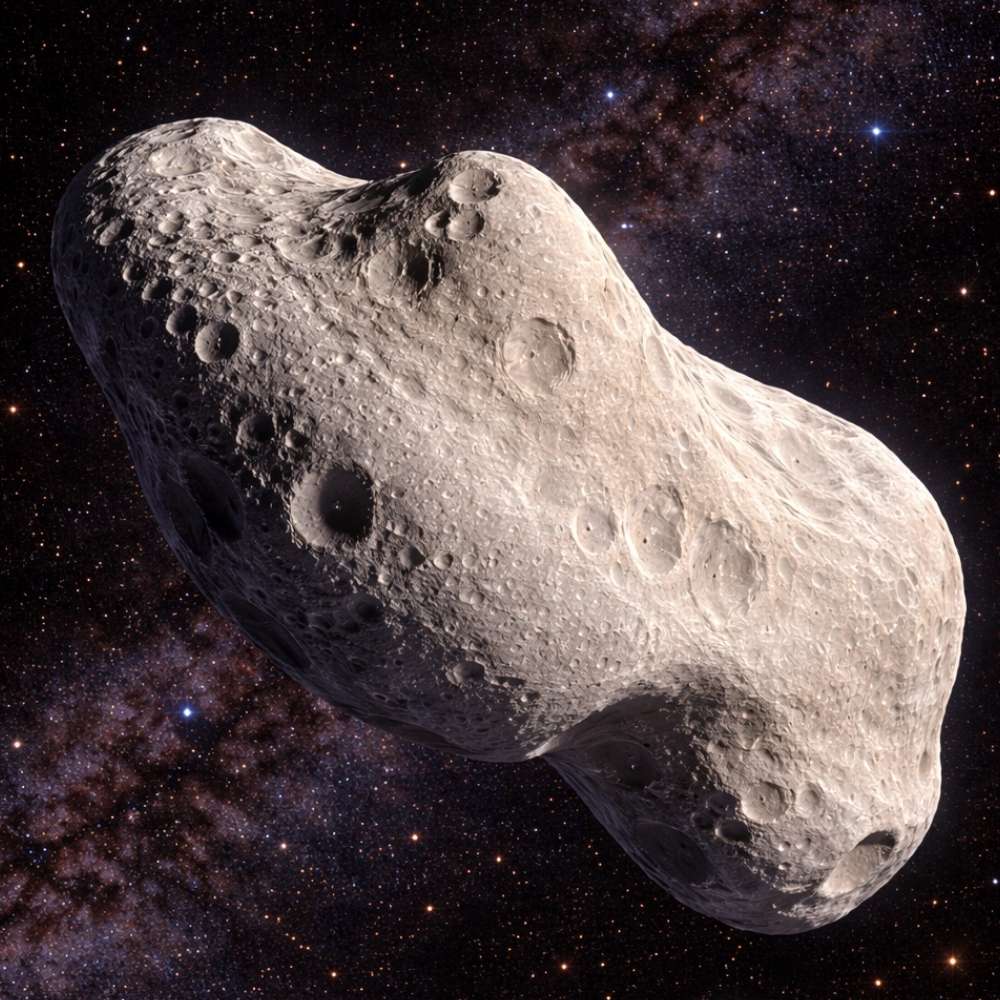
433 Eros – visited by NASA’s NEAR Shoemaker mission
1036 Ganymed – largest known near-Earth asteroid
1221 Amor – the group’s namesake
These objects helped shape early understanding of near-Earth asteroid dynamics.
Why Amor Asteroids Matter
Amor asteroids matter because they represent potential future threats, not immediate ones.
They help scientists:
Model long-term orbital evolution
Understand how Earth-crossers are supplied
Refine planetary defense strategies
Select safe mission targets
They are warning signs written in orbital mechanics, not alarms.
Amor vs Apollo vs Aten – Understanding Near-Earth Asteroid Classes
Near-Earth asteroids are divided by how their orbits relate to Earth’s orbit, not by size or composition.
Amor asteroids occupy a very specific—and revealing—position in this system.
Comparison of Near-Earth Asteroid Groups
| Feature | Amor Asteroids | Apollo Asteroids | Aten Asteroids |
|---|---|---|---|
| Earth Orbit Crossing | No | Yes | Yes |
| Perihelion Distance | Outside Earth’s orbit | Inside Earth’s orbit | Inside Earth’s orbit |
| Semi-Major Axis | Usually > 1 AU | > 1 AU | < 1 AU |
| Typical Risk Level | Low (current) | Moderate to high | Moderate |
| Orbital Stability | Relatively longer-lived | Chaotic | Highly chaotic |
| Evolutionary Role | Transitional reservoir | Active impactors | Inner-system crossers |
This table shows why Amors are unique: they are near-Earth without being Earth-threatening—yet.
Why Amor Asteroids Dominate the Large NEA Population
One striking pattern in near-Earth asteroid surveys is that many of the largest NEAs are Amors.
This is not a coincidence.
Key reasons include:
Earth-crossing orbits are dynamically unstable
Large bodies survive longer in safer orbits
Amors avoid frequent close encounters with Earth
Their lifetimes are statistically longer
As a result, large NEAs often accumulate temporarily in Amor-type orbits before transitioning inward.
Amors are the holding zone for big objects.
Orbital Evolution – How Amors Become Earth-Crossers
Amor orbits are not fixed.
Over time, they evolve through:
Gravitational encounters with Mars
Secular resonances with Jupiter and Saturn
Long-term chaotic diffusion
Small orbital changes can:
Reduce perihelion distance
Shift an Amor into an Apollo orbit
Turn a non-crosser into a crosser
This process occurs over:
Tens of thousands to millions of years
With no single trigger event
But predictable statistical behavior
Amors are future risk, not present danger.
Impact Probability – Why Amors Still Matter
Although Amors do not currently cross Earth’s orbit, they still matter for planetary defense.
Why?
Because:
Many Earth-crossers originate as Amors
Large Amors represent stored kinetic energy
Long-term models must include them
Planetary defense is not just about tracking today’s threats—it is about understanding tomorrow’s supply chain of impactors.
Amors are part of that chain.
Mission Targets – Why Amors Are Attractive
Amor asteroids are excellent candidates for exploration.
Advantages include:
Predictable, relatively stable orbits
Lower delta-v requirements than main belt targets
Reduced radiation and thermal extremes
Lower immediate hazard
This is why missions like NEAR Shoemaker targeted an Amor asteroid (433 Eros).
Amors allow deep scientific return without extreme mission risk.
Surface Properties and Space Weathering
Because Amors spend time closer to the Sun than main-belt asteroids, their surfaces experience:
Stronger solar radiation
Micrometeorite bombardment
Thermal cycling
This leads to:
Space weathering effects
Altered surface spectra
Differences between surface and interior composition
Studying Amors helps calibrate how asteroid surfaces evolve over time.
Amors and Planetary Defense Strategy
Modern planetary defense frameworks consider:
Current Earth-crossers (priority monitoring)
Potential future crossers (risk forecasting)
Amors fall into the second category.
They are tracked because:
Orbital uncertainties grow over time
Resonances can shift trajectories
Long-term predictions require population modeling
Ignoring Amors would mean ignoring the future.
Why Amor Asteroids Are Scientifically Underrated
Amors lack the drama of impact threats—but they are scientifically rich.
They provide insight into:
Orbital chaos and stability boundaries
Material transport from the asteroid belt
The supply mechanism of near-Earth objects
They are quiet, transitional, and essential.
The Long-Term Fate of Amor Asteroids
Amor asteroids are not permanent residents of their current orbits.
On cosmic timescales, their futures fall into a few broad paths:
Gradual transition into Earth-crossing Apollo or Aten orbits
Scattering back toward the main asteroid belt
Ejection from the inner Solar System
Rarely, collision with a terrestrial planet or the Sun
Statistical models show that most Amors eventually leave the Amor class, but this process unfolds over millions of years, not human timescales.
They are stable enough to study—yet dynamic enough to matter.
Why Amors Represent “Delayed Risk,” Not Immediate Threat
Amor asteroids are often misunderstood in impact discussions.
Key clarification:
Amors do not pose an immediate impact threat
Their danger lies in orbital evolution, not proximity
Because gravitational perturbations accumulate slowly, Amors function as a long-term reservoir that can replenish Earth-crossing populations even after current hazards are removed.
In planetary defense terms, Amors define the future background risk level.
Amors and the Architecture of Near-Earth Space
Near-Earth space is not random—it is structured.
Amor asteroids outline a boundary zone where:
Main-belt stability breaks down
Planetary perturbations begin to dominate
Orbital chaos increases sharply
This boundary helps scientists map:
Where asteroid orbits become unstable
How material leaks inward from the main belt
Why Earth-crossing populations persist
Amors reveal the mechanical structure of the inner Solar System.
Why Large Impactors Often Pass Through the Amor Stage
One subtle but important pattern is size.
Many of the largest near-Earth asteroids appear first as Amors.
Reason:
Large bodies survive longer in non-crossing orbits
Earth-crossing phases shorten their lifetimes
Amors act as a temporary safe harbor
This means that:
Catastrophic impactors are often “stored” as Amors long before becoming dangerous
Early detection matters more than late-stage tracking
Amors are where prevention begins, not where danger peaks.
Common Misconceptions About Amor Asteroids
“Amors are harmless”
Not exactly. They are harmless now, but dynamically important later.
“They are just main-belt asteroids”
No. Their orbits place them in a distinct gravitational regime.
“If they don’t cross Earth, they don’t matter”
Incorrect. Most Earth-crossers originate from Amor-like orbits.
Frequently Asked Questions (FAQ)
Can an Amor asteroid suddenly become dangerous?
Not suddenly. Orbital evolution is gradual, but cumulative.
Are Amor asteroids monitored by space agencies?
Yes. They are tracked as part of long-term planetary defense programs.
Is every Amor destined to become an Earth-crosser?
No. Many are ejected or stabilized elsewhere before that happens.
Why study Amors instead of only Apollo asteroids?
Because Apollos show current risk—Amors show future supply.
Amor Asteroids in the Context of Planetary Defense
Modern impact science is predictive, not reactive.
Amor asteroids play a central role because they:
Define the inflow rate of future Earth-crossers
Help calibrate long-term impact probability
Inform mitigation timelines decades to centuries ahead
Ignoring Amors would be equivalent to ignoring the source of the problem.
Final Perspective
Amor asteroids are not the villains of the Solar System.
They are the boundary keepers—objects balanced between stability and danger, between the asteroid belt and Earth’s neighborhood. Their orbits trace the invisible gravitational pathways that connect distant debris to planetary surfaces.
To understand Earth’s long-term impact risk, one must look not only at what crosses our path today—but at what almost does.
Amor asteroids show us that in celestial mechanics, the most important stories often unfold before the crossing ever happens.