










Amycus
A Violent Centaur from the Outer Solar System
Quick Reader
| Attribute | Details |
|---|---|
| Official Designation | (55576) Amycus |
| Classification | Centaur object |
| Discovery Date | 8 February 2002 |
| Discoverer | Spacewatch Project |
| Orbital Region | Between Uranus and Neptune |
| Semi-major Axis | ~24.0 AU |
| Orbital Period | ~118 Earth years |
| Eccentricity | High |
| Inclination | ~15° |
| Diameter | ~95–120 km (estimated) |
| Surface Type | Very dark, carbon-rich |
| Albedo | Extremely low |
| Activity | None observed |
| Rotation | Rapid (likely chaotic past) |
| Dynamical Stability | Low (unstable orbit) |
Introduction to Amycus – One of the Darkest Known Centaurs
Amycus is one of the darkest and most extreme Centaur objects ever observed. Unlike Centaurs that attract attention through cometary activity or rings, Amycus stands out because of its exceptionally dark surface and violent dynamical history.
It is a relic shaped not by renewal, but by repeated gravitational trauma.
Discovery and Naming
Amycus was discovered in 2002 by the Spacewatch Project, which focuses on tracking faint and fast-moving objects.
The name Amycus comes from Greek mythology:
A brutal king of the Bebryces
Known for violence and physical dominance
This mythological association mirrors Amycus’s inferred past—marked by intense collisions and gravitational encounters.
Orbital Characteristics – A Harsh Neighborhood
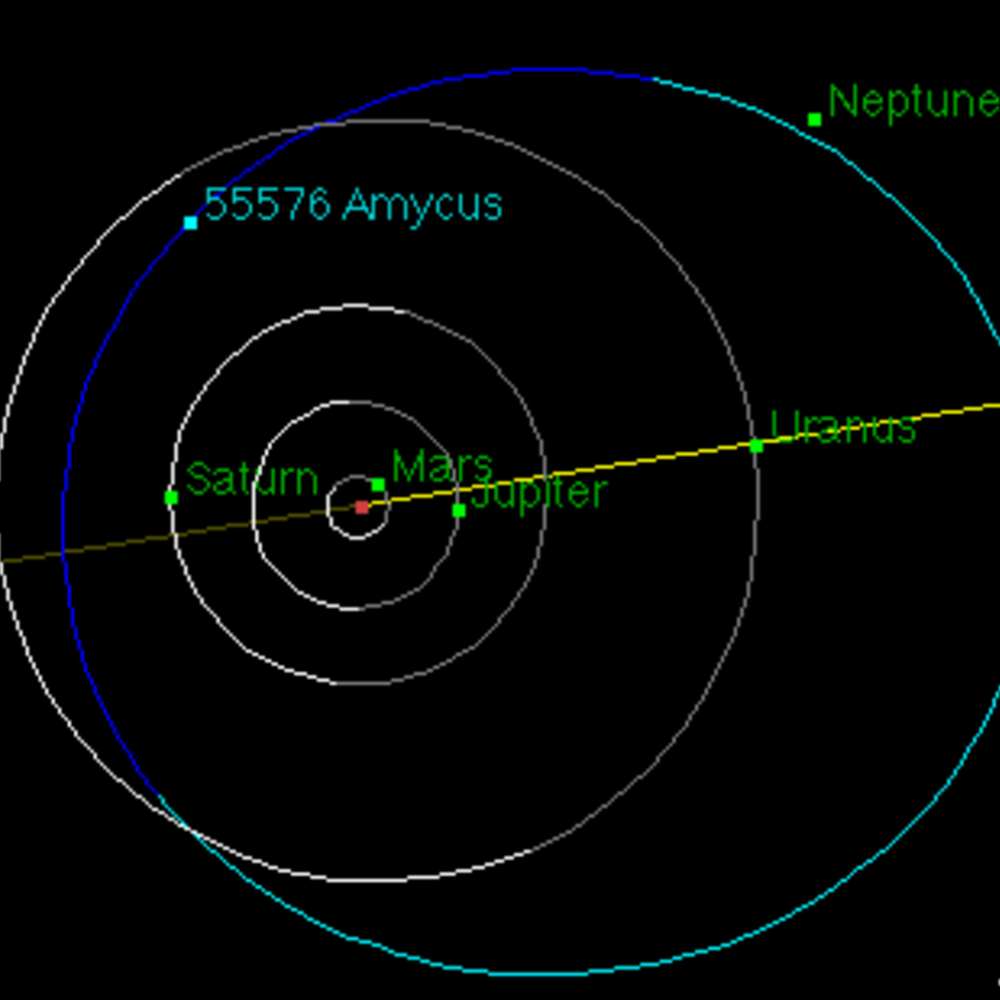
Amycus orbits the Sun in the outer Solar System, primarily between Uranus and Neptune.
Key orbital traits:
Strongly perturbed by giant planets
Not protected by long-term resonances
Highly unstable on astronomical timescales
Like most Centaurs, Amycus is a temporary visitor, not a permanent resident.
Size and Physical Nature
With an estimated diameter under 120 km, Amycus is smaller than Chiron or Chariklo, but still large enough to preserve primordial material.
Its physical traits suggest:
High porosity
Primitive, unprocessed composition
Limited internal heating history
Amycus is likely a fragment of a larger Kuiper Belt object.
One of the Darkest Objects Ever Measured
Amycus has an exceptionally low albedo, placing it among the darkest objects in the Solar System.
Implications of this darkness:
Surface rich in complex organics (tholins)
Heavy space-weathering exposure
Minimal resurfacing for billions of years
Its surface absorbs nearly all incoming sunlight.
Rotation and Surface History
Observations indicate Amycus has a rapid rotation, which may hint at:
Past collisions
Tidal interactions
Fragmentation events
Such rotation states are common among objects that have experienced violent dynamical histories.
Why Amycus Shows No Cometary Activity
Despite its Centaur classification, Amycus shows:
No coma
No tail
No detected outgassing
Possible reasons include:
Loss of near-surface volatiles
Thick insulating crust
Deeply buried ices
Amycus may represent a deactivated evolutionary state.
Amycus Compared to Other Centaurs (Initial Context)
Early comparisons suggest:
Darker than Chiron
Smaller than Chariklo
Less stable than Pholus
Amycus represents the extreme-darkness end of the Centaur population.
Why Amycus Matters in Planetary Science
Amycus is important because it:
Represents heavily processed Centaur surfaces
Shows how violent dynamics alter small bodies
Helps define the range of Centaur physical states
Preserves chemically primitive material
It reminds scientists that not all Centaurs evolve toward activity.
Why Amycus Matters (Big-Picture Context)
Amycus shows that the outer Solar System is not only a place of migration, but also of erosion. Some objects survive not by remaining unchanged, but by becoming chemically hardened and inert. Amycus represents the dark, battered survivors of planetary chaos.
Amycus vs Other Centaurs – Darkness, Size, and Behavior Compared
Amycus becomes more meaningful when compared with better-known Centaurs. This comparison highlights why Amycus is considered an extreme case.
| Feature | Amycus | Chiron | Pholus |
|---|---|---|---|
| Diameter (approx.) | 95–120 km | 200–220 km | ~185 km |
| Surface Brightness | Extremely dark | Moderately dark | Very dark |
| Cometary Activity | None | Episodic | None |
| Rings | None detected | Possible | None |
| Orbital Stability | Low | Low | Moderate |
| Scientific Role | Surface processing extreme | Transition prototype | Pristine chemistry |
Interpretation:
Amycus is not defined by activity or size, but by surface evolution under extreme conditions.
Why Amycus Is So Dark
Amycus’s darkness is one of its most striking features and is central to its scientific value.
Key contributors to its low albedo:
Long-term exposure to cosmic radiation
Accumulation of complex organic residues (tholins)
Lack of resurfacing events to expose fresh ice
Over time, these processes transform icy material into a carbon-rich, light-absorbing crust.
Space Weathering in the Outer Solar System
Amycus is an excellent example of extreme space weathering.
Processes involved:
Solar wind particle bombardment
Galactic cosmic rays
Micrometeorite impacts
Because Amycus lacks tectonics or cryovolcanism, these effects accumulate without interruption, producing one of the darkest surfaces known.
Why Amycus Remains Inactive
Despite likely containing internal ice, Amycus shows no cometary behavior.
Likely reasons include:
Volatiles buried beneath a thick crust
Insufficient heating at its current distance
Loss of near-surface ices during earlier orbital phases
Amycus represents a chemically hardened Centaur, not an active one.
Rotation and Structural Stress
Amycus’s relatively rapid rotation suggests:
Past collisions
Angular momentum transfer during close encounters
Possible internal fracturing
Fast rotation can enhance surface cracking but does not necessarily lead to activity if volatiles are inaccessible.
Amycus’s Likely Origin
Dynamical models suggest Amycus:
Originated in the Kuiper Belt
Was scattered inward by Neptune
Entered the Centaur region without strong resonance protection
This pathway is common, but Amycus’s surface indicates it has spent a long time exposed.
Amycus vs Kuiper Belt Objects – A Before-and-After View
| Feature | Amycus | Typical Kuiper Belt Object |
|---|---|---|
| Surface Color | Very dark | Mixed (often brighter) |
| Radiation Exposure | Extreme | Moderate |
| Orbital Stability | Low | High |
| Geological Renewal | None | Possible (early) |
Amycus shows what can happen after prolonged dynamical stress.
Why Amycus Is Important Beyond Centaur Studies
Amycus helps scientists:
Understand surface aging processes
Interpret dark exoplanetary debris disks
Model the chemical evolution of small icy bodies
It represents the end-stage surface evolution of some outer Solar System objects.
Why Amycus Matters (Big-Picture Context)
Amycus demonstrates that survival in the outer Solar System does not always involve activity or renewal. Some objects endure by becoming inert, darkened, and chemically sealed. Studying Amycus allows astronomers to understand how time and radiation can erase surface freshness—without erasing scientific value.
The Long-Term Future of Amycus
Amycus, like all Centaurs, occupies a temporary and unstable orbital zone. Its future will be shaped by repeated gravitational interactions with the giant planets.
Long-term simulations suggest that Amycus will:
Be scattered inward toward the inner Solar System
Be ejected into interstellar space
Or collide with a giant planet
None of these outcomes allow Amycus to remain a Centaur indefinitely.
Could Amycus Ever Become Active?
Activity is unlikely, but not impossible.
For activity to occur:
Amycus would need to move significantly closer to the Sun
Surface crust would need to fracture or erode
Subsurface volatiles would need exposure
Given its thick, radiation-processed surface, Amycus is more likely to remain inert than to develop a coma.
Amycus vs Active Centaurs – Evolutionary Contrast
| Feature | Amycus | Active Centaur (e.g., Chiron) |
|---|---|---|
| Surface Brightness | Extremely dark | Moderate |
| Cometary Activity | None | Episodic |
| Surface Renewal | None | Partial |
| Evolutionary State | Chemically sealed | Transitional |
This contrast highlights how surface history influences evolutionary paths.
Amycus’s Role in Centaur Population Evolution
Amycus helps define the upper limit of surface processing among Centaurs.
It shows that:
Not all Centaurs become comets
Some evolve toward permanent inactivity
Radiation and time can dominate over heating
Amycus represents a dead-end branch in Centaur evolution.
Why Amycus Is Important for Small-Body Models
Amycus is critical for:
Modeling radiation-driven surface evolution
Understanding albedo extremes
Calibrating thermal models for dark objects
Without Amycus-like bodies, models would underestimate how dark and inert Centaurs can become.
Frequently Asked Questions (FAQ)
What is Amycus?
Amycus is a Centaur object—an icy body orbiting between the giant planets with an exceptionally dark surface.
Is Amycus a comet?
No. It shows no cometary activity and is classified as an inactive Centaur.
Why is Amycus so dark?
Its surface has been heavily altered by radiation, producing complex organic residues that absorb most incoming sunlight.
Will Amycus stay in its current orbit forever?
No. Like all Centaurs, Amycus’s orbit is temporary on astronomical timescales.
Could Amycus collide with a planet?
Yes. Collisions with giant planets are one possible long-term outcome.
Amycus’s Place in the Universe Map
Within the Universe Map framework, Amycus represents:
Extreme surface darkening
A chemically inert evolutionary endpoint
The harsh effects of radiation and chaos
The diversity of Centaur outcomes
Amycus defines the dark, silent survivors of the outer Solar System.
Final Thoughts
Amycus is not dramatic—it does not erupt, glow, or reshape itself. Instead, it tells a quieter story: how time, radiation, and gravity can slowly erase activity while preserving chemical history.
By studying Amycus, astronomers learn that evolution does not always mean change—it can also mean endurance under erosion.