










Antares
The Red Supergiant Heart of Scorpius
Quick Reader
| Attribute | Details |
|---|---|
| Name | Antares |
| Bayer Designation | α Scorpii |
| Star Type | Red Supergiant (Antares A) + Blue Subgiant Companion (Antares B) |
| Spectral Class | M1.5 Iab (primary) + B2.5 V (companion) |
| Constellation | Scorpius |
| Distance from Earth | ~550 light-years |
| Radius | ~680–800 R☉ (highly variable) |
| Mass | ~11–14 M☉ |
| Temperature | ~3,400 K |
| Luminosity | ~75,000 L☉ |
| Variability | Irregular variable star |
| Companion Separation | ~550 AU |
| Notable Feature | One of the largest and brightest red supergiants visible to the naked eye |
| Cultural Role | Known as “The Heart of the Scorpion” |
| Best Viewing Months | June to September |
Introduction – A Star That Dominates the Southern Sky
Antares, the brightest star in the constellation Scorpius, is a magnificent red supergiant famous for its deep, fiery color that sets it apart from nearly every other bright star in the sky. Known since antiquity, Antares’ name means “rival of Mars” because its reddish hue closely resembles the planet Mars when both appear near each other in the night sky.
Located roughly 550 light-years away, Antares is one of the largest and most luminous stars visible without a telescope. Its radius is estimated to be over 680 times that of the Sun, and in some measurements, its extended atmosphere suggests a radius approaching 800 times the Sun. If placed at the center of our Solar System, Antares would engulf the orbits of Mercury, Venus, Earth, and Mars, reaching close to Jupiter.
This enormous, unstable star is nearing the final stages of its life, making Antares an important object for understanding supergiant evolution, stellar winds, and the precursors of supernova explosions.
Physical Characteristics of Antares A – A Massive, Dying Supergiant
Antares A, the primary star in the system, is a classic red supergiant with extremely low surface temperature and vast physical size. While the Sun’s surface temperature is about 5,778 K, Antares A is only around 3,400 K, giving it its iconic deep orange-red glow.
Key physical properties:
Mass: ~11–14 times the Sun
Radius: ~680–800 times the Sun (changes due to atmospheric dynamics)
Luminosity: ~75,000 times the Sun
Density: Lower than Earth’s atmosphere in its outer layers
Gravity: Extremely weak at the surface, leading to heavy mass loss
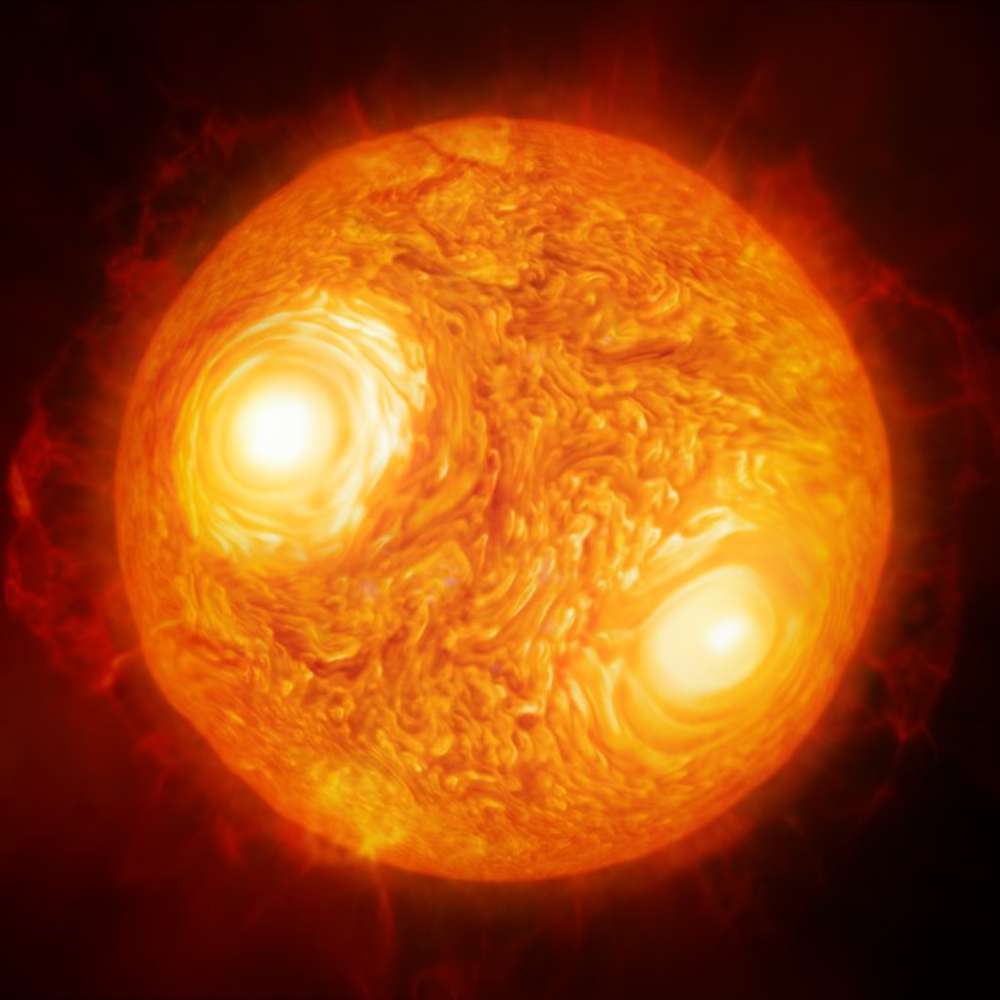
Its surface is covered in giant convection cells—regions of rising and falling gas larger than the entire orbit of Mars. These convection currents, together with weak gravity, produce turbulent movement across the surface and contribute to Antares’ irregular brightness variations.
The Extended Atmosphere and Mass Loss
Antares sheds enormous amounts of mass into space. Its stellar wind is thousands of times stronger than the Sun’s, creating a vast surrounding nebular envelope.
Characteristics of its mass-loss region:
Extends for several hundred astronomical units
Filled with dust, ionized gas, and molecules
Shows arcs, shells, and knots formed by pulsation cycles
Observed in infrared, radio, and submillimeter wavelengths
Because the star is so close by astronomical standards, detailed imaging from instruments like ALMA and the Very Large Telescope has revealed the complex patterns of outflowing material.
Antares is expected to lose significant mass before it undergoes a supernova. This mass loss will influence the eventual explosion, shaping its brightness and the appearance of the resulting supernova remnant.
Antares B – The Hot Blue Companion
While Antares appears as a solitary red point to the naked eye, it actually has a companion star: Antares B, a hot B-type subgiant.
Properties of Antares B:
Spectral type: B2.5 V
Temperature: ~18,000 K
Mass: ~7 M☉
Luminosity: ~400 times the Sun
Color: Blue-white
Separation: ~550 AU from Antares A
This companion orbits the red supergiant with a period estimated at several thousand years.
Because Antares A is so much brighter in visible light, the companion is difficult to observe. However, in ultraviolet wavelengths, Antares B is prominent, offering a contrast study between two very different stars in one system.
Why Antares Appears So Distinctive in the Sky
Antares’ brightness, deep color, and position within the prominent constellation Scorpius have made it culturally and visually striking.
It stands out because:
It is one of the brightest stars (~magnitude 1.0).
It is one of the largest stars visible without telescopes.
It has a vivid red color unmatched by most bright stars.
It lies near the ecliptic, often appearing close to Mars, enhancing its nickname “Rival of Mars.”
This unique combination makes Antares an immediate focal point in the summer sky.
The Life Cycle of Antares – From Massive Star to Supernova Progenitor
Antares began its life as a massive blue-white star, likely more than ten times the mass of the Sun. Stars this massive burn their fuel extremely quickly, evolving through their life cycles in just a few million years—far faster than the Sun’s ten-billion-year timeline.
Antares’ evolutionary path:
Main Sequence Phase
Burned hydrogen in its core with extremely high luminosity.Expansion into a Red Supergiant
After exhausting its core hydrogen, Antares expanded dramatically.
Its radius increased hundreds of times while its surface cooled.Helium Fusion and Heavy Element Production
Helium is currently fusing into carbon and oxygen in the core.
In outer shells, hydrogen continues to fuse.Future Shell-Burning Stages
Antares will proceed to fuse heavier elements—carbon, neon, oxygen, silicon—layer by layer.Core Collapse and Supernova
Once an iron core forms, fusion will stop.
Gravity will rapidly collapse the core, triggering a Type II supernova.
This final explosion will be incredibly bright—visible even during the day on Earth—but it poses no danger due to Antares’ distance.
Antares as a Template for Understanding Red Supergiant Physics
Antares is one of the closest red supergiants to Earth (after Betelgeuse), making it a crucial object in studying the complex atmospheric physics of dying massive stars.
Key areas where Antares provides insight:
Convection
Its atmosphere displays enormous convection cells—each the size of Earth’s orbit or larger. These cells produce brightness variations and complex surface structures.
Pulsations
Antares experiences irregular pulsations that cause its radius, brightness, and temperature to fluctuate over time.
Gas Outflow
The star’s weak surface gravity allows material to escape easily.
This contributes to enormous mass-loss rates and the creation of a dense circumstellar nebula.
Dust Formation
Dust grains form in Antares’ cooling wind.
This dust plays a major role in seeding the interstellar medium with heavy elements.
Because Antares is so bright and relatively close, astronomers have captured detailed images of its surface—something still impossible for most distant supergiants.
Observing Antares – What Makes It Unique to Astronomers
Antares is studied at nearly every wavelength of light, from radio waves to X-rays.
Different wavelengths reveal different layers of the star:
Optical: The visible red photosphere
Infrared: Dust, molecular gas, and extended atmospheric layers
Radio: Stellar wind regions and mass-loss structures
Ultraviolet: The hot blue companion, Antares B
X-rays: Shock waves in the stellar wind, magnetic activity
The combination of multi-wavelength data provides one of the richest datasets for any red supergiant.
Because Antares is a nearby supernova candidate (on astronomical timescales), it is regularly monitored for:
Temperature changes
Brightness variations
Mass-loss irregularities
Movement of atmospheric material
Magnetic signatures
This continuous observation helps astronomers refine supernova models and understand the last stages of massive stars’ evolution.
Antares and Its Surrounding Nebula
Antares is enveloped by a faint but extensive nebula created by its powerful stellar wind. This outflow has been detected through:
Infrared telescopes
Submillimeter observations
High-resolution radio interferometry
The nebula contains:
Ionized gas
Dust
Shock fronts
Molecular shells formed in pulsation cycles
The nebula’s structure is not smooth—it exhibits asymmetries caused by convection-driven eruptions and possibly gravitational disturbance from Antares B.
Studying this nebula is essential to understanding:
How supergiant mass loss works
The conditions into which the future supernova will expand
How stars enrich the interstellar medium with heavy elements
Antares B: The Hidden but Powerful Companion
Antares B is a striking contrast to the enormous red supergiant. It is a hot B-type star that orbits Antares A at a great distance, yet its presence profoundly influences our understanding of the system.
Characteristics of Antares B:
Hot blue-white color
Much smaller but far hotter than Antares A
Emits strong ultraviolet radiation
Helps ionize material in the surrounding nebula
Visible only with specialized instruments due to Antares A’s brightness
This companion star makes the Antares system a prime example of how different types of stars can co-evolve within a wide binary.
How Antares Will End Its Life – A Future Supernova
Antares is destined to end in a core-collapse supernova, one of the most energetic phenomena in the universe. This will occur when it exhausts all nuclear fuel in its core, eventually forming an iron core that cannot produce fusion energy.
What will happen:
Core Collapse
Gravity overwhelms the inert iron core, causing it to collapse in less than a second.Shockwave Formation
As the collapsing core rebounds, a massive shockwave blasts outward.Supernova Explosion
Antares will brighten to millions of times its normal luminosity.
From Earth, it may appear brighter than the Moon and be visible even in daylight.Remnant Formation
Depending on the final mass of the core, Antares will leave behind either:A neutron star, or
A black hole (if the remnant core exceeds the neutron star mass limit)
Expansion of the Supernova Nebula
The material Antares shed during its red supergiant phase will shape the structure of the exploding shell.
Though spectacular, the event will be perfectly safe for Earth due to Antares’ distance of ~550 light-years.
Antares in the Hertzsprung–Russell (H-R) Diagram
Antares occupies the upper-right region of the H-R diagram, where red supergiants reside. This region is characterized by:
Very low surface temperature
Extremely high luminosity
Large radii
Unstable atmospheres and heavy mass loss
Antares sits close to Betelgeuse in this diagram, both being examples of massive stars nearing the final stages of evolution.
Its placement helps researchers:
Test theories of late-stage stellar structure
Compare supergiant atmospheres
Understand convection at extremely large scales
Model supernova precursors
Because Antares is well-studied, it serves as a reference point for red supergiants across the Milky Way.
Frequently Asked Questions (FAQ)
Why is Antares red?
Because its surface temperature is low (~3,400 K), causing most of its light to be emitted at longer, redder wavelengths.
Is Antares larger than Betelgeuse?
They are comparable in size, but precise measurements vary. Both are among the largest stars visible to the naked eye.
Will Antares explode soon?
“Soon” astronomically means within the next few hundred thousand years. No immediate explosion is expected.
Is Antares part of a binary system?
Yes. It has a hot blue companion, Antares B, orbiting at about 550 AU.
Is Antares dangerous to Earth?
No. At 550 light-years away, it poses no threat even when it becomes a supernova.
Why is Antares called the ‘Rival of Mars’?
Its reddish color and brightness resemble Mars, especially when the planet passes nearby in the sky.
Related Stars and Comparative Study
Betelgeuse – Another well-known nearby red supergiant
Aldebaran – A less massive but prominent orange giant
VY Canis Majoris – One of the largest known stars
Mu Cephei (Herschel’s Garnet Star) – A deep-red supergiant
Rigel – A blue supergiant representing the opposite end of massive star evolution
These stars provide a spectrum of evolutionary stages for high-mass stellar life cycles.
Cultural and Historical Importance of Antares
Antares has been revered across civilizations:
Babylonians considered it a royal star, one of the four guardians of the skies.
Greeks associated it with Ares (Mars) due to its red color.
In Polynesian navigation, Antares served as a key seasonal star.
In Chinese astronomy, Antares belonged to the Azure Dragon of the East.
Its visibility and striking color made Antares a central star in mythologies worldwide.
Final Thoughts
Antares stands as one of the most iconic and scientifically valuable stars in the sky. Its immense size, deep red color, heavy mass loss, and status as a future supernova make it a crucial object for understanding massive stellar evolution.
From its turbulent atmosphere to the faint companion orbiting hundreds of AU away, Antares offers astronomers a complete portrait of a massive star in the final chapters of its life. Its future explosion will eventually enrich the Milky Way with new elements, continuing the cycle of star formation and cosmic evolution.
Whether admired as the glowing “Heart of the Scorpion” or studied as a supernova precursor, Antares remains one of the most remarkable stars in our galaxy.