










Arrokoth
The Most Pristine Relic of Solar System Formation
Quick Reader
| Attribute | Details |
|---|---|
| Official Name | 486958 Arrokoth |
| Provisional Designation | 2014 MU₆₉ |
| Nickname (former) | Ultima Thule |
| Type | Kuiper Belt Object (KBO) |
| Classification | Cold Classical Kuiper Belt Object |
| Discovery Date | 26 June 2014 |
| Discoverers | New Horizons search team |
| Discovery Telescope | Hubble Space Telescope |
| Distance from Sun | ~44.6 AU |
| Diameter | ~36 km (end-to-end) |
| Shape | Contact binary (bilobed) |
| Surface Composition | Water ice, methanol ice, complex organics |
| Surface Color | Reddish |
| Rotation Period | ~15.9 hours |
| Atmosphere | None |
| Flyby Mission | New Horizons (1 Jan 2019) |
| Naming Origin | Powhatan word meaning “sky” |
Introduction to Arrokoth – A Perfect Time Capsule
Arrokoth is one of the most important objects ever studied in planetary science — not because it is large, active, or dramatic, but because it is unchanged.
Located deep within the cold classical Kuiper Belt, Arrokoth is the most distant object ever visited by a spacecraft and the best-preserved remnant of the Solar System’s birth ever observed directly.
When NASA’s New Horizons spacecraft flew past Arrokoth on January 1, 2019, it revealed something astonishing: a gently merged, two-lobed object that looked exactly like what theoretical models predicted for early planet formation — slow, calm, and non-violent.
Arrokoth is not a survivor of chaos. It is a survivor of quiet.
Discovery of Arrokoth
Arrokoth was discovered in 2014 during a dedicated search for a Kuiper Belt flyby target for New Horizons after its Pluto encounter.
Key discovery facts:
Found using the Hubble Space Telescope
Extremely faint and small
Located in a dynamically cold, stable orbit
Because of its pristine orbit and location, Arrokoth was selected as the ideal target to study early Solar System material.
Why Arrokoth Is Not Like Other Kuiper Belt Objects
Most Kuiper Belt objects show evidence of:
Collisions
Fragmentation
Orbital excitation
Arrokoth does not.
Its defining characteristics:
Low inclination
Nearly circular orbit
No signs of disruptive impacts
This places Arrokoth in the cold classical population, thought to be the least disturbed material from the protoplanetary disk.
Shape and Structure – A Gentle Cosmic Snowman
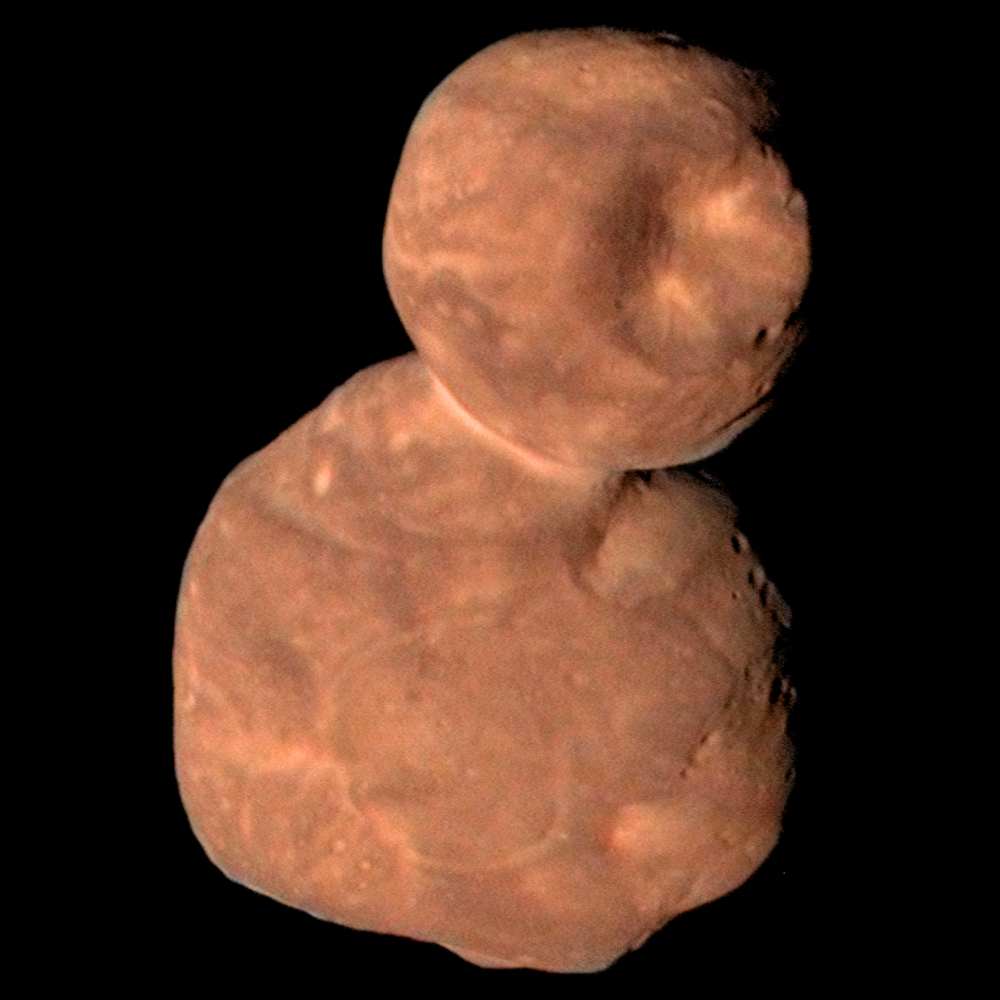
Arrokoth’s most iconic feature is its bilobed shape.
It consists of:
A larger lobe (“Ultima”)
A smaller lobe (“Thule”)
A narrow neck connecting them
This structure shows that Arrokoth formed when two objects:
Orbited each other slowly
Lost energy gently
Merged at walking speed
This directly contradicts older models of violent accretion.
What Arrokoth Tells Us About Planet Formation
Before Arrokoth, planet formation models were divided.
The New Horizons flyby confirmed that:
Planetesimals formed by gentle gravitational collapse
Pebble accretion played a major role
Early Solar System growth was calm in outer regions
Arrokoth is physical proof that planets began as soft assemblies, not high-speed collisions.
Surface Composition and Color
Arrokoth’s surface is uniformly reddish.
Spectral analysis indicates:
Water ice as a base component
Methanol ice (CH₃OH)
Complex organic molecules (tholins)
The presence of methanol suggests formation in extremely cold conditions, where volatile compounds could survive intact.
Why Arrokoth Is So Red
The red color is caused by:
Cosmic radiation processing surface ices
Formation of complex organic residues
Billions of years without resurfacing
Arrokoth’s surface is ancient — likely unchanged since formation.
No Atmosphere, No Activity
Arrokoth is:
Too small to retain gas
Too cold for sublimation
Too stable for geological activity
This makes it a frozen fossil, not an evolving world.
Why Arrokoth Matters More Than Pluto
Pluto is complex, active, and geologically evolved.
Arrokoth is none of those things — and that is exactly why it matters.
It shows:
What came before planets
What the Solar System started with
What most building blocks looked like
Arrokoth is the starting point of planetary history.
The New Horizons Flyby – A Historic Close Encounter
After completing its Pluto flyby in 2015, NASA’s New Horizons spacecraft was redirected deeper into the Kuiper Belt toward a much smaller and fainter target: Arrokoth.
On January 1, 2019, New Horizons passed Arrokoth at a distance of about 3,500 km, marking:
The most distant planetary flyby ever conducted
The first close-up study of a cold classical Kuiper Belt object
Humanity’s closest look at an untouched planetesimal
This encounter transformed Arrokoth from a point of light into a geological object with measurable structure.
What the Flyby Revealed Immediately
The first images shocked scientists.
Instead of a single irregular body, Arrokoth was revealed to be:
A contact binary with two distinct lobes
Smooth and rounded, not jagged
Largely free of impact craters
This appearance indicated a formation history dominated by gentle processes, not high-energy collisions.
The Two Lobes – Ultima and Thule
Arrokoth consists of two lobes that formed separately before merging.
Key characteristics:
The larger lobe is about 22 km across
The smaller lobe is about 14 km across
Both lobes are flattened rather than spherical
Their shapes suggest that each lobe formed by slow accumulation of smaller particles, then later became gravitationally bound to each other.
The Neck Region – Evidence of Gentle Merger
The narrow neck connecting the two lobes is one of Arrokoth’s most important features.
Observations show:
A brighter region at the neck
Possible accumulation of fine-grained material
No signs of shock deformation
This strongly supports a low-velocity merger, likely at speeds comparable to walking pace. Such a collision would not generate heat, fractures, or melting.
Surface Geology – Smooth, Ancient, Untouched
Arrokoth’s surface shows:
Very few craters
Subtle grooves and shallow depressions
No tectonic features or fractures
This indicates that Arrokoth:
Formed early
Avoided later bombardment
Has remained dynamically isolated
It is one of the least-altered solid surfaces ever observed.
Rotation and Stability
Arrokoth rotates slowly, completing one rotation in about 15.9 hours.
This slow rotation:
Is consistent with gentle formation
Indicates no major angular momentum injection
Suggests long-term rotational stability
Unlike many small bodies, Arrokoth shows no signs of spin-up from collisions.
Comparison with Comets
Arrokoth’s shape resembles some comet nuclei, such as comet 67P/Churyumov–Gerasimenko.
However, key differences exist:
Comets have been heated and altered by the Sun
Arrokoth has never entered the inner Solar System
Arrokoth retains original surface chemistry
This means Arrokoth represents a pre-cometary state, showing what comet nuclei looked like before solar processing.
Why Arrokoth Changed Planet Formation Theory
Before Arrokoth, many models assumed that planetesimals formed through:
Frequent collisions
High relative velocities
Fragmentation and reassembly
Arrokoth demonstrated instead that:
Pebbles gently collapsed under gravity
Relative velocities were very low
Growth occurred without destruction
This confirmed pebble accretion and gravitational collapse as dominant processes in the outer Solar System.
Why Arrokoth Changed Planet Formation Theory
Before Arrokoth, many models assumed that planetesimals formed through:
Frequent collisions
High relative velocities
Fragmentation and reassembly
Arrokoth demonstrated instead that:
Pebbles gently collapsed under gravity
Relative velocities were very low
Growth occurred without destruction
This confirmed pebble accretion and gravitational collapse as dominant processes in the outer Solar System.
The Long-Term Fate of Arrokoth
Arrokoth’s future is remarkably simple because its past has been so calm. As a cold classical Kuiper Belt object, it occupies one of the most stable regions of the Solar System.
Over billions of years:
Arrokoth will remain on a low-eccentricity, low-inclination orbit
It is unlikely to experience close encounters or collisions
Solar heating will never significantly affect its surface
Unless disturbed by an extremely rare stellar flyby, Arrokoth will remain essentially unchanged for the rest of the Sun’s lifetime.
Why Arrokoth Will Likely Never Change
Unlike comets or scattered disk objects, Arrokoth:
Never approaches the Sun
Is not perturbed by Neptune
Does not undergo resurfacing
This means:
No atmosphere can ever form
No geological activity will ever begin
No major erosion will occur
Arrokoth is effectively a permanent fossil, locked in the state it formed in over 4.5 billion years ago.
Arrokoth and the Boundary of Planetary Evolution
Arrokoth sits at the very beginning of the planetary growth ladder.
It represents:
The stage before planets
The building blocks that never grew larger
The raw material from which worlds formed
Everything from dwarf planets to gas giants started from objects similar to Arrokoth — but most were altered beyond recognition.
Why Arrokoth Is Unique in the Universe Map
Within the Universe Map framework, Arrokoth occupies a special role.
It is:
The most primitive solid object ever visited
A direct test of planetesimal formation theories
A reference object for cold classical Kuiper Belt bodies
No other known object provides such a clean, uncontaminated view of Solar System origins.
Frequently Asked Questions (FAQ)
Why was Arrokoth chosen as a New Horizons target?
Arrokoth was chosen because of its stable orbit, pristine condition, and location in the cold classical Kuiper Belt, making it an ideal object to study early planet formation.
Is Arrokoth a planet or dwarf planet?
No. Arrokoth is far too small to be a planet or dwarf planet. It is classified as a planetesimal — a basic building block of planets.
Why does Arrokoth have two lobes?
Arrokoth formed when two separate objects gently orbited each other and slowly merged at very low speed, creating a contact binary rather than a collisionally shattered body.
Does Arrokoth have an atmosphere?
No. Arrokoth is too small and too cold to retain any atmosphere.
Is Arrokoth similar to comets?
Arrokoth resembles comet nuclei in shape, but unlike comets, it has never been altered by solar heating. It represents a pre-cometary state.
Will Arrokoth ever be visited again?
No future missions are currently planned. However, the data collected by New Horizons will remain scientifically valuable for decades.
Why is Arrokoth red?
Its red color comes from complex organic molecules formed when cosmic radiation processed surface ices over billions of years.
Arrokoth’s Place in the Universe Map
Arrokoth defines the starting point of planetary history.
In the Universe Map structure, it represents:
The origin of solid bodies
The quiet pathway of planet formation
The contrast between gentle growth and violent evolution
Without understanding Arrokoth, the rest of the Solar System’s story remains incomplete.
Final Thoughts
Arrokoth did not become a planet, a moon, or a comet — and that is exactly why it matters. It avoided the chaos that reshaped most Solar System bodies and preserved the original conditions of planet formation.
In the deep cold beyond Neptune, Arrokoth continues its silent orbit, unchanged and unchanging — a perfect relic of how worlds begin.