



Asteroid Belt
The Fragmented Archive of Planet Formation
Quick Reader
| Attribute | Details |
|---|---|
| Object Type | Circumstellar debris region |
| Location | Between Mars and Jupiter |
| Average Distance from Sun | ~2.1–3.3 AU |
| Estimated Total Mass | ~4% of Earth’s Moon |
| Largest Object | Ceres (dwarf planet) |
| Major Bodies | Ceres, Vesta, Pallas, Hygiea |
| Object Count | Millions (≥1 km scale) |
| Orbital Stability | Long-term, dynamically excited |
| Composition Types | C-type, S-type, M-type asteroids |
| Age | ~4.5 billion years |
| Formation Role | Leftover planet-building material |
| Primary Influencer | Jupiter’s gravity |
Key Highlights
- Remnant material from early planet formation
- Never formed a planet due to Jupiter’s disruption
- Composition varies strongly with distance from the Sun
- Contains both primitive and differentiated bodies
- Acts as a historical record of Solar System evolution
Introduction – Not a Failed Planet, but a Preserved One
The Asteroid Belt is often misunderstood.
It is commonly described as a failed planet, a region where material simply never came together.
That idea is outdated.
The Asteroid Belt is better understood as a fragmented archive—a region where planet formation was interrupted, altered, and preserved rather than completed.
What remains today is not rubble from destruction, but unfinished construction.
Where Is the Asteroid Belt?
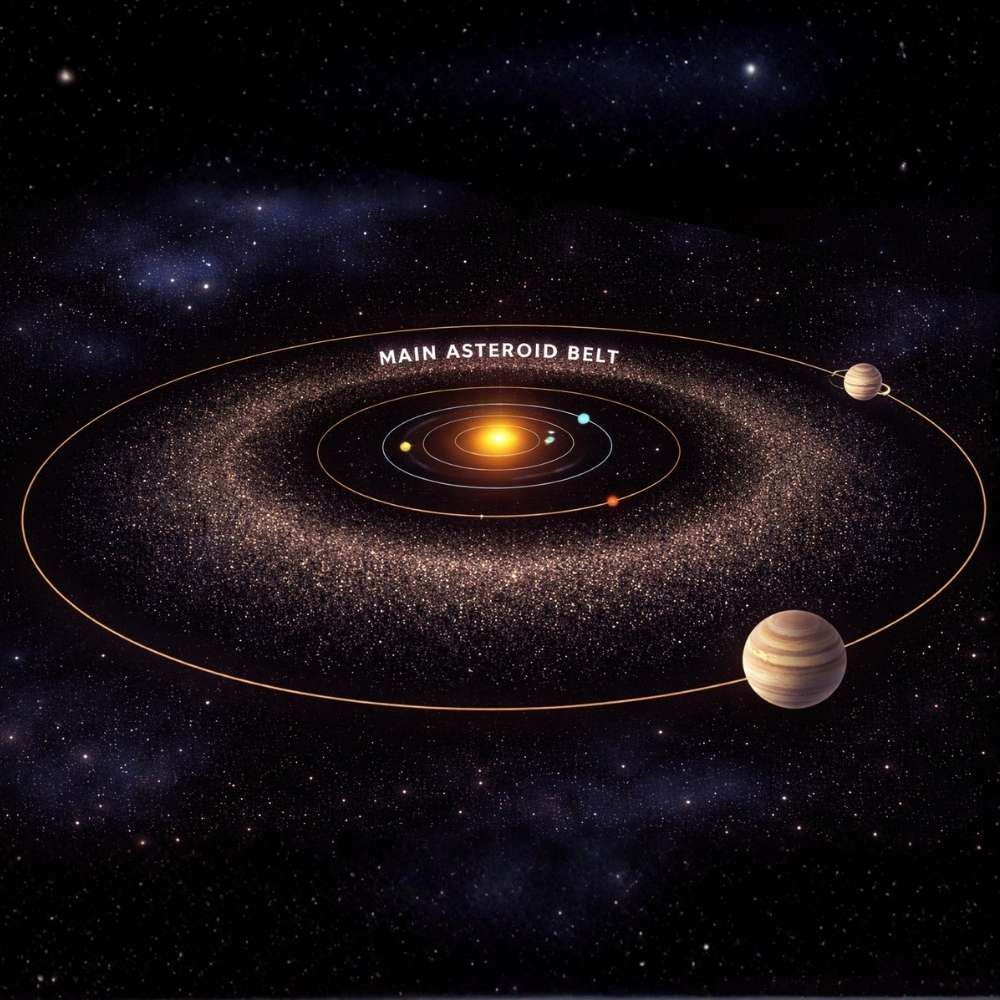
The Asteroid Belt lies between the orbits of Mars and Jupiter, spanning a broad region of space.
Despite popular depictions, it is:
Not densely packed
Mostly empty space
Safe for spacecraft to traverse
Individual asteroids are separated by vast distances, often millions of kilometers apart.
The danger is historical, not navigational.
Why a Planet Never Formed There
Early in Solar System history, solid material existed throughout this region.
Under normal conditions, that material would have accreted into a planet.
It did not—because of Jupiter.
Jupiter’s immense gravity:
Stirred up asteroid orbits
Increased collision speeds
Prevented gentle accretion
Triggered repeated fragmentation
Instead of building a planet, the region entered a cycle of collision without growth.
The Role of Jupiter – Architect of Disruption
Jupiter is not merely nearby—it is dominant.
Its gravitational influence caused:
Orbital resonances within the belt
Gaps in asteroid distribution (Kirkwood gaps)
Ejection of material from the belt
Long-term orbital excitation
The Asteroid Belt exists in its present form largely because Jupiter would not allow it to become anything else.
Composition Gradient – Not All Asteroids Are the Same
Asteroids in the belt show a clear compositional pattern.
Closer to Mars:
More rocky, metal-rich bodies
S-type asteroids dominate
Farther from the Sun:
Carbon-rich, primitive objects
C-type asteroids become common
This gradient reflects:
Temperature differences in the early Solar System
Condensation of different materials at different distances
The Asteroid Belt preserves the chemical zoning of the protoplanetary disk.
Major Members – More Than Just Rocks
The belt contains several large, complex bodies.
Notably:
Ceres – a dwarf planet with water and brines
Vesta – a differentiated, volcanic protoplanet
Pallas – a primitive, high-inclination survivor
These objects demonstrate that the Asteroid Belt is not uniform debris, but a collection of diverse planetary embryos.
Collisions – Destruction and Creation
Collisions dominate belt evolution.
Over billions of years:
Large bodies were shattered
Families of fragments formed
Smaller asteroids were created
Yet collisions also:
Exposed interior material
Created meteorites that reached Earth
Preserved early Solar System chemistry
The Asteroid Belt is destructive—but informative.
Why the Asteroid Belt Matters
The Asteroid Belt is essential for understanding:
How planets form—and fail to form
How Jupiter shaped the inner Solar System
Where Earth’s water and organics may have originated
It is a cosmic fossil bed, not a graveyard.
Asteroid Belt vs Kuiper Belt – Two Very Different Debris Worlds
Although both are collections of small bodies, the Asteroid Belt and Kuiper Belt formed under very different conditions.
Comparison of Solar System Debris Belts
| Feature | Asteroid Belt | Kuiper Belt |
|---|---|---|
| Location | Between Mars and Jupiter | Beyond Neptune |
| Average Temperature | Relatively warm | Extremely cold |
| Dominant Composition | Rock and metal | Ice-rich bodies |
| Largest Object | Ceres (dwarf planet) | Pluto (dwarf planet) |
| Primary Shaping Planet | Jupiter | Neptune |
| Collisional Activity | High (early), moderate today | Lower overall |
| Scientific Role | Inner Solar System fossil record | Outer Solar System reservoir |
The Asteroid Belt records interrupted growth, while the Kuiper Belt preserves distant leftovers.
Asteroid Families – Tracing Ancient Collisions
Many asteroids belong to families—groups sharing similar orbits and compositions.
These families formed when:
A parent body was shattered by impact
Fragments remained on similar orbits
Dynamical evolution slowly spread them over time
By studying families, scientists can:
Reconstruct ancient collisions
Identify parent bodies
Date major disruptive events
Asteroid families are the genealogy of the belt.
Meteorites – Asteroid Belt Material on Earth
Most meteorites that fall to Earth originate in the Asteroid Belt.
Process overview:
Collisions create fragments
Resonances shift their orbits
Some enter Earth-crossing paths
Meteorites allow:
Laboratory study of asteroid material
Precise age dating
Chemical analysis of early Solar System matter
They are direct samples of the belt.
Resonances and Kirkwood Gaps
The Asteroid Belt is not uniform.
Certain regions are depleted due to orbital resonances with Jupiter.
These resonances:
Repeatedly perturb asteroid orbits
Increase eccentricity
Clear material over time
The resulting empty regions are known as Kirkwood gaps—a signature of Jupiter’s long-term influence.
Ongoing Evolution – A Living System
The Asteroid Belt is ancient, but not static.
Today:
Collisions still occur
Small bodies continue to fragment
Objects are slowly removed via resonances
The belt is evolving—just at a much slower pace than in its youth.
Why the Asteroid Belt Is Scientifically Irreplaceable
Without the Asteroid Belt, scientists would lose:
Direct access to primitive Solar System material
Evidence of early planetary dynamics
Clues to Earth’s formation environment
It is a reference region for planet formation models.
The Long-Term Future of the Asteroid Belt
The Asteroid Belt is not fading quickly—it is stabilizing.
Over billions of years:
Most large asteroids will remain in stable orbits
Smaller bodies will slowly erode through collisions
Resonances will continue to remove material gradually
The belt will persist for the lifetime of the Solar System, though its population will slowly thin.
Is the Asteroid Belt Dangerous to Earth?
No.
Contrary to popular media:
The belt itself does not pose a direct threat
Asteroids are widely spaced
Earth-impacting objects usually originate from resonances, not the belt as a whole
The Asteroid Belt is not a shooting gallery aimed at Earth.
Common Misconceptions
Is the Asteroid Belt a destroyed planet?
No. The total mass is far too small to have formed an Earth-sized planet.
Are asteroids packed closely together?
No. Spacecraft routinely pass through the belt without incident.
Does the belt still create planets?
No. Planet formation ended there billions of years ago.
Frequently Asked Questions (FAQ)
Why is Ceres classified as a dwarf planet?
Because it is spherical and differentiated but has not cleared its orbital zone.
Do asteroids contain water?
Many do, especially carbon-rich types.
Can humans mine the Asteroid Belt?
In theory, yes—but current technology makes it impractical.
Will the belt disappear?
No. It will persist, though slowly changing.
Asteroid Belt in the Context of Solar System Architecture
The Asteroid Belt acts as:
A boundary between terrestrial and giant planets
A record of Jupiter’s gravitational influence
A source of meteorites and scientific insight
It is not empty, not chaotic, and not accidental.
Final Perspective
The Asteroid Belt is a reminder that not every region of the Solar System was destined to become a planet.
Shaped by Jupiter’s gravity, frozen in a state of arrested development, it preserves the materials and processes that built the worlds we see today.
To study the Asteroid Belt is to study planet formation interrupted—but not erased.