





Barnard’s
The Fast-Moving Red Dwarf Next Door
Quick Reader
| Attribute | Details |
|---|---|
| Name | Barnard’s Star |
| Other Designation | BD+04°3561, Gliese 699 |
| Star Type | Red dwarf (M4 V) |
| Constellation | Ophiuchus |
| Distance | ~5.96 light-years |
| Apparent Magnitude | ~9.5 (not visible to the naked eye) |
| Temperature | ~3,130 K |
| Mass | ~0.144 M☉ |
| Radius | ~0.196 R☉ |
| Luminosity | ~0.0004 L☉ |
| Age | ~7–12 billion years (very old) |
| Notable Feature | Highest proper motion of any known star |
| Best Viewing Season | May–August (Northern Hemisphere) |
Introduction – A Quiet but Extraordinary Neighbor
Barnard’s Star is one of the most intriguing objects in our local galactic neighborhood. Located just 6 light-years away, it is the second-closest individual star system to the Sun after the Alpha Centauri system. Although invisible to the naked eye, it has become one of the most studied red dwarfs in astrophysics.
Its importance comes from three key features:
It has the fastest proper motion of any star in the sky
It is one of the oldest stars near the Sun
It is a low-mass red dwarf with stable long-term evolution
Barnard’s Star moves across the sky at an astonishing speed of 10.3 arcseconds per year, shifting its position noticeably within a human lifetime. This fast motion is a direct result of its proximity combined with its independent velocity through the galaxy.
Despite its dimness, Barnard’s Star is a cornerstone of stellar astrophysics, exoplanet searches, and galactic kinematics. The star’s stability and advanced age also make it one of the prime targets for studying long-term habitability around red dwarfs.
Physical Characteristics of Barnard’s Star
A Typical but Old Red Dwarf
Barnard’s Star is classified as an M4 V red dwarf:
Very cool
Very small
Very dim
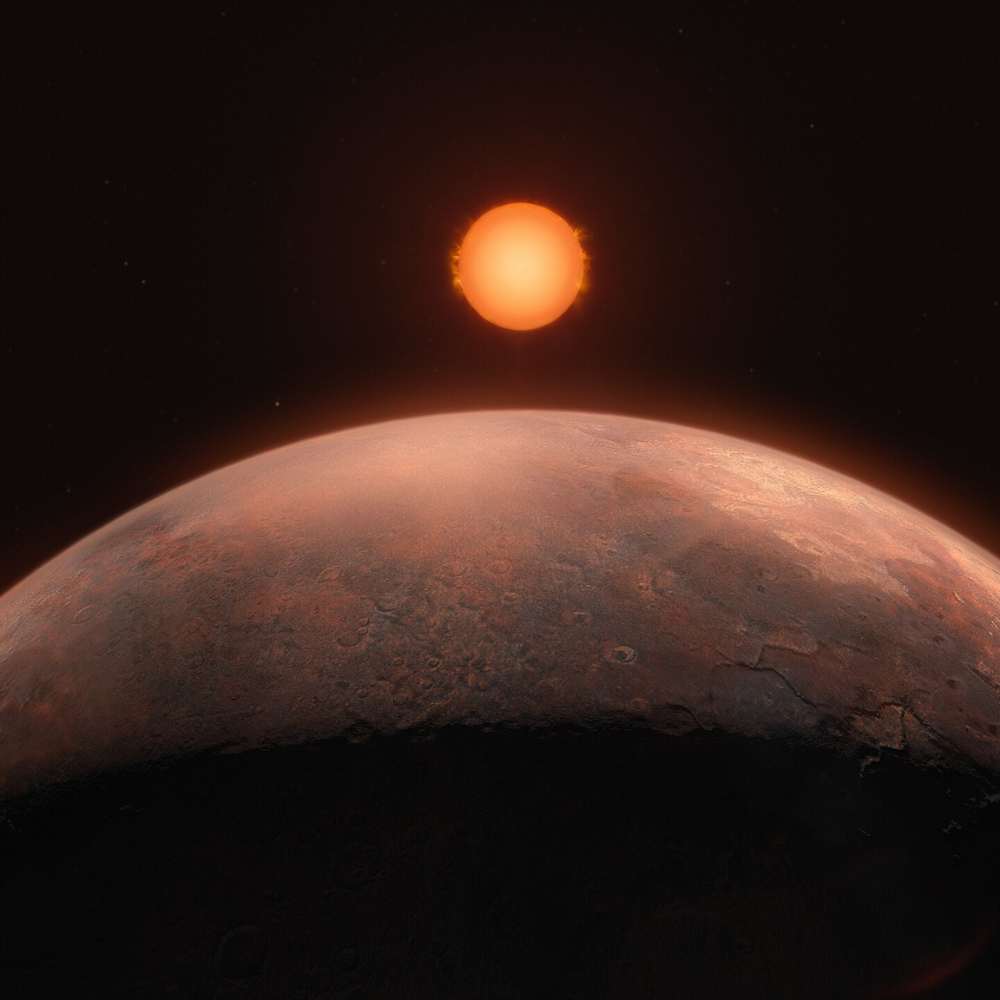
Its surface temperature of ~3,130 K gives it a deep red hue, typical of mid-M-class stars.
Size, Mass, and Luminosity
Compared to the Sun:
Radius: ~20% of the Sun’s
Mass: ~14% of the Sun’s
Luminosity: Only 0.04% of the Sun’s
If Barnard’s Star replaced the Sun:
It would appear as a faint orange-red point
Earth would freeze instantly
The habitable zone would lie extremely close, within 0.05–0.1 AU
Its faintness explains why it was not discovered until 1916 despite being a near neighbor.
Age and Stability – A Star Older Than the Sun
Barnard’s Star is ancient:
Estimated age: 7 to 12 billion years
Much older than the Sun (4.6 billion years)
Formed when the Milky Way was young and metal-poor
This makes it valuable for studying:
Stellar longevity
Magnetic aging in red dwarfs
Early galactic history
Older red dwarfs like Barnard’s Star tend to be quiet and magnetically stable, which is important for long-term habitability.
Magnetic Activity and Variability
Barnard’s Star is relatively calm compared to younger red dwarfs such as Proxima Centauri and Wolf 359.
Characteristics of Its Activity Level
Low flare frequency
Modest X-ray emission
Weak magnetic field cycles
Occasional minor outbursts detected in the past
Its quietness is expected for an old red dwarf whose rotation has slowed significantly over billions of years.
Optical Variability
Barnard’s Star shows small variations attributed to:
Starspots
Slow rotation
Magnetic cycles
However, it remains one of the least active mid-M dwarfs known.
Record-Breaking Proper Motion – The Fastest Star in the Sky
Barnard’s Star’s most famous property is its extreme speed across the sky.
Proper Motion
10.3 arcseconds per year
Equivalent to a full Moon diameter in ~180 years
The largest known motion for any star
This motion is caused by:
Its proximity
Its rapid movement through the Milky Way
A trajectory that crosses the Sun’s motion
Radial Velocity
Barnard’s Star is currently:
Moving toward the Sun
Will reach its closest distance (~3.8 light-years) around year 11,800
This future approach briefly made Barnard’s Star famous as a hypothetical destination for interstellar missions.
Exoplanet Searches and the Barnard’s Star “Planet” Controversy
Barnard’s Star has been the subject of exoplanet searches for over a century.
Historical Claims
In the 1960s, Peter van de Kamp claimed that Barnard’s Star had one or more planets.
These claims were later proven false due to:
Telescope optical errors
Miscalibrated observations
Modern Searches
Recent precision radial velocity campaigns suggested:
A possible super-Earth (“Barnard’s Star b”) with a 233-day orbit
But further studies show the signal may be:
Instrumental
Or stellar variability
Or statistical noise
As of today:
There are no confirmed planets around Barnard’s Star
But Earth-sized planets in close orbits remain possible
Barnard’s Star and Habitability
If planets exist around Barnard’s Star:
The habitable zone lies extremely close
Tidal locking is certain
Stellar flux changes would be small due to stability
Long-term habitability is more feasible than around flare stars
Its low activity makes it a promising target for future atmospheric studies.
Internal Structure of Barnard’s Star – A Fully Convective Stellar Engine
Barnard’s Star is a fully convective red dwarf, meaning its interior is fundamentally different from that of stars like the Sun.
Fully Convective Interior
Because Barnard’s Star is so low in mass (~0.144 M☉):
Its core never becomes hot enough for radiative zones to form
Convection occurs from the core to the surface
Consequences of full convection:
Energy is transported efficiently throughout the entire star
Hydrogen is mixed uniformly across the interior
No helium core builds up until very late in the star’s life
Fuel is used slowly and evenly
This structural simplicity ensures extreme longevity.
Energy Generation – The Proton–Proton Chain
Unlike hotter stars that rely on the CNO cycle, Barnard’s Star produces energy through the proton–proton (pp) chain, which dominates in:
Low-mass stars
Cool cores
Low-pressure fusion environments
Because of the pp chain:
Barnard’s Star burns hydrogen extremely slowly
Luminosity remains very low
Temperature stays stable over billions of years
Magnetic Field and Rotation
Barnard’s Star rotates slowly due to:
Magnetic braking
Age-related angular momentum loss
Slow rotation reduces:
Magnetic field strength
Flaring events
X-ray output
This aligns with observations showing Barnard’s Star is an old, quiet M dwarf.
Long-Term Evolution – A Star Built for Trillions of Years
Barnard’s Star will outlive most stars in the Milky Way.
Stellar Lifetime
Estimated lifespan:
Over 10 trillion years — more than 1,000 times the current age of the universe.
Because of its low mass:
It will never become a red giant
It will slowly brighten over trillions of years
It will evolve gradually into a hot blue dwarf
Eventually, after exhausting hydrogen uniformly, it will become a helium white dwarf
This is the quietest, longest evolutionary path of any star type.
Why Longevity Matters
Barnard’s Star represents what most stars in the universe actually look like:
Small
Dim
Extremely long-lived
Red dwarfs with masses like Barnard’s will be the last stars still shining when the universe reaches its final ages.
Galactic Orbit and High Velocity
Barnard’s Star belongs to the Milky Way’s thick disk population, which explains several of its motions and characteristics.
High Space Velocity
Barnard’s Star moves through the galaxy at:
~140 km/s relative to the Sun
Much faster than thin disk stars
Its rapid motion includes components of:
Proper motion (across the sky)
Radial motion (toward the Sun)
Thick Disk Membership
Thick disk stars are:
Older
Metal-poor
High-velocity
Formed early in the Milky Way’s history
This matches Barnard’s Star’s:
Old age
Low metallicity
High proper motion
Future Close Approach to the Sun
In year 11,800, Barnard’s Star will reach its minimum distance to the Sun:
~3.8 light-years
This won’t disrupt the Solar System, but it is one of the notable future “stellar flybys.”
Comparisons with Other Nearby Red Dwarfs
Barnard’s Star vs Proxima Centauri
| Feature | Barnard’s Star | Proxima Centauri |
|---|---|---|
| Activity | Very low | Extremely high flaring |
| Age | Older | Younger |
| Mass | Slightly higher | Slightly lower |
| Habitable Zone Stability | High potential | Very challenging |
Proxima is dangerous for planets; Barnard’s is calmer but cooler.
Barnard’s Star vs Wolf 359
| Feature | Barnard’s Star | Wolf 359 |
|---|---|---|
| Temperature | Slightly warmer | Cooler |
| Age | Much older | Younger |
| Activity | Low | High |
| Luminosity | Higher | Lower |
Barnard’s Star is more stable due to its age.
Barnard’s Star vs Teegarden’s Star
- Teegarden’s Star is cooler and smaller
- Has multiple confirmed exoplanet candidates
- Is similar in metallicity
Barnard’s Star is older and more luminous.
Barnard’s Star vs TRAPPIST-1
- TRAPPIST-1 is ultracool (much cooler)
- Has seven Earth-sized planets
- Emits strong flares
Barnard’s Star is hotter, brighter, and more stable, but no planets have been confirmed.
Why Barnard’s Star Is a Top Target for Exoplanet Research
Even though no planets are confirmed yet, Barnard’s Star remains an ideal target because:
It is extremely nearby
It is magnetically quiet
It emits stable light over long periods
Small planets would cause detectable signals
Future missions like:
ELT
JWST follow-up
Giant Magellan Telescope
Next-generation radial velocity spectrographs
may uncover Earth-sized worlds in tight orbits.
Observing Barnard’s Star – A Subtle But Rewarding Target
Barnard’s Star is too faint for naked-eye viewing, but it is an iconic observing challenge for amateur astronomers.
Naked-Eye Visibility
Not possible.
With an apparent magnitude of 9.5, Barnard’s Star requires optical assistance.
Using Binoculars
Most binoculars (7×50 or 10×50) cannot resolve Barnard’s Star, but they can help locate the region within Ophiuchus. You will need a precise star chart to pinpoint its location.
Telescopes
A small to medium-sized telescope (80–150 mm aperture) can reveal Barnard’s Star as:
A faint, steady red point
Located among background stars of similar brightness
To the observer:
The star appears unremarkable
Its scientific value comes only from careful study
Tracking Proper Motion
One of the most exciting aspects of observing Barnard’s Star is watching it move across the sky.
Because its proper motion is 10.3 arcseconds per year, observers can detect:
Noticeable position changes over a few years
Significant movement over a decade
Astrophotographers often take images years apart to create “motion comparisons,” highlighting Barnard’s Star’s drifting position relative to the star field.
Approaching the Solar System – Future Flyby
Barnard’s Star is moving toward the Sun at roughly 110 km/s and will reach its closest distance around the year 11,800.
Closest Approach
Distance: ~3.8 light-years
It will not enter the Oort Cloud
It will not disturb planetary orbits
Its approach, while notable, poses no gravitational threat to the Solar System.
Barnard’s Star’s rapid motion and future proximity made it a target for early interstellar mission concepts such as Project Daedalus.
Scientific Importance of Barnard’s Star
Barnard’s Star is scientifically valuable for several key reasons.
1. Oldest Nearby Red Dwarf
Its age (~7–12 billion years) provides a window into the early Milky Way:
Thick disk stellar populations
Ancient chemical composition
Magnetic aging processes
2. Model for Low-Mass Stellar Evolution
Because it is fully convective:
It burns hydrogen uniformly
It evolves extremely slowly
It demonstrates the long life of red dwarfs
Barnard’s Star is among the most stable types of star known.
3. Exoplanet Search Benchmark
Even though no planets are confirmed:
Its stability makes it a prime candidate
Radial velocity precision increases yearly
Earth-sized planets could exist in close orbits
Future telescopes may finally verify the long-suspected “super-Earth” signals.
4. Astrometric Landmark
Because of its extreme proper motion:
It is essential for calibrating sky catalogs
It tests long-term positional accuracy
It verifies galactic models of local stellar kinematics
Barnard’s Star is one of the cornerstones of modern astrometry.
Cultural and Historical Significance
Barnard’s Star holds a special place in scientific history rather than mythology.
Discovered by Edward Emerson Barnard (1916)
Using photographic plates
Identified for its rapid motion
The fastest-moving star ever observed
This discovery highlighted the dynamic nature of the Milky Way long before space telescopes existed.
A Symbol of Interstellar Exploration
Because of its proximity and stability, Barnard’s Star:
Became a target for early starship concepts
Appeared in science fiction involving near-future interstellar travel
Inspired realistic mission proposals such as Project Daedalus and Project Icarus
Although not as famous as Alpha Centauri, Barnard’s Star is a key destination in speculative interstellar engineering.
Frequently Asked Questions (FAQ)
Why is Barnard’s Star so faint if it’s close?
Because it is a red dwarf:
Very small
Very cool
Very low luminosity
Proximity does not guarantee brightness.
Why does it move so fast?
Its extreme proper motion comes from:
High velocity through the Milky Way
Close distance to the Sun
This combination makes its movement appear rapid from Earth.
Does Barnard’s Star have planets?
No confirmed planets yet.
Possible signals exist but require more data.
Is Barnard’s Star older than the Sun?
Yes.
It formed when the Milky Way was young, making it one of the oldest nearby stars.
Could life exist around Barnard’s Star?
Possible but difficult:
The habitable zone is very close
Planetary tidal locking is likely
Low activity increases habitability potential
No confirmed planets yet
Will Barnard’s Star ever pass near the Solar System?
Yes, in ~9,000 years it will reach its closest point (~3.8 light-years), then move away again.
Final Scientific Overview
Barnard’s Star stands as one of the most important red dwarfs in the galaxy—not because it is bright, but because it is:
Extremely close
Very old
Fully convective
Fast-moving
Astrometrically unique
Its unparalleled proper motion, ancient age, quiet magnetic behavior, and potential for hosting low-mass planets make it a vital pillar of stellar astrophysics and exoplanet research.
Barnard’s Star represents the quiet, stable, long-lived future of most stars in the universe. While massive stars burn bright and die quickly, Barnard’s Star—and countless others like it—will continue shining trillions of years after the Sun is gone.