







BepiColombo
Europe and Japan’s Mission to Decode Mercury
Quick Reader
| Attribute | Details |
|---|---|
| Mission Name | BepiColombo |
| Mission Type | Mercury orbiter (dual spacecraft) |
| Space Agencies | ESA (Europe) + JAXA (Japan) |
| Launch Date | 20 October 2018 |
| Target | Planet Mercury |
| Spacecraft | MPO (Mercury Planetary Orbiter), Mio / MMO (Mercury Magnetospheric Orbiter) |
| Propulsion | Solar electric propulsion + gravity assists |
| Arrival at Mercury | December 2025 (planned orbit insertion) |
| Mission Duration | Minimum 1 year (with extensions possible) |
| Primary Goals | Mercury’s interior, surface, exosphere, and magnetic field |
Key Points
- BepiColombo is the most complex mission ever sent to Mercury
- It uses two orbiters working together for complementary science
- Extreme heat near the Sun required unprecedented thermal engineering
- The mission builds directly on discoveries made by NASA’s MESSENGER
Introduction – Why Mercury Is So Hard to Explore
Mercury is the least explored rocky planet in the Solar System, despite being one of the most scientifically important.
Its proximity to the Sun creates extreme challenges:
Surface temperatures swing from intense heat to deep cold
Strong solar gravity makes orbit insertion difficult
Solar radiation severely limits spacecraft electronics
For decades, Mercury remained largely mysterious.
BepiColombo was designed to change that — not with a single spacecraft, but with a coordinated, dual-orbiter system capable of studying the planet in unmatched detail.
What Is BepiColombo?
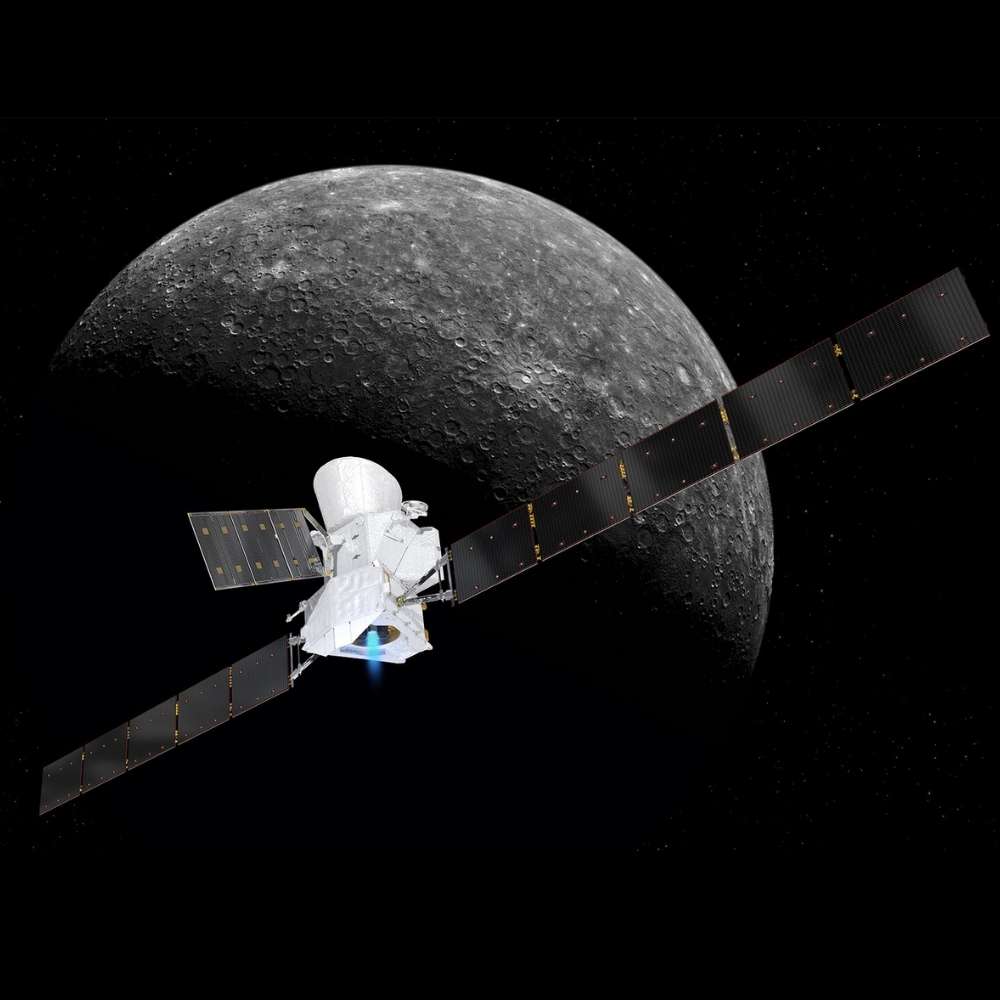
BepiColombo is a joint European–Japanese mission created to perform the most comprehensive study of Mercury ever attempted.
Unlike previous missions, it consists of:
Mercury Planetary Orbiter (MPO) – focused on surface and interior
Mio (MMO) – focused on Mercury’s magnetic environment
This division allows scientists to study Mercury as a complete planetary system, not just a rocky surface.
Why the Mission Is Named “BepiColombo”
The mission is named after Giuseppe “Bepi” Colombo, an Italian mathematician and engineer.
His contributions include:
Discovering Mercury’s unusual spin–orbit resonance (3:2 rotation)
Proposing gravity-assist trajectories later used by Mariner 10
Laying the conceptual groundwork for modern Mercury missions
Naming the mission after him honors the scientific insight that made Mercury exploration possible.
Why Mercury Matters in Planetary Science
Mercury is not just another rocky planet — it is an extreme endmember.
Studying Mercury helps answer fundamental questions:
How do rocky planets form near a star?
Why does Mercury have such a large metallic core?
How does a global magnetic field survive on a small planet?
What happens to planetary surfaces under intense solar radiation?
BepiColombo is designed to address all of these at once.
The Two Orbiters – One Mission, Two Perspectives
Mercury Planetary Orbiter (MPO)
MPO, built by ESA, focuses on Mercury itself.
Primary investigations include:
Surface composition and mineralogy
Crust and mantle structure
Gravity field and internal layering
Long-term surface evolution
It will orbit close to the planet, enabling high-resolution mapping.
Mio (Mercury Magnetospheric Orbiter)
Mio, built by JAXA, focuses on Mercury’s interaction with the Sun.
Key objectives:
Study Mercury’s magnetic field dynamics
Analyze solar wind interactions
Observe particle acceleration near the planet
Understand space weather effects close to the Sun
Mio’s highly elliptical orbit allows it to sample wide regions of Mercury’s magnetosphere.
Reaching Mercury – Why It Takes So Long
Despite being close to Earth in distance, Mercury is one of the hardest planets to reach.
BepiColombo must slow down, not speed up.
To achieve this, it uses:
One Earth flyby
Two Venus flybys
Six Mercury flybys
Continuous ion propulsion
This carefully choreographed journey gradually reduces orbital energy, allowing safe capture by Mercury’s gravity.
Thermal Survival Near the Sun
At Mercury, sunlight is up to 10 times stronger than at Earth.
BepiColombo survives using:
Multi-layer thermal shielding
High-reflectivity ceramic coatings
Radiators angled away from the Sun
Strict spacecraft orientation control
Without these measures, onboard instruments would fail within minutes.
What Makes BepiColombo Different from MESSENGER
While NASA’s MESSENGER transformed our understanding of Mercury, BepiColombo goes further.
It offers:
Simultaneous surface and magnetosphere measurements
Higher instrument precision
Longer-term orbital stability
Improved thermal and radiation resistance
Together, both missions form a continuous scientific legacy.
Why BepiColombo Is a Milestone Mission
BepiColombo represents:
International scientific collaboration at the highest level
Engineering at the limits of solar-system exploration
A decisive step toward understanding extreme terrestrial planets
Its data will influence not only Mercury science, but also exoplanet studies around hot stars.
The Scientific Payload – Tools Built for an Extreme Planet
BepiColombo carries one of the most advanced scientific payloads ever sent to a rocky planet.
Together, the two orbiters host 16 major scientific instruments, each optimized to survive and operate close to the Sun.
The instruments are divided according to mission role:
MPO studies Mercury itself, while Mio studies the space environment around it.
MPO Instruments – Reading Mercury’s Surface and Interior
The Mercury Planetary Orbiter (MPO) is designed to answer fundamental questions about Mercury’s structure, composition, and evolution.
Surface Composition and Mineralogy
Key instruments include:
SIMBIO-SYS – High-resolution imaging and spectral analysis
MERTIS – Thermal infrared spectrometer and radiometer
MGNS – Gamma-ray and neutron spectrometer
These instruments allow scientists to:
Identify surface minerals and chemical elements
Map temperature variations across the planet
Determine how Mercury’s crust differs from other rocky planets
Interior Structure and Gravity
Understanding Mercury’s interior is critical because its core is unusually large.
MPO will measure:
Variations in Mercury’s gravity field
Subtle changes in spacecraft motion
Tidal deformation caused by the Sun
From this data, scientists can infer:
Core size and state (liquid vs solid)
Mantle thickness
Internal layering and density distribution
This information is essential for explaining how Mercury formed.
Mio Instruments – Studying Mercury’s Magnetic Environment
Mercury has a global magnetic field, something unexpected for a planet so small.
The Mio orbiter focuses on this mystery.
Magnetic Field and Plasma Studies
Mio carries instruments such as:
MGF – Magnetometer
MPPE – Plasma particle detectors
PWI – Plasma wave investigation
These instruments allow scientists to study:
How Mercury’s magnetic field is generated
How solar wind interacts with the planet
How charged particles move near Mercury
Mercury’s magnetosphere is extremely dynamic due to its closeness to the Sun.
Why Mercury’s Magnetosphere Is Unique
Unlike Earth:
Mercury’s magnetic field is much weaker
The magnetosphere is compressed by intense solar wind
Solar particles can reach the surface directly
This creates:
Space weather conditions unlike any other planet
Direct surface erosion by solar particles
A constantly changing plasma environment
Mio will observe these processes in real time.
Mercury’s Exosphere – A Planet Without an Atmosphere
Mercury does not have a traditional atmosphere.
Instead, it has an exosphere — a thin cloud of atoms constantly being created and destroyed.
Sources of exospheric material include:
Solar wind sputtering
Micrometeoroid impacts
Thermal desorption from the surface
BepiColombo will analyze:
Sodium, potassium, and other elements
How these particles escape into space
How the exosphere changes with Mercury’s orbit
This helps explain how airless bodies interact with their space environment.
Key Scientific Questions BepiColombo Seeks to Answer
BepiColombo was designed around several unresolved questions.
1. Why Is Mercury So Dense?
Mercury’s large iron core makes it far denser than expected.
Possible explanations include:
Early giant impacts stripping away the mantle
Formation in a metal-rich region of the Solar System
Extreme solar heating during early formation
BepiColombo’s gravity and composition data will help discriminate between these models.
2. How Did Mercury’s Surface Evolve?
Mercury shows evidence of:
Ancient volcanic plains
Global contraction features
Long-lived tectonic activity
The mission will determine:
When volcanism occurred
How long Mercury remained geologically active
How solar proximity influenced surface aging
3. Why Does Mercury Still Have a Magnetic Field?
Most small planets lose their magnetic fields early.
BepiColombo will test whether:
Mercury’s core is still partially molten
Chemical layering sustains dynamo action
Unique cooling processes are at work
This has implications for magnetic field generation across planets.
Comparing BepiColombo and MESSENGER
| Feature | MESSENGER | BepiColombo |
|---|---|---|
| Orbiters | One | Two (MPO + Mio) |
| Magnetosphere Coverage | Limited | Comprehensive |
| Instrument Precision | High | Very high |
| Mission Duration | ~4 years | 1+ years (extendable) |
| Thermal Design | Advanced | Extreme |
BepiColombo does not replace MESSENGER — it builds directly upon it.
Why BepiColombo Matters Beyond Mercury
The mission’s impact extends far beyond a single planet.
Its findings will influence:
Models of rocky planet formation
Understanding of exoplanets near their stars
The physics of magnetic fields in small bodies
Engineering strategies for extreme environments
Mercury serves as a natural laboratory for planets orbiting close to their suns.
What Scientists Expect to Discover
BepiColombo was designed not just to refine existing knowledge, but to resolve long-standing contradictions in Mercury science.
Based on current models, scientists expect the mission to:
Precisely determine the size and state of Mercury’s core
Reveal chemical differences between Mercury and other terrestrial planets
Clarify how long volcanism remained active
Explain how a small planet sustains a global magnetic field
Track real-time interactions between the Sun and Mercury
Many of these questions could not be answered with a single orbiter alone.
Mercury as a Window into Extreme Planet Formation
Mercury represents an extreme outcome of rocky planet formation.
Its unusual properties include:
A disproportionately large iron core
A thin silicate mantle
Weak but persistent magnetism
Severe solar radiation exposure
By understanding Mercury, scientists gain insight into:
How close-in exoplanets may evolve
What happens to planets during intense stellar activity
The limits of habitability around sun-like stars
Mercury helps define the boundary conditions of rocky worlds.
The Long-Term Legacy of BepiColombo
BepiColombo’s scientific value will extend far beyond its operational lifetime.
A Reference Dataset for Decades
The mission will provide:
Global, high-resolution surface maps
Long-baseline magnetic field measurements
Detailed gravity and interior models
Comprehensive exosphere observations
These datasets will become the baseline reference for Mercury studies for decades to come.
Influence on Future Missions
BepiColombo will shape:
Future Mercury lander concepts
Missions to other high-temperature environments
Spacecraft thermal design strategies
International collaboration frameworks
Its engineering solutions are as important as its science.
BepiColombo in the Context of Inner Planet Exploration
With BepiColombo, Mercury joins a small group of deeply explored inner planets.
| Planet | Major Orbital Missions |
|---|---|
| Mercury | MESSENGER, BepiColombo |
| Venus | Magellan, Akatsuki |
| Earth | Multiple ongoing missions |
| Mars | Numerous orbiters and landers |
Mercury’s inclusion in this group completes a comparative picture of terrestrial planet evolution.
Frequently Asked Questions (FAQ)
Is BepiColombo currently orbiting Mercury?
Not yet. Orbital insertion is planned for December 2025 after a series of gravity-assist flybys.
Why does the mission take so long to arrive?
Reaching Mercury requires reducing orbital energy. Multiple flybys and ion propulsion are necessary to slow the spacecraft enough for capture.
Why are two orbiters necessary?
Mercury’s surface and magnetic environment interact continuously. Studying both at the same time requires separate spacecraft in different orbits.
Can BepiColombo detect water on Mercury?
Indirectly. It can study polar ice deposits and volatile elements, but it is not designed as a direct water-detection mission.
How long will the mission operate at Mercury?
The nominal mission duration is one Earth year, with possible extensions depending on spacecraft health and fuel.
Why BepiColombo Matters for Universe Map
For Universe Map readers, BepiColombo represents more than a mission.
It connects:
Planetary formation theory
Extreme-environment engineering
Comparative planetology
Solar-planet interactions
It shows how modern planetary science blends physics, geology, and space engineering into a unified effort.
Related Topics for Universe Map
Mercury
Solar electric propulsion
Planetary magnetospheres
Inner Solar System missions
Extreme space environments
These topics together explain why Mercury remains one of the most scientifically valuable planets.
Final Perspective
BepiColombo is not simply a spacecraft traveling to Mercury.
It is a carefully engineered experiment at the limits of what modern spaceflight can achieve — probing a planet shaped by fire, gravity, and time.
By decoding Mercury, BepiColombo helps us understand how rocky worlds form, evolve, and survive under extreme conditions.
In doing so, it completes a critical chapter in humanity’s exploration of the inner Solar System.