Boötes Void The Great Nothing in Space
The Boötes Void is a vast cosmic void in the direction of the Boötes constellation. Spanning about 330 million light-years, it contains far fewer galaxies than expected and is often called one of the universe’s most famous empty regions.
Explore the Boötes Void in 3D
Move beyond the article and view the Boötes Void as a spatial cosmic structure, showing how this vast low-density region sits within the larger cosmic web.
Boötes Void Quick Facts
A fast scientific summary of the Boötes Void, including its size, location, coordinates, galaxy density, and why it is known as the Great Nothing.
| Attribute | Details |
|---|---|
| Name | Boötes Void, also called the Great Nothing or Great Void. |
| Type | Cosmic void, meaning a vast underdense region where galaxies are much rarer than normal. |
| Location | In the direction of the Boötes constellation in the northern sky. |
| Coordinates | Approximate sky position: RA ~14h 20m, Dec ~+46°. The exact boundary depends on survey data. |
| Distance from Earth | Hundreds of millions of light-years away, commonly described as roughly 700 million light-years from Earth. |
| Diameter | About 330 million light-years across, making it one of the most famous large cosmic voids. |
| Discovery | Identified in 1981 by Robert Kirshner and colleagues through redshift survey observations. |
| Galaxy Density | Far below the average cosmic density, often described as less than 10% of normal galaxy density. |
| Galaxies Inside | Not completely empty; roughly 60 galaxies have been estimated within the vast region. |
| Is It a Black Hole? | No. The Boötes Void is not a black hole; it is a huge low-density region of space. |
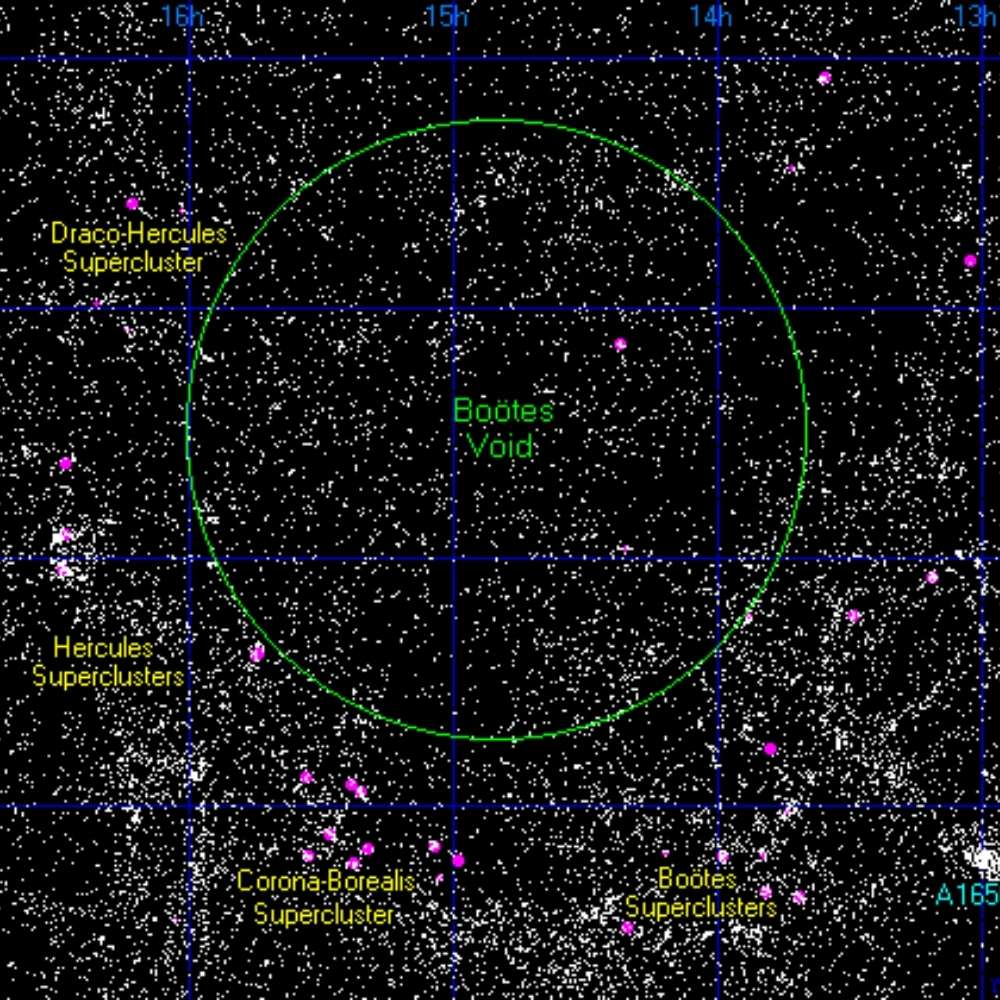
| Real Image | There is no single ordinary photograph of the void. It is mainly shown through galaxy maps, redshift surveys, and scientific visualizations. |
| Best Known For | Its enormous emptiness in a universe shaped by galaxy filaments, clusters, and superclusters. |
Note: A cosmic void is not an object like a planet, star, or black hole. It is identified by mapping where galaxies are unusually sparse across deep space.
Introduction: What Is the Boötes Void?
The Boötes Void, often called “The Great Nothing,” is a vast cosmic void located in the direction of the Boötes constellation. It is not a black hole, planet, galaxy, or empty hole in space. Instead, it is a huge low-density region where galaxies are much rarer than expected compared with the surrounding cosmic web.
Spanning about 330 million light-years across, the Boötes Void is one of the most famous large voids known in the observable universe. It was identified in 1981 through redshift survey observations, when astronomers found an unusually large region with very few galaxies inside it. Although it is often described as “empty,” the void is not completely empty; roughly several dozen galaxies have been found within its enormous volume.
The Boötes Void matters because it helps astronomers study how galaxies, clusters, filaments, and empty regions form across the universe. In the cosmic web, galaxies gather along dense filaments and clusters, while vast underdense regions like the Boötes Void remain comparatively empty. This makes it an important natural laboratory for understanding galaxy distribution, void formation, dark matter structure, and the large-scale architecture of the universe.
Where Is the Boötes Void Located?
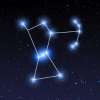
The Boötes Void is located in the direction of the Boötes constellation in the northern sky. This does not mean the void is inside the constellation in a physical sense. From Earth, it appears along the same line of sight as the stars that form Boötes, but it lies far beyond them in deep space.
Astronomers identify the Boötes Void by mapping the three-dimensional distribution of galaxies through redshift surveys. Its approximate sky position is often described around right ascension 14h 20m and declination +46°, although the exact boundaries depend on the survey and definition used.
In simple terms, the Boötes Void is not a visible object in the night sky. It is a vast galaxy-poor region discovered by measuring where galaxies are unusually sparse across a large volume of space.
How Far Is the Boötes Void from Earth?
The Boötes Void is located hundreds of millions of light-years away from Earth. It is commonly described as being roughly 700 million light-years away, although exact distance values can vary depending on how the void’s center, edge, and boundaries are defined.
Because the Boötes Void is not a single object like a galaxy or star, its distance is not measured in the same simple way. Astronomers study it as a large three-dimensional region, using galaxy redshifts to estimate where the surrounding galaxies and empty areas are located.
How Was the Boötes Void Discovered?
Redshift Surveys and the Surprise of Emptiness
The Boötes Void was discovered in 1981 during a galaxy redshift survey led by astronomer Robert Kirshner and his colleagues. The purpose of the survey was to map the three-dimensional positions of galaxies and understand how matter is distributed across the large-scale universe.
Redshift surveys help astronomers estimate how far away galaxies are by measuring how much their light has been stretched as the universe expands. When Kirshner’s team mapped galaxies in the direction of the Boötes constellation, they noticed an unusually large gap where very few galaxies appeared, even though a normal region of that size should have contained many more.
Follow-up observations showed that this was not caused by dust, telescope error, or missing data. It was a real underdense region in the cosmic web. This enormous galaxy-poor area became known as the Boötes Void, or the Great Nothing.
Later studies found that the Boötes Void spans hundreds of millions of light-years and contains only a small number of galaxies scattered across its vast volume. This discovery made it one of the best-known examples of a large cosmic void and an important subject in studies of galaxy distribution and cosmic structure formation.
Scale of Emptiness: How Big Is the Boötes Void?
The Boötes Void is often described as being about 330 million light-years across. This makes it one of the most famous large cosmic voids in the observable universe and a striking example of how unevenly galaxies are distributed across deep space.
Its enormous size becomes easier to understand when compared with familiar cosmic structures. The Local Group, which includes the Milky Way, Andromeda, and dozens of smaller galaxies, is only about 10 million light-years across. The Boötes Void is therefore not just a gap between nearby galaxies; it is a vast underdense region on a truly cosmological scale.
- Approximate diameter: about 330 million light-years
- Estimated volume: roughly 236,000 cubic megaparsecs
- Galaxy density: far below average, often described as less than 10% of normal cosmic galaxy density
- Galaxies inside: roughly 60 known or estimated galaxies scattered across the region
The void is not completely empty, but its galaxies are so widely separated that it appears extraordinarily sparse compared with the surrounding cosmic web. If a galaxy like the Milky Way were located deep inside such a void, nearby large galaxies would appear much farther away, and the universe beyond the void would be harder to recognize without modern telescopes and redshift surveys.
Is the Boötes Void a Black Hole?
No, the Boötes Void is not a black hole. A black hole is a compact object with extremely strong gravity, while a cosmic void is a vast low-density region where galaxies are unusually rare.
The Boötes Void does not pull everything into a central point, and it does not have an event horizon. It is simply a huge region of space where far fewer galaxies formed compared with denser parts of the cosmic web.
This distinction is important because the word “void” can sound like a dark hole or empty tunnel in space. In astronomy, however, a void means an underdense region, not a gravitational trap.
What Causes Such a Large Cosmic Void?
How Underdense Regions Form in the Cosmic Web
Large cosmic voids like the Boötes Void are thought to form from tiny density differences in the early universe. In regions where matter was slightly less concentrated, gravity pulled less material together. Over billions of years, surrounding matter moved toward denser areas, helping form galaxies, clusters, and filaments, while the underdense regions became emptier.
This process is part of the growth of the cosmic web. Galaxies tend to gather along dense filaments and walls, while the spaces between those structures become large voids. The Boötes Void is an extreme example of this pattern because it is unusually large and contains far fewer galaxies than expected for a region of its size.
Astronomers do not need a black hole or a single explosive event to explain a cosmic void. A void is not an object pulling matter away; it is a region where relatively little matter gathered in the first place. However, the size and emptiness of the Boötes Void make it useful for testing how well cosmological models describe the large-scale structure of the universe.
Possible Explanations for the Boötes Void
- Natural evolution of the cosmic web: The Boötes Void may be a rare but natural large underdensity that formed as matter flowed toward surrounding filaments and clusters.
- Merging of smaller voids: Several smaller void regions may have expanded and connected over time, creating a much larger galaxy-poor region.
- Early-universe density patterns: The void may reflect very early differences in matter distribution that grew larger as the universe expanded.
- Speculative physics: Some theoretical ideas discuss whether unusual voids could be connected to early-universe inflation or dark energy behavior, but these remain speculative and are not confirmed explanations for the Boötes Void.
The safest scientific explanation is that the Boötes Void formed through the same broad structure-building process that shaped the cosmic web, but on an unusually large scale. Its emptiness does not mean space is completely empty; it means galaxies are much more widely separated there than in ordinary cosmic regions.
Comparison with Other Cosmic Voids
The Boötes Void is one of the most famous large cosmic voids, but it is not the only enormous underdense region known or proposed in astronomy. Other voids, such as the Local Void, Eridanus Supervoid, and the proposed KBC Void, help scientists compare how empty regions vary in size, distance, density, and scientific interpretation.
| Void Name | Approximate Size | Scientific Status | Location / Direction |
|---|---|---|---|
| Boötes Void | About 330 million light-years across | Well-known large cosmic void with very low galaxy density | Direction of the Boötes constellation |
| Eridanus Supervoid | Often discussed as hundreds of millions of light-years across | Associated in some studies with the CMB Cold Spot, though interpretations vary | Direction of the Eridanus constellation |
| Local Void | Roughly 150 million light-years across | A nearby underdense region important for understanding local galaxy motions | Near the Local Group and Milky Way |
| KBC Void | Proposed to be about 2 billion light-years across | Large proposed local underdensity; its interpretation remains debated | Proposed around our broader local cosmic region |
Compared with these structures, the Boötes Void remains especially important because it is a clear and widely recognized example of a galaxy-poor region within the cosmic web. Its size, low density, and historical discovery make it a useful reference point when explaining how cosmic voids shape the large-scale structure of the universe.
Galaxies Inside the Boötes Void: Islands in a Cosmic Desert
The Boötes Void is not completely empty. Although it is famous for its enormous emptiness, astronomers have identified a small number of galaxies scattered across this vast region. Estimates often describe roughly 60 galaxies inside the void, which is far fewer than expected for a region about 330 million light-years across.
These galaxies are sometimes called void galaxies because they exist in unusually isolated environments. Unlike galaxies inside rich clusters or crowded filaments, void galaxies have fewer close neighbors, fewer major gravitational interactions, and less influence from dense cosmic environments. This makes them useful for studying how galaxies evolve when they are almost alone.
What Makes Void Galaxies Different?
- Isolated evolution: Galaxies inside voids can evolve with fewer mergers and fewer close gravitational encounters, allowing astronomers to study galaxy growth in quieter environments.
- High gas content: Many void galaxies may retain significant amounts of hydrogen gas, which can support continued star formation even in isolated regions.
- Smaller galaxy populations: Void environments often contain more small, faint, or low-mass galaxies than giant galaxy clusters do.
- Unusual structures: Because these galaxies are less shaped by crowded environments, some may show irregular forms, extended disks, or slower evolutionary histories.
One example often discussed in studies of void environments is HS 1442+4250, a blue compact dwarf galaxy located in the Boötes Void region. It is small but actively forming stars, showing that even in extremely underdense regions, galaxy formation and star formation can still occur.
This is why the Boötes Void is scientifically important. It does not represent a place where nothing exists at all; instead, it shows what galaxy evolution looks like in one of the sparsest known environments in the cosmic web.
Is There a Real Image of the Boötes Void?
There is no single ordinary photograph of the Boötes Void like there is for a planet, galaxy, or nebula. A cosmic void does not shine, reflect light, or have a visible surface. It is identified by mapping where galaxies are missing or unusually sparse.
Most images of the Boötes Void are therefore scientific maps, redshift survey diagrams, or conceptual visualizations. These visuals show the distribution of galaxies around the void and help reveal why this region is called the Great Nothing.
So when people search for a real picture of the Boötes Void, the most accurate result is usually a data-based map rather than a direct telescope photograph.
How Do Astronomers Observe a Void?
Observing a cosmic void like the Boötes Void is different from observing a galaxy, nebula, or star cluster. A void does not shine as a visible object. Instead, astronomers identify it by mapping where galaxies are missing or unusually sparse across a large region of space.
This is why there is no single ordinary photograph of the Boötes Void. Most images of the void are based on galaxy surveys, redshift maps, and scientific visualizations that show the distribution of galaxies around the empty region.
Key Methods Used to Study Cosmic Voids
- Redshift surveys: Astronomers measure the redshift of galaxies to estimate their distance and build three-dimensional maps of galaxy positions. Large gaps in these maps can reveal cosmic voids.
- Galaxy distribution mapping: Scientists use galaxy catalogs and void-finding algorithms to locate regions where galaxy density is far below average.
- Statistical analysis: Researchers compare observed galaxy patterns with cosmological simulations to check whether a void is a real large-scale structure or a result of limited survey coverage.
- Radio observations: Hydrogen surveys can help detect faint, gas-rich galaxies inside or near voids, including galaxies that may be difficult to find in visible-light images.
- Weak gravitational lensing: In some studies, tiny distortions in background galaxy shapes can help estimate how matter, including dark matter, is distributed around underdense regions.
- Cosmic microwave background studies: Very large voids may have subtle effects on CMB photons through gravitational processes, although these signals are difficult to measure and interpret.
In short, the Boötes Void is observed indirectly. Astronomers do not see a glowing boundary or a black empty sphere. They map the surrounding galaxies and identify the void as a vast region where far fewer galaxies exist than expected.
Why Are Voids Like Boötes Important to Science?
Cosmic voids may look like empty regions, but they are extremely valuable for understanding the universe. The Boötes Void helps astronomers study how matter is distributed across deep space, how galaxies form in isolation, and how the cosmic web developed over billions of years.
Because voids are shaped by gravity, expansion, and the surrounding distribution of matter, they provide important clues about cosmology, dark matter, dark energy, and galaxy evolution.
1. Testing Cosmological Models
The size, shape, and number of cosmic voids help scientists test models of the large-scale universe. If simulations can reproduce voids like the Boötes Void, they become more useful for understanding how galaxies, clusters, filaments, and empty regions formed after the Big Bang.
- Expansion history: Void patterns can help researchers study how the universe expanded over cosmic time.
- Dark energy: Since dark energy is linked to cosmic expansion, void statistics can help test how expansion affects large-scale structure.
- ΛCDM model: The Boötes Void helps astronomers compare real galaxy distributions with predictions from the Lambda Cold Dark Matter model.
2. Understanding Dark Matter Distribution
Voids are not completely empty. They may contain low-density dark matter structures, faint galaxies, gas, and matter that is difficult to observe directly. Studying voids helps scientists understand where dark matter is sparse and how gravity shapes both dense and underdense regions of the universe.
This is important because dark matter is not only found around galaxies and clusters. Its distribution also affects the spaces between them, including the large underdense regions of the cosmic web.
3. Studying Galaxy Evolution in Isolation
The Boötes Void also acts as a natural laboratory for studying galaxies in isolated environments. In dense clusters, galaxies are strongly affected by nearby neighbors, mergers, gas stripping, and gravitational interactions. Inside a void, galaxies experience fewer of these external effects.
- Isolated galaxy growth: Void galaxies can show how galaxies evolve with fewer mergers and close encounters.
- Star formation: Some void galaxies still form stars, helping scientists understand how gas and internal processes shape galaxy growth.
- Dwarf and faint galaxies: Voids may help reveal how smaller galaxies form and survive in low-density environments.
In this way, the Boötes Void is not just an empty region. It is a powerful scientific reference point for studying the hidden structure, history, and evolution of the universe.
Cosmic Web Context: Where Does the Boötes Void Fit?
The universe is not arranged randomly. On the largest scales, galaxies form a vast cosmic web made of interconnected structures. This web includes dense filaments filled with galaxies, clusters, and superclusters, as well as enormous underdense regions known as voids.
The Boötes Void is one of these major low-density regions. It lies between denser concentrations of galaxies and is bordered by the larger network of cosmic structures around it. In this sense, the Boötes Void is not an isolated mystery floating outside the universe’s structure. It is part of the cosmic web itself.
Main Parts of the Cosmic Web
- Filaments: Long, thread-like structures packed with galaxies, gas, and dark matter.
- Nodes: Dense intersections where filaments meet, often containing galaxy clusters or superclusters.
- Walls and sheets: Broad large-scale regions where galaxies form extended structures.
- Voids: Vast underdense bubbles between filaments, where galaxies are much more sparse.
The Boötes Void is one of the most famous examples of a large cosmic void. Its significance comes from how clearly it shows the contrast between crowded galaxy-rich regions and the enormous gaps between them. By studying this contrast, astronomers can better understand how matter has flowed through the universe over billions of years.
This overall pattern is explained by hierarchical structure formation. Small density variations in the early universe gradually grew under gravity. Matter collected into galaxies, groups, clusters, and filaments, while the less dense regions became emptier over time. The Boötes Void is therefore a product of the same large-scale process that built the cosmic web.
In short, the Boötes Void fits into the universe as one of the giant empty regions between the brighter, denser threads of the cosmic web. It helps reveal that the structure of the universe is shaped not only by where galaxies gather, but also by where galaxies are missing.
Cosmic Voids and the CMB Cold Spot
Large cosmic voids are sometimes discussed in relation to the Cosmic Microwave Background, or CMB, because very large underdense regions may have subtle effects on light traveling across the universe. The CMB is the ancient radiation left over from the early universe, and small temperature variations in it help scientists study cosmic structure.
The well-known CMB Cold Spot is more often associated with discussions about the Eridanus Supervoid than the Boötes Void. Because of this, the Boötes Void should not be described as a proven cause of the Cold Spot. However, it remains relevant to the broader scientific conversation about how supervoids may affect light, matter distribution, and large-scale cosmic maps.
One possible effect discussed in cosmology is the Integrated Sachs-Wolfe effect, where light from the CMB may gain or lose a tiny amount of energy as it travels through large gravitational structures, including underdense regions. These effects are subtle and difficult to measure, so scientists treat them carefully.
In this context, the Boötes Void is useful not because it directly explains the CMB Cold Spot, but because it provides a clear example of an enormous galaxy-poor region. Studying voids like Boötes helps astronomers understand how empty regions may influence cosmic observations on the largest scales.
Unanswered Mysteries About the Boötes Void
Even after decades of study, the Boötes Void still raises important scientific questions. Its enormous size, low galaxy density, and unusual emptiness make it a valuable target for astronomers studying cosmic voids, galaxy formation, and the large-scale structure of the universe.
The Boötes Void is not mysterious because it is supernatural or impossible. It is mysterious because scientists are still refining how such large underdense regions form, evolve, and fit into the cosmic web.
1. Is the Boötes Void One Single Structure?
One important question is whether the Boötes Void is a single large void or a connected region made from several smaller voids. In the cosmic web, neighboring voids can expand and merge over time, creating larger underdense zones.
If the Boötes Void is a combination of multiple smaller voids, it would fit naturally with models of cosmic structure growth. If it is closer to one coherent large underdensity, then it remains an especially striking example of how large voids can become in the universe.
2. Why Are There So Few Galaxies Inside?
Another mystery is why the Boötes Void contains so few galaxies compared with a normal region of similar size. Astronomers know that voids are underdense by nature, but the Boötes Void is famous because its galaxy population is extremely sparse.
Several possibilities may help explain this. The region may have had less matter available for galaxy formation from the beginning, or small galaxies inside the void may be faint and difficult to detect. Some dark matter halos may also exist there without forming bright, easily visible galaxies.
Future observations using deeper optical surveys, radio hydrogen surveys, infrared data, and weak-lensing studies may reveal more faint galaxies or hidden structures inside and around the void.
3. What Can the Boötes Void Teach Us About Early Structure Formation?
The Boötes Void may also help scientists study how tiny density differences in the early universe grew into today’s cosmic web. Very small differences in the early distribution of matter eventually became enormous differences between dense galaxy-rich regions and nearly empty voids.
Some theoretical ideas explore whether unusually large voids could provide clues about inflation, dark energy, or other early-universe processes. However, these ideas remain speculative. The safest view is that the Boötes Void is an extreme but scientifically useful example of cosmic web evolution.
4. Are There More Hidden Galaxies in the Boötes Void?
Because void galaxies can be faint, small, or gas-rich, it is possible that future surveys will identify additional galaxies inside the Boötes Void. Radio observations are especially useful because they can detect neutral hydrogen gas in galaxies that may not appear bright in visible light.
Finding more galaxies would not make the void disappear. Instead, it would help astronomers measure its true density more accurately and understand how galaxy formation works in one of the universe’s quietest environments.
These unanswered questions make the Boötes Void more than an empty region. It is a natural laboratory for studying the relationship between matter, gravity, galaxy formation, and the evolving structure of the universe.
What Happens If You Enter the Boötes Void?
If a spacecraft could somehow travel into the Boötes Void, nothing strange would happen instantly. The void is not a black hole, wormhole, or dangerous cosmic object. It is a very large region where galaxies are extremely far apart.
From inside the void, the universe would look much emptier. Nearby large galaxies would be far more distant than they appear from regions like our Local Group. The night sky would likely contain fewer bright external galaxies, making the surrounding cosmos seem unusually isolated.
The main difference would be perspective, not danger. The Boötes Void is scientifically fascinating because of its emptiness, not because it behaves like a destructive object.
Frequently Asked Questions About the Boötes Void
What is the Boötes Void?
The Boötes Void is a huge cosmic void, or low-density region of space, located in the direction of the Boötes constellation. It is famous because it contains far fewer galaxies than expected for such an enormous volume.
Why is it called the Boötes Void?
It is called the Boötes Void because it appears in the direction of the Boötes constellation in the northern sky. The void is not physically related to the nearby stars of Boötes; it only lies along the same line of sight from Earth.
Why is the Boötes Void called the Great Nothing?
The Boötes Void is often called the Great Nothing because it is an extremely large region where galaxies are unusually sparse. It is not completely empty, but compared with ordinary regions of the cosmic web, it contains very few galaxies.
Where is the Boötes Void located?
The Boötes Void is located in the direction of the Boötes constellation. It is a distant deep-space structure, hundreds of millions of light-years away from Earth, and is identified through galaxy maps and redshift surveys.
How big is the Boötes Void?
The Boötes Void is commonly described as being about 330 million light-years across. This makes it one of the most famous large cosmic voids known in the observable universe.
How many galaxies are inside the Boötes Void?
Estimates often suggest that roughly 60 galaxies exist inside the Boötes Void. This is far fewer than expected for a region of its size, which is why it is considered an extremely underdense cosmic region.
Is the Boötes Void completely empty?
No. The Boötes Void is not completely empty. It contains some galaxies, gas, dark matter, and large-scale structure, but its galaxy density is much lower than in normal regions of the universe.
Is the Boötes Void a black hole?
No. The Boötes Void is not a black hole. A black hole is a compact object with extremely strong gravity, while a cosmic void is a vast low-density region where galaxies are unusually rare.
Can we see the Boötes Void in the night sky?
No. The Boötes Void cannot be seen directly with the naked eye or as a visible object. Voids are identified by mapping where galaxies are missing or sparse. However, stars in the foreground Boötes constellation, such as Arcturus, can be seen from Earth.
Is there a real image of the Boötes Void?
There is no single ordinary photograph of the Boötes Void like a planet, galaxy, or nebula. Most images of the Boötes Void are scientific maps, redshift survey diagrams, or visualizations showing where galaxies are sparse.
What happens if you enter the Boötes Void?
Nothing unusual would happen instantly. The Boötes Void is not a dangerous object or black hole. If a spacecraft could travel there, it would simply be in a region where galaxies are extremely far apart and the surrounding universe would look much emptier.
Does the Boötes Void affect Earth or the Milky Way?
The Boötes Void has no direct effect on Earth or the Milky Way. It is far away and does not influence our Solar System. Its importance is scientific: it helps astronomers study galaxy distribution, cosmic expansion, and large-scale structure.
How does the Boötes Void compare to the Eridanus Supervoid?
The Boötes Void and Eridanus Supervoid are both large underdense regions, but they are discussed in different contexts. The Boötes Void is famous as a clear galaxy-poor region, while the Eridanus Supervoid is often discussed in relation to the CMB Cold Spot.
How do you pronounce Boötes Void?
Boötes is commonly pronounced “boh-OH-teez” or “boo-OH-teez.” The two dots over the second “o” show that the vowels are pronounced separately.
Related Cosmic Structures
The Boötes Void is part of the universe’s larger cosmic web, where galaxies, clusters, superclusters, filaments, and voids form a vast three-dimensional structure. To understand the Boötes Void more clearly, it helps to compare it with other large-scale cosmic regions and concepts.
Cosmic Web
Explore how galaxies form filaments, nodes, walls, and voids across the large-scale universe.
Dark Matter
Learn how invisible matter helps shape galaxies, clusters, filaments, and underdense regions.
Dark Energy
Understand the mysterious force linked to the accelerating expansion of the universe.
Laniakea Supercluster
See the enormous galaxy supercluster that includes the Milky Way’s broader cosmic neighborhood.
Local Group
Compare the galaxy group containing the Milky Way with much larger cosmic structures.
Eridanus Supervoid
Compare another famous supervoid often discussed in relation to the CMB Cold Spot.
These related structures show that the universe is shaped not only by bright galaxy-rich regions, but also by the vast empty spaces between them.
Final Thoughts: Why the Boötes Void Matters
The Boötes Void is more than a vast region with few galaxies. It is an important part of the universe’s large-scale structure and one of the clearest examples of how the cosmic web is shaped by both dense galaxy-rich regions and enormous underdense spaces.
By studying the Boötes Void, astronomers can better understand how galaxies form, how matter flows toward filaments and clusters, and how low-density regions evolve over billions of years. Its emptiness is scientifically valuable because it shows what happens in regions where gravity, matter, and galaxy formation operate very differently from crowded cosmic environments.
- It helps explain the cosmic web: The Boötes Void shows how empty regions fit between galaxy filaments, clusters, and superclusters.
- It supports galaxy evolution studies: Galaxies inside and near the void reveal how isolated galaxies grow with fewer interactions.
- It tests cosmological models: Its size and low density help scientists compare real galaxy maps with simulations of the universe.
Future galaxy surveys, radio observations, and deep-sky mapping projects may discover more faint galaxies inside the void and improve our understanding of its true shape and density. The Boötes Void reminds us that the universe is not defined only by what shines, but also by the vast spaces where galaxies are missing.