










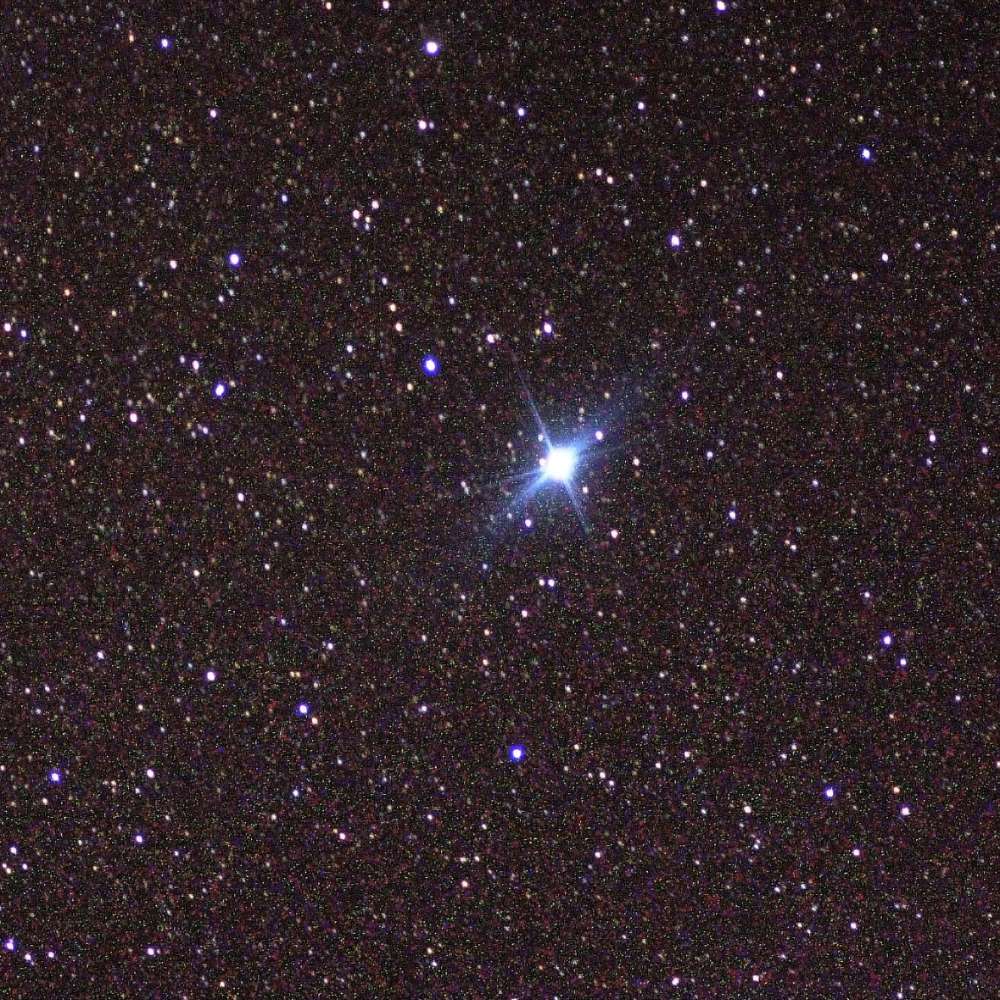
Canopus
The Second-Brightest Star in the Night Sky
Quick Reader
| Attribute | Details |
|---|---|
| Name | Canopus |
| Alternative Names | Alpha Carinae |
| Star Type | F0 II – Supergiant (Yellowish-White) |
| Constellation | Carina |
| Distance from Earth | ~310 light-years |
| Apparent Magnitude | –0.74 (2nd brightest star in the night sky) |
| Absolute Magnitude | –5.71 |
| Luminosity | ~10,000× the Sun |
| Radius | ~71× the Sun |
| Temperature | ~7,350 K |
| Age | ~10–20 million years (young but evolved quickly) |
| Notable Feature | Extremely bright supergiant used extensively for spacecraft navigation |
| Best Viewing Regions | Southern Hemisphere, lower Northern Hemisphere up to ~37°N |
| Best Viewing Season | December–March |
Introduction – The Guiding Flame of the Southern Sky
Canopus, or Alpha Carinae, is one of the most iconic stars in the entire night sky. As the second-brightest star after Sirius, it has captivated ancient navigators, astronomers, space agencies, and modern astrophysicists alike. Its brilliance, enormous luminosity, and position deep in the southern sky make it a defining feature of the Southern Hemisphere’s celestial landscape.
Located roughly 310 light-years away, Canopus is a yellow-white F-type supergiant—an evolved star that has already moved beyond the main sequence despite being only a few tens of millions of years old. Its size is extraordinary: nearly 70 times wider than the Sun and about 10,000 times more luminous. If placed at the center of our Solar System, Canopus would extend almost to the orbit of Mercury.
But Canopus is more than just a bright star. It has played a central role in:
Ancient maritime navigation
Arabic and Indian astronomical traditions
Modern spacecraft orientation systems (especially NASA missions)
Studies of stellar evolution, aging, and mass-loss processes
Its combination of brightness, distance, and supergiant properties make it a natural laboratory for understanding the late life stages of massive stars.
The Star’s Position and Visibility
Canopus lies in the southern constellation Carina, part of the larger Argo Navis region in ancient astronomy. Today, Carina is recognized as the keel of a ship—a fitting home for a star long used for navigation.
Visibility in the Southern Hemisphere
In most southern latitudes, Canopus is:
High in the sky
Extremely bright
Perfectly visible throughout the summer months
Its appearance near the zenith at mid-southern latitudes makes it a stable reference point for both sea and air navigation.
Visibility in the Northern Hemisphere
Although primarily a southern star:
Canopus can be seen from latitudes up to 37° north
Appears low on the southern horizon from locations such as the southern United States, North Africa, the Middle East, and southern China
Historically, this made Canopus especially important across ancient civilizations that lived in these regions.
Physical Properties of Canopus
Canopus is a supergiant undergoing rapid evolutionary change. Its physical characteristics reveal a star far more massive and advanced than our Sun.
Luminosity and Temperature
Luminosity: ~10,000 times the Sun
Surface Temperature: ~7,350 K
Color Index: Appears yellowish-white to the human eye
Energetics: Emits large amounts of UV and visible light
Despite being cooler than some blue-white supergiants, Canopus is extremely bright because of its immense size.
Size and Radius
Radius: ~71 times the Sun
If Canopus replaced our Sun, its surface would reach near Mercury’s orbit
Strong stellar winds blow significant amounts of material into space
This enormous size is a hallmark of stars transitioning into later evolutionary stages.
Mass and Age
Estimated mass: ~8–10 solar masses
Age: ~10–20 million years
Current stage: Post-main-sequence F-type supergiant
Stars of this mass live rapidly and die young. Canopus has already exhausted much of its hydrogen and expanded dramatically.
Evolutionary Status
Canopus offers astronomers a unique view of intermediate-mass stellar evolution. It is not massive enough to become a supernova immediately but is still evolving extremely fast.
Past
Canopus likely began its life as:
A hot, blue-white B-type star
With luminosity and mass significantly higher than middle-sized stars
Burning hydrogen at an accelerated rate
Present
Today Canopus is:
F0 II supergiant
Transitioning between hydrogen exhaustion and later helium-burning phases
Losing mass through a steady, high-speed stellar wind
This combination gives it its striking brightness and inflated radius.
Future
Canopus may eventually evolve into:
A red giant (temporarily)
A more luminous supergiant
A white dwarf with oxygen-neon-magnesium composition
Its final fate is most likely a massive white dwarf, not a supernova, since its mass is near but below the typical supernova threshold.
Why Is Canopus So Bright?
Canopus stands out not because it is close but because it is intrinsically powerful.
Reasons for its exceptional brightness:
Very large radius
High surface temperature
Extremely high luminosity
Strong internal fusion reactions
Stage of evolution that inflates supergiant stars dramatically
If Canopus were as close as Sirius (8.6 light-years), it would appear bright enough to cast shadows and be visible even in daylight.
Scientific Importance of Canopus
Canopus is invaluable to astronomy and space exploration for several reasons.
Calibration Star for Photometry
Because it is:
Extremely bright
Stable
Well-studied
Canopus is used as a standard candle for calibrating instruments and brightness measurement systems.
Stellar Evolution Model Benchmark
Its combination of:
Brightness
Intermediate mass
Supergiant status
makes Canopus a key object for building accurate models of:
Mass loss in evolved stars
Helium-burning phases
Surface convection in massive stars
Spacecraft Navigation
Perhaps most remarkably, Canopus is a navigation anchor for spacecraft.
Missions including:
Apollo (attitude alignment)
Voyager
Cassini
Pioneer
New Horizons
have relied on Canopus as a bright, easily identifiable star for orientation.
It is so bright and isolated on the sky that onboard star trackers easily lock onto it, even in noisy conditions.
Cultural and Historical Significance
Canopus has been revered across civilizations:
In Ancient Arabia
Canopus was known as Suhail and widely used for:
Navigating deserts
Predicting seasonal shifts
Because its rising heralded the peak of summer, it played a role in regional climate lore.
In Indian Astronomy
Known as Agastya:
Considered a sacred star
Symbol of purity and wisdom
Linked to the sage Agastya in mythology
The star’s rising was historically used to mark seasonal agricultural changes.
In Ancient Egypt
Canopus was associated with:
Navigation along the Red Sea
Timing of the Nile’s seasonal cycles
It was often considered a guardian of voyagers.
In Maritime Navigation
Before modern instruments:
Canopus served as a southern pole reference
Helped sailors determine latitude
Was a primary guide for Indian Ocean explorers and Polynesian navigators
Its brightness made it impossible to mistake.
Internal Structure and Fusion Processes of Canopus
Canopus is an evolved supergiant, and its internal structure reveals the dramatic transformation that massive stars undergo after leaving the main sequence. Unlike the Sun’s steady hydrogen-burning core, Canopus is transitioning through later stages of nuclear fusion.
Hydrogen Exhaustion and Core Contraction
Canopus originally spent millions of years fusing hydrogen into helium in its core.
But once that hydrogen was depleted:
The core contracted under gravity
Temperatures rose to several hundred million Kelvin
Pressure increased sharply
The outer layers expanded enormously
This expansion is what transformed Canopus into a yellow-white F-type supergiant.
Current Fusion Stage
The star is believed to be in a helium-burning or helium-shell-burning phase, meaning:
Its core may be fusing helium into carbon and oxygen
Hydrogen fusion continues in a surrounding shell
The outer envelope is loosely bound and highly extended
This layered structure is typical of stars moving toward the red giant or supergiant phases.
Stellar Envelope and Convection
The outer envelope of Canopus is:
Massive
Extended
Cool relative to the core
Highly convective
Convection cells carry energy outward from the hot interior, giving Canopus subtle variability. Though not classified as a classical variable star, it shows:
Small changes in brightness
Pulsation-like surface activity
Possible granulation patterns caused by convection
These variations make Canopus an important object for studying supergiant atmospheres.
Mass Loss and Stellar Winds
Massive stars lose material rapidly once they reach the supergiant stage. Canopus is no exception.
Stellar Winds
Canopus emits strong stellar winds that:
Eject material into interstellar space
Contribute to the enrichment of nearby clouds
Shape the star’s outer atmosphere
Cause gradual dimming over long timescales
These winds are driven by:
Radiation pressure
Pulsations in the envelope
The shallow gravitational binding of the outer layers
Rate of Mass Loss
Although estimates vary, Canopus may be losing mass at:
About 10 million times the Sun’s current solar wind rate
Enough that over a few million years, its mass will significantly decrease
This mass loss influences the star’s long-term evolution and leads toward its final stage as a dense stellar remnant.
Canopus in Different Wavelengths
Studying Canopus across the electromagnetic spectrum reveals details impossible to see in visible light.
Ultraviolet Observations
Canopus emits strong ultraviolet radiation due to:
Its high surface temperature
Exposed layers of the star’s atmosphere
Ionization zones in its outer layers
UV imaging helps astronomers measure:
Mass loss via stellar winds
Composition of hot plasma
Temperature structure of upper layers
Infrared Observations
Infrared wavelengths penetrate dust and reveal:
Mass-loss signature
Outer atmospheric layers
Possible circumstellar dust
Temperature gradients across the extended envelope
Infrared monitoring helps determine how the star cools and expands over time.
X-Ray Observations
Although not as strong a source as young massive stars, Canopus emits detectable X-rays due to:
Shockwaves from turbulent convection
Small magnetic activity zones
Colliding stellar wind flows
X-ray observations confirm that Canopus has a complex and dynamic atmosphere.
Why Spacecraft Use Canopus for Navigation
One of the most unique aspects of Canopus is its role in spaceflight guidance systems.
Brightness Makes It Easy for Star Trackers
Star trackers aboard spacecraft must identify stable, bright stars against the backdrop of space. Canopus is ideal because:
It is extremely bright (magnitude –0.74)
It stands alone in a relatively uncluttered part of the sky
It is easily detectable even with low-light sensors
Used in Many Historic Missions
Canopus has guided many missions, including:
Pioneer
Voyager
Galileo
Cassini
Apollo guidance systems
New Horizons
Its consistent position and brightness allow spacecraft to maintain accurate orientation thousands or millions of kilometers from Earth.
Redundant Navigation with Sirius
Often, star trackers pair:
Sirius (the brightest star)
Canopus (the second brightest)
This two-star system provides triangulation for spacecraft attitude control.
Comparison with Other Bright Stars
Canopus vs. Sirius
| Feature | Canopus | Sirius |
|---|---|---|
| Brightness | –0.74 | –1.46 (brighter due to closeness) |
| Distance | 310 light-years | 8.6 light-years |
| Type | Supergiant | Main-sequence binary (A1V + white dwarf) |
| Luminosity | ~10,000× the Sun | ~25× the Sun |
| Role | Space navigation, supergiant model | Reference star, nearest bright system |
Although Sirius appears brighter, it is far less luminous intrinsically.
Canopus vs. Rigel
| Feature | Canopus | Rigel |
|---|---|---|
| Spectral Type | F0 II | B8 I (blue supergiant) |
| Color | Yellowish-white | Blue-white |
| Luminosity | ~10,000× Sun | ~100,000× Sun |
| Temperature | ~7,350 K | ~12,000 K |
Rigel is larger and hotter, but Canopus is more prominent visually because of its sky position and stability.
Canopus vs. Betelgeuse
Betelgeuse is:
- Cooler
- Red
- More variable
- Much closer to supernova stage
Canopus is hotter and more stable, providing valuable contrast for studying supergiant evolution.
The Long-Term Fate of Canopus
Canopus is approaching the later stages of its stellar life.
Will It Go Supernova?
Probably not.
Although very massive, Canopus is likely just below the threshold needed to explode. It will instead:
Expand into a larger supergiant
Shed massive amounts of material
Collapse into a dense, hot oxygen-neon white dwarf
Timeline of Future Evolution
Millions of years from now:
Canopus will brighten further
Its outer layers will peel away
It will leave behind a massive white dwarf
Eventually, it will cool for billions of years
Because of its mass, the final white dwarf will be much larger and hotter than typical ones.
Cultural Mythology and Symbolism
Canopus holds deep cultural roots across various civilizations.
Middle Eastern Cultures
Called Suhail, meaning “smooth” or “brilliant”
Associated with desert navigation and seasonal markers
Used to predict extreme heat during summer
Indian Tradition
Known as Agastya
Symbol of sage Agastya, who was believed to purify oceans
Rising of Agastya star marked auspicious periods
Mentioned in ancient astronomy texts and literature
Chinese Astronomy
Named Laoren, “The Old Man Star”
Associated with longevity and wisdom
Considered lucky and protective
Egyptian and African Navigation
Canopus guided sailors along:
The Red Sea
The Indian Ocean
Coastal Africa
It functioned as a natural compass long before mechanical navigation existed.
Unresolved Mysteries and Current Scientific Questions
Although Canopus is one of the most studied bright stars, several aspects of its physics remain uncertain due to its distance, size, and complex atmospheric structure. Supergiants often defy simple models, and Canopus is no exception.
What Is the Exact Stage of Evolution?
Canopus is known to be an evolved supergiant, but:
Some models place it in a core helium-burning phase
Others suggest it is in a helium-shell-burning stage
A few propose it is transitioning into a late-stage supergiant before the asymptotic giant branch
The challenge lies in accurately modeling its internal layers, which cannot be directly observed.
Why Does Canopus Show Subtle Variability?
Although not a classical variable star, Canopus exhibits:
Minor fluctuations in brightness
Small changes in temperature
Slight shifts in spectral lines
Possible causes include:
Convective cell turnover in the stellar envelope
Mild pulsation modes
Magnetic field activity
Turbulent mass-loss regions
These subtle variations provide valuable insights into how supergiant atmospheres behave on short timescales.
How Fast Is Canopus Losing Mass?
Supergiants lose mass quickly through strong stellar winds, but Canopus’s exact mass-loss rate is still debated. The star’s outer layers are:
Extended
Highly convective
Loosely gravitationally bound
This makes it difficult to measure wind speeds and densities accurately. Upcoming ultraviolet and infrared missions may refine these values.
Does Canopus Have a Companion?
Although Canopus appears solitary:
Some early studies hinted at a potential faint companion
No companion has ever been confirmed
The star’s brightness and size make faint objects difficult to detect
Any companion would likely be a small red dwarf or white dwarf
This remains an open question, though modern observations strongly lean toward Canopus being a single-star system.
Canopus and the Structure of the Milky Way
As one of the most luminous nearby supergiants, Canopus serves as a marker for the structure of the southern Milky Way.
A Key Star in the Carina Region
Canopus is located in the rich region containing:
The Carina Nebula
Eta Carinae
Multiple open clusters
Dense star-forming clouds
This region traces the Sagittarius–Carina Arm, one of the Milky Way’s major spiral arms.
Standard Candle Potential
Because Canopus:
Has a stable brightness
Is extremely luminous
Has well-measured distance markers
…it can be used as a standard photometric reference for calibrating brightness scales in the southern sky. Although not used for cosmic distances, Canopus is a reliable reference point for calibrating instruments and models.
Mapping Southern Galactic Rotation
Canopus’s exact motion and radial velocity contribute to:
Understanding rotation of the Milky Way disk
Modeling the Carina arm’s local dynamics
Tracking the solar system’s movement relative to bright supergiants
Its proper motion across the sky is large enough to be measured precisely over decades.
Canopus in Human Exploration and Navigation
Ancient Navigation
For thousands of years, sailors relied on Canopus to:
Determine latitude
Track seasonal movements
Navigate oceans where the North Star was not visible
Its extreme brightness made it visible through thin clouds and haze, unlike many dimmer guide stars.
Modern Navigation
Even today, Canopus is used in:
Aviation navigation systems in the southern hemisphere
Long-distance sea navigation reference charts
Orientation for autonomous robotic systems
Spacecraft star trackers (one of its most iconic uses)
Unlike terrestrial navigation beacons, Canopus is:
Constant
Stable
Unaffected by weather or distance
This reliability makes it irreplaceable in precision guidance systems.
Observation Guide for Canopus
Because it is extraordinarily bright, Canopus is easy to find—but its visibility depends heavily on your latitude.
Best Visibility by Region
Southern Hemisphere: High overhead, extremely bright
Middle Northern Latitudes: Visible low in the south (only up to ~37°N)
Northern Europe, Canada, Russia: Not visible at all
How to Identify Canopus
Locate Sirius (brightest star).
Draw a mental line downward (southward) from Sirius.
Canopus lies below it, glowing intensely.
No telescope is necessary—Canopus is a naked-eye object.
Through a Telescope
Even though it is bright:
Appears as a sharp white-gold point
Shows diffraction spikes in telescopes with secondary mirrors
Filters are not required
Atmospheric turbulence may cause slight flickering when the star is low on the horizon
For astrophotographers, capturing Canopus is straightforward due to its strong brightness.
Frequently Asked Questions (FAQ)
Why is Canopus so bright?
Because it is a supergiant with a luminosity about 10,000× greater than the Sun, not because it is close. It appears brilliant even from 310 light-years away.
How long will Canopus live?
Canopus will last only a few million more years. Stars of this mass burn fuel rapidly and evolve quickly.
Will Canopus explode?
Unlikely. Its mass suggests it will not undergo a supernova. Instead, it will shed its outer layers and eventually become a very massive white dwarf.
Does Canopus have planets?
There is no confirmed evidence of planets. Detecting planets around supergiants is extremely difficult due to their size and variability.
Why is Canopus important for spacecraft?
Its brightness and isolated position allow star trackers to lock onto it easily for orientation in deep space.
Why is Canopus called Agastya?
In Indian astronomy, Canopus is identified with the sage Agastya, considered a purifier and a symbol of wisdom. Its rising was used to mark important seasonal events.
Final Scientific Overview
Canopus is an essential milestone in both astronomy and human exploration. As the second-brightest star in the night sky, it has served as:
A celestial guide for sailors and explorers
A reference point for spacecraft navigation
A benchmark for models of supergiant evolution
A marker of the Carina constellation and the structure of the Milky Way
Its immense size, luminosity, and brilliant glow make it stand out among nearby stars, offering a rare and valuable opportunity to study the life cycle of massive stars as they evolve into giants.
Though millions of years from now Canopus will fade into a massive white dwarf, today it shines as one of the most impressive stellar beacons in our cosmic neighborhood.