






Capella
The Golden Giant System of Auriga
Quick Reader
| Attribute | Details |
|---|---|
| Name | Capella |
| Bayer Designation | α Aurigae |
| System Type | Quadruple star system |
| Primary Components | Capella Aa (G-type giant), Capella Ab (G-type giant) |
| Spectral Classes | G8 III + G0 III |
| Distance from Earth | ~42.9 light-years |
| Combined Apparent Magnitude | 0.08 (sixth-brightest night-sky star) |
| Masses | Aa: ~2.7 M☉, Ab: ~2.6 M☉ |
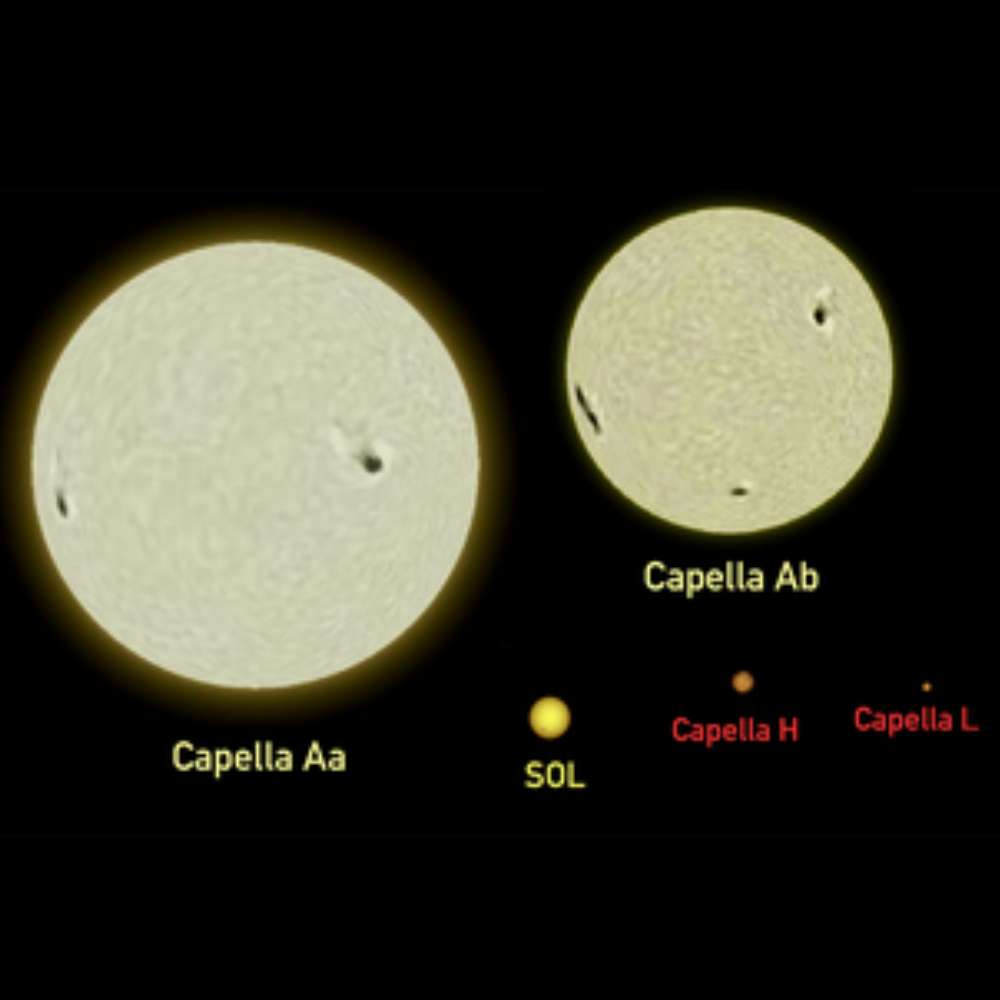
| Radii | Aa: ~11.9 R☉, Ab: ~8.8 R☉ |
| Luminosities | Aa: ~79 L☉, Ab: ~73 L☉ |
| Orbital Period (inner pair) | ~104 days |
| Outer Companions | Capella H & L (cool M-dwarfs) |
| Notable Feature | The brightest star in Auriga |
| Best Viewing Months | November to March |
Introduction – A System That Appears as One Star but Is Actually Four
Capella, the brightest star in the constellation Auriga, is one of the most interesting and complex stellar systems in the solar neighborhood. Although it appears as a single golden point of light to the naked eye, Capella is actually a quadruple star system, dominated by two bright G-type giants that orbit each other in just over 100 days.
With a combined apparent magnitude of 0.08, Capella ranks as the sixth-brightest star in the entire night sky. Its warm yellowish color and high brightness have made it a prominent object in navigation, mythology, and cultural astronomy for thousands of years.
The two giant stars at the heart of the system—Capella Aa and Capella Ab—are at different evolutionary stages, offering astronomers a rare and valuable opportunity to compare stellar evolution within a tightly bound binary pair.
The Main Pair: Two Giant Stars in a Close Orbit
The core of the Capella system consists of two evolved giant stars:
Capella Aa – A cooler G8 III giant
Capella Ab – A hotter G0 III giant
Both stars began their lives as A-type main-sequence stars more than 500 million years ago. After exhausting hydrogen in their cores, they expanded into giants. Although they are nearly equal in mass, they show different temperatures and radii because one has evolved slightly ahead of the other.
Capella Aa (G8 III)
Radius: ~11.9 R☉
Temperature: ~4,900 K
Luminosity: ~79 L☉
Evolutionary Stage: Red clump giant burning helium in its core
Capella Ab (G0 III)
Radius: ~8.8 R☉
Temperature: ~5,700 K
Luminosity: ~73 L☉
Evolutionary Stage: On the subgiant branch transitioning toward helium burning
Together, they form a tight pair that orbit each other every 104 days, separated by only about 0.74 AU—roughly the distance between the Sun and Venus.
Why Metal Pollution Matters
In most white dwarfs, heavy elements sink below the surface within days or years due to immense gravity. The presence of metals in Van Maanen’s Star’s atmosphere indicates recent accretion. The most likely source is:
Disrupted asteroids
Comet-like debris
Rocky planetary material
This suggests that the star may once have had a planetary system, and remnants of that system—asteroids or minor planets—still orbit the white dwarf, occasionally falling inward.
For astronomers, metal-polluted white dwarfs act as forensic archives, allowing reconstruction of the composition of ancient planetary bodies. Van Maanen’s Star, being nearby and bright in ultraviolet wavelengths, is an ideal target for such studies.
Why Capella Appears Golden
Capella’s warm golden color arises from the average temperature of its two main stars. With temperatures around 4,900 K and 5,700 K, the combined light falls into the yellow-white portion of the spectrum.
However, the color is slightly deeper than that of stars like the Sun or Procyon because:
The giants have broader, cooler atmospheres
Their spectral energy distribution peaks at longer wavelengths
Their combined luminosity enhances the richness of the hue
This is why Capella stands out as a golden beacon in the winter sky.
Importance of Capella in Stellar Evolution Models
Capella is one of the nearest giant-star binaries to Earth. Because the masses, radii, temperatures, and orbital parameters are known with exceptional accuracy, Capella serves as a cornerstone for testing stellar evolutionary models.
Astronomers use the Capella system to:
Compare the evolution of two nearly identical stars
Test helium-burning models in red clump giants
Understand how mass influences evolutionary timing
Study tidal interactions between giant stars
Calibrate stellar parameters for more distant giant stars
Its proximity and brightness make Capella one of the most precisely understood multi-star systems in the Milky Way.
Orbital Dynamics of the Giant Binary System
The inner pair of Capella—Capella Aa and Capella Ab—forms one of the most precisely measured stellar orbits known for giant stars. Their orbital period of about 104 days means the two stars revolve around a shared center of mass roughly every three months.
Key orbital characteristics:
Separation: ~0.74 AU
Eccentricity: Extremely low, nearly circular
Inclination: ~137°, allowing precise radial velocity measurements
Velocity: Each star moves at tens of kilometers per second around the barycenter
Because both stars are giant-class objects with expanded envelopes, tidal interactions have gradually circularized the orbit. These interactions also synchronize the rotation of the stars with their orbital motion, though not perfectly.
The Capella system is a prime example of how close binary stars evolve together, influencing each other’s rotation, magnetic fields, and outer layers.
Magnetic Activity and Coronal Emission
Even though Capella’s two main stars are giants, they show surprisingly strong magnetic and coronal activity—phenomena more commonly associated with younger, smaller stars.
This activity is visible through:
X-ray emission
Ultraviolet emission
Hot plasma confined by magnetic fields
Capella is one of the brightest non-solar X-ray sources in the sky, frequently observed by space telescopes like:
Chandra
XMM-Newton
ROSAT
The magnetic fields are likely maintained through:
Rapid rotation (enhanced by tidal forces)
Deep convective envelopes
Strong dynamo processes
Capella’s coronal studies help astronomers understand how magnetic activity persists in evolved stars.
The Evolutionary Paths of the Two Giant Stars
Even though Capella Aa and Capella Ab have nearly the same mass, they are in slightly different evolutionary stages.
Capella Aa – The More Evolved Giant
Currently in the red clump stage
Burning helium into carbon in its core
Exhibits stable luminosity and moderate expansion
Capella Ab – Slightly Younger in Evolution
Hotter and smaller than Aa
Transitioning from subgiant to helium-burning stage
Approaching the red clump phase, but not quite there yet
This difference—caused by small variations in mass—provides a rare laboratory for comparing how two nearly identical stars diverge as they evolve.
Capella’s Significance in Astrophysical Calibration
Because Capella is bright, close, and composed of stars with well-determined properties, it is frequently used as a calibration target in observational astronomy.
Areas where Capella is widely used:
Radial velocity calibration
Interferometric angular diameter measurements
High-resolution spectroscopy
X-ray and ultraviolet calibration
Its consistent brightness and well-known spectrum make it an ideal reference star for instruments and observational campaigns across the world.
The Outer Companions: Capella H and Capella L
Beyond the bright G-giant pair lies a distant pair of cool red dwarfs:
Capella H: M-dwarf
Capella L: M-dwarf
These small stars orbit the primary pair at a distance of over 10,000 AU, taking hundreds of thousands of years to complete one orbit.
Characteristics:
Very faint
Cool and low mass
Little influence on the giant binary
Their presence, however, confirms that Capella is a hierarchical quadruple system—one of the most stable multi-star configurations found in the solar neighborhood.
Capella in Culture, Navigation, and History
Throughout history, Capella has held special prominence due to its brightness and golden color.
Civilizations that referenced Capella:
Ancient Greeks and Romans, who linked it with the mythological goat Amalthea
Arab astronomers, who named it Al-Raqib, “The Watcher”
Polynesian navigators, who used it as a guide across the Pacific
Medieval European scholars, who associated it with the charioteer constellation Auriga
Because of its near-zenith position in northern latitudes during winter, Capella has been a dependable navigation marker for centuries.
Capella’s Role in Understanding Binary Star Evolution
Capella’s inner binary pair offers one of the clearest real-world examples of how binary systems evolve when both stars are of similar mass but slightly different ages.
Key lessons Capella provides:
Even small mass differences lead to notably different evolutionary speeds.
One star moves into the red clump phase sooner, while the other remains in a hotter, less expanded state.Tidal forces in close binaries affect rotation, magnetic activity, and energy distribution.
Binary interactions help circularize orbits and synchronize stellar spin.
The comparison of two giants in a single system helps refine models for intermediate-mass stars.
Capella thus serves as a benchmark for studying binary evolution in the era of modern stellar astrophysics.
How Capella Will Evolve in the Future
The two giant stars in Capella will eventually experience dramatic changes as they continue aging.
What lies ahead:
Capella Aa (the cooler giant)
Will continue burning helium until the core is depleted
Will expand again as it begins shell-burning heavier elements
Will eventually shed its outer layers
Will produce a planetary nebula
Will end its life as a white dwarf
Capella Ab (the slightly hotter, less evolved giant)
Will soon enter the red clump stage
Will follow a similar evolutionary path
Will also ultimately become a white dwarf
Over time, the system will end up with two white dwarfs orbiting each other. Their orbit may shrink extremely slowly due to gravitational wave radiation, but this process will take trillions of years—far longer than the current age of the universe.
Capella’s Place in the Night Sky
Capella is located in the constellation Auriga, the Charioteer. It dominates the winter sky in the Northern Hemisphere, rising high overhead in December and January.
Important sky notes:
It forms part of the Winter Hexagon, a large asterism including Sirius, Procyon, Rigel, Aldebaran, Pollux, and Capella.
It is one of the few bright stars nearly directly overhead for mid-northern latitudes.
Due to its brightness and color, Capella is easy to identify even in light-polluted cities.
Its near-circumpolar position for many northern observers also makes it visible throughout much of the year.
Frequently Asked Questions (FAQ)
Why does Capella appear as one star to the naked eye?
Because its two bright giants are extremely close together in the sky. Their combined light blends into a single point.
How far away is Capella?
Approximately 42.9 light-years.
Is Capella brighter than Vega?
No. Capella appears slightly dimmer than Vega but is still one of the brightest stars in the night sky.
Does Capella have planets?
As of now, no planets have been confirmed in the Capella system.
Why is Capella used for instrument calibration?
Its brightness, stable output, and well-studied spectrum make it ideal for calibrating telescopes and spectroscopic instruments.
Will Capella explode as a supernova?
No. The Capella giants are not massive enough. Both will eventually become white dwarfs.
Related Stars and Further Study
Arcturus – A nearby giant star used for comparative stellar modeling
Aldebaran – Another bright orange giant useful for spectral comparison
Pollux – A giant star with a confirmed exoplanet
Procyon A and B – A bright star with a white dwarf companion
Castor – A complex multiple-star system also located in Gemini
Studying Capella alongside these helps astronomers map the full range of stellar evolution among nearby stars.
Final Thoughts
Capella stands as one of the most scientifically and culturally significant stars in our sky. Though it looks like a single golden point of light, it is, in reality, an exquisite quadruple system with two giant stars at its heart. Their different evolutionary stages, precise orbital dynamics, and strong magnetic activity make Capella an essential object in astrophysics.
From the study of stellar evolution to its long history in navigation and mythology, Capella continues to shine as a guiding star—both scientifically and culturally. Its proximity and brightness will ensure that it remains one of the most important reference points in observational astronomy for centuries to come.