




Ceres
The Ocean-Bearing Dwarf Planet of the Asteroid Belt
Quick Reader
| Attribute | Details |
|---|---|
| Object Type | Dwarf planet |
| Location | Main Asteroid Belt (between Mars and Jupiter) |
| Discovery | 1801 |
| Discoverer | Giuseppe Piazzi |
| Mean Radius | ~473 km |
| Diameter | ~946 km |
| Orbital Period | ~4.6 Earth years |
| Rotation Period | ~9.1 hours |
| Density | ~2.16 g/cm³ |
| Composition | Rock, water ice, hydrated minerals, salts |
| Surface Ice | Water ice detected (localized) |
| Subsurface Brine | Strong evidence for salty liquid reservoirs |
| Core | Partially differentiated, rocky interior |
| Surface Age | Mixed (ancient + geologically young regions) |
| Notable Features | Occator Crater, bright salt deposits |
| Atmosphere | Extremely tenuous (transient water vapor) |
| Heat Source (Past) | Radiogenic heating |
| Astrobiology Potential | Moderate (chemical habitability) |
Key Highlights
- Largest object in the asteroid belt
- The only dwarf planet in the inner Solar System
- Contains significant water—possibly more than all freshwater on Earth
- Shows evidence of recent cryovolcanic activity
- Blurs the line between asteroid and planet
Introduction – Not an Asteroid, Not a Planet
For decades, Ceres was treated as just a large asteroid.
That view is now obsolete.
Ceres is a fully differentiated dwarf planet—a world with internal structure, chemical evolution, and signs of recent geological activity. It is neither rubble nor debris. It is a planetary body, quietly evolving in the middle of the asteroid belt.
Ceres forces a fundamental rethink of what the inner Solar System contains.
A World Apart in the Asteroid Belt
Ceres accounts for nearly one-third of the total mass of the entire asteroid belt.
This alone sets it apart.
Unlike most asteroids, Ceres:
Is spherical due to self-gravity
Possesses layered internal structure
Contains large amounts of water and salts
Ceres did not form as a fragment.
It formed as a world.
Internal Structure – A Partially Differentiated Body
Data from NASA’s Dawn mission revealed that Ceres is internally complex.
Current models suggest:
A rocky core
A thick icy–salty mantle
Residual brines trapped at depth
This structure indicates that Ceres experienced early internal heating, likely driven by radioactive decay, sufficient to allow partial melting and chemical separation.
Ceres is small—but not simple.
Water, Ice, and Brine – Ceres’ Hidden Reservoirs
Water defines Ceres.
Evidence includes:
Surface water ice at mid-to-high latitudes
Hydrated minerals across the crust
Salty deposits exposed at the surface
Detection of water vapor plumes (transient)
Most compelling is evidence for subsurface brines—salty liquids that can remain unfrozen at low temperatures.
Ceres may not host a global ocean like Europa, but it likely harbors localized liquid reservoirs even today.
Occator Crater – A Window into the Interior
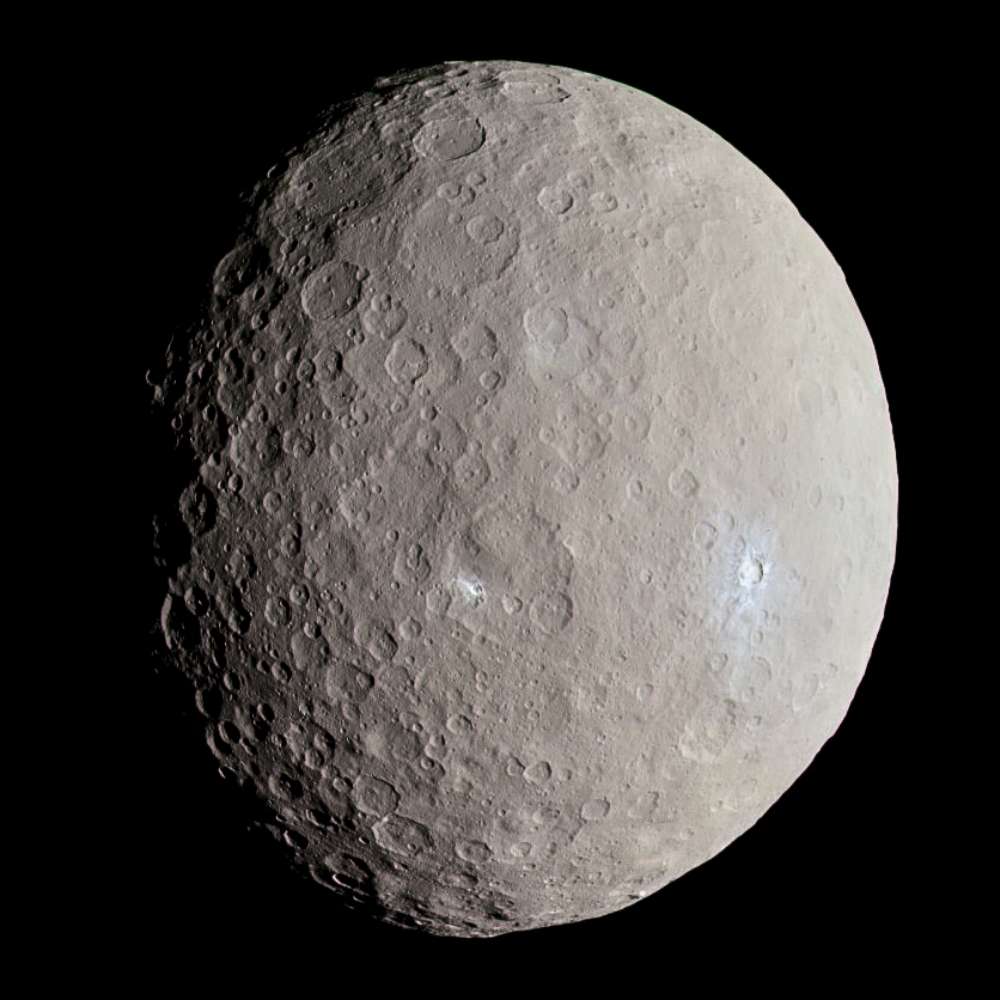
Occator Crater is Ceres’ most famous feature.
At its center lie bright deposits composed of:
Sodium carbonate
Ammonium salts
Other evaporite minerals
These salts could only have formed if liquid brine reached the surface and evaporated.
Crucially, some of these deposits are geologically young, indicating activity within the last few million years—extremely recent by planetary standards.
Ceres is not dead.
Cryovolcanism – Cold Volcanism on a Small World
Ceres does not erupt lava.
It erupts brine and ice.
Evidence suggests:
Cryovolcanic flows in the past
Gradual extrusion rather than explosive eruptions
Long-lived internal fluid mobility
This makes Ceres the smallest known body to show convincing cryovolcanic activity.
A Transient Atmosphere
Ceres lacks a true atmosphere, but it is not airless.
Observations show:
Episodic water vapor releases
Possible seasonal effects
Sublimation-driven processes
This “exosphere” reflects ongoing interaction between surface ice and space.
Why Ceres Matters
Ceres occupies a critical scientific position.
It helps answer:
How water was distributed in the early Solar System
Whether small worlds can remain geologically active
How planetary bodies transition between asteroid-like and planet-like states
Ceres is a chemical archive of the inner Solar System.
Ceres vs Asteroids vs Icy Moons – A Hybrid World
Ceres does not fit neatly into any single category.
It combines properties of rocky asteroids, icy moons, and dwarf planets.
Comparative Planetary Context
| Feature | Ceres | Typical Asteroid | Icy Moon (Europa-like) |
|---|---|---|---|
| Shape | Spherical | Irregular | Spherical |
| Internal Structure | Differentiated | Undifferentiated | Differentiated |
| Water Content | High (ice + brine) | Low to moderate | Very high |
| Geological Activity | Past + recent | Minimal | Active |
| Ocean | Local brines | None | Global |
| Atmosphere | Transient exosphere | None | Thin or none |
Ceres occupies a transitional zone between small bodies and full planetary systems.
Where Did Ceres’ Water Come From?
Ceres’ chemistry suggests it did not form where it currently resides.
Clues include:
Presence of ammoniated clays
Salts more typical of outer Solar System bodies
High volatile content for its location
Leading hypothesis:
Ceres formed farther from the Sun, possibly near the region of the giant planets, and migrated inward early in Solar System history.
If true, Ceres represents transported outer Solar System material embedded in the asteroid belt.
Radiogenic Heating – Enough to Change a World
Ceres is too small for tidal heating.
Its early evolution was driven by:
Radioactive decay of short-lived isotopes
Long-lived radiogenic heating
Internal melting and differentiation
This energy allowed:
Water–rock reactions
Chemical stratification
Formation of subsurface brines
While radiogenic heating faded, its effects persist.
Habitability – Chemistry Without Life
Ceres lacks key ingredients for life as we know it.
Limitations include:
No long-term global ocean
Limited energy flux today
No thick atmosphere
However, Ceres does meet several prebiotic criteria:
Liquid water (brines)
Organic-rich materials
Long-term chemical stability
Ceres may represent a pre-life laboratory, rather than a living world.
What Dawn Revealed – Redefining Small Worlds
The Dawn mission transformed our understanding of Ceres.
Major discoveries:
Global distribution of hydrated minerals
Evidence for ongoing brine activity
Young salt deposits
Complex internal layering
Before Dawn, Ceres was an anomaly.
After Dawn, it became a class-defining object.
Why Ceres Is Not Europa
Although both contain water, their evolutionary paths diverged.
Key differences:
Europa’s ocean is global and sustained by tidal heating
Ceres’ liquids are localized and radiogenic in origin
Europa’s environment is continuously energized
Ceres is chemically active but energetically limited
Ceres is quieter—but not simpler.
The Long-Term Future of Ceres – A Slowly Fading World
Ceres is not a frozen relic—but it is approaching dormancy.
Models suggest:
Radiogenic heating continues at very low levels
Subsurface brines may persist locally for long periods
Cryovolcanic activity will become increasingly rare
Ceres is transitioning from an active chemical world to a geological fossil, but that transition spans billions of years.
Will Ceres Ever Become Completely Inactive?
Eventually, yes—but not soon.
Factors that slow complete shutdown:
Salt-rich brines lower freezing temperatures
Insulating crust reduces heat loss
Low-level radioactive decay continues
These processes may keep pockets of liquid stable far longer than expected for a body of Ceres’ size.
Frequently Asked Questions (FAQ)
Is Ceres truly a dwarf planet?
Yes. It is massive enough to be spherical and has cleared its local region in a gravitational sense, but not its orbital zone.
Does Ceres have an ocean today?
Not a global ocean. Evidence supports localized subsurface brines.
Could life exist on Ceres?
Life is unlikely, but prebiotic chemistry is plausible.
Why are Ceres’ bright spots so reflective?
They are composed of highly reflective salts left behind by evaporating brines.
Is Ceres unique in the asteroid belt?
Yes. No other object in the belt shows comparable differentiation and activity.
Ceres and Planetary Classification
Ceres challenges rigid definitions.
It shows that:
Planetary behavior is not binary
Size alone does not determine complexity
Small worlds can evolve internally
Ceres sits at the boundary between asteroid and planet, redefining both.
Final Perspective
Ceres is a quiet world—but not a simple one.
In the heart of the asteroid belt lies a dwarf planet shaped by water, chemistry, and time. Its salty deposits and hidden brines tell a story of internal evolution that once seemed impossible for such a small body.
Ceres reminds us that planetary complexity does not require size—only the right ingredients and enough time.