






Chandra
Humanity’s Sharpest Eye on the High-Energy Universe
Quick Reader
| Attribute | Details |
|---|---|
| Mission Name | Chandra X-ray Observatory |
| Original Name | AXAF (Advanced X-ray Astrophysics Facility) |
| Space Agency | NASA |
| Mission Type | X-ray space observatory |
| Launch Date | 23 July 1999 |
| Launch Vehicle | Space Shuttle Columbia (STS-93) |
| Operating Orbit | Highly elliptical Earth orbit |
| Primary Wavelength | X-ray |
| Angular Resolution | ~0.5 arcseconds (exceptional) |
| Mission Status | Operational |
| Design Lifetime | 5 years (greatly exceeded) |
In two sentences
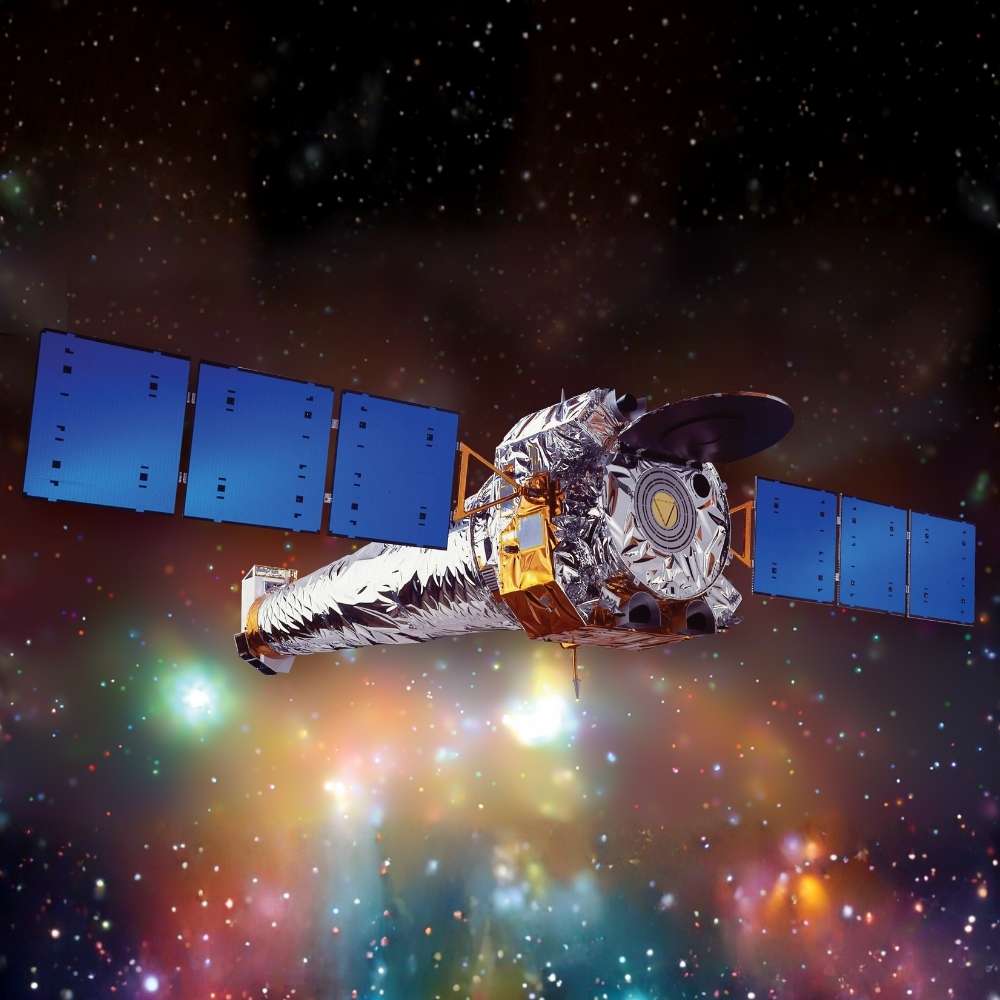
The Chandra X-ray Observatory is NASA’s flagship mission for high-resolution X-ray astronomy, designed to observe the universe’s hottest, most energetic, and most violent phenomena. Its unmatched sharpness allows astronomers to pinpoint X-ray sources with extraordinary clarity.
Key takeaway
Where XMM-Newton sees deep, Chandra sees sharp.
Best for
High-energy astrophysics, black holes, supernova remnants, neutron stars, and precision X-ray imaging.
Introduction – Seeing the Universe at Its Extremes
In visible light, the universe appears calm and orderly.
In X-rays, it is explosive, violent, and extreme.
Matter spiraling into black holes, shock waves from supernova explosions, and gas heated to millions of degrees all emit X-rays—radiation completely blocked by Earth’s atmosphere. Chandra was built to observe this invisible universe with unprecedented spatial precision.
Since its launch, Chandra has redefined what astronomers can resolve in high-energy space.
What Is the Chandra X-ray Observatory?
Chandra is a space-based telescope that:
Observes X-rays from extremely hot and energetic regions
Uses ultra-precise grazing-incidence mirrors
Produces the sharpest X-ray images ever obtained
Unlike optical telescopes that reveal appearance, Chandra reveals physical processes—where energy is released, matter is accelerated, and gravity dominates.
Why X-Ray Astronomy Requires Space Telescopes
X-rays cannot penetrate Earth’s atmosphere.
To observe them, a telescope must operate:
Above the atmosphere
In a stable radiation environment
With minimal Earth interference
Chandra’s orbit takes it far beyond Earth’s radiation belts, allowing long, uninterrupted observations with low background noise—ideal for faint and compact X-ray sources.
Mission Design – Precision Above All
Chandra was designed with one overriding goal: angular resolution.
Its mirror system:
Uses four pairs of nested grazing-incidence mirrors
Is polished to extreme smoothness
Achieves sub-arcsecond resolution
This allows Chandra to separate X-ray sources that would blur together in other observatories, making it the sharpest X-ray telescope ever built.
Chandra’s Core Instruments
ACIS – Advanced CCD Imaging Spectrometer
High-resolution X-ray imaging
Energy measurement of incoming photons
Ideal for supernova remnants, galaxies, and clusters
HRC – High Resolution Camera
Extremely fine spatial detail
Excellent for fast variability and compact objects
Transmission Gratings (HETG & LETG)
High-resolution X-ray spectroscopy
Measures temperature, composition, and motion of hot plasma
These instruments allow Chandra to combine imaging precision with physical diagnostics.
What Chandra Observes Best
Chandra excels at observing:
Black holes and accretion disks
Neutron stars and pulsars
Supernova remnants
Jets from active galaxies
Shock fronts in galaxy clusters
Its strength lies in resolving fine structure within complex, energetic environments.
Chandra and Black Hole Physics
Chandra has provided some of the most compelling evidence for black holes.
It can:
Isolate X-ray emission near event horizons
Resolve jets launched from galactic centers
Track hot gas falling into gravitational wells
These observations test predictions of general relativity and accretion physics in extreme regimes.
Why Chandra Is Still Scientifically Dominant
Despite launching in 1999, Chandra remains essential because:
Its angular resolution is still unmatched
Many discoveries require spatial precision, not raw sensitivity
Long-term datasets enable time-domain astrophysics
No newer mission has replaced Chandra’s unique niche.
Chandra in the Context of Modern Astronomy
Chandra complements other observatories:
XMM-Newton provides deep sensitivity
Chandra provides sharp detail
Future missions will combine both strengths
Together, they allow astronomers to study the universe across scales, from compact objects to galaxy clusters.
Chandra vs XMM-Newton – Precision vs Power
Chandra and XMM-Newton observe the same violent universe, but they are built for different scientific priorities.
| Feature | Chandra | XMM-Newton |
|---|---|---|
| Primary Strength | Extreme angular resolution | High photon-collecting power |
| Angular Resolution | ~0.5 arcseconds | ~6 arcseconds |
| Best For | Fine spatial structure | Faint, distant sources |
| Field of View | Smaller | Larger |
| Typical Science | Jets, shock fronts, compact objects | Deep surveys, spectroscopy |
Interpretation
Chandra shows where things happen.
XMM-Newton shows how much is happening.
Many of the most influential results come from joint Chandra–XMM analyses.
Why Angular Resolution Changes Everything
In X-ray astronomy, poor resolution can blend multiple sources into one.
Chandra’s sharpness allows astronomers to:
Separate crowded X-ray sources in galaxies
Resolve fine shock fronts in supernova remnants
Distinguish black hole emission from surrounding hot gas
Track narrow jets emerging from galactic nuclei
This level of detail is essential for understanding structure, cause, and evolution.
Supernova Remnants – Watching Stellar Death Up Close
Chandra has revolutionized the study of supernova remnants.
It can:
Resolve expanding shock waves
Map temperature and chemical composition
Identify neutron stars left behind
Iconic examples include detailed imaging of the Crab Nebula and Cassiopeia A, where Chandra reveals how stellar explosions shape their surroundings.
Black Holes and Relativistic Jets
Chandra has provided unprecedented views of jets launched by black holes.
Key insights include:
Jets extending thousands of light-years
Knots and shock structures within jets
Interaction between jets and intergalactic gas
These observations show how black holes influence their environments far beyond their immediate vicinity.
Galaxy Clusters and Dark Matter
Chandra plays a crucial role in studying galaxy clusters—the largest bound structures in the universe.
It observes:
Hot intracluster gas emitting X-rays
Shock fronts from cluster mergers
Cavities carved by black hole activity
By mapping hot gas distribution, Chandra helps infer the dark matter framework that holds clusters together.
The Bullet Cluster – A Landmark Discovery
One of Chandra’s most famous observations is the Bullet Cluster.
This system showed:
Hot gas separated from the bulk of mass
Gravitational lensing tracing unseen matter
Strong evidence for dark matter’s existence
Chandra’s X-ray data was essential in identifying where normal matter resides—making the case for dark matter stronger than ever.
Neutron Stars and Extreme Matter
Chandra observes neutron stars to probe matter under extreme density.
It can:
Measure surface temperatures
Map magnetic field effects
Track cooling rates over time
These data constrain the equation of state of ultra-dense matter—physics impossible to replicate on Earth.
Time-Domain X-Ray Astronomy
Chandra’s long operational life enables time-based studies.
It has tracked:
Supernova remnant expansion over decades
Variability in active galactic nuclei
Long-term changes in pulsars and binaries
Time-domain data turns snapshots into movies of cosmic evolution.
Why Chandra Remains Irreplaceable
Even with newer missions planned, Chandra remains essential because:
No current telescope matches its spatial resolution
Many discoveries require precise source separation
Its data archive spans more than two decades
Chandra’s niche is so specific that it has not been superseded—only complemented.
Chandra’s Long-Term Legacy
Chandra has reshaped high-energy astrophysics more than any other X-ray mission.
Its legacy includes:
The sharpest X-ray images ever produced
Definitive observations of black hole jets and shock fronts
Key evidence supporting the existence of dark matter
Long-term monitoring of energetic cosmic systems
Many textbook examples of X-ray astronomy are Chandra images—a rare distinction for any observatory.
Why Chandra Data Will Remain Valuable
Even after operations end, Chandra’s impact will continue.
This is because:
Spatial resolution cannot be retroactively improved
Long time-baseline data is irreplaceable
Many objects evolve slowly over decades
Future missions will compare their observations against Chandra’s archive to understand change, not just structure.
How Long Can Chandra Continue Operating?
Chandra remains operational well beyond its original design lifetime.
Key factors:
Instruments remain scientifically productive
Careful fuel and thermal management
Reduced—but controlled—operational load
NASA continues to operate Chandra in extended-mission mode, with science planning optimized to preserve its unique capabilities as long as possible.
Chandra and the Future of X-Ray Astronomy
Chandra bridges generations of missions.
It connects:
Earlier observatories (Einstein, ROSAT)
Contemporary missions (XMM-Newton, NICER)
Future observatories (Athena, Lynx concept)
Future X-ray missions aim to combine Chandra’s sharpness with XMM-Newton–level sensitivity, guided directly by lessons learned from Chandra.
Why Chandra Will Not Be “Replaced” Easily
Replacing Chandra is difficult because:
Achieving its mirror precision is extremely challenging
High-resolution X-ray optics are expensive and complex
Few missions prioritize angular resolution over sensitivity
As a result, Chandra occupies a unique and enduring niche in astronomy.
Frequently Asked Questions (FAQ)
What makes Chandra different from other X-ray telescopes?
Chandra’s defining feature is its extreme angular resolution, allowing it to resolve fine structures that blur together in other X-ray observatories.
Is Chandra still operational today?
Yes.
Chandra continues to operate and produce valuable scientific data, far beyond its originally planned mission lifetime.
Why was Chandra launched by the Space Shuttle?
The Space Shuttle allowed Chandra’s large and delicate mirror system to be safely deployed into its complex, highly elliptical orbit—something not easily achievable with rockets at the time.
Can Chandra observe black holes directly?
No telescope can see a black hole itself.
Chandra observes X-rays emitted by hot gas and jets near black holes, allowing scientists to infer their presence and properties.
How did Chandra help prove the existence of dark matter?
Chandra’s X-ray observations of galaxy clusters, especially the Bullet Cluster, showed that hot gas (normal matter) is separated from the main gravitational mass—strong evidence for dark matter.
What will succeed Chandra in the future?
No single mission fully replaces Chandra.
ESA’s Athena and proposed missions like Lynx aim to build on its legacy, but Chandra’s resolution remains unmatched.
Why is Chandra important for Universe Map readers?
Chandra reveals how energy, gravity, and matter interact at their most extreme—connecting black holes, galaxy evolution, and cosmic structure into a single physical story.
Chandra in the Context of Cosmic Understanding
Chandra shows that the universe is not static.
It reveals:
Shock waves shaping galaxies
Black holes influencing entire clusters
Energy flowing across cosmic scales
Through X-rays, Chandra exposes the engine room of the universe.
Related Topics for Universe Map
XMM-Newton
Athena Mission
Black Holes
Neutron Stars
Supernova Remnants
Galaxy Clusters
Dark Matter
These topics together define high-energy astrophysics.
Final Perspective
Chandra does not show the universe as it appears—it shows the universe under stress.
Where gravity crushes matter, where stars explode, and where black holes dominate their surroundings, Chandra brings clarity to chaos. Its images are not just scientifically precise; they are foundational records of how the high-energy universe truly works.
Chandra stands as a reminder that sometimes, seeing more clearly matters more than seeing more deeply.