








Chandrayaan-2
India’s Most Ambitious Lunar Exploration Mission
Quick Reader
| Attribute | Details |
|---|---|
| Mission Name | Chandrayaan-2 |
| Space Agency | ISRO (Indian Space Research Organisation) |
| Launch Date | 22 July 2019 |
| Launch Vehicle | GSLV Mk III |
| Mission Type | Orbiter + Lander + Rover |
| Primary Target | Moon (South Polar Region) |
| Orbiter Status | Operational (extended science mission) |
| Lander | Vikram (hard landing) |
| Rover | Pragyan (not deployed) |
| Key Focus | Polar science, water ice, lunar geology |
Scientific Role
Chandrayaan-2 is India’s first mission to conduct long-term, high-resolution lunar science from orbit, with special emphasis on the Moon’s south polar environment.
Why It Matters
Despite the lander loss, Chandrayaan-2’s orbiter became one of the most capable lunar science platforms in operation, significantly advancing global understanding of lunar water, minerals, and polar conditions.
Introduction – Why Chandrayaan-2 Was a Turning Point
Chandrayaan-2 represented a major leap for India’s space program.
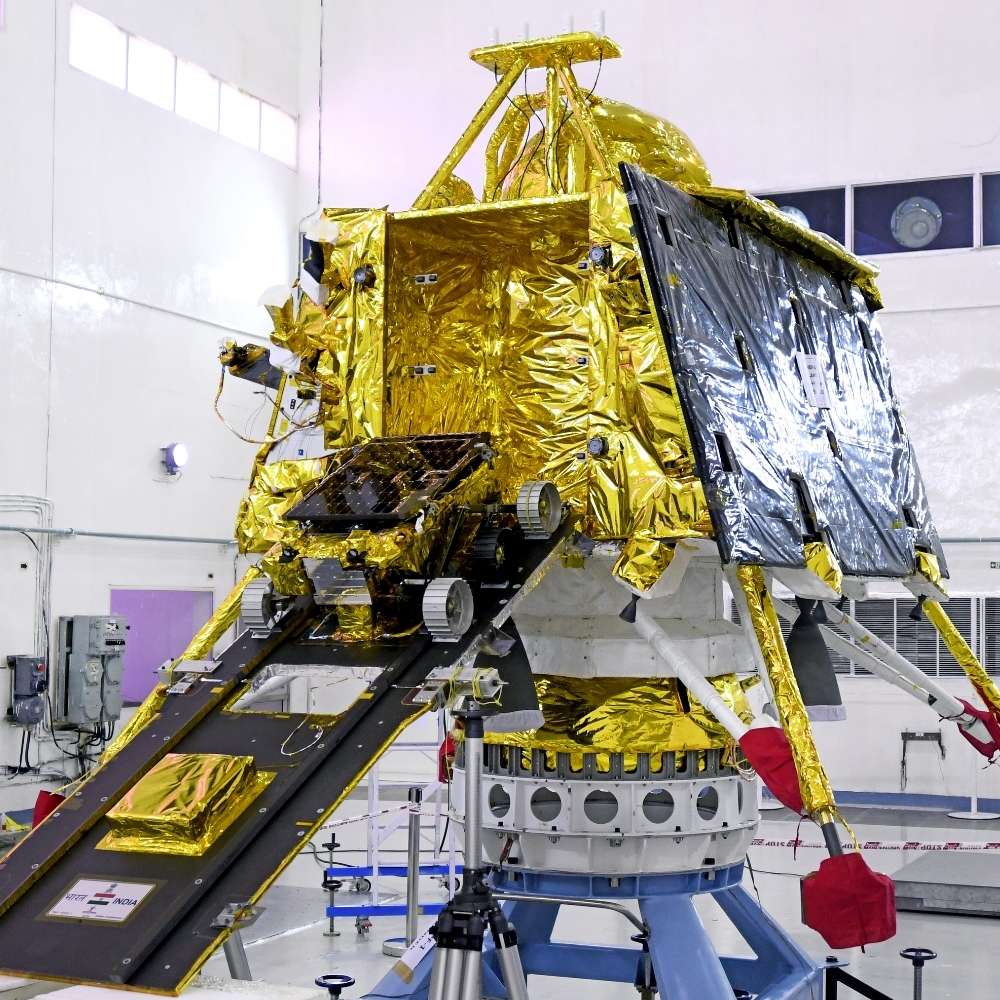
It was not designed as a single-objective mission, but as a complete lunar exploration architecture—orbiter, lander, and rover—aimed at the most challenging region of the Moon.
The mission’s ambition was clear:
Attempt a soft landing near the lunar south pole
Study permanently shadowed regions
Expand India’s role from reconnaissance to surface exploration
Even though the lander did not succeed, Chandrayaan-2 did not fail as a mission. Its orbiter continues to deliver high-impact science that reshaped lunar research.
Mission Architecture – Three Elements, One Vision
Chandrayaan-2 was designed as an integrated system.
Orbiter
Long-term lunar science platform
High-resolution imaging and spectroscopy
Acts as data backbone of the mission
Vikram Lander
Intended for soft landing near the south pole
Technology demonstrator for precision landing
Pragyan Rover
Designed for short-range surface exploration
In-situ elemental analysis
This architecture placed Chandrayaan-2 among a small group of missions attempting full-spectrum lunar exploration.
Why the South Pole Was the Target
The Moon’s south polar region is scientifically and strategically unique.
Key reasons for targeting it:
Presence of permanently shadowed craters
Extremely low temperatures
High likelihood of water ice preservation
Unlike equatorial regions explored during Apollo, the south pole offers:
Long periods of sunlight on certain ridges
Natural cold traps for volatiles
Ideal conditions for sustained exploration
Chandrayaan-2 was India’s entry into polar lunar science, an area of global priority.
The Orbiter – The Real Success of Chandrayaan-2
While public attention often focuses on the lander, the orbiter is the mission’s scientific core.
Orbiter capabilities include:
Higher spatial resolution than many previous lunar orbiters
Extended mission lifetime
Advanced spectroscopic instruments
The orbiter now functions as:
A standalone lunar science mission
A contributor to global lunar datasets
A complementary platform alongside missions like LRO
Key Instruments on the Chandrayaan-2 Orbiter
| Instrument | Primary Function | Scientific Importance |
|---|---|---|
| OHRC | Ultra-high-resolution imaging | Landing site analysis, geology |
| TMC-2 | Stereo terrain mapping | 3D surface models |
| IIRS | Infrared spectroscopy | Mineral & water detection |
| DFSAR | Dual-frequency radar | Subsurface ice investigation |
| CLASS | X-ray spectroscopy | Elemental composition |
| ChACE-2 | Atmospheric analysis | Lunar exosphere studies |
This payload suite allows Chandrayaan-2 to study the Moon from surface to subsurface.
Water and Ice – Chandrayaan-2’s Scientific Core
One of Chandrayaan-2’s most important objectives is refining our understanding of lunar water.
Its instruments are capable of:
Detecting hydroxyl and water molecules
Identifying ice beneath the surface
Distinguishing rock roughness from ice signatures
Early results reinforced the idea that:
Water-related signatures are widespread
Polar regions are especially enriched
The Moon’s water cycle is more dynamic than previously thought
Why Chandrayaan-2 Still Matters
Chandrayaan-2 matters because it:
Advanced lunar polar science significantly
Provided independent confirmation of water signatures
Demonstrated India’s deep-space mission capability
Contributed high-value data despite partial mission loss
It showed that mission success is measured by science return, not headlines.
The Vikram Lander – Ambition Meets Reality
The most dramatic phase of Chandrayaan-2 was the Vikram lander’s descent toward the lunar south polar region.
Vikram was designed to:
Perform autonomous hazard avoidance
Execute a controlled soft landing
Deploy the Pragyan rover for surface science
During descent, the lander successfully completed:
Rough braking phase
Attitude control adjustments
Initial navigation updates
However, in the final moments, communication was lost, and Vikram experienced a hard landing.
What Went Wrong – A Controlled Failure, Not a Collapse
Post-mission analysis showed that:
Vikram deviated from its planned trajectory during fine braking
Velocity reduction did not remain within safe limits
Guidance and control parameters exceeded tolerance
Importantly:
The mission was not a launch failure
The lander reached the lunar surface region as planned
Valuable descent data was transmitted until the final phase
This event became one of the most data-rich landing attempts ever made, despite not achieving a soft touchdown.
Why the Vikram Attempt Still Matters
The Vikram landing attempt provided:
Real-world data on autonomous lunar descent
Critical lessons for control algorithms
Engineering insights into polar terrain challenges
These lessons directly informed:
Improved navigation logic
Enhanced landing redundancy
Future mission risk mitigation
In space exploration, such partial failures often become stepping stones, not dead ends.
Chandrayaan-2 Orbiter – Science Continues
While attention focused on Vikram, the orbiter quietly exceeded expectations.
It continues to:
Map the Moon at high resolution
Study mineral distribution
Investigate subsurface ice
The orbiter’s longer-than-planned lifespan allowed:
Extended polar observations
Seasonal illumination analysis
Cross-mission data comparison
In many respects, Chandrayaan-2 evolved into a pure science powerhouse.
Key Scientific Contributions from Orbit
Water and Hydroxyl Mapping
Detected widespread OH/H₂O signatures
Showed variation with latitude and illumination
Strengthened the case for lunar water cycling
Subsurface Ice Evidence
Dual-frequency radar indicated ice-consistent signals
Especially strong near permanently shadowed regions
Mineralogy and Geology
High-quality infrared spectra refined lunar rock classification
Improved understanding of crustal composition
These findings complemented and expanded earlier missions.
Chandrayaan-2 vs Chandrayaan-1
| Feature | Chandrayaan-1 | Chandrayaan-2 |
|---|---|---|
| Mission Type | Orbiter | Orbiter + Lander + Rover |
| Polar Focus | Limited | Primary target |
| Water Detection | Discovery-level | Quantitative mapping |
| Resolution | Moderate | High to ultra-high |
| Mission Complexity | Low | Very high |
Chandrayaan-2 represented a strategic leap, not a simple continuation.
Chandrayaan-2 vs LRO – Complementary, Not Redundant
| Aspect | Chandrayaan-2 | LRO |
|---|---|---|
| Primary Role | Polar science & ice | Global mapping & safety |
| Radar Capability | Dual-frequency | Single-band |
| Imaging Focus | Ultra-high-resolution | Operational mapping |
| Mission Philosophy | Scientific exploration | Exploration infrastructure |
Together, these missions form a global lunar observation network.
How Chandrayaan-2 Shaped Chandrayaan-3
The lessons from Vikram were not theoretical.
They directly led to:
Redesigned landing algorithms
Enhanced sensors and redundancy
More conservative descent profiles
Chandrayaan-3’s success is inseparable from Chandrayaan-2’s experience.
Long-Term Legacy – How Chandrayaan-2 Changed Lunar Science
Chandrayaan-2’s true impact is best measured over time, not at the moment of landing.
Despite the loss of Vikram, the mission:
Delivered a high-performing lunar orbiter
Generated independent, high-quality polar datasets
Strengthened international confidence in India’s deep-space capabilities
Today, Chandrayaan-2 is regarded as a scientifically successful mission with critical engineering lessons, not a failed attempt.
Why the Orbiter Became a Global Asset
The Chandrayaan-2 orbiter continues to operate as a standalone lunar science mission.
Its data is valuable because it:
Offers higher spatial resolution in selected regions than many predecessors
Provides dual-frequency radar insights unavailable on most missions
Focuses strongly on polar science, where future activity is expected
The orbiter’s longevity transformed it from a support component into a primary contributor to global lunar research.
Chandrayaan-2 and the Modern Understanding of Lunar Water
One of the mission’s most lasting contributions is its refinement of lunar water science.
Chandrayaan-2 showed that:
Water-related signatures are not rare or localized
Polar regions concentrate ice more effectively
Subsurface ice may exist beyond permanently shadowed craters
This shifted scientific thinking from:
“Is there water on the Moon?”
to
“How is lunar water distributed, stored, and cycled?”
That shift is foundational for future exploration.
Engineering Lessons That Enabled Chandrayaan-3
Chandrayaan-2’s landing attempt directly shaped the success of Chandrayaan-3.
Key lessons included:
Tighter guidance and control constraints
Improved real-time navigation feedback
Greater redundancy in landing systems
Chandrayaan-2 provided real descent data under polar conditions, something simulations alone cannot replace.
In planetary exploration, this type of data is often more valuable than a flawless first attempt.
Frequently Asked Questions (FAQ)
Was Chandrayaan-2 a failed mission?
No. While the lander did not achieve a soft landing, the orbiter succeeded and continues to produce high-impact science.
Is Chandrayaan-2 still operating?
Yes. The orbiter remains operational under an extended mission phase.
Did Chandrayaan-2 confirm water ice on the Moon?
It provided strong, multi-instrument evidence for water-related materials, especially in polar regions, strengthening earlier findings.
Why focus on the lunar south pole instead of the equator?
The south pole contains cold traps, potential ice reserves, and regions with long-duration sunlight, making it ideal for sustained exploration.
How did Chandrayaan-2 influence future missions?
Its scientific results and engineering lessons directly informed Chandrayaan-3 and contribute to international lunar planning efforts.
How does Chandrayaan-2 compare globally?
It stands alongside missions like LRO as a key contributor to modern lunar science, especially in polar research.
Chandrayaan-2 in the Global Lunar Context
Chandrayaan-2 occupies a unique role:
More ambitious than early reconnaissance missions
More science-focused than purely operational orbiters
A bridge between discovery and sustained exploration
It demonstrated that meaningful scientific progress does not require perfection—it requires persistence, analysis, and iteration.
What We Would Not Know Without Chandrayaan-2
Without Chandrayaan-2:
Polar ice distribution would be less constrained
Dual-frequency radar insights would be missing
High-resolution polar mineral maps would be incomplete
Chandrayaan-3’s landing success would have been far less likely
This makes Chandrayaan-2 a critical enabler mission, even beyond its own objectives.
Related Topics for Universe Map
Moon
Lunar South Pole
Chandrayaan-1
Chandrayaan-3
Lunar Water Ice
Polar Exploration Missions
LRO (Lunar Reconnaissance Orbiter)
Together, these topics explain how lunar exploration evolved from reconnaissance to readiness.
Final Perspective
Chandrayaan-2 was not a mission defined by a single moment—it was defined by continuity.
It proved that:
Scientific success can outlast engineering setbacks
Ambitious exploration accelerates learning
Orbital science can be as transformative as surface operations
Chandrayaan-2 did not end with a landing—it expanded India’s role in humanity’s return to the Moon and reshaped how polar lunar science is conducted.
That legacy continues, orbit by orbit.