











Chariklo
The Ringed Centaur That Redefined Small Bodies
Quick Reader
| Attribute | Details |
|---|---|
| Name | 10199 Chariklo |
| Object Type | Centaur (minor planet) |
| Discovery Year | 1997 |
| Discoverer | James V. Scotti |
| Orbital Region | Between Saturn and Uranus |
| Semi-Major Axis | ~15.8 AU |
| Orbital Period | ~63 Earth years |
| Orbital Eccentricity | Moderate |
| Orbital Inclination | Low to moderate |
| Estimated Diameter | ~250 km |
| Shape | Likely elongated |
| Rotation Period | ~7 hours |
| Surface Composition | Water ice, dark carbon-rich material |
| Surface Color | Neutral to moderately red |
| Rings | Yes (two narrow rings) |
| Ring Discovery | 2013 (stellar occultation) |
| Ring Names | C1R and C2R |
| Ring Composition | Likely water ice + dust |
| Activity | Inactive |
Key Points
- Chariklo is the first small body ever discovered with rings
- Its rings were detected indirectly through stellar occultation
- Chariklo is a Centaur, not a planet or dwarf planet
- The discovery proved that rings are not exclusive to giant planets
- Chariklo changed how scientists think about small-body dynamics
Introduction – A Discovery That Shocked Planetary Science
Before Chariklo, rings were thought to belong exclusively to giant planets.
Jupiter, Saturn, Uranus, and Neptune—these worlds had the gravity and scale needed to host stable ring systems. Small bodies, especially irregular ones like Centaurs, were never expected to possess rings.
Chariklo broke that assumption completely.
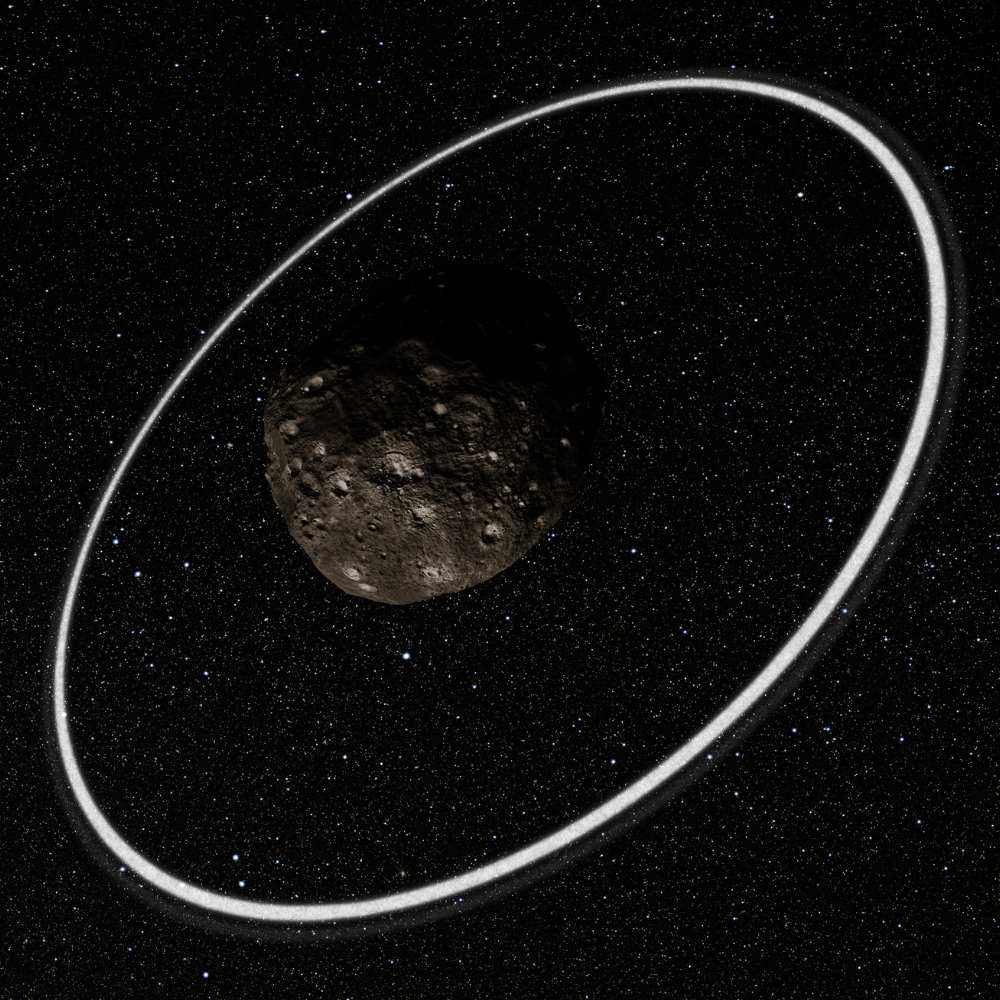
In 2013, observations revealed that this relatively small object—barely a few hundred kilometers across—was surrounded by two narrow, well-defined rings. This single discovery forced a major rethink of how rings form, survive, and evolve.
Discovery – A Typical Centaur at First
Chariklo was discovered in 1997 by James V. Scotti during observations of the outer Solar System.
At the time:
It appeared to be an ordinary Centaur
No unusual brightness variations were noticed
It showed no cometary activity
For more than a decade, Chariklo attracted little special attention.
That changed dramatically in 2013.
What Is a Centaur?
Centaurs are small bodies that:
Orbit between Jupiter and Neptune
Have unstable, chaotic orbits
Are thought to originate in the Kuiper Belt
They are transitional objects—neither asteroids nor comets, but potential precursors to Jupiter-family comets.
Chariklo is one of the largest known Centaurs, which may be key to its unusual properties.
The Ring Discovery – A Stellar Occultation Surprise
Chariklo’s rings were discovered using a method called stellar occultation.
How It Worked
Chariklo passed in front of a distant star
The star’s light dimmed briefly
Unexpected secondary dips appeared before and after the main event
These dips were:
Symmetrical
Sharp
Reproducible
The only explanation: rings.
The Rings – Small, Sharp, and Stable
Chariklo has two narrow rings, designated C1R and C2R.
Ring Characteristics
Very thin and sharply defined
Likely composed of icy particles and dust
Orbit close to Chariklo’s equator
Possibly shepherded by small, unseen moons
Their narrowness suggests active confinement, otherwise they would spread out over time.
Why Rings Around a Small Body Are So Surprising
Chariklo’s gravity is weak compared to planets.
This raises immediate questions:
How did the rings form?
Why haven’t they dispersed?
How long can they survive?
Possible formation scenarios include:
Debris from a past collision
Material from a disrupted moon
Remnants of surface material lofted into orbit
None are fully confirmed.
Chariklo’s Size and Internal Structure
Chariklo’s relatively large size for a Centaur may be critical.
Key implications:
Stronger gravity than smaller Centaurs
Ability to retain orbiting debris
Possible differentiated interior
Its rotation and shape may also help stabilize the ring system.
Surface Properties – Less Extreme Than Pholus
Unlike Pholus, Chariklo does not have an ultra-red surface.
Its surface appears:
Neutral to moderately red
Mixed with water ice and dark material
Possibly altered by past resurfacing
This suggests Chariklo has experienced more surface evolution than Pholus.
Why Chariklo Is Scientifically Important
Chariklo demonstrated that:
Rings can exist around small bodies
Ring formation is not limited to planets
Small-body dynamics are more complex than expected
It opened the door to:
Ring searches around other minor planets
New models of debris confinement
A deeper understanding of Centaur evolution
Chariklo is a category-breaking object.
How Can Chariklo’s Rings Remain Stable?
The biggest mystery surrounding Chariklo is not the existence of rings—but how they survive.
Given Chariklo’s small size and weak gravity, its rings should spread out and dissipate relatively quickly. Yet observations show that the rings are narrow, sharply defined, and stable.
Key Stabilizing Factors
Equatorial alignment: The rings orbit close to Chariklo’s equatorial plane, minimizing perturbations
Low ring thickness: Thin rings reduce internal collisions
Possible shepherd moons: Small, unseen moons may confine ring particles
Slow orbital evolution: Chariklo’s current orbit avoids extreme tidal stresses
Among these, shepherd moons are considered the most likely explanation, though none have been directly detected.
The Role of Shepherd Moons
On Saturn, narrow rings are maintained by small moons that:
Gravitationally confine ring particles
Prevent spreading and collisions
Maintain sharp edges
A similar mechanism may operate at Chariklo—on a much smaller scale.
If shepherd moons exist:
They are likely only a few kilometers across
Extremely faint and difficult to detect
Orbit just inside or outside the rings
Their discovery would confirm that complex ring dynamics are not exclusive to planets.
Possible Origins of Chariklo’s Rings
Several formation scenarios have been proposed, none conclusively proven.
1. Collision Debris
A past impact ejected material into orbit
Debris settled into Chariklo’s equatorial plane
Larger fragments either re-accreted or escaped
This scenario fits the presence of narrow rings but requires a precisely tuned impact.
2. Disrupted Satellite
Chariklo once had a small moon
Tidal forces or collisions destabilized it
Debris formed rings
This explanation naturally produces:
Equatorial ring alignment
Long-lived ring material
However, no remnant moon has yet been observed.
3. Surface Material Lofting
Past activity or impacts ejected surface ice
Material entered temporary orbit
Rings formed as debris settled
This is less favored, as Chariklo shows no signs of strong past activity.
Comparison with Other Ringed Small Bodies
Chariklo is no longer alone.
Haumea
Dwarf planet in the Kuiper Belt
Possesses a confirmed ring
Ring aligned with its equator and rotation
Quaoar (candidate)
Evidence suggests possible ring material
Still under investigation
These discoveries suggest that rings around small bodies may be more common than once believed—especially among rapidly rotating or elongated objects.
Chariklo vs Haumea – Similarities and Differences
| Feature | Chariklo | Haumea |
|---|---|---|
| Object Type | Centaur | Dwarf planet |
| Diameter | ~250 km | ~1,600 km |
| Rings | Two narrow rings | One broad ring |
| Shape | Likely elongated | Highly elongated |
| Rotation | Moderate | Very rapid |
Despite large differences in size, both show that rotation and shape may be key factors in ring formation.
Chariklo’s Chaotic Orbit and Its Risks
Like all Centaurs, Chariklo’s orbit is dynamically unstable.
Influenced by Uranus and Saturn
Subject to close planetary encounters
Likely temporary on million-year timescales
Future encounters could:
Disrupt the ring system
Strip ring material away
Alter Chariklo’s rotation and shape
The rings may not survive indefinitely.
Why Chariklo Changed Centaur Science
Before Chariklo:
Centaurs were thought to be simple, inactive bodies
After Chariklo:
Structural complexity became undeniable
Ring formation had to be rethought
Small-body evolution gained new dimensions
Chariklo showed that even transitional objects can host delicate, planet-like systems.
The Long-Term Future of Chariklo
Chariklo exists in one of the most unstable regions of the Solar System. As a Centaur, its orbit is temporary on astronomical timescales.
Numerical models suggest that:
Chariklo’s current orbit may last only a few million years
Close encounters with Uranus or Saturn are inevitable
Its orbit could be drastically altered, or it could be ejected inward or outward
Chariklo’s future is not fixed—and neither is the fate of its rings.
How Long Can Chariklo’s Rings Survive?
The rings are delicate structures, especially around a small body.
Factors That Threaten Ring Survival
Gravitational perturbations during close planetary encounters
Collisions within the ring system
Loss of shepherd moons (if they exist)
Changes in Chariklo’s rotation or shape
Some models suggest the rings could survive:
Tens of thousands of years
Possibly up to a few million years under stable conditions
This means Chariklo’s rings may be temporary features, not permanent ones.
Could the Rings Reform?
Interestingly, ring systems may not be one-time events.
If Chariklo:
Experiences a future collision
Loses a small moon
Undergoes surface disruption
…it could potentially form new rings, even if the current ones are lost.
This suggests that ring formation around small bodies may be episodic, rather than singular.
Why Chariklo Matters for Planetary Formation Theory
Chariklo forced scientists to revise several long-held assumptions.
It demonstrated that:
Ring formation does not require a giant planet
Small-body gravity can sustain complex orbital systems
Transitional objects can host planet-like features
These insights influence:
Models of early Solar System debris disks
Understanding of satellite and ring formation
The evolution of minor planets
Chariklo bridges the gap between planetary-scale systems and small-body physics.
Frequently Asked Questions (FAQ)
Is Chariklo a planet or dwarf planet?
No. Chariklo is classified as a Centaur, not massive enough to qualify as a dwarf planet.
Are Chariklo’s rings visible in telescopes?
No. The rings are too small and faint to be directly imaged with current Earth-based telescopes.
Do Chariklo’s rings have names?
Yes. They are designated C1R and C2R, based on their discovery order.
Could Chariklo become a comet?
Yes. Like other Centaurs, Chariklo could evolve into a comet if its orbit shifts closer to the Sun.
Are rings common among Centaurs?
They were once thought to be extremely rare. After Chariklo and Haumea, scientists now believe they may be more common than previously assumed.
Chariklo in the Context of Small-Body Evolution
Chariklo connects several key populations:
Kuiper Belt objects
Centaurs
Ringed minor planets
By studying Chariklo, scientists gain insight into:
How debris behaves around small bodies
The role of rotation and shape in orbital stability
Transitional stages between distant icy worlds and active comets
Chariklo represents a missing link in Solar System architecture.
Related Topics for Universe Map
Centaurs
Pholus
Chiron
Haumea
Kuiper Belt
Ring systems in the Solar System
Together, these topics reveal how surprisingly complex even small Solar System bodies can be.
Final Perspective
Chariklo is a reminder that the Solar System still holds surprises—not at its center, but at its edges.
A small, unassuming Centaur turned out to host a delicate ring system once thought possible only around giant planets. In doing so, Chariklo reshaped our understanding of what small bodies can do and how dynamic the outer Solar System truly is.
Its rings may one day vanish, scattered by gravity or time. But Chariklo’s scientific legacy is permanent: it proved that complexity is not reserved for large worlds.