








Chiron
The Bridge Between Asteroids and Comets
Quick Reader
| Attribute | Details |
|---|---|
| Official Designation | (2060) Chiron |
| Classification | Centaur object |
| Discovery Date | 1 November 1977 |
| Discoverer | Charles T. Kowal |
| Discovery Location | Palomar Observatory |
| Orbital Region | Between Saturn and Uranus |
| Semi-major Axis | ~13.7 AU |
| Orbital Period | ~50.7 Earth years |
| Diameter | ~200–220 km |
| Surface Composition | Water ice, dust, organic materials |
| Activity | Comet-like outgassing observed |
| Atmosphere | Temporary coma (episodic) |
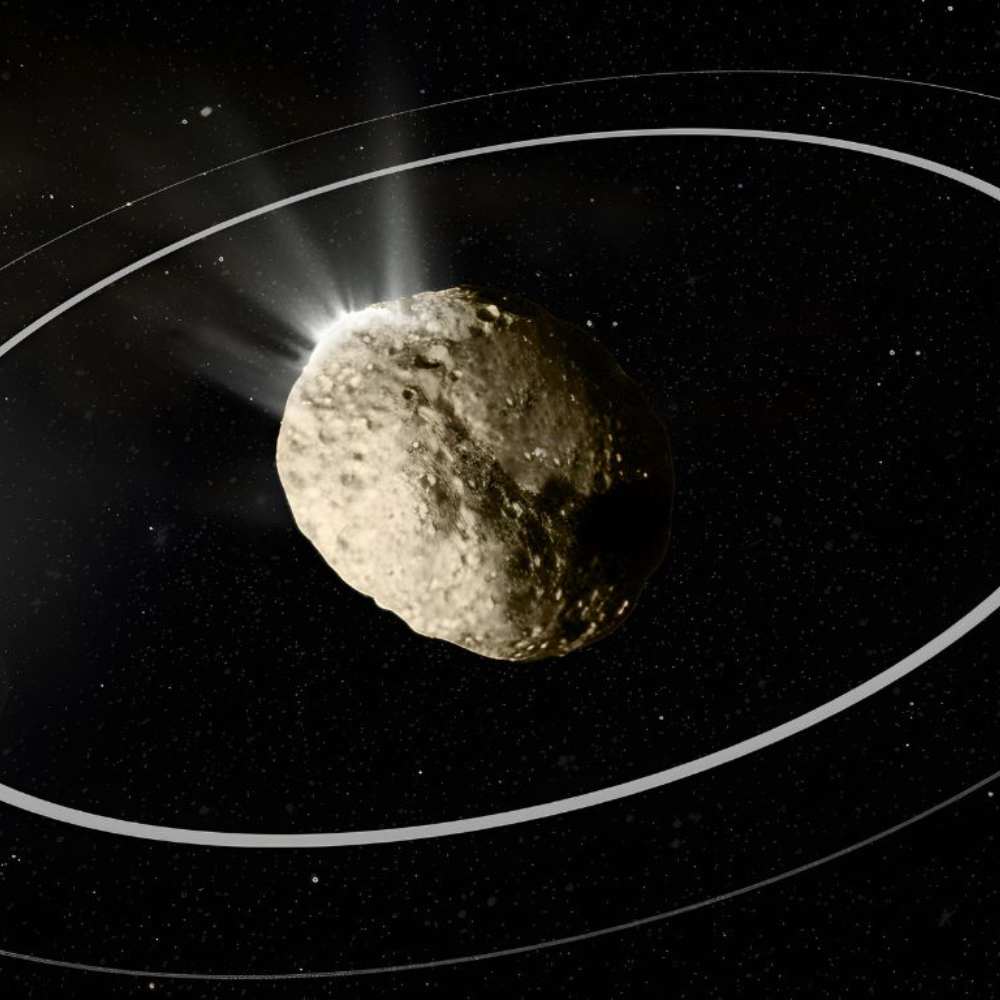
| Rings | Possible ring system detected |
| Dynamical Lifetime | Short (astronomically unstable) |
Introduction to Chiron – A World That Refused Classification
Chiron is one of the most important transitional objects ever discovered in the Solar System. Neither a typical asteroid nor a classical comet, Chiron occupies a chaotic region between Saturn and Uranus, where gravitational instability dominates.
When discovered in 1977, Chiron shattered existing categories. It was:
Too large to be a normal comet
Too active to be a standard asteroid
Chiron became the first recognized Centaur, a population of objects that act as messengers from the outer Solar System.
Discovery of Chiron and Its Immediate Impact
Chiron was discovered by Charles Kowal during a survey for distant Solar System objects. At the time, its orbit was unprecedented.
Key discoveries:
First object found orbiting between Saturn and Uranus
Larger than any known comet nucleus
Initially classified as an asteroid
This forced astronomers to reconsider how small bodies are classified.
Why Chiron Changed Solar System Taxonomy
Before Chiron:
Asteroids were rocky and inactive
Comets were icy and active
Chiron blurred this boundary.
Later observations revealed:
A faint coma
Episodic outgassing
Dust production far from the Sun
Chiron proved that activity is not limited to classical comets, especially for objects originating beyond Jupiter.
Chiron as the Prototype Centaur
Centaurs are objects that:
Orbit between Jupiter and Neptune
Are dynamically unstable
Likely originated in the Kuiper Belt
Chiron is the largest and most studied of this group.
It represents:
A temporary phase of orbital migration
A transition from Kuiper Belt object to Jupiter-family comet
A snapshot of Solar System recycling
Orbital Instability – A Temporary Resident
Chiron’s orbit is inherently unstable.
Characteristics include:
Strong gravitational perturbations from Saturn and Uranus
Chaotic orbital evolution
Eventual ejection, collision, or inward migration
On astronomical timescales, Chiron will not remain where it is. Its current orbit is temporary.
Size and Internal Composition
With a diameter over 200 km, Chiron is unusually large for an active small body.
This suggests:
A differentiated interior is possible
Significant ice reserves remain
Activity is driven by volatile sublimation
Chiron is more similar to a fragment of a dwarf planet than a classical comet.
Surface and Activity – Why Is Chiron Active?
Chiron shows activity at distances where water ice should not sublimate efficiently.
Possible drivers include:
Carbon monoxide (CO) or carbon dioxide (CO₂) sublimation
Crystallization of amorphous ice
Internal gas release
This makes Chiron a key object for studying non-water-driven cometary activity.
Rings Around Chiron – A Surprising Possibility
Observations suggest Chiron may possess a ring system, similar to Chariklo.
Evidence includes:
Stellar occultation data
Symmetric dimming events
If confirmed, this would make Chiron one of the smallest known bodies with rings, further complicating its classification.
Why Chiron Matters in Planetary Science
Chiron is scientifically critical because it:
Connects Kuiper Belt objects and comets
Demonstrates activity far from the Sun
Reveals transitional evolutionary stages
Challenges rigid object classification
Chiron is not an anomaly—it is a process in motion.
Why Chiron Matters (Big-Picture Context)
Chiron shows that the Solar System is not static. Objects migrate, transform, and change identity over time. By studying Chiron, astronomers observe planetary evolution as an ongoing process, not a finished structure.
Chiron vs Charon – A Common but Critical Confusion (Important Clarification)
One of the most frequent misunderstandings in planetary science content is the confusion between Chiron and Charon. Despite their similar names, these two objects are entirely unrelated in origin, orbit, and scientific role.
Key Difference in One Sentence
Chiron is a Centaur object orbiting the Sun, while Charon is a moon orbiting Pluto.
Chiron vs Charon – Side-by-Side Comparison
| Feature | Chiron | Charon |
|---|---|---|
| Object Type | Centaur (small body) | Natural satellite |
| Orbits | The Sun | Pluto |
| Location | Between Saturn and Uranus | Pluto system (Kuiper Belt) |
| Discovery Year | 1977 | 1978 |
| Discoverer | Charles Kowal | James Christy |
| Diameter | ~200–220 km | ~1,212 km |
| Activity | Comet-like outgassing | No cometary activity |
| Atmosphere | Temporary coma | None |
| Rings | Possible | None |
| Scientific Role | Asteroid–comet transition | Binary dwarf planet system |
Why This Confusion Matters Scientifically
Mixing up Chiron and Charon leads to:
Incorrect classification in educational content
Misleading search results and summaries
Errors in Solar System structure explanations
From an SEO perspective, “Chiron vs Charon” is a high-intent clarification keyword, often searched by students, educators, and astronomy readers.
Including this distinction improves:
Content accuracy
Topical authority
User trust (E-E-A-T signal)
Naming Origin – Similar Names, Different Roles
Both names come from Greek mythology, but their astronomical roles diverge sharply.
Chiron – A wise centaur, symbolizing a transitional being
Charon – The ferryman of the underworld, fitting Pluto’s mythological theme
The similarity is linguistic, not physical or dynamical.
Chiron vs Other Centaurs – Contextual Placement
To understand Chiron properly, it must be compared with other Centaurs, not moons.
| Object | Size | Activity | Rings | Role |
|---|---|---|---|---|
| Chiron | ~200 km | Yes | Possible | Transitional prototype |
| Chariklo | ~250 km | No | Confirmed | Ring-bearing Centaur |
| Pholus | ~185 km | No | No | Pristine Centaur |
| Nessus | ~60 km | Possible | No | Highly unstable |
Chiron stands out as the first discovered and most dynamically important Centaur.
Activity Mechanisms Revisited – Why Chiron Behaves Like a Comet
Unlike typical asteroids, Chiron shows episodic activity far from the Sun.
Likely mechanisms:
Sublimation of CO or CO₂
Crystallization of amorphous ice
Internal gas release
This confirms that comet-like behavior does not require proximity to the Sun.
Chiron’s Likely Origin – A Migrating Kuiper Belt Object
Dynamical models suggest Chiron:
Formed in the Kuiper Belt
Was scattered inward by Neptune
Temporarily trapped between giant planets
Chiron represents a short-lived evolutionary phase in small-body dynamics.
Why Chiron Is Central to Centaur Studies
Chiron is essential because it:
Defines the Centaur class
Demonstrates transitional evolution
Connects Kuiper Belt objects to Jupiter-family comets
Reveals volatile-driven activity in cold environments
Without Chiron, the Centaur population might not have been recognized as a distinct class.
The Future of Chiron – A Temporary Object by Nature
Chiron is not a permanent resident of its current orbit. Like all Centaurs, it exists in a dynamically unstable region of the Solar System.
Long-term simulations show that Chiron will eventually:
Be ejected from the Solar System
Collide with a giant planet
Or migrate inward and become a Jupiter-family comet
Its current orbit is likely to last only a few million years, a very short time astronomically.
Chiron’s Likely End State
The most probable future for Chiron is transformation rather than destruction.
Possible outcomes include:
Becoming an active comet closer to the Sun
Fragmentation due to thermal stress
Gradual loss of volatile material
Chiron represents a snapshot of an object in transition, not a final evolutionary stage.
Why Chiron Is Scientifically Rare
Most objects are observed either:
Before migration (Kuiper Belt objects)
Or after migration (classical comets)
Chiron is observed mid-journey, making it exceptionally valuable.
It allows scientists to:
Study volatile loss in real time
Observe orbital chaos directly
Understand how comet populations are replenished
Chiron’s Role in Solar System Recycling
The Solar System constantly recycles material.
Chiron participates in this cycle by:
Transporting ices inward
Feeding the comet population
Redistributing primitive material
Centaurs like Chiron act as delivery systems between distant reservoirs and the inner Solar System.
Chiron vs Typical Comets – Evolutionary Perspective
| Feature | Chiron | Typical Short-Period Comet |
|---|---|---|
| Size | Very large (~200 km) | Small (1–10 km) |
| Orbit | Between Saturn–Uranus | Jupiter-controlled |
| Activity Distance | Far from Sun | Near Sun |
| Lifetime | Millions of years | Thousands of years |
| Origin | Kuiper Belt | Kuiper Belt (processed) |
Interpretation:
Chiron is not a comet yet—but it may become one.
Why Chiron Matters for Planet Formation Models
Chiron helps constrain:
Early Solar System scattering events
Migration of giant planets
Survival of volatile-rich bodies
Without objects like Chiron, models of Solar System evolution would miss a critical transitional phase.
Frequently Asked Questions (FAQ)
What exactly is Chiron?
Chiron is a Centaur object—an icy body orbiting between Saturn and Uranus that shows comet-like activity.
Is Chiron a comet?
Not officially. Chiron behaves like a comet at times, but it is classified as a Centaur because of its orbit.
Is Chiron the same as Charon?
No. Chiron is a Sun-orbiting Centaur; Charon is Pluto’s moon. They are completely different objects.
Why is Chiron active so far from the Sun?
Its activity is likely driven by carbon monoxide or carbon dioxide sublimation, not water ice.
Does Chiron have rings?
Observations suggest it may have a ring system, but this has not yet been fully confirmed.
Will Chiron ever reach the inner Solar System?
Possibly. Orbital simulations show Centaurs often evolve into Jupiter-family comets.
Chiron’s Place in the Universe Map
Within the Universe Map framework, Chiron represents:
A transitional Solar System object
The prototype of the Centaur population
A bridge between Kuiper Belt objects and comets
Direct evidence of Solar System dynamical evolution
Chiron is best categorized as a process, not a destination.
Final Thoughts
Chiron is important not because it is large, bright, or famous—but because it is in motion. It captures the Solar System in the act of change, revealing that planets and small bodies alike are part of a continuous evolutionary flow.
By studying Chiron, we learn that classification is temporary—but physics is not.