



Deimos
The Smaller, Stranger Moon of Mars
Quick Reader
| Attribute | Details |
|---|---|
| Object Type | Natural satellite (moon of Mars) |
| Discovery | 1877 |
| Discoverer | Asaph Hall |
| Orbital Distance | ~23,460 km from Mars |
| Orbital Period | ~30.3 hours |
| Rotation | Synchronous (tidally locked) |
| Mean Radius | ~6.2 km |
| Shape | Irregular (non-spherical) |
| Mass | ~1.48 × 10¹⁵ kg |
| Density | ~1.47 g/cm³ |
| Composition | Carbonaceous material (C-type–like) |
| Surface Gravity | Extremely weak |
| Atmosphere | None |
| Surface Age | Very old, lightly cratered |
| Relationship to Mars | Slowly spiraling outward |
Key Highlights
- Smaller and smoother than Phobos
- One of the smallest moons in the Solar System
- Orbits farther from Mars and is dynamically calmer
- Likely formed alongside Phobos from shared material
- Represents a transitional body between asteroid and moon
Introduction – The Overlooked Moon
When people think of Mars’ moons, Phobos dominates the conversation.
Deimos is quieter, smaller, and easier to ignore—but scientifically, it may be more revealing.
While Phobos appears fractured and doomed, Deimos is stable and ancient. Its smooth surface and distant orbit suggest a very different evolutionary path. Deimos does not scream catastrophe—it whispers history.
To understand Mars’ moon system fully, Deimos is essential.
Discovery – Completing Mars’ Moon System
Deimos was discovered in 1877 by Asaph Hall at the U.S. Naval Observatory, just days after the discovery of Phobos.
Together, these discoveries:
Confirmed Mars has exactly two moons
Resolved centuries of speculation
Created one of the most unusual moon systems in the Solar System
Unlike Earth’s Moon or Jupiter’s satellites, Mars’ moons are tiny, irregular, and asteroid-like.
Physical Nature – A Moon That Refused to Become Round
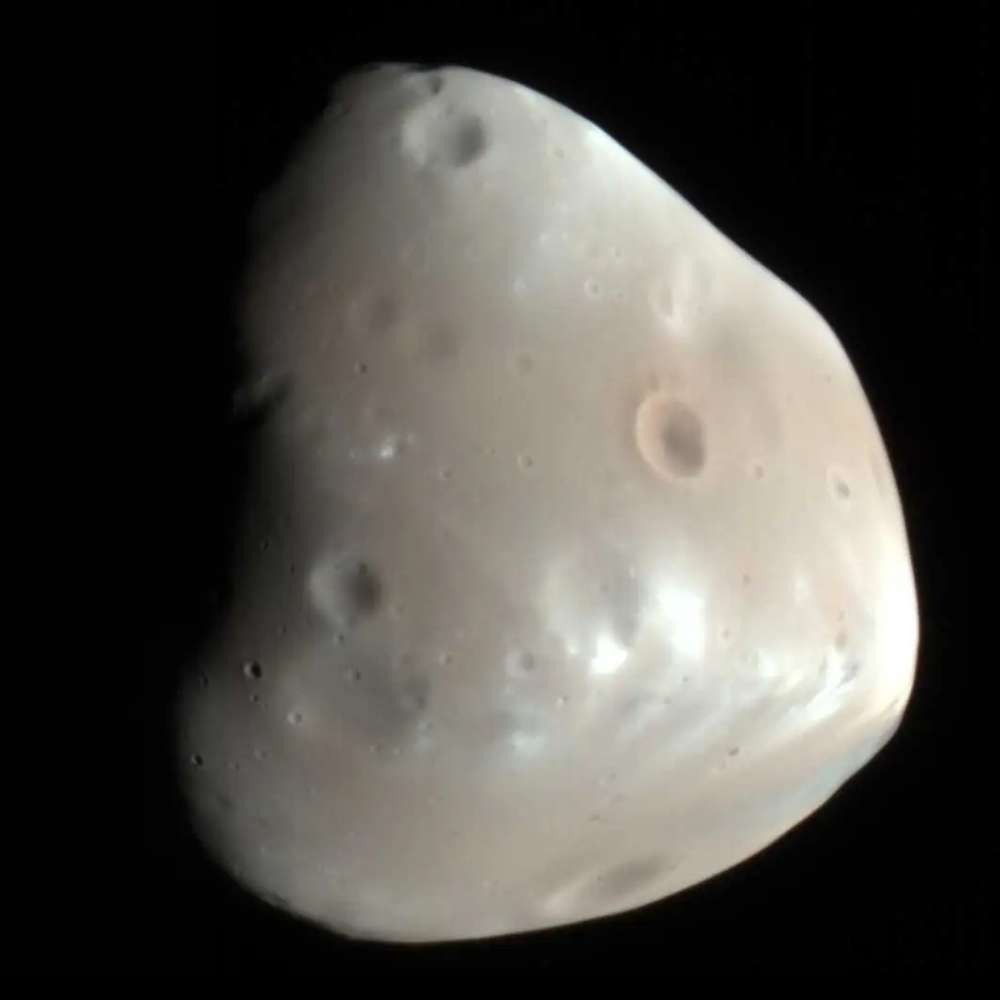
Deimos is far too small for gravity to shape it into a sphere.
Consequences of its size:
Irregular, potato-like shape
Weak internal cohesion
No geological differentiation
No internal heating
Deimos is essentially a single coherent body, not a layered world.
Its smoothness suggests minimal internal stress and a long, uneventful history.
Surface Features – Quiet and Ancient
Compared to Phobos, Deimos has:
Fewer large craters
No massive grooves or fractures
Broad, gently sloping regolith
This tells us:
Deimos has experienced fewer disruptive impacts
Its orbit has remained relatively stable
Surface renewal has been minimal
The largest crater, Voltaire, is modest relative to the moon’s size—evidence that Deimos avoided catastrophic collisions.
Orbit – Farther, Slower, Safer
Deimos orbits Mars at nearly three times the distance of Phobos.
This has major consequences:
Weaker tidal forces
Greater long-term orbital stability
Slow outward migration
Unlike Phobos, which is spiraling inward toward eventual destruction, Deimos is drifting away from Mars.
It is one of the few moons in the Solar System whose orbit is becoming more stable with time.
Composition – Asteroid-Like but Not an Asteroid
Spectral analysis shows that Deimos resembles carbonaceous asteroids, yet it does not behave exactly like a captured object.
Key observations:
Low albedo
Hydrated mineral signatures
Porous internal structure
However:
Its orbit is unusually circular
Its inclination closely matches Mars’ equator
These properties make simple asteroid capture unlikely, pushing scientists toward more complex formation scenarios.
Formation Mystery – Capture or Construction?
Deimos plays a central role in the debate over Mars’ moon origins.
Two leading models exist:
Captured asteroid hypothesis
Explains composition
Struggles with orbital properties
In-situ formation from debris disk
Explains orbit and alignment
Suggests material originated from Mars or nearby asteroids
Modern evidence increasingly favors a hybrid scenario, where debris from impacts formed a disk that later coalesced into Phobos and Deimos.
Deimos may be a constructed moon, not a captured one.
Why Deimos Matters
Deimos matters because it represents:
A stable endpoint of Mars’ moon evolution
A preserved record of early inner Solar System material
Evidence for disk-based moon formation around small planets
It is not dramatic—but it is diagnostic.
Deimos vs Phobos – Twin Moons, Very Different Fates
Although Deimos and Phobos orbit the same planet, their evolutionary paths could not be more different.
Comparative Overview
| Feature | Deimos | Phobos |
|---|---|---|
| Mean Radius | ~6.2 km | ~11.3 km |
| Orbital Distance | ~23,460 km | ~9,376 km |
| Orbital Period | ~30.3 hours | ~7.7 hours |
| Surface Appearance | Smooth, gently sloped | Heavily fractured, grooved |
| Tidal Stress | Weak | Very strong |
| Orbital Evolution | Slowly moving outward | Spiraling inward |
| Long-Term Fate | Stable | Eventual destruction |
This contrast exists primarily because of distance from Mars.
Phobos lies deep inside Mars’ tidal influence.
Deimos remains safely outside the most destructive zone.
Why Phobos Is Breaking While Deimos Is Not
Mars exerts tidal forces on both moons—but not equally.
Key differences:
Phobos orbits faster than Mars rotates
Deimos orbits slower than Mars rotates
Phobos loses orbital energy
Deimos gains orbital energy
As a result:
Phobos is slowly decaying inward
Deimos is gradually migrating outward
This simple mechanical difference determines whether a moon is destroyed or preserved.
Tidal Evolution – The Calm Path of Deimos
Deimos experiences extremely weak tidal deformation.
Consequences include:
No large-scale fracturing
No tidal heating
No internal stress buildup
Over billions of years, this allowed:
Regolith to settle and smooth the surface
Craters to remain shallow
Structural integrity to remain intact
Deimos represents a low-energy tidal environment, rare among close-in moons.
Formation Models – Why Deimos Is Central to the Debate
Understanding Deimos is essential for solving the origin of Mars’ moons.
Captured Asteroid Model – Where It Fails
The capture model suggests Deimos was once a free asteroid.
Problems include:
Circular orbit is hard to achieve after capture
Low inclination aligned with Mars’ equator is unlikely
Energy dissipation mechanisms are insufficient
These issues are even harder to solve for both moons simultaneously.
Debris Disk Formation – A Better Fit
In the debris-disk model:
A large impact strikes early Mars
Material enters Mars orbit
A disk forms around the planet
Moons accrete from this disk
This model explains:
Circular, equatorial orbits
Similar composition of Phobos and Deimos
Why Deimos is farther out and more stable
In this scenario, Deimos is the outer survivor of a once larger moon system.
Did Mars Once Have More Moons?
Some models suggest that Mars originally hosted:
Multiple small moons
A dynamically evolving moon system
Repeated cycles of moon formation and loss
In this view:
Inner moons fell back onto Mars
Some were torn apart
Only Phobos and Deimos remain
Deimos may be the last intact remnant of an earlier generation.
Surface Materials – What Deimos Is Made Of
Deimos’ surface composition provides critical clues.
Observations indicate:
Carbon-rich material
Hydrated minerals
High porosity
This composition is consistent with:
Primitive Solar System material
Impact-generated debris mixed with Martian ejecta
Deimos may contain a chemical blend—not purely asteroid, not purely Martian.
Why Deimos Is a Scientific Control Sample
Because Deimos is:
Small
Geologically inactive
Dynamically stable
It serves as a baseline object.
Scientists use Deimos to:
Compare with Phobos’ stressed environment
Test formation models
Understand regolith behavior in microgravity
Deimos is quiet—but scientifically invaluable.
The Long-Term Future of Deimos – A Rare Case of Stability
Deimos is one of the few moons in the Solar System whose future is not catastrophic.
Dynamical models indicate that:
Deimos will continue to slowly spiral outward from Mars
Tidal forces will weaken further over time
Structural disruption is extremely unlikely
Unlike Phobos—which will either break apart into a ring or crash into Mars within ~30–50 million years—Deimos may survive for billions of years, potentially until the Sun’s red giant phase reshapes the inner Solar System.
Deimos is not a doomed moon.
It is a persistent one.
Could Deimos Ever Escape Mars?
Complete escape is theoretically possible—but extremely unlikely.
Why?
Mars’ Hill sphere is large enough to retain Deimos
Orbital energy gain is very slow
No strong resonances actively destabilize its orbit
Only major external disturbances—such as close planetary encounters in a radically altered Solar System—could remove Deimos.
In practical terms, Deimos is gravitationally settled.
Deimos as a Future Exploration Target
Deimos is increasingly viewed as a strategic exploration object.
Advantages include:
Very low surface gravity
Predictable, stable orbit
Continuous line-of-sight to Mars
Easier landing and takeoff than Phobos
Potential mission roles:
Sampling primitive material
Testing in-situ resource utilization
Serving as a communication relay hub
Acting as a staging point for Mars exploration
Deimos offers access without risk, something rare in planetary science.
Sampling Deimos – Why It Matters
A returned sample from Deimos could answer key questions:
Are its materials asteroid-like, Martian, or mixed?
Did Mars’ moons form from a debris disk?
What does early Martian crustal material look like?
Because Deimos is undisturbed and ancient, its regolith may preserve unmodified Solar System material unavailable on Mars’ surface.
Deimos is a clean archive.
Frequently Asked Questions (FAQ)
Is Deimos a captured asteroid?
Unlikely in a simple sense. Its orbit strongly favors formation from a debris disk.
Why is Deimos smoother than Phobos?
Because it experiences far weaker tidal stress and internal fracturing.
Will Deimos ever collide with Mars?
No. Its orbit is slowly expanding, not decaying.
Is Deimos hollow or rubble-pile?
It is likely a porous, loosely consolidated body—not hollow, but not solid rock either.
Can humans live on Deimos?
Long-term habitation is unlikely, but temporary robotic or crewed missions are feasible.
Deimos in the Context of Small Moons
Deimos represents a class of moons that are:
Small
Irregular
Dynamically calm
Geologically inactive
These moons are often ignored, yet they preserve formation conditions rather than surface processes.
Deimos shows that not all moons evolve through violence—some evolve through avoidance.
Final Perspective
Deimos is easy to overlook.
It has no dramatic fractures, no impending destruction, no spectacular geology. Yet that is precisely why it matters.
Deimos is what remains when chaos ends.
In its quiet orbit around Mars, it preserves a record of impact, construction, and survival—unchanged for billions of years. While Phobos tells the story of tidal death, Deimos tells the story of tidal escape.
To understand Mars’ past and the mechanics of moon formation around small planets, Deimos is not optional—it is essential.