









Dysnomia
Eris’s Dark and Mysterious Moon
Quick Reader
| Attribute | Details |
|---|---|
| Name | Dysnomia |
| Type | Natural satellite (moon) |
| Parent Body | Dwarf planet Eris |
| Discovery Year | 2005 |
| Discoverer | Mike Brown and team |
| Discovery Method | Adaptive optics (Keck Observatory) |
| Orbital Distance | ~37,000 km from Eris |
| Orbital Period | ~15.8 days |
| Orbit Type | Nearly circular |
| Estimated Diameter | ~600–700 km (uncertain) |
| Albedo | Low (darker than Eris) |
| Location | Scattered Disk / Trans-Neptunian region |
| Naming Origin | Greek mythology (lawlessness) |
Introduction – A Moon Born in the Outer Darkness
Far beyond Neptune, in the frozen outskirts of the Solar System, lies Eris—one of the most massive known dwarf planets and a key reason Pluto lost its planetary status. Orbiting this distant, icy world is a single known moon: Dysnomia.
Unlike the bright, reflective surface of Eris, Dysnomia is dark, elusive, and difficult to study. Yet this small satellite plays a critical role in modern planetary science. Without Dysnomia, astronomers would not know Eris’s true mass with precision—and without Eris, the definition of “planet” itself might never have been revised.
Dysnomia may be small compared to major moons like Titan or Ganymede, but its scientific importance far outweighs its size. It is a silent witness to violent collisions, early Solar System chaos, and the formation of distant icy worlds.
Discovery of Dysnomia – Seeing the Unseen
Dysnomia was discovered in 2005, shortly after Eris itself was identified. At such extreme distances—over 68 astronomical units from the Sun—detecting a small moon is exceptionally difficult.
The discovery was made using:
Keck Observatory in Hawaii
Advanced adaptive optics systems
Long-exposure imaging to separate Dysnomia’s faint light from Eris’s glare
Initially, Dysnomia was referred to simply as S/2005 (2003 UB313) 1, reflecting Eris’s provisional designation at the time.
Only later was it formally named Dysnomia.
The Meaning Behind the Name
In Greek mythology:
Eris is the goddess of strife and discord
Dysnomia is the spirit of lawlessness and disorder
The name choice was deliberate and symbolic.
Eris’s discovery sparked intense debate within the astronomical community, ultimately leading to the redefinition of what constitutes a planet by the International Astronomical Union (IAU) in 2006. Dysnomia’s name reflects this disruption of established order.
There is also a subtle tribute: “Dysnomia” echoes the name of Mike Brown’s daughter, a playful but accepted tradition in astronomical naming.
Orbital Characteristics – A Calm Dance Around a Violent Past
Dysnomia orbits Eris at a distance of roughly 37,000 kilometers, completing one orbit every 15.8 days. Its orbit is:
Nearly circular
Well-aligned with Eris’s equatorial plane
Dynamically stable
This calm, orderly orbit suggests something important about Dysnomia’s origin.
Rather than being a captured object, Dysnomia likely formed from debris generated by a massive collision, similar to how Earth’s Moon is believed to have formed.
Why Dysnomia Matters More Than It Looks
Despite being faint and difficult to observe, Dysnomia is one of the most important moons in the outer Solar System.
Measuring Eris’s Mass
By tracking Dysnomia’s orbit, astronomers can calculate:
The mass of Eris with high accuracy
The density of Eris
Constraints on Eris’s internal composition
These measurements revealed that Eris is slightly more massive than Pluto, even though it is marginally smaller in diameter.
This single fact reshaped planetary classification.
Physical Properties – A Dark Companion
Much about Dysnomia remains uncertain, but available data suggest:
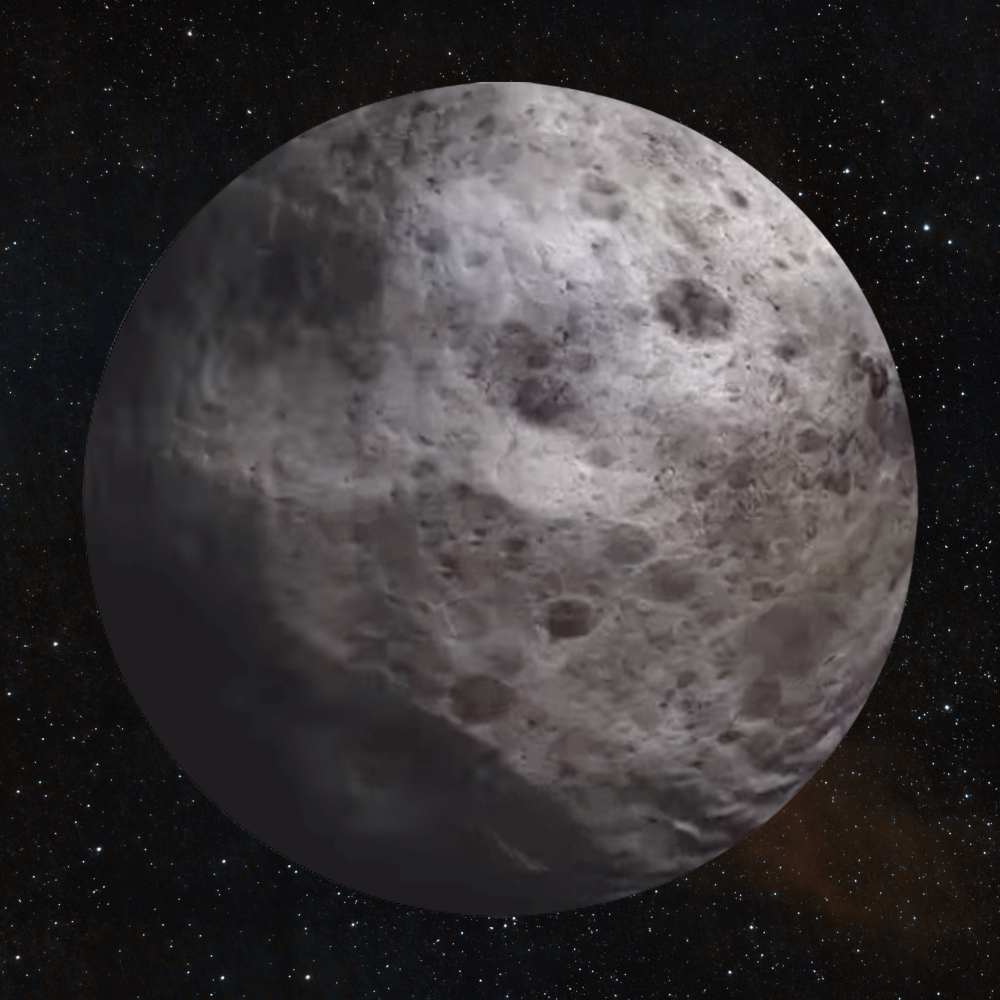
It is significantly darker than Eris
Its surface likely contains organic-rich material or radiation-darkened ice
It may have a lower albedo similar to many Kuiper Belt objects
Unlike Eris, which reflects sunlight efficiently due to frozen nitrogen and methane, Dysnomia absorbs more light—making it harder to detect and study.
Its estimated diameter places it among the larger known moons of dwarf planets, comparable in size to some mid-sized Kuiper Belt objects.
Formation Hypothesis – Born from Impact
The leading theory for Dysnomia’s formation is a giant impact scenario.
Key supporting evidence:
Circular orbit
Low inclination
Single-moon system
Similar mass ratios to other impact-formed systems
In this model:
A large object collided with proto-Eris
Debris was ejected into orbit
That debris coalesced into Dysnomia
This mirrors the formation of:
Earth’s Moon
Pluto’s moon Charon (though Charon is much larger relative to Pluto)
Dysnomia in the Context of Dwarf Planet Moons
Dysnomia is part of a growing family of moons orbiting dwarf planets, including:
Charon (Pluto)
Vanth (Orcus)
Hiʻiaka and Namaka (Haumea)
Together, these systems reveal that moon formation is common even in the distant Solar System, challenging older models that assumed isolated icy bodies.
Dysnomia Compared with Other Dwarf Planet Moons
Dysnomia may appear unremarkable at first glance, but when compared with other moons of dwarf planets, its role becomes clearer.
Dysnomia vs Charon (Pluto)
Charon is unusually large—about half the diameter of Pluto—forming a near binary system. Dysnomia, in contrast, is much smaller relative to Eris.
Key differences:
Charon dominates Pluto’s system dynamics
Dysnomia primarily serves as a mass-tracing companion
Pluto–Charon formed from an extreme impact
Eris–Dysnomia likely formed from a more asymmetric collision
This contrast shows that giant impacts in the outer Solar System can produce very different outcomes depending on collision energy, angle, and mass ratios.
Dysnomia vs Haumea’s Moons (Hiʻiaka and Namaka)
Haumea hosts two moons and rotates extremely fast, likely due to a violent past.
Compared to them:
Dysnomia’s orbit is more circular and stable
Eris rotates slowly, suggesting less angular momentum transfer
Dysnomia’s darker surface hints at different debris composition
This suggests Eris experienced a collision that was energetic enough to form a moon, but not enough to spin the system into instability.
Dysnomia vs Vanth (Orcus)
Vanth, the moon of Orcus, is another key comparison.
Similarities:
Comparable size scale
Single-moon systems
Likely impact-origin
Differences:
Vanth’s orbit is more inclined
Dysnomia’s orbit is tightly aligned
These subtle differences help astronomers refine models of moon formation in the Kuiper Belt and Scattered Disk.
Surface Composition – Why Is Dysnomia So Dark?
One of the biggest mysteries surrounding Dysnomia is its low albedo.
Possible explanations include:
Radiation-Processed Ice
Over billions of years, exposure to:
Cosmic rays
Solar wind (weak but persistent)
Interstellar radiation
…can chemically alter surface ices, forming dark, carbon-rich residues known as tholins.
Organic-Rich Debris Origin
If Dysnomia formed from subsurface material ejected during an impact, it may contain:
Less volatile nitrogen and methane
More complex organic compounds
Less reflective water ice
This would naturally make it darker than Eris, whose surface is refreshed by volatile ice cycles.
Lack of Surface Renewal
Eris likely experiences:
Seasonal frost deposition
Atmospheric freeze-out and resurfacing
Dysnomia, being smaller and less massive:
Cannot retain an atmosphere
Cannot recycle surface material
Gradually darkens over time
This leads to increasing contrast between the bright primary and its dark moon.
Tidal Interactions Between Eris and Dysnomia
Tidal forces play a subtle but important role in shaping the Eris–Dysnomia system.
Current Understanding
Dysnomia is likely tidally locked, always showing the same face to Eris
Eris itself rotates slowly (~25.9 hours), possibly influenced by past tidal interactions
Energy dissipation is minimal due to large separation
Unlike Pluto–Charon, where tides strongly influence both bodies, Eris–Dysnomia is a weakly coupled system.
What Dysnomia Reveals About the Scattered Disk
Eris belongs to the Scattered Disk, a population of icy objects on highly elongated, tilted orbits shaped by Neptune’s early migration.
Dysnomia provides indirect evidence about this region:
Giant impacts occurred even at extreme distances
Large bodies were once more numerous
The outer Solar System was dynamically violent
The existence of a moon around Eris suggests the Scattered Disk was not a quiet graveyard, but a place of frequent collisions during the Solar System’s youth.
Observational Challenges
Studying Dysnomia is exceptionally difficult.
Main challenges:
Extreme distance from Earth
Low brightness and low contrast
Proximity to Eris’s glare
Limited observation windows
Most data comes from:
Large ground-based telescopes
Adaptive optics
Space-based observations (Hubble)
No spacecraft has ever visited Eris or Dysnomia, and none are currently planned.
Why Dysnomia Remains Scientifically Valuable
Even without direct imaging, Dysnomia continues to contribute to planetary science by enabling:
Precise mass calculations
Density estimates
Formation modeling
Comparative Kuiper Belt studies
It proves that even the faintest moons can have outsized importance when placed in the right scientific context.
Does Dysnomia Have an Internal Structure?
At present, there is no direct evidence that Dysnomia has internal differentiation, but scientists can make informed inferences based on its size, formation history, and environment.
Given its estimated diameter (~600–700 km), Dysnomia may be large enough to have experienced:
Partial internal heating during formation
Compression of ice–rock mixtures
Early differentiation into denser and lighter layers
However, due to its small mass and extreme distance from the Sun, any internal heat would have dissipated quickly. Unlike moons such as Europa or Enceladus, Dysnomia almost certainly does not possess a subsurface ocean.
Its interior is likely a cold, rigid mixture of water ice, rock, and complex organic compounds—essentially frozen in time since the early Solar System.
Could Dysnomia Ever Show Geological Activity?
Geological activity requires energy. In Dysnomia’s case, energy sources are extremely limited.
Energy Constraints
No tidal heating of significance
No radioactive heating sufficient for long-term activity
No atmosphere to drive surface cycles
As a result, Dysnomia is best described as a geologically dead world.
That said, its surface still records a valuable history:
Impact craters
Radiation-darkened regions
Ancient collision scars
Studying these features remotely allows scientists to reconstruct conditions in the distant Solar System billions of years ago.
Future Observation and Exploration Possibilities
Direct exploration of Dysnomia remains unlikely in the near future, but technology continues to improve.
Future Opportunities
Next-generation ground telescopes
Extremely Large Telescope (ELT)
Thirty Meter Telescope (TMT)
Improved adaptive optics
Long-duration observation campaigns
These may allow:
Better size estimates
Albedo mapping
Refined orbital dynamics
A dedicated mission to Eris and Dysnomia would require decades of travel time and currently has no approved proposals. For now, observation is our only tool.
Dysnomia’s Role in Redefining Planets
Dysnomia’s importance is inseparable from Eris’s impact on astronomy.
Because Dysnomia allowed scientists to:
Measure Eris’s mass precisely
Compare it directly with Pluto
…Eris became the key catalyst behind the 2006 IAU redefinition of “planet.”
In this way, Dysnomia indirectly influenced:
Planetary classification
Educational materials worldwide
How humanity categorizes worlds
Few moons can claim such influence.
Frequently Asked Questions (FAQ)
Is Dysnomia larger than Pluto’s moon Charon?
No. Charon is significantly larger and more massive. Dysnomia is modest in size by comparison.
Can Dysnomia be seen with amateur telescopes?
No. Dysnomia is far too faint and distant. It can only be observed using large professional telescopes with advanced optics.
Does Dysnomia have an atmosphere?
No. Its gravity is too weak to retain an atmosphere.
Why is Dysnomia darker than Eris?
Likely due to lack of volatile ice resurfacing and long-term radiation processing that darkens surface materials.
How was Dysnomia’s orbit determined?
Through repeated high-resolution observations tracking its motion around Eris over time.
Related Topics for Universe Map
Eris (Dwarf Planet)
Charon
Kuiper Belt
Scattered Disk
Dwarf Planet Moons
Planetary Classification
These topics together explain why Dysnomia matters despite its faintness.
Final Perspective
Dysnomia is a quiet world in a cold, distant orbit—but its scientific voice is loud. It helped astronomers weigh Eris, rethink Pluto, and refine our understanding of how planets and moons form in the far reaches of the Solar System.
In the story of planetary science, Dysnomia proves that even small, dark moons can reshape how we understand the universe.