






Earth–Moon L₂
The Gateway Beyond the Moon
Quick Reader
| Attribute | Details |
|---|---|
| System | Earth–Moon |
| Lagrange Point | L2 |
| Relative Position | ~65,000 km beyond the Moon (far side) |
| Stability Type | Metastable (requires station-keeping) |
| Gravitational Balance | Earth + Moon vs orbital motion |
| Visibility from Earth | Not directly visible |
| Line of Sight | Always behind the Moon |
| Key Uses | Deep-space relay, astronomy, lunar far-side support |
| Strategic Importance | Critical for future lunar infrastructure |
Key Insights
- Earth–Moon L2 lies beyond the Moon’s far side, opposite Earth
- It provides continuous line-of-sight to both the Moon’s far side and deep space
- It is ideal for communication relay and space observatories
- It is a cornerstone location for future lunar exploration
Introduction – The Most Important Point You Cannot See
When we look at the Moon from Earth, we always see the same face.
The far side remains hidden — not because it is dark, but because of orbital geometry.
Behind that hidden hemisphere lies Earth–Moon L₂, a gravitational balance point that quietly solves one of the biggest challenges in lunar exploration:
communication and access beyond the Moon.
What Is Earth–Moon L₂?
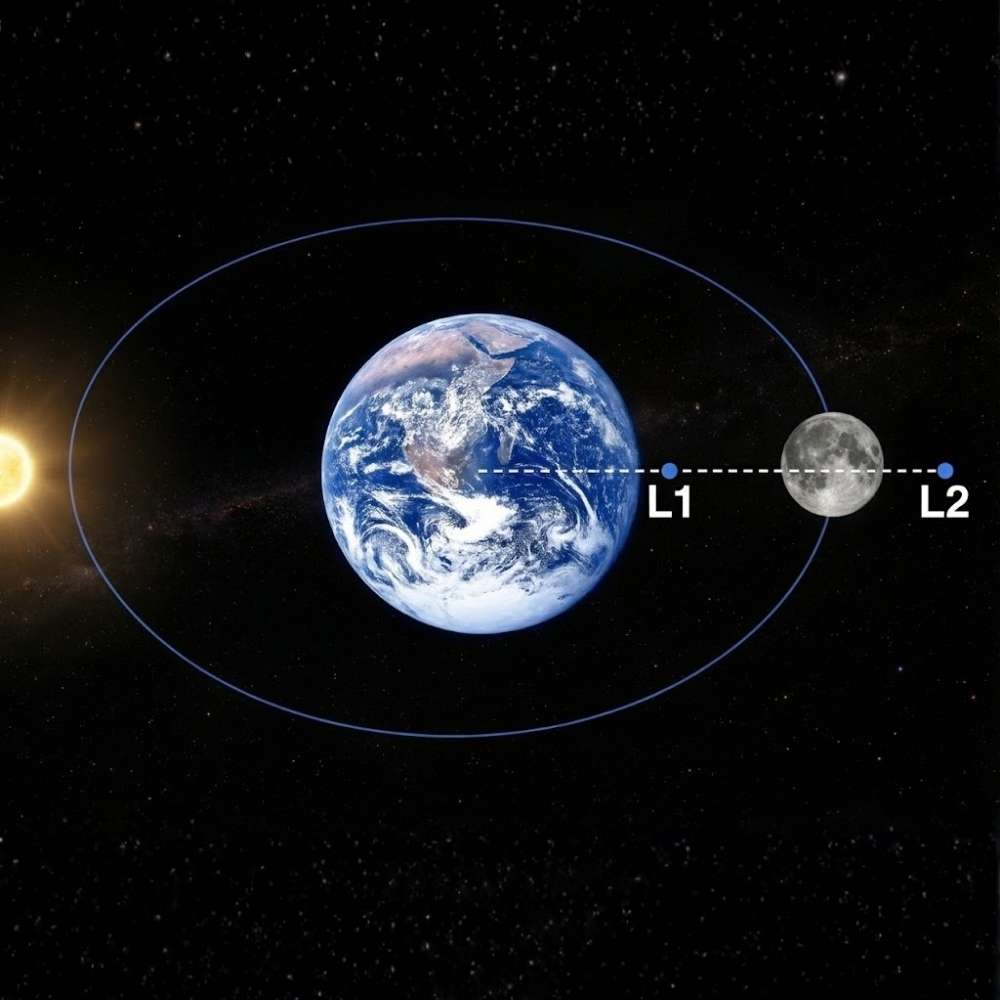
Earth–Moon L₂ is one of five Lagrange points in the Earth–Moon system.
At this location:
The combined gravity of Earth and the Moon balances orbital motion
A spacecraft can orbit in a stable halo or Lissajous orbit
Continuous visibility of the lunar far side is possible
Unlike Earth–Sun L₂, this point is closer and dynamically more complex.
Where Exactly Is Earth–Moon L₂ Located?
Earth–Moon L₂ sits:
Along the Earth–Moon line
On the far side of the Moon
Roughly 65,000 km beyond the Moon
From this position:
Earth is always hidden by the Moon
Deep space is fully visible
A relay spacecraft can “see” both Earth and far-side landers
This geometry is uniquely valuable.
Why Earth–Moon L₂ Is Not Fully Stable
Earth–Moon L₂ is not a naturally stable parking spot.
Key characteristics:
Small disturbances grow over time
Spacecraft must perform regular station-keeping
Orbits are maintained, not passive
However, the fuel cost is low enough to make long-term missions practical.
Why L₂ Is Perfect for the Moon’s Far Side
The Moon’s far side has a major limitation:
it cannot communicate directly with Earth.
Earth–Moon L₂ solves this.
From L₂, a relay satellite can:
Receive signals from far-side landers
Transmit data back to Earth
Maintain near-continuous coverage
This makes far-side exploration feasible.
The First Mission to Use Earth–Moon L₂
China’s Queqiao relay satellite was the first spacecraft to operate at Earth–Moon L₂.
Its role:
Relay communication for Chang’e-4
Enable the first soft landing on the Moon’s far side
This validated Earth–Moon L₂ as an operationally critical location.
Why the Lunar Far Side Is Scientifically Special
The Moon’s far side is shielded from Earth’s radio noise.
This makes it ideal for:
Low-frequency radio astronomy
Studying the early universe
Observing cosmic signals blocked on Earth
Earth–Moon L₂ enables these experiments by supporting far-side infrastructure.
Earth–Moon L2 vs Earth–Sun L2
Although they share a name, they serve different roles.
| Feature | Earth–Moon L2 | Earth–Sun L2 |
|---|---|---|
| Distance | ~450,000 km from Earth | ~1.5 million km |
| Primary Use | Lunar support | Astronomy |
| Stability | Lower | Higher |
| Key Missions | Queqiao | JWST, Gaia, Planck |
Earth–Moon L2 is about access, not isolation.
Universe Map Context – Why Earth–Moon L₂ Matters
Earth–Moon L₂ represents a new class of locations Universe Map highlights:
Dynamical gateways, not destinations
Infrastructure nodes in space
Points that enable exploration elsewhere
It is not a place to land — it is a place to connect.
Orbital Mechanics Around Earth–Moon L₂
A spacecraft does not sit motionless at Earth–Moon L₂.
Instead, it flies carefully shaped orbits that balance gravity and motion.
Because L₂ itself is only metastable, spacecraft use controlled trajectories to remain nearby.
The two most common are:
Halo orbits
Lissajous orbits
These orbits allow continuous operation with modest fuel use.
Halo Orbits – The Practical Way to Use L₂
Most spacecraft near Earth–Moon L₂ do not sit exactly at the point.
They follow halo orbits, which are:
Large, looping orbits around L₂
Three-dimensional (not flat)
Designed to avoid eclipses and line-of-sight blockage
Halo orbits allow a spacecraft to:
Maintain constant visibility of Earth
Keep the lunar far side in view
Avoid unstable drift through active control
Queqiao uses this type of orbit.
Lissajous Orbits – Flexible but Complex
Another option is a Lissajous orbit, a more complex, non-repeating path.
Characteristics include:
No fixed period
Greater flexibility in geometry
Slightly higher station-keeping complexity
Lissajous orbits are useful when mission designers want to fine-tune:
Communication angles
Thermal conditions
Observation geometry
Why Station-Keeping Is Manageable
Although Earth–Moon L₂ is unstable, the fuel cost is modest.
Reasons include:
Weak gravitational gradients
Predictable perturbations
Efficient correction maneuvers
This makes multi-year missions feasible, even for small satellites.
Earth–Moon L₂ as a Communication Hub
One of L₂’s most important roles is communication relay.
From L₂, a spacecraft can:
See Earth continuously
Maintain line-of-sight to far-side landers
Relay commands and data in near real time
This transforms the Moon’s far side from inaccessible to operational.
Why Direct Far-Side Communication Is Impossible
The Moon is tidally locked.
As a result:
The far side never faces Earth
Radio signals are completely blocked
Orbiters alone cannot provide constant coverage
Earth–Moon L₂ solves this geometrical dead end.
Missions Enabled by Earth–Moon L₂
Earth–Moon L₂ is not a destination mission — it is an enabling mission location.
It supports:
Far-side landers and rovers
Radio astronomy arrays
Long-duration lunar infrastructure
Future human exploration support
Without L₂, these missions become far more complex.
Earth–Moon L₂ and the Artemis Era
As human lunar exploration expands, Earth–Moon L₂ gains strategic importance.
Potential roles include:
Relay support for far-side human missions
Coordination of robotic assets
Gateway-style communication infrastructure
It complements cislunar space operations rather than replacing them.
Scientific Advantages of Operating at L₂
From Earth–Moon L₂, spacecraft benefit from:
Minimal Earth radio interference
Stable thermal conditions
Predictable observation geometry
These advantages are especially valuable for:
Low-frequency radio experiments
Long-baseline lunar science
Quiet-space astronomy support
Universe Map Perspective – Orbits That Enable Exploration
Earth–Moon L₂ demonstrates a key concept:
Some of the most important places in space are not surfaces, but orbits.
It exists to enable:
Access
Communication
Continuity
Not discovery in isolation, but discovery elsewhere.
The Long-Term Future of Earth–Moon L₂
Earth–Moon L₂ is expected to become more important over time, not less.
As lunar activity expands, L₂ shifts from a single-mission solution into a permanent infrastructure node.
In the coming decades, Earth–Moon L₂ is likely to support:
Continuous far-side lunar operations
Networks of relay satellites
Scientific observatories requiring radio quietness
Coordination between robotic and human missions
Rather than being a destination, L₂ becomes a service point for everything beyond the Moon’s near side.
Why Earth–Moon L₂ Is Critical for a Permanent Lunar Presence
A sustained human and robotic presence on the Moon requires three things:
Communication
Navigation
Operational continuity
Earth–Moon L₂ directly enables all three.
Without L₂:
Far-side missions are isolated
Data return is intermittent
Real-time control is impossible
With L₂:
The Moon becomes a fully accessible world
Both hemispheres are operationally equal
Long-term planning becomes realistic
Earth–Moon L₂ and Lunar Radio Astronomy
One of the most scientifically powerful uses of Earth–Moon L₂ is indirect support of radio astronomy on the lunar far side.
The far side is:
Shielded from Earth’s radio interference
Free from human-made electromagnetic noise
Ideal for low-frequency observations
Earth–Moon L₂ allows:
Data relay without contaminating observations
Control of instruments without local transmitters
Continuous monitoring from Earth
This could open a new observational window on:
The cosmic dark ages
Early galaxy formation
Large-scale cosmic structure
Could Humans Operate Near Earth–Moon L₂?
Direct human habitation at L₂ is unlikely.
However, humans may:
Operate spacecraft stationed near L₂
Control robotic platforms from cislunar space
Use L₂ as a coordination node
In this sense, L₂ functions more like a space intersection than a space station.
Earth–Moon L₂ vs Lunar Gateway
It is important to distinguish roles.
Lunar Gateway: human-tended platform in near-rectilinear halo orbit
Earth–Moon L₂: communication and infrastructure node
They are complementary, not competing.
Gateway supports people.
L₂ supports access.
Frequently Asked Questions (Expanded)
Is Earth–Moon L₂ completely stable?
No. Spacecraft must perform regular station-keeping to remain in orbit around L₂.
Why not place relay satellites in lunar orbit instead?
Lunar orbit alone cannot provide continuous far-side coverage. L₂ offers persistent geometry.
Can Earth see Earth–Moon L₂ directly?
No. The Moon blocks direct line-of-sight, which is why relay geometry matters.
Is Earth–Moon L₂ useful without far-side missions?
Its value increases dramatically with far-side activity, but it can also support deep-space operations.
Will more satellites be placed at Earth–Moon L₂?
Almost certainly, as lunar exploration expands.
Why Earth–Moon L₂ Matters for Universe Map
Earth–Moon L₂ represents a category Universe Map emphasizes:
Invisible locations that control access to visible worlds.
It connects:
Orbital mechanics
Lunar exploration strategy
Space infrastructure
The future of cislunar space
It proves that exploration depends as much on where you orbit as where you land.
Related Topics for Universe Map
Lagrange points
Lunar far side
Queqiao relay satellite
Cislunar space
Lunar radio astronomy
Together, these topics explain how space is organized not just by distance, but by dynamics.
Final Perspective
Earth–Moon L₂ is not dramatic.
There are no landscapes, no horizons, no surfaces to photograph.
Yet without it, half the Moon would remain functionally unreachable.
Earth–Moon L₂ reminds us that the most powerful locations in space are often defined not by what you can see there, but by what they allow you to reach.
It is a quiet gateway — and one of the most important points in the Earth–Moon system.