











Eris
The Dwarf Planet That Redefined the Solar System
Quick Reader
| Attribute | Details |
|---|---|
| Official Name | 136199 Eris |
| Provisional Designation | 2003 UB₃₁₃ |
| Type | Trans-Neptunian Object (TNO) |
| Classification | Dwarf Planet |
| Discovery Date | 5 January 2005 |
| Discoverers | Mike Brown, Chad Trujillo, David Rabinowitz |
| Discovery Location | Palomar Observatory |
| Distance from Sun | ~38 AU (perihelion) to ~97 AU (aphelion) |
| Orbital Period | ~558 years |
| Diameter | ~2,326 km |
| Mass | ~27% more massive than Pluto |
| Shape | Nearly spherical |
| Surface Composition | Nitrogen ice, methane ice |
| Surface Color | Bright, reflective |
| Average Temperature | ~−230°C |
| Known Moon | Dysnomia |
| Naming Origin | Greek goddess of discord |
Introduction to Eris – The World That Changed Planetary Science
Eris is not just another distant world beyond Neptune. It is the object that forced astronomers to redefine what a planet is. When Eris was discovered in 2005, it appeared to be larger and more massive than Pluto, instantly triggering a scientific and public debate that reshaped the Solar System’s classification.
For decades, Pluto held a special place as the ninth planet. Eris challenged that status directly. Its discovery made one question unavoidable: If Pluto is a planet, then what is Eris?
The answer to that question would ultimately change astronomy textbooks forever.
Discovery of Eris – A Shock Beyond Pluto
Eris was discovered during a systematic survey of the outer Solar System aimed at finding large trans-Neptunian objects. Initially designated 2003 UB₃₁₃, the object was nicknamed “Xena” by its discoverers before receiving its official name.
What made Eris extraordinary was not just its distance, but its sheer size and mass.
Key early revelations:
Comparable in size to Pluto
Significantly more massive
Located far beyond the classical Kuiper Belt
Its discovery confirmed that Pluto was not unique.
Why Eris Caused a Planetary Crisis
Before Eris, Pluto’s planetary status was already under quiet debate. Eris brought that debate into the open.
If Eris were declared a planet:
Many similar objects would also qualify
The Solar System could contain dozens of planets
The definition of a planet would become meaningless
Astronomers were forced to confront a fundamental issue: clear scientific definitions were missing.
The Birth of the Dwarf Planet Category
In 2006, the International Astronomical Union introduced a new classification: dwarf planet.
Under this definition, a planet must:
Orbit the Sun
Be nearly round
Clear its orbital neighborhood
Eris and Pluto meet the first two criteria but fail the third.
As a result:
Pluto was reclassified
Eris became a dwarf planet
The Solar System gained a clearer structure
Eris did not lose planetary status — it created a new one.
Size, Mass, and Density
Although Eris is slightly smaller in diameter than Pluto, it is more massive, making it the most massive known dwarf planet.
Important characteristics:
Diameter nearly equal to Pluto
Higher density, suggesting a rock-rich interior
Strong surface gravity for its size
This makes Eris a compact, dense world rather than a fluffy icy body.
Surface and Composition – A Frozen Mirror
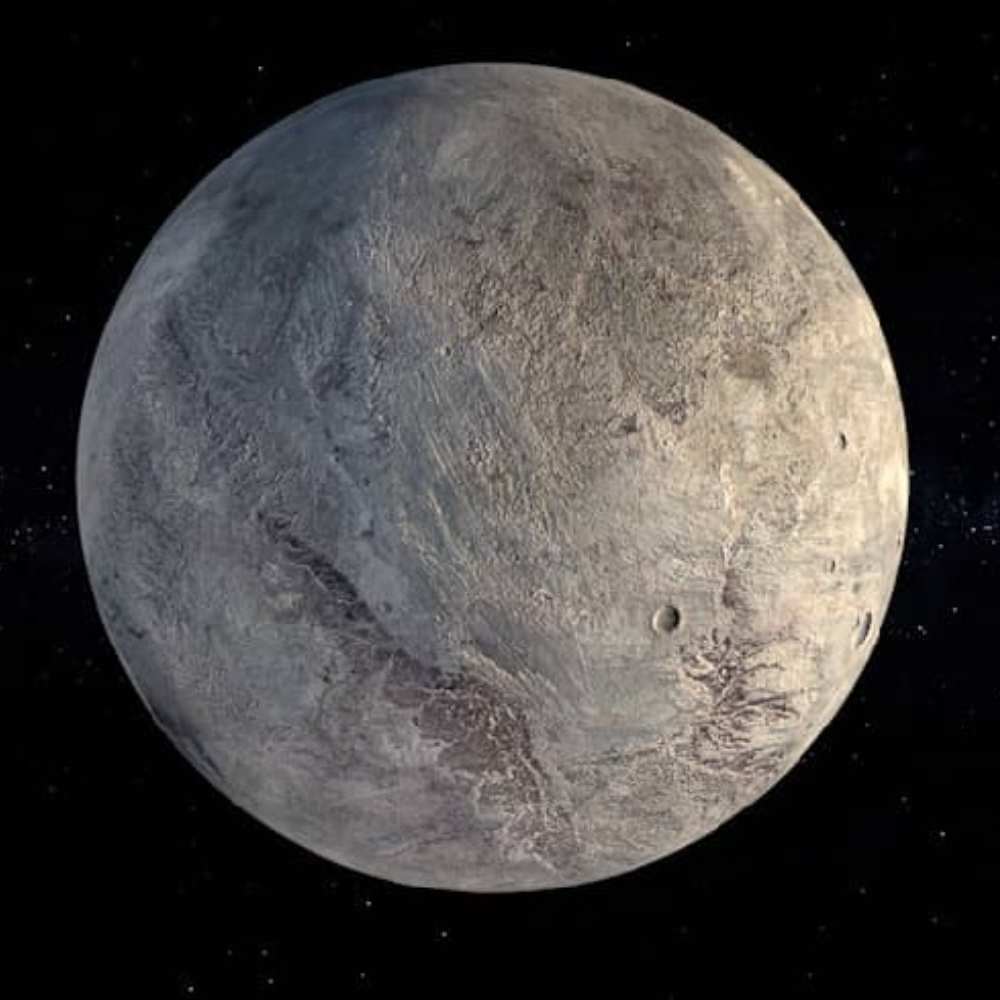
Eris has one of the brightest surfaces in the Solar System.
Its surface is dominated by:
Nitrogen ice
Methane ice
Possibly carbon monoxide ice
These volatile ices create a highly reflective surface, bouncing sunlight efficiently and keeping Eris unusually bright despite its distance.
An Extreme Orbit
Eris follows a highly elliptical orbit that carries it far beyond Pluto for most of its year.
Orbital traits:
High eccentricity
Significant inclination
Long periods spent in extreme cold
At aphelion, Eris is so distant that its surface temperature drops low enough for atmospheric gases to freeze solid onto the ground.
Why Eris Matters
Eris is important because it:
Ended the era of nine planets
Clarified Solar System classification
Demonstrated the diversity of outer Solar System bodies
Proved Pluto is part of a larger population
Without Eris, the modern understanding of planets might still be unresolved.
Dysnomia – The Moon That Revealed Eris’s True Mass
Shortly after Eris’s discovery, astronomers detected a small companion orbiting it. This moon was later named Dysnomia, after the Greek spirit of lawlessness and disorder — a fitting counterpart to Eris, the goddess of discord.
Why Dysnomia Is Scientifically Crucial
Dysnomia’s orbit allows astronomers to apply Kepler’s laws to determine Eris’s mass with high precision. From Dysnomia’s motion, scientists learned that:
Eris is more massive than Pluto
Its density is higher than most Kuiper Belt objects
It likely contains a substantial rocky core beneath its icy surface
Without Dysnomia, Eris’s role in redefining planetary science would have been far less certain.
Eris’s Density and Internal Structure
Eris has an average density of about 2.5 g/cm³, making it one of the densest known objects in the outer Solar System.
This implies:
A significant fraction of rock mixed with ice
A differentiated interior (rocky core, icy mantle)
Strong internal gravity relative to its size
Compared to Pluto, Eris appears more compact and less volatile-rich overall.
Seasonal Atmosphere – A World That Breathes Over Centuries
Eris does not have a permanent atmosphere, but it likely develops a temporary atmosphere during part of its orbit.
How Eris’s Atmosphere Works
As Eris approaches perihelion:
Surface ices (nitrogen and methane) can sublimate
A thin, transient atmosphere may form
Frost may redistribute across the surface
As Eris moves away from the Sun:
Temperatures plummet
Atmospheric gases freeze and fall back onto the surface
The atmosphere collapses completely
This slow atmospheric cycle occurs over hundreds of years.
Why Eris Looks Brighter Than Pluto
Despite being farther from the Sun, Eris reflects more sunlight than Pluto.
This is because:
Its surface is coated with fresh, reflective ice
Seasonal freezing renews the surface
Darkening processes are periodically reversed
Eris is essentially self-cleaning, resurfaced by its own orbital motion.
Comparing Eris and Pluto
Eris and Pluto are often mentioned together, but they differ in important ways.
| Feature | Eris | Pluto |
|---|---|---|
| Diameter | Slightly smaller | Slightly larger |
| Mass | Greater | Lower |
| Density | Higher | Lower |
| Orbit | More eccentric | Less eccentric |
| Atmosphere | Seasonal, rare | Seasonal, more frequent |
| Surface Brightness | Very high | Moderate |
Eris is colder, denser, and more extreme.
Eris vs Other Dwarf Planets
Eris stands apart even among its peers.
Haumea is fast-spinning and elongated
Makemake lacks a strong atmosphere
Gonggong rotates very slowly and is much darker
Ceres formed in the inner Solar System
Eris represents the coldest, most massive end of the dwarf planet spectrum.
Orbital Context – A Detached Giant
Eris is often classified as a detached trans-Neptunian object.
Key characteristics:
Minimal interaction with Neptune
High orbital inclination
Long-term dynamical stability
Its orbit suggests early gravitational disturbances, possibly involving:
Neptune’s migration
Stellar flybys in the Sun’s birth cluster
Why Eris Is Hard to Observe
Despite its brightness, Eris is difficult to study because:
It spends most of its time extremely far from Earth
Its orbital motion is slow
Full seasonal changes take centuries
Most of what we know about Eris comes from brief observational windows.
Scientific Importance of Eris
Eris matters because it:
Anchors the dwarf planet classification
Sets the upper mass limit for known TNOs
Provides a benchmark for icy-rocky worlds
Helps refine models of outer Solar System evolution
It is not just a Pluto analog — it is a category-defining object.
The Long-Term Orbital Fate of Eris
Eris follows one of the most extreme stable orbits known among dwarf planets. Its highly eccentric and inclined path keeps it far from the Sun for most of its long year.
Over very long timescales:
Eris remains dynamically detached from Neptune
Galactic tides have only minor influence
Stellar flybys are extremely rare but theoretically possible
Current models indicate that Eris will remain in a stable orbit for billions of years, preserving its surface in deep freeze for most of the Solar System’s lifetime.
Could Eris Ever Be Visited by a Spacecraft?
At present, no mission is planned to visit Eris. Its distance and slow orbital motion make it a difficult and costly target.
Major challenges include:
Travel times exceeding several decades
Very limited solar power availability
Minimal opportunities for gravity assists
However, Eris represents an ideal target for future long-duration missions designed to study the Kuiper Belt and detached objects as a population rather than as isolated worlds.
What Eris Reveals About Planetary Formation
Eris provides crucial insight into how large bodies formed in the outer Solar System.
Its properties suggest:
Large icy worlds formed across a wide range of distances
Rock-rich compositions are common among massive TNOs
Planetary migration strongly shaped present-day orbits
Eris supports the idea that the Solar System’s outer regions were once crowded with large bodies competing for stable orbits.
Eris and the Architecture of the Outer Solar System
Eris is not an anomaly — it is a representative of a hidden population.
Its discovery implies:
Pluto is part of a broader class of worlds
Dwarf planets form a continuum rather than a special case
The Solar System’s true size extends far beyond classical diagrams
Eris helped shift astronomy away from planet-counting toward structure-based classification.
Frequently Asked Questions (FAQ)
What is Eris?
Eris is a dwarf planet located beyond Neptune. It is one of the most massive known trans-Neptunian objects and played a key role in redefining the concept of a planet.
Is Eris larger than Pluto?
Eris is slightly smaller in diameter than Pluto but more massive, making it denser overall.
Why did Eris cause Pluto to lose planet status?
Eris showed that Pluto was not unique. If Pluto were classified as a planet, then Eris and many similar objects would also qualify. This led astronomers to create the dwarf planet category.
Does Eris have an atmosphere?
Eris does not have a permanent atmosphere. It may develop a very thin, temporary atmosphere near perihelion when surface ices sublimate, but this atmosphere collapses as Eris moves farther from the Sun.
What is Dysnomia?
Dysnomia is Eris’s only known moon. Its orbit allowed astronomers to accurately measure Eris’s mass and density.
Why is Eris so bright?
Eris’s surface is covered in highly reflective nitrogen and methane ice. Seasonal freezing may continuously renew this icy surface, preventing long-term darkening.
Where is Eris located now?
Eris is currently far beyond Pluto, moving slowly along its elongated orbit in the scattered and detached regions of the outer Solar System.
Is Eris colder than Pluto?
Yes. Because Eris spends most of its orbit much farther from the Sun, its surface temperatures are generally lower than Pluto’s.
Eris’s Place in the Universe Map
Eris stands as a turning point in astronomical history. It links observational discovery with conceptual change, marking the moment when astronomers shifted from tradition-based classification to physics-based definitions.
In the Universe Map framework, Eris represents:
The upper limit of dwarf planet mass
The cold extreme of trans-Neptunian worlds
A cornerstone of modern Solar System structure
Final Thoughts
Eris is not famous because it is distant or cold — it is famous because it forced humanity to rethink the Solar System itself. By challenging Pluto’s uniqueness, Eris clarified how planets form, how systems evolve, and where meaningful boundaries truly lie.
Long after debates fade, Eris will remain — a silent, frozen world whose discovery reshaped our cosmic perspective.