









Europa
The Ocean World That Changed the Search for Life
Quick Reader
| Attribute | Details |
|---|---|
| Object Type | Icy moon of Jupiter |
| Discovery | 1610 |
| Discoverer | Galileo Galilei |
| Mean Radius | ~1,560 km |
| Diameter | ~3,122 km |
| Orbital Distance | ~670,900 km from Jupiter |
| Orbital Period | ~3.55 Earth days |
| Rotation | Synchronous (tidally locked) |
| Density | ~3.01 g/cm³ |
| Core | Rocky–metallic core |
| Ice Shell Thickness | ~15–25 km (estimated) |
| Subsurface Ocean | Confirmed (global, salty) |
| Ocean Depth | ~60–150 km (estimated) |
| Surface Age | Very young (10–90 million years) |
| Atmosphere | Extremely thin oxygen (O₂) |
| Heat Source | Tidal heating from Jupiter |
| Notable Features | Lineae, chaos terrain, possible plumes |
| Astrobiology Potential | One of the highest in the Solar System |
Key Highlights (Why Europa Is Extraordinary)
- Hosts a global liquid water ocean beneath its ice
- Contains more water than all Earth’s oceans combined
- Surface is geologically young and constantly renewed
- Tidal heating keeps the ocean liquid despite extreme cold
- Strong candidate in the search for extraterrestrial life
- Acts as the bridge between icy moons and habitable worlds
Introduction – A Small Moon with a Big Implication
Europa looks calm.
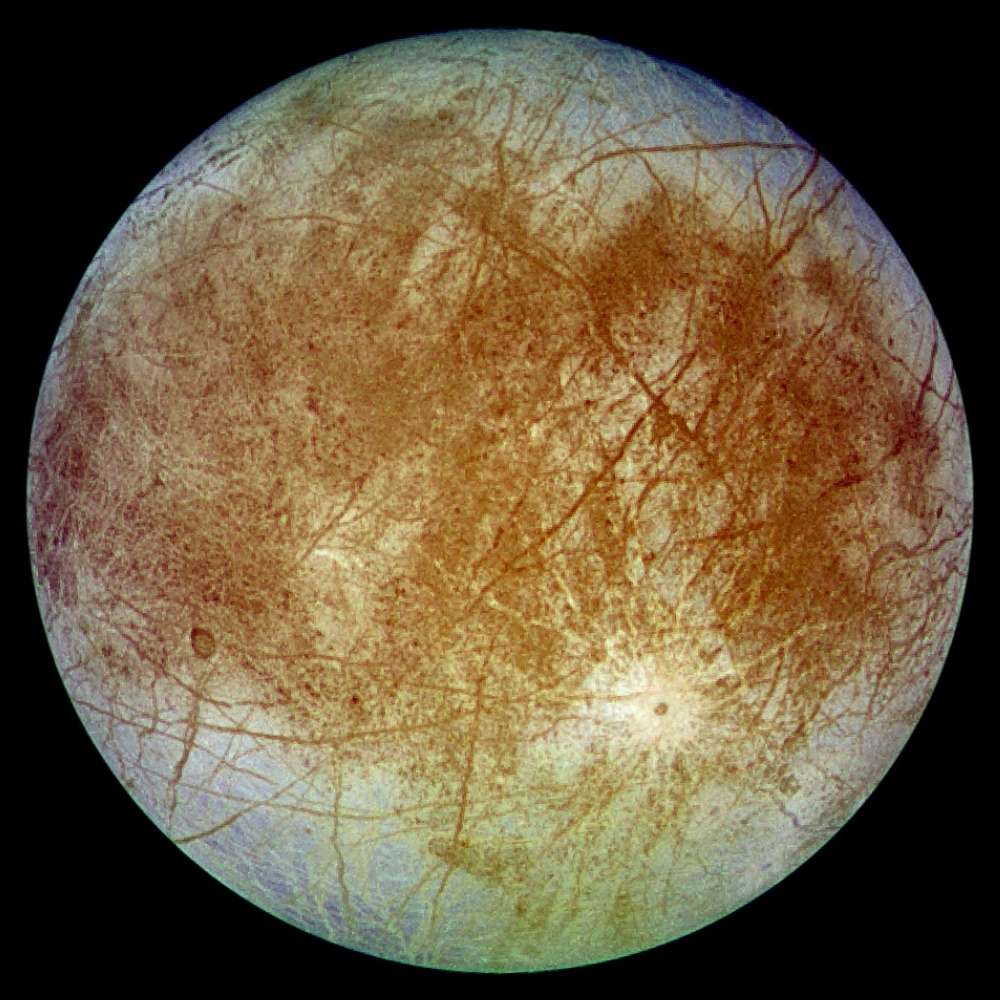
From a distance, it appears as a smooth, bright sphere marked by dark cracks—nothing dramatic, nothing explosive. Yet beneath this frozen shell lies one of the most revolutionary discoveries in planetary science:
a global ocean of liquid water, hidden beneath ice.
Europa transformed how scientists think about habitability.
It proved that life-supporting environments do not require sunlight or Earth-like conditions—only water, energy, and chemistry.
Europa is not just a moon.
It is a question.
An Icy Shell Hiding a Liquid World
Europa’s surface is composed almost entirely of water ice, but this ice is not static.
Observations reveal:
Long, intersecting fractures (lineae)
Regions of disrupted ice blocks (chaos terrain)
Minimal impact cratering
These features indicate:
Continuous surface renewal
Ice movement and cracking
Interaction with a liquid layer below
Europa’s ice shell floats on a salty subsurface ocean, much like Earth’s polar seas—but on a planetary scale.
The Subsurface Ocean – Europa’s Defining Feature
Europa’s ocean is not hypothetical.
Multiple lines of evidence confirm it:
Induced magnetic field measurements
Surface geology consistent with ice–water interaction
Flexing of the ice shell due to tidal forces
Key characteristics of Europa’s ocean:
Global, not regional
In direct contact with a rocky seafloor
Chemically active
Maintained by tidal heating
This combination makes Europa one of the most promising habitats beyond Earth.
Tidal Heating – Energy Without Sunlight
Europa’s ocean stays liquid because of gravity.
Europa is locked in an orbital resonance with Io and Ganymede, which:
Maintains a slightly elliptical orbit
Causes rhythmic stretching and compression
Generates internal friction and heat
Unlike Io, where this energy melts rock, Europa’s energy melts ice.
This process:
Prevents the ocean from freezing
Drives ice tectonics
Enables chemical exchange between surface and ocean
Europa is powered from within, not from above.
Surface Features – A Planetary Ice Puzzle
Europa’s surface lacks mountains, volcanoes, or large craters.
Instead, it shows:
Lineae: long, dark cracks stretching thousands of kilometers
Double ridges formed by repeated ice movement
Chaos terrain where ice blocks appear broken and refrozen
These features suggest:
Upwelling of warmer ice or water
Possible exchange between ocean and surface
A dynamically active ice shell
Europa’s surface is young because it is constantly being recycled.
Possible Water Plumes – Windows into the Ocean
Hubble observations suggest intermittent water vapor plumes erupting from Europa’s surface.
If confirmed, these plumes would:
Provide direct access to subsurface material
Allow sampling without drilling
Strengthen the case for active ocean–surface exchange
Even if rare, these events hint that Europa’s ocean is not sealed away forever.
Europa’s Thin Atmosphere
Europa possesses a tenuous oxygen atmosphere.
Important notes:
Oxygen is produced by radiation splitting surface ice
The atmosphere is extremely thin
It is not breathable and offers no protection
Despite this, the presence of oxygen raises intriguing questions about:
Chemical cycles
Potential oxidant delivery to the ocean
Why Europa Matters
Europa matters because it reshaped planetary science.
It demonstrates that:
Habitability does not require Earth-like planets
Oceans can exist far from the Sun
Life-friendly environments may be common
Europa is a template for ocean worlds throughout the galaxy.
Europa vs Enceladus vs Earth – Comparing Ocean Worlds
Europa is often compared to Enceladus and Earth because all three possess liquid water. But the context of that water makes all the difference.
Comparison of Ocean Worlds
| Feature | Europa | Enceladus | Earth |
|---|---|---|---|
| Primary Water Location | Subsurface global ocean | Subsurface regional ocean | Surface oceans |
| Ocean Volume | Greater than Earth | Much smaller than Earth | Baseline reference |
| Energy Source | Tidal heating | Tidal heating | Solar + internal heat |
| Ocean–Rock Contact | Yes | Yes | Yes |
| Atmosphere | Extremely thin | Thin, plume-fed | Thick, stable |
| Surface Renewal | Ice tectonics | Cryovolcanism | Plate tectonics |
| Habitability Potential | Very high | High | Confirmed |
Europa stands out because its ocean is global, deep, and long-lived.
Chemical Energy – Life Without Sunlight
Life does not require sunlight.
It requires chemical energy.
Europa’s ocean may support:
Hydrothermal vents at the seafloor
Water–rock reactions (serpentinization)
Redox gradients between ocean and ice
These processes are similar to environments on Earth where life thrives without photosynthesis.
Europa’s ocean floor could resemble Earth’s deep-sea hydrothermal systems—one of the strongest arguments for potential life.
Ice–Ocean Exchange – Why It Matters
For life to persist, chemistry must cycle.
Europa’s ice shell is not static.
Evidence suggests:
Brine pockets within the ice
Partial melting and refreezing
Surface material occasionally transported downward
This exchange could deliver:
Oxidants from the surface
Nutrients to the ocean
Chemical energy for metabolism
Europa’s ice may act as a chemical conveyor belt.
How Thick Is Europa’s Ice Shell?
Estimates suggest:
Ice thickness: ~15–25 km
Ocean depth: up to ~150 km
The ice shell is thick—but not impenetrable.
Local thinning, fractures, and chaos regions may allow:
Direct ocean–ice interaction
Occasional water exposure
Efficient material transport
These regions are prime targets for future exploration.
Could Europa’s Ocean Be Too Cold or Too Salty?
Europa’s ocean is likely:
Cold (near freezing)
Salty (possibly magnesium sulfate–rich)
But life on Earth thrives in:
Polar oceans
Hypersaline lakes
Deep, cold environments
Cold and salty conditions do not preclude life—they shape it.
Radiation – Europa’s Surface Hazard
Europa orbits deep within Jupiter’s radiation belts.
Consequences:
Surface is heavily irradiated
Organic molecules on the surface degrade quickly
Human exploration is challenging
However:
Ice provides excellent radiation shielding
The ocean is well protected
Radiation is a surface problem—not an ocean one.
Europa and Astrobiology – A Turning Point
Europa shifted scientific priorities.
Before Europa:
Habitability was tied to Earth-like planets
After Europa:
Ocean worlds became prime targets
Tidal heating gained prominence
Exoplanet studies expanded dramatically
Europa changed the definition of a habitable world.
Exploring Europa – From Distant Observation to Direct Investigation
Europa is no longer just a theoretical ocean world.
It is now a primary target of modern planetary exploration.
Europa Clipper Mission
Europa Clipper is designed to answer one question:
Is Europa’s ocean potentially habitable?
Key mission goals:
Measure ice shell thickness
Confirm the depth and salinity of the ocean
Analyze surface chemistry
Search for active plumes
Characterize radiation environment
The mission will perform multiple close flybys rather than orbiting Europa directly, reducing radiation exposure.
Why Europa Is Hard to Explore
Europa presents unique challenges:
Intense radiation from Jupiter
Thick, fractured ice shell
No stable landing sites identified yet
Extremely low temperatures
Despite these obstacles, Europa remains one of the most accessible ocean worlds thanks to its strong geological signals.
Will Humans Ever Drill Through Europa’s Ice?
Not anytime soon.
Drilling challenges include:
Ice thickness of tens of kilometers
Extreme cold
Radiation exposure
Power requirements
Future concepts involve:
Autonomous melting probes
Subsurface navigation
Long-duration robotic missions
For now, science focuses on indirect evidence.
Frequently Asked Questions (FAQ)
Does Europa definitely have life?
No. Europa has the conditions that could support life, but no life has been detected yet.
Is Europa warmer than Earth’s oceans?
No. Europa’s ocean is likely near freezing but kept liquid by pressure and salts.
Why is Europa considered more promising than Mars?
Because Europa has abundant liquid water and long-term energy sources, whereas Mars lost most of its surface water early.
Can Europa’s ocean freeze completely?
Unlikely, as long as tidal heating continues.
Is Europa’s surface safe for landers?
Radiation makes long-duration surface missions difficult but not impossible.
Europa in the Context of the Solar System
Europa connects several major scientific themes:
Tidal heating as a life-enabling process
Ocean worlds beyond the habitable zone
Ice–ocean interactions
Planet–moon energy exchange
Europa is not an exception—it may be the prototype.
Final Perspective
Europa is quiet on the surface, but alive beneath.
It shows that habitability does not depend on sunlight or warmth, but on energy, chemistry, and time. Beneath its fractured ice lies an ocean that may have persisted for billions of years—long enough for life to emerge, adapt, and endure.
If life exists anywhere beyond Earth in our Solar System today, Europa remains one of the strongest candidates.