











Gacrux
The Red Giant Beacon at the Top of the Southern Cross
Quick Reader
| Attribute | Details |
|---|---|
| Name | Gacrux |
| Bayer Designation | Gamma Crucis |
| Star Type | M3.5 III (Red Giant) |
| Constellation | Crux (Southern Cross) |
| Distance from Earth | ~88 light-years |
| Apparent Magnitude | ~1.63 (third brightest star in Crux) |
| Temperature | ~3,600 K |
| Radius | ~120 R☉ |
| Mass | ~1.2–1.5 M☉ |
| Luminosity | ~820 L☉ |
| Age | Several billion years |
| Notable Features | Red giant, vivid orange-red color, forms the top of the Southern Cross |
| Best Viewing Season | March–August (Southern Hemisphere) |
Introduction – The Fiery Red Crown of the Southern Cross
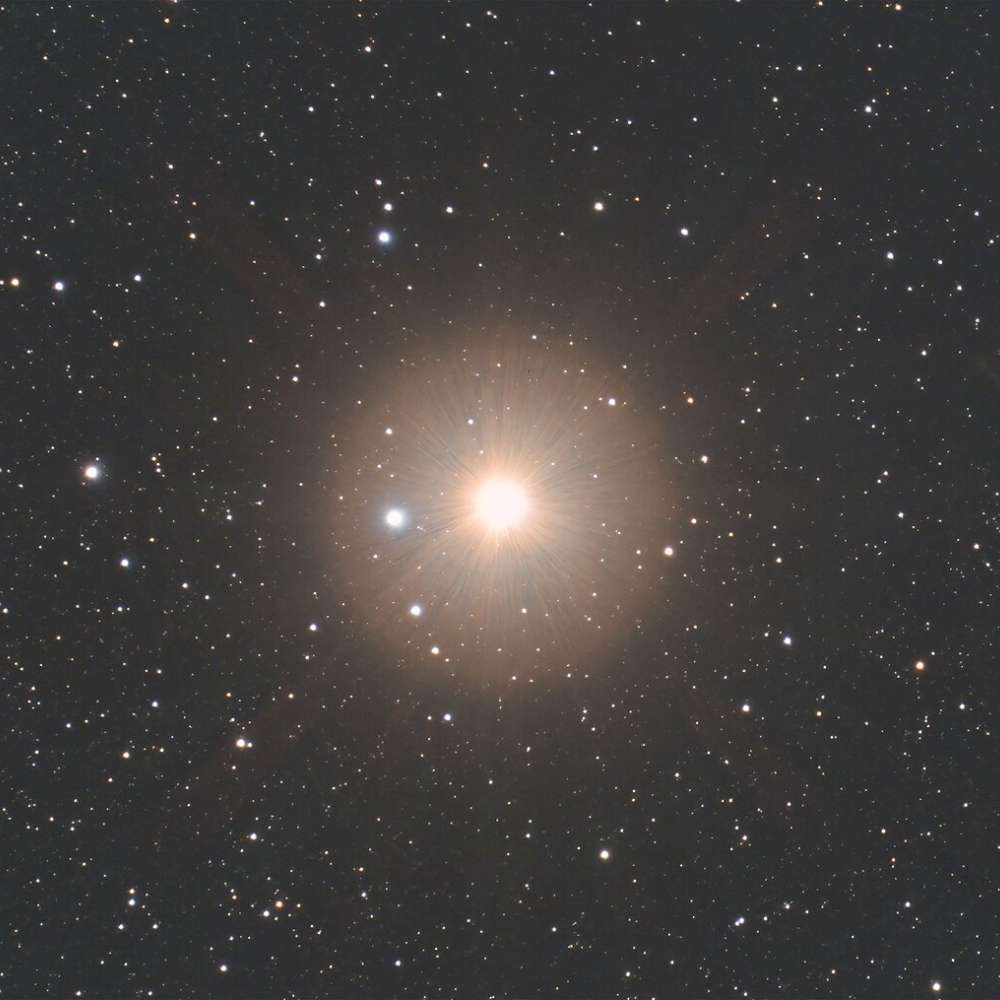
Gacrux, also known as Gamma Crucis, is the bright red star that marks the top of the Southern Cross—one of the most iconic constellations in Earth’s skies. While Acrux (Alpha Crucis) shines blue-white at the bottom of the Cross, Gacrux provides a dramatic visual contrast with its deep orange-red glow, creating one of the most striking color pairings in the entire night sky.
Gacrux is a red giant, a star nearing the final stages of its evolution. Once similar in size and brightness to the Sun, it has now expanded more than a hundred times in radius, radiating hundreds of times more energy. As a result, it appears bright and bold despite being relatively close to the Sun—one of the nearest red giants in the Milky Way.
Located only about 88 light-years away, Gacrux is not just a navigational anchor for southern skywatchers but a valuable stellar laboratory for studying how Sun-like stars evolve after leaving the main sequence.
Its color, brightness, location, and evolutionary stage make Gacrux one of the most important and recognizable giants in the southern sky.
Physical Characteristics of Gacrux
A Classic Red Giant
Gacrux is classified as:
M3.5 III
A cool, inflated, evolved star with low surface gravity
This means:
The star has exhausted hydrogen in its core
Core contraction and shell burning have begun
Its outer layers have expanded enormously
Gacrux’s surface temperature is only ~3,600 K, making it much cooler and redder than the Sun.
Size and Luminosity
Gacrux has:
A radius approximately 120 times that of the Sun
A luminosity about 820 times greater
If placed at the center of the Solar System:
Its surface would extend nearly to the orbit of Mercury
The inner planets would be engulfed
A bright orange-red “sun” would dominate the sky
Mass and Age
Gacrux likely began as a star:
With a mass around 1.2–1.5 M☉
Slightly more massive than the Sun
Because higher-mass stars evolve faster:
Gacrux is already a red giant
Even though it may be roughly the same age or slightly older than the Sun
Gacrux provides a real-world preview of the Sun’s appearance several billion years from today.
Gacrux’s Atmospheric and Spectral Features
Red giants like Gacrux have distinctive atmospheric physics:
Cool, Extended Atmosphere
The outer atmosphere is:
Extremely low-density
Highly expanded
Characterized by strong molecular absorption lines
Unlike hot stars, Gacrux’s spectrum is dominated by:
Titanium oxide (TiO) bands
Deep absorption features
Clear indicators of low surface gravity
Slight Variability
Gacrux exhibits gentle brightness variations due to:
Convection cycles
Pulsation-like behavior
Changing granulation patterns
These variations are small but scientifically valuable.
Stellar Winds and Mass Loss
Like all red giants, Gacrux is shedding mass through a gentle stellar wind:
Slow but steady mass loss
Enrichment of the interstellar medium
Formation of dust and gas around the star
This slow shedding process will eventually shape Gacrux’s final transition into a planetary nebula.
Gacrux in the Southern Cross – A Key Anchor of the Night Sky
The Southern Cross (Crux) is one of the most famous star patterns in the world, symbolizing:
Navigation
Geographic identity
Cultural heritage
Gacrux sits at the top of the Cross, making it the most familiar red star in southern skies.
Crux Star Pattern:
Acrux (bottom)
Mimosa (Beta Crucis, left)
Gacrux (top)
Delta Crucis (right)
Epsilon Crucis (central star)
Gacrux’s brilliant orange-red color contrasts sharply with the blue-white light of Acrux and Mimosa.
Navigational Importance
For centuries:
Gacrux was used to locate the south celestial pole
The long axis of the Cross points southward
Its position helped travelers and sailors across the Southern Hemisphere
Gacrux remains a fundamental reference point in celestial navigation.
Evolutionary State – A Glimpse of the Future Sun
Studying Gacrux is particularly valuable because it represents a stage the Sun will eventually reach.
What Stage Is Gacrux In?
Gacrux is:
On the red giant branch (RGB)
Burning hydrogen in a shell around a helium core
Still growing and expanding
It has not yet undergone the helium flash, the next major transition in its evolution.
Future Steps for Gacrux
Over the coming millions of years:
Gacrux will ignite helium in its core
It will shrink slightly and heat up
It will enter the horizontal branch phase
Later, it will ascend the asymptotic giant branch (AGB)
It will shed its outer layers
A planetary nebula will form
It will finally become a white dwarf
This same sequence awaits the Sun.
Scientific Importance of Gacrux
Gacrux is a valuable science target for several reasons:
1. Nearby Red Giant Modeling
Because Gacrux is one of the closest red giants, it allows:
Precise measurement of radius
Surface temperature analysis
Study of chemical abundances
2. Stellar Evolution Calibration
Gacrux’s proximity allows astronomers to:
Test models of red giant expansion
Improve stellar atmosphere simulations
Study mass-loss processes
3. Contrast Study in Crux
Crux features:
Blue-white massive stars
A red giant (Gacrux)
A central K-type star
This mix provides a unique multi-spectral laboratory.
Internal Structure and Physics of Gacrux – Life Inside a Red Giant
Gacrux is an evolved star whose internal structure is fundamentally different from that of the Sun. Understanding its internal physics reveals how stars change as they age.
Core Structure – Contracting and Heating
Gacrux’s core is:
Composed mainly of helium ash
Extremely dense
No longer undergoing hydrogen fusion
Because hydrogen fusion has ceased in the core:
The core is contracting under gravity
Temperatures and pressures are rising
It is preparing for helium ignition in the future
This contraction is the energy source that fuels the star’s expansion.
Shell Hydrogen Fusion
Surrounding the core is a shell where hydrogen is still burning. This shell:
Generates enormous amounts of energy
Causes the outer layers to expand
Increases luminosity dramatically
This shell-burning process is what powers the red giant phase.
Convective Envelope – A Boiling Ocean of Plasma
Most of Gacrux’s outer layers are fully convective:
Hot material rises
Cooler material sinks
The star behaves like a giant, slow-moving boiling pot
Consequences of strong convection:
Surface temperature becomes relatively uniform
Large granulation cells dominate the star’s photosphere
Magnetic activity becomes weak or irregular
Chemical elements are mixed from deep layers to the surface
These physical processes contribute to its distinctive red color.
Atmosphere, Mass Loss, and Stellar Winds
Red giants like Gacrux lose mass at a slow but significant rate.
Low Surface Gravity
Surface gravity in Gacrux is extremely low because:
The star is huge
Its mass is spread across a massive radius
This low gravity allows atmospheric material to drift away easily.
Stellar Winds
Gacrux is slowly shedding mass through:
Dust formation
Cool, slow stellar winds
Weak chromospheric outflow
Typical mass-loss rates may be:
Around 10⁻⁷ to 10⁻⁹ solar masses per year
Although small annually, over millions of years this becomes significant.
Enriching the Galaxy
Material lost from Gacrux contributes to the chemical enrichment of:
Interstellar dust clouds
Future generations of stars
Potential planet-forming regions
Red giants are some of the galaxy’s most important contributors to chemical evolution.
Gacrux as a Semi-Regular Variable Star
Although Gacrux appears stable to the naked eye, it shows small-scale variability.
Causes of Variability
Brightness changes may result from:
Light pulsation due to envelope instability
Convection-driven luminosity fluctuations
Changes in atmospheric opacity
These variations are typically subtle, but measurable with precision photometry.
Importance of Studying Variations
Variability in red giants helps astronomers:
Understand internal structure
Map convection cell dynamics
Study pulsation mechanics
Improve models of stellar atmosphere physics
Gacrux serves as a close, well-observed benchmark for modeling red giant variability.
Motion Through the Milky Way – Gacrux’s Galactic Journey
Gacrux is relatively close to the Sun, allowing astronomers to track its galactic motion precisely.
Proper Motion
Gacrux exhibits noticeable proper motion:
Moving across the sky due to proximity
Drifting relative to background stars
Over centuries, this motion will slowly distort the familiar shape of the Southern Cross.
Radial Velocity and Space Motion
Gacrux is moving:
Slightly toward the Sun
With moderate velocity relative to the local standard of rest
It is part of the Milky Way’s thin disk population, characterized by:
Moderate age
Near-circular galactic orbits
Metallicity similar to the Sun
Its trajectory ensures it will remain visible in Earth’s skies for many thousands of years.
Gacrux in Context – Comparison with Other Red Giants
Gacrux vs Arcturus
| Feature | Gacrux | Arcturus |
|---|---|---|
| Color | Deep red-orange | Yellow-orange |
| Distance | 88 ly | 37 ly |
| Type | M giant | K giant |
| Luminosity | ~820 L☉ | ~170 L☉ |
Arcturus is closer and less evolved, while Gacrux is larger and more luminous.
Gacrux vs Aldebaran
| Feature | Gacrux | Aldebaran |
|---|---|---|
| Surface Temperature | Cooler (~3600 K) | Warmer (~3900 K) |
| Radius | Larger | Smaller |
| Color | More red | Orange |
Both are prominent red giants, but Gacrux is more evolved.
Gacrux vs Antares
- Antares is much more massive
- Antares is a red supergiant
- Antares is far more luminous
Gacrux is modest in comparison, representing the typical red giant fate of Sun-like stars.
Gacrux vs Betelgeuse
- Betelgeuse is nearing a supernova stage
- Betelgeuse has far more mass
- Betelgeuse varies dramatically in brightness
Gacrux is stable and low mass, destined for a white dwarf ending.
Cultural and Scientific Importance of Gacrux
A Key Marker of the Southern Hemisphere
Gacrux has guided:
Polynesian navigators
Australian Aboriginal astronomy
Maritime explorers
Modern navigational charts
Crux itself is featured on multiple national flags, and Gacrux forms its uppermost star.
A Natural Laboratory for Red Giant Evolution
Because Gacrux is nearby:
Its radius, luminosity, and surface properties are precisely measured
It provides a benchmark for red giant models
It helps calibrate evolutionary tracks for Sun-like stars
It is one of the best real-world examples of a red giant transitioning toward helium-core ignition.
Observing Gacrux – A Southern Hemisphere Essential
Gacrux is one of the most visually striking red giants in the sky and a key guidepost for observers living in southern latitudes.
Naked-Eye Visibility
Gacrux is:
Easily visible without optical aid
Bright (magnitude ~1.63)
Deep orange-red in color
The topmost star of the Southern Cross (Crux)
Even in moderately light-polluted areas, Gacrux remains prominent.
How to Locate Gacrux
To find it:
Look for the distinctive kite-shaped pattern of Crux.
Identify the topmost star—that is Gacrux.
Compare its warm red tone to the blue-white stars Acrux and Mimosa.
Its brightness and color make it the easiest red giant to recognize in the southern sky.
Binocular Viewing
Binoculars enhance:
Gacrux’s reddish hue
Nearby star field complexity
The contrast between Gacrux and the blue stars of Crux
Bright red giants are excellent color targets for casual observers.
Telescope Observation
In telescopes:
Gacrux displays a steady, warm orange disk-like appearance
Slight color variations are visible through aperture sizes of 80 mm or larger
No surface features can be seen, but its color saturation is striking
Gacrux’s simplicity makes it useful for:
Photometric calibration
Atmospheric seeing comparisons
Demonstrating stellar color types to beginners
The Future of Gacrux – From Red Giant to White Dwarf
Gacrux will undergo dramatic changes as it completes its evolution.
Helium Flash
In the near future (astronomically speaking):
The contracting helium core will ignite suddenly
A brief but intense internal reaction will occur
The outer layers will adjust, shrinking slightly and heating up
This marks the transition into the horizontal branch phase.
Later Evolution
After the helium-burning stage:
Gacrux will expand again onto the asymptotic giant branch (AGB).
It will lose mass at a much higher rate.
A thick envelope of gas and dust will form around the star.
Pulsations will increase, causing visible variability.
Planetary Nebula Formation
Eventually, Gacrux will shed its entire outer envelope. This will create:
A glowing planetary nebula
Illuminated by ultraviolet radiation from the hot core
This nebula may last tens of thousands of years before dispersing into space.
Final Stage – A White Dwarf
The exposed core of Gacrux will settle into:
A compact, dense white dwarf
Roughly the size of Earth
Slowly cooling over billions of years
This is the same destiny that awaits the Sun.
Gacrux in Navigation and Cultural Astronomy
Navigational Importance
For centuries, Gacrux has been essential for southern navigation:
The long axis between Gacrux and Acrux points almost directly to the south celestial pole.
Polynesian navigators used Crux to determine latitude during ocean voyages.
The star is included in modern navigational star catalogs.
Even without Polaris in the southern sky, Gacrux and the Southern Cross provide an effective guiding tool.
Cultural Symbolism
Crux, with Gacrux as its crown, appears prominently in:
The national flags of Australia, New Zealand, Samoa, Papua New Guinea, and Brazil
Aboriginal star lore
Polynesian star lines and chants
Latin American cultural astronomy
Gacrux’s color and brightness make it a symbolic representation of guidance, orientation, and southern identity.
Frequently Asked Questions (FAQ)
Why is Gacrux so red?
Because its surface temperature is only about 3,600 K, emitting most of its light in the red-orange part of the spectrum.
Is Gacrux close to Earth?
Yes. At ~88 light-years, it is one of the closest red giants to the Sun.
Will Gacrux explode as a supernova?
No. Gacrux is not massive enough. It will end as a white dwarf.
Is Gacrux a variable star?
Yes, but only slightly. Its brightness changes subtly due to convection and pulsation, though not enough to notice by eye.
Why does Gacrux look different from Acrux?
Acrux is a hot blue-white star, while Gacrux is a cool red giant. Their contrasting temperatures produce dramatically different colors.
How old is Gacrux?
It is likely several billion years old and has already passed through its main-sequence lifetime.
Does Gacrux have planets?
No confirmed planets, and its red giant expansion would likely destabilize any close-orbit planets.
Final Scientific Overview
Gacrux stands as one of the most visually compelling red giants in the sky. Its proximity, brightness, and deep red glow make it a natural reference point for studying the late evolutionary stages of Sun-like stars. As the highest star in the Southern Cross, Gacrux:
Marks the celestial south
Serves as a navigational anchor
Contrasts beautifully with its hot, blue-white neighbors
Demonstrates the physics of shell hydrogen burning
Gives astronomers a close-up look at red giant convection and mass loss
In the far future, Gacrux will cast off its outer layers, form a planetary nebula, and fade into a cooling white dwarf. For now, it continues to illuminate southern skies as one of the brightest and most recognizable giants in the Milky Way.