






Ganymede
The Largest Moon in the Solar System
Quick Reader
| Attribute | Details |
|---|---|
| Object Name | Ganymede |
| Parent Planet | Jupiter |
| Object Type | Icy moon (Galilean satellite) |
| Discovery | 1610 |
| Discoverer | Galileo Galilei |
| Mean Radius | ~2,634 km |
| Diameter | ~5,268 km (larger than Mercury) |
| Orbital Distance | ~1.07 million km from Jupiter |
| Orbital Period | ~7.15 Earth days |
| Rotation | Tidally locked |
| Surface Age | Mixed (ancient + younger regions) |
| Composition | Water ice, silicate rock, metal core |
| Internal Structure | Fully differentiated |
| Subsurface Ocean | Confirmed (multi-layered) |
| Magnetic Field | Intrinsic (unique among moons) |
| Geological Activity | Ancient to moderate (past) |
| Radiation Exposure | Moderate (less than Europa, more than Callisto) |
Key Highlights
- Ganymede is the largest moon in the Solar System, even larger than Mercury
- It is the only moon known to have its own magnetic field
- Hosts a confirmed subsurface ocean system
- Shows evidence of past geological activity and resurfacing
- Acts as a bridge between active moons and fossil worlds
Introduction – A Moon Bigger Than a Planet
Ganymede is not just a moon.
It is a planet-sized world orbiting another planet.
Larger than Mercury and nearly as complex as Mars, Ganymede challenges the traditional boundary between moons and planets. If it orbited the Sun instead of Jupiter, it would almost certainly be classified as a planet.
Yet Ganymede exists in the powerful gravitational grip of Jupiter—shaped, heated, and organized by its giant parent.
What Is Ganymede?
Ganymede is the third Galilean moon of Jupiter and the largest satellite in the Solar System.
It is composed of:
A metallic core
A rocky mantle
A thick ice shell
Unlike Callisto, Ganymede underwent full internal differentiation, meaning its materials separated into layers early in its history.
This internal evolution set Ganymede on a very different path.
Size and Scale – Why Ganymede Is Unique
Ganymede’s size gives it planetary-level complexity.
Key comparisons:
Larger than Mercury by diameter
More massive than Earth’s Moon by over two times
Larger than Pluto
Despite this, Ganymede remains gravitationally bound to Jupiter, showing how dominant Jupiter’s gravity truly is.
Size alone, however, does not define Ganymede’s importance—internal structure does.
Internal Structure – A Fully Evolved Moon
Ganymede’s interior is layered and dynamic.
Current models indicate:
A dense iron-rich core
A silicate mantle
Multiple layers of high-pressure ice
A deep, salty subsurface ocean
This structure allows Ganymede to:
Generate its own magnetic field
Retain internal heat longer than Callisto
Support long-term ocean stability
Ganymede is not frozen inside—it is quietly active.
The Only Moon with a Magnetic Field
One of Ganymede’s most extraordinary features is its intrinsic magnetic field.
This means:
The field is generated internally
Likely driven by a liquid metallic core
Independent of Jupiter’s magnetic field
As a result:
Ganymede has its own magnetosphere
It interacts in complex ways with Jupiter’s magnetosphere
Auroral features form on its surface
This makes Ganymede unique among all known moons.
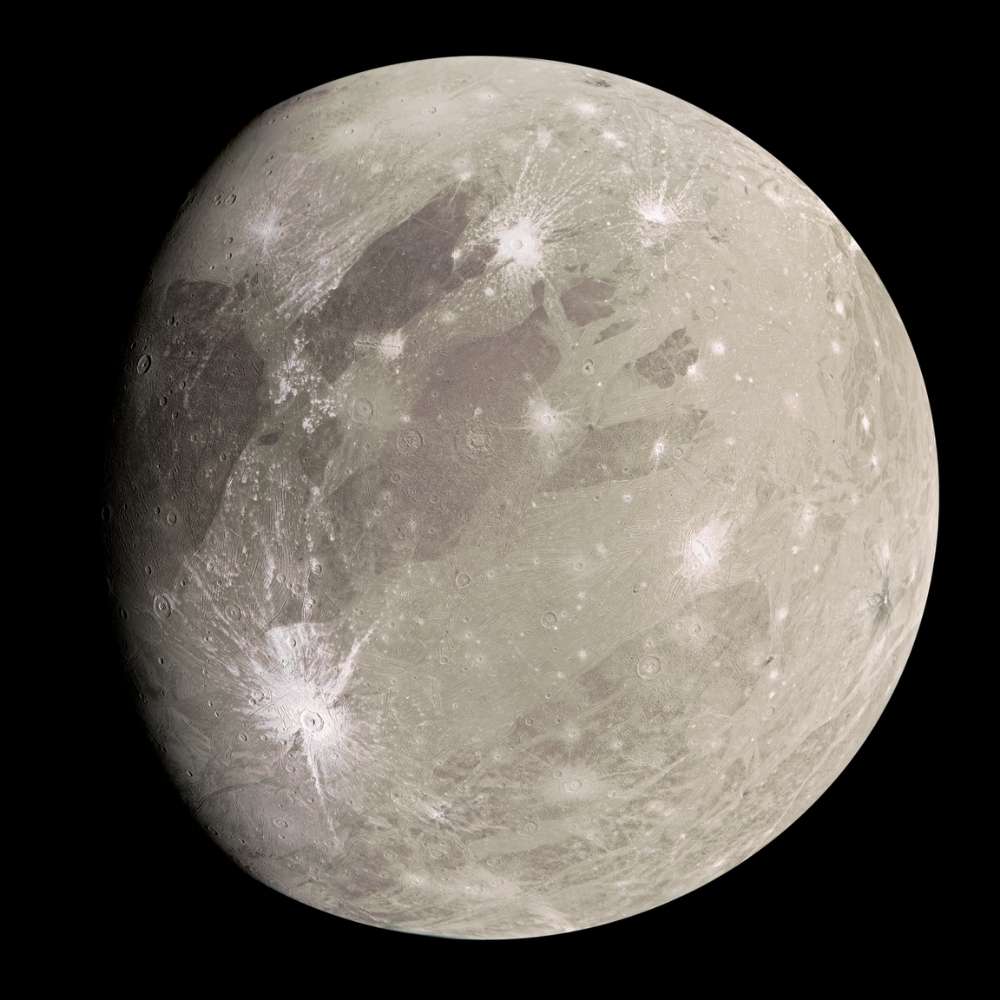
Surface Features – A World of Two Faces
Ganymede’s surface shows clear evidence of geological evolution.
It consists of:
Dark, heavily cratered ancient terrain
Lighter, grooved regions formed later
These grooved terrains indicate:
Tectonic deformation
Ice shell movement
Partial resurfacing
Unlike Callisto, Ganymede did not remain static.
Geological History – Active, Then Quiet
Ganymede’s geological activity peaked billions of years ago.
During that time:
Internal heat drove tectonics
Ice shell fractured and shifted
Surface was partially renewed
Over time:
Internal heat diminished
Geological processes slowed
The surface stabilized
Today, Ganymede is geologically quiet—but not primitive.
Ganymede vs Callisto – First Comparison
| Feature | Ganymede | Callisto |
|---|---|---|
| Size | Larger than Mercury | Slightly smaller |
| Differentiation | Full | Partial |
| Magnetic Field | Intrinsic | Induced |
| Surface Renewal | Yes (past) | None |
| Subsurface Ocean | Confirmed | Possible |
| Geological Evolution | Significant | Minimal |
This comparison highlights why Ganymede is often seen as Callisto’s evolved counterpart.
Why Ganymede Matters
Ganymede matters because it:
Blurs the line between moons and planets
Demonstrates planetary-scale processes in a moon
Hosts a long-lived subsurface ocean
Expands the definition of potentially habitable environments
It is one of the most complex non-planetary bodies ever discovered.
The Subsurface Ocean System – A Layered Ocean World
Ganymede hosts one of the most complex ocean systems in the Solar System.
Unlike Europa, which likely has a single global ocean beneath a thin ice shell, Ganymede’s ocean is multi-layered, trapped between different phases of high-pressure ice.
Evidence indicates:
A deep, salty liquid water layer
Multiple ice phases above and below the ocean
Electrical conductivity consistent with briny water
This ocean is confirmed through:
Magnetic field measurements
Induced magnetic responses detected by spacecraft
Ganymede’s ocean may contain more water than all of Earth’s oceans combined.
How Ganymede’s Magnetic Field Protects Its Ocean
Ganymede’s intrinsic magnetic field plays a crucial role.
It:
Creates a mini-magnetosphere
Deflects some charged particles from Jupiter
Reduces radiation exposure at the surface
This shielding effect:
Preserves chemical stability
Limits radiation-driven breakdown of surface ice
Helps protect the deep ocean from energetic particles
No other moon offers this combination of an ocean and intrinsic magnetic protection.
Ganymede vs Europa – Two Very Different Ocean Worlds
Although both moons have oceans, their environments differ radically.
| Feature | Ganymede | Europa |
|---|---|---|
| Ocean Depth | Very deep | Relatively shallow |
| Ice Shell Thickness | Very thick | Thin |
| Magnetic Field | Intrinsic | None |
| Geological Activity | Ancient | Active |
| Surface–Ocean Exchange | Limited | Strong |
| Habitability Potential | Moderate | High |
Europa’s ocean is more accessible and energetic.
Ganymede’s ocean is more stable and isolated.
Geological Evolution – Why Ganymede Changed and Callisto Did Not
Ganymede and Callisto formed from similar materials, yet evolved differently.
Key reasons include:
Ganymede formed closer to Jupiter
Stronger tidal heating early on
Faster internal differentiation
This allowed Ganymede to:
Melt internally
Separate rock and metal
Generate a magnetic field
Callisto, farther out, missed this thermal window.
Tectonics and Surface Renewal
The grooved terrain on Ganymede reveals a tectonic past.
These features suggest:
Stretching of the ice shell
Horizontal motion of ice plates
Partial replacement of older crust
This process resembles icy plate tectonics, though far slower than Earth’s.
Ganymede may be the best example of large-scale tectonics on an icy moon.
Radiation Environment – A Balanced Zone
Ganymede sits in a radiation “middle ground.”
Less intense than Europa
Stronger than Callisto
This makes it:
Safer for long-duration spacecraft than Europa
More scientifically active than Callisto
Its magnetic field further moderates the environment, especially near the poles.
Is Ganymede Habitable?
Habitability depends on energy, chemistry, and interaction.
Strengths:
Confirmed liquid water
Long-term stability
Magnetic shielding
Limitations:
Thick ice shell blocks surface exchange
Low chemical energy flow
Weak interaction between ocean and rock
Ganymede may host low-energy, long-lived environments, but not ideal for complex life.
Why Ganymede Is a Key Astrobiology Target
Ganymede expands the definition of habitable worlds.
It shows that:
Oceans can exist without surface activity
Magnetic fields can arise in moons
Planet-like processes occur in satellites
Studying Ganymede helps scientists understand how common ocean worlds may be in the galaxy.
The Long-Term Future of Ganymede
Ganymede’s future will be quiet but stable.
Over the next billions of years:
Internal heat will continue to decline
Geological activity will remain minimal
The subsurface ocean will likely persist
Because of its size and internal structure, Ganymede can retain heat longer than smaller moons, allowing its ocean to survive long after surface processes end.
Ganymede is evolving slowly—not transforming.
Could Ganymede Ever Become Active Again?
A return to major geological activity is extremely unlikely.
For reactivation, Ganymede would require:
Increased tidal heating
Major orbital changes
Strong external perturbations
Current orbital resonances keep Ganymede stable, not energetic.
Its active phase belongs to the distant past.
Ganymede and Exploration Missions
Ganymede is a priority target for future exploration.
Key mission interests include:
Mapping its magnetic field in detail
Studying its ocean structure
Understanding ice-shell dynamics
The JUICE mission (Jupiter Icy Moons Explorer) is designed to:
Orbit Ganymede
Study its magnetosphere
Characterize surface and subsurface features
This will provide the most detailed view of any moon beyond Earth’s Moon.
Human Exploration Potential
While not suitable for surface habitation, Ganymede offers advantages:
Lower radiation than Europa
Stable terrain
Predictable orbital environment
It may serve as:
A long-term scientific outpost location
A communication relay hub
A staging point for robotic missions
Human presence would remain limited and highly technological.
Frequently Asked Questions (FAQ)
Is Ganymede bigger than Mercury?
Yes. Ganymede is larger in diameter, though Mercury is more massive due to its density.
Does Ganymede have its own magnetic field?
Yes. It is the only moon known to generate an intrinsic magnetic field.
Is Ganymede more habitable than Europa?
No. Europa’s ocean is more accessible and energetic, making it a stronger candidate for life.
Could life exist in Ganymede’s ocean?
Possibly, but conditions are likely low-energy and isolated.
Why is Ganymede important?
Because it shows that moons can evolve like small planets.
Ganymede’s Role in Universe Map
Ganymede links several major concepts:
Ocean worlds
Magnetic fields beyond planets
Icy moon tectonics
Jupiter’s gravitational system
Related Universe Map topics:
Europa
Callisto
Io
Jupiter
Ocean worlds
Together, these objects illustrate the diversity of satellite evolution.
Final Perspective
Ganymede is a world that nearly became a planet.
With its size, internal complexity, magnetic field, and ocean system, it stands as the most planet-like moon ever discovered.
It proves that planetary processes do not stop at planets—they continue wherever mass, heat, and time allow them to operate.
Ganymede is not merely Jupiter’s largest moon.
It is a reminder that the boundary between planet and moon is far thinner than it appears.