








GPS
The Invisible Navigation System That Runs the Modern World
Quick Reader
| Attribute | Details |
|---|---|
| Full Name | Global Positioning System (GPS) |
| Operator | United States Space Force |
| Country | United States |
| System Type | Satellite-based navigation system (GNSS) |
| Orbit Type | Medium Earth Orbit (MEO) |
| Orbital Altitude | ~20,200 km |
| Number of Satellites | ~30+ active satellites |
| Coverage | Global |
| Primary Services | Positioning, navigation, timing (PNT) |
| Civilian Signal | Free and global |
| Military Signal | Encrypted, high-precision |
Scientific & Operational Role
GPS provides precise position, velocity, and time anywhere on Earth, forming the backbone of modern navigation and synchronization.
Why It Matters
Without GPS, modern transportation, telecommunications, finance, emergency services, and scientific research would be severely disrupted.
Introduction – What GPS Really Is (and Isn’t)
Most people think GPS tells you where you are.
In reality, GPS tells you what time it is—with extraordinary precision.
Position comes second.
GPS works by measuring how long it takes radio signals from satellites to reach a receiver. With accurate timing and known satellite positions, location becomes a solvable geometry problem.
This makes GPS not just a navigation system, but a global time-distribution infrastructure.
The Core Idea – Distance from Time
GPS is based on a simple principle:
Distance = speed of light × time delay
Each GPS satellite:
Broadcasts its exact time
Announces its precise orbital position
Your receiver:
Compares signal arrival times
Calculates distances to multiple satellites
Solves its position in 3D space + time
At least four satellites are required:
Three for position
One to correct receiver clock error
GPS Constellation – Why MEO Is Used
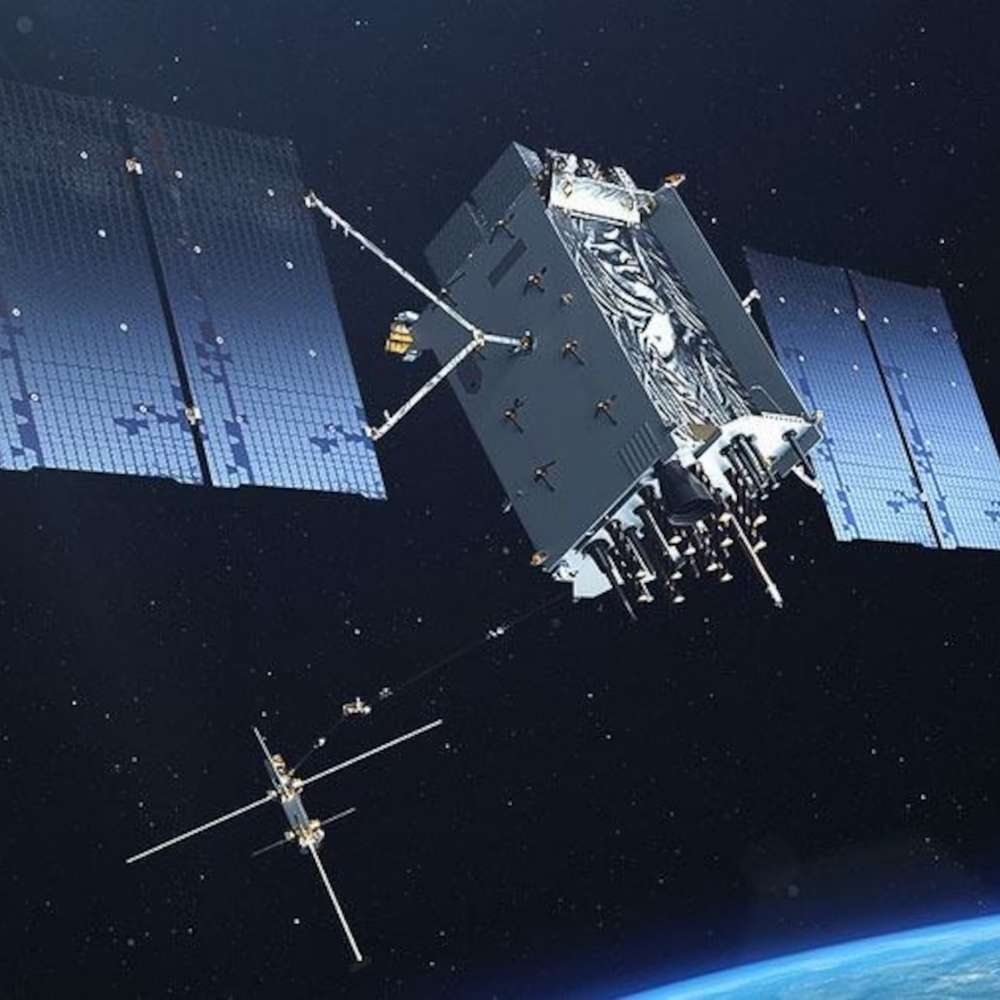
GPS satellites orbit in Medium Earth Orbit (MEO).
This orbit is chosen because it:
Covers large areas of Earth
Balances signal strength and coverage
Minimizes atmospheric drag
Why Not LEO or GEO?
LEO satellites move too fast for stable navigation
GEO satellites provide poor geometry and coverage at high latitudes
MEO provides the optimal compromise for global navigation accuracy.
Constellation Geometry – Why Many Satellites Are Needed
GPS satellites are arranged in:
Multiple orbital planes
Carefully phased positions
This ensures that:
At least 4–6 satellites are visible anywhere
Geometry remains favorable
Accuracy remains consistent
Redundancy is essential—navigation cannot tolerate gaps.
Signals – Civilian vs Military
GPS broadcasts multiple signals.
Civilian Signals
Open and free worldwide
Used by smartphones, vehicles, ships, aircraft
Accuracy: meters (or better with augmentation)
Military Signals
Encrypted and resistant to interference
Higher precision and reliability
Used for defense and strategic operations
Both are transmitted simultaneously from the same satellites.
Timing – The Hidden Superpower of GPS
GPS satellites carry atomic clocks.
These clocks:
Are accurate to billionths of a second
Enable precise synchronization
GPS time is used for:
Mobile phone networks
Internet data routing
Financial transaction timestamps
Power grid synchronization
In many systems, GPS timing matters more than GPS location.
Why GPS Accuracy Depends on Relativity
GPS would fail without Einstein’s relativity.
Because:
Satellites move fast (special relativity)
Satellites are higher in Earth’s gravity field (general relativity)
Their clocks:
Run faster than clocks on Earth
Require constant relativistic correction
Without these corrections:
GPS errors would grow by kilometers per day
GPS is one of the most practical, everyday confirmations of relativity in action.
Why GPS Matters Beyond Navigation
GPS supports:
Aviation and maritime navigation
Precision agriculture
Earthquake monitoring
Scientific timing experiments
Autonomous systems
It is not a consumer convenience—it is global infrastructure.
GPS vs Other Global Navigation Systems – One of Many, Still Central
GPS is part of a broader family known as Global Navigation Satellite Systems (GNSS). While GPS was the first fully operational system, others now operate alongside it.
Major GNSS Systems Compared
| System | Operator | Orbit Type | Global Coverage | Status |
|---|---|---|---|---|
| GPS | USA | MEO | Yes | Fully operational |
| GLONASS | Russia | MEO | Yes | Fully operational |
| Galileo | European Union | MEO | Yes | Operational |
| BeiDou | China | MEO + GEO + IGSO | Yes | Fully operational |
Interpretation
Modern receivers often use multiple GNSS systems simultaneously, improving accuracy, availability, and reliability. GPS remains foundational, but redundancy is now the norm.
Why Multi-GNSS Improves Accuracy
Using signals from multiple constellations:
Increases the number of visible satellites
Improves geometric coverage
Reduces signal blockage in cities and terrain
As a result:
Position fixes are faster
Accuracy improves
Reliability increases under challenging conditions
This is why smartphones today outperform early standalone GPS receivers.
Sources of GPS Error – Why Position Isn’t Perfect
GPS accuracy is affected by several real-world factors.
Primary Error Sources
Ionospheric delay – Signal slows through Earth’s upper atmosphere
Tropospheric delay – Weather-related signal effects
Satellite clock and orbit errors – Small but measurable
Multipath interference – Signals bouncing off buildings
Receiver noise – Hardware limitations
On their own, these errors are small. Combined, they can shift position by several meters.
Correction Systems – How GPS Becomes Precise
To reduce errors, GPS uses augmentation systems.
Key Correction Methods
SBAS (WAAS, EGNOS, GAGAN) – Regional corrections
DGPS – Local reference stations
RTK (Real-Time Kinematic) – Centimeter-level precision
PPP (Precise Point Positioning) – High accuracy without local base stations
With corrections:
Navigation reaches lane-level accuracy
Surveying reaches centimeter precision
Autonomous systems become viable
GPS scales from everyday use to scientific-grade measurement.
Vulnerabilities – Jamming and Spoofing
Despite its importance, GPS signals are weak by design.
This makes them vulnerable to:
Jamming – Overpowering the signal with noise
Spoofing – Broadcasting fake GPS signals
Potential consequences include:
Navigation disruption
Timing errors
Safety and security risks
Because of this, GPS is classified as critical infrastructure in many countries.
How Systems Mitigate GPS Vulnerabilities
To counter these risks:
Multi-frequency signals improve resilience
Multi-GNSS receivers reduce single-system dependence
Encrypted military signals resist spoofing
Ground-based backups are under development
Modern navigation systems are designed to degrade gracefully, not fail suddenly.
GPS and Critical Infrastructure
GPS underpins systems far removed from navigation.
Examples include:
Financial markets (timestamping trades)
Power grids (phase synchronization)
Telecommunications (network timing)
Scientific experiments (precision timing)
In many cases, loss of timing would be more damaging than loss of location.
Why GPS Is Considered Strategic Infrastructure
Because GPS affects:
National security
Economic stability
Transportation safety
It is treated as:
A strategic military asset
A public civilian utility
A global shared service
This dual-use nature shapes how GPS is maintained and upgraded.
Modernization – How GPS Keeps Improving
GPS is not static. It has undergone continuous upgrades to improve accuracy, reliability, and resilience.
Modern GPS generations include:
Block IIR / IIR-M – Improved reliability and new signals
Block IIF – Better clocks and civilian signal improvements
GPS III – Higher power, improved accuracy, and stronger signals
These upgrades ensure GPS remains competitive and robust in a multi-GNSS environment.
New Signals – More Accuracy, More Resilience
Modern GPS satellites broadcast additional signals:
L2C – Improved civilian accuracy
L5 – Safety-of-life signal for aviation
L1C – Interoperable with Galileo
Benefits include:
Better ionospheric correction
Faster position fixes
Improved resistance to interference
Multi-frequency reception is a major step toward higher precision and reliability.
GPS III – A Major Leap Forward
The GPS III satellites bring:
Up to three times better accuracy
Stronger signals for urban environments
Longer operational lifetimes
For civilian users, this means:
More stable navigation
Improved performance in cities
Better support for autonomous systems
For military users, it means greater security and resilience.
The Future of Navigation – Beyond GPS Alone
Future positioning systems will be multi-layered.
Key trends:
Multi-GNSS receivers as standard
Integration with inertial sensors
Ground-based backup timing systems
Enhanced authentication against spoofing
Navigation is evolving from a single system into a robust ecosystem.
Frequently Asked Questions (FAQ)
Is GPS free to use?
Yes. Civilian GPS signals are free and available worldwide.
Can GPS work indoors?
Not reliably. GPS signals are weak indoors, so devices often use Wi-Fi and cellular positioning as supplements.
How accurate is GPS today?
Typical accuracy is a few meters, but with correction systems it can reach centimeter-level precision.
What happens if GPS is unavailable?
Many systems degrade gracefully using other sensors or GNSS systems, but prolonged outages would cause widespread disruption.
Is GPS being replaced?
No. It is being complemented by other GNSS systems and technologies, not replaced.
Why GPS Will Remain Essential
Even in a multi-GNSS world, GPS remains:
A foundational reference system
Deeply embedded in infrastructure
Continuously upgraded and maintained
Its longevity, global adoption, and interoperability ensure it will remain central for decades.
What We Would Lose Without GPS
Without GPS:
Global transportation would slow and become less safe
Financial systems would lose precise timing
Emergency response coordination would degrade
Scientific and industrial precision would suffer
GPS is woven into daily life so deeply that its absence would be immediately felt worldwide.
Related Topics for Universe Map
GNSS
Galileo
GLONASS
BeiDou
Atomic Clocks
Relativity in Space
Satellite Navigation
Together, these topics explain how humanity measures position and time on a planetary scale.
Final Perspective
GPS does not explore the universe—but it connects us to it with precision.
By synchronizing time and space across the planet, GPS allows aircraft to land safely, networks to stay synchronized, economies to function, and science to measure reality with accuracy.
It is one of humanity’s quietest technological triumphs:
always on, rarely noticed, and absolutely indispensable.