




Haumea
The Fast-Spinning Dwarf Planet of the Kuiper Belt
Quick Reader
| Attribute | Details |
|---|---|
| Name | Haumea |
| Classification | Dwarf planet |
| Region | Kuiper Belt |
| Discovery | 2004–2005 (announced 2005) |
| Discoverers | Mike Brown team / José Luis Ortiz team |
| Distance from Sun | ~43–51 AU |
| Orbital Period | ~284 years |
| Rotation Period | ~3.9 hours (extremely fast) |
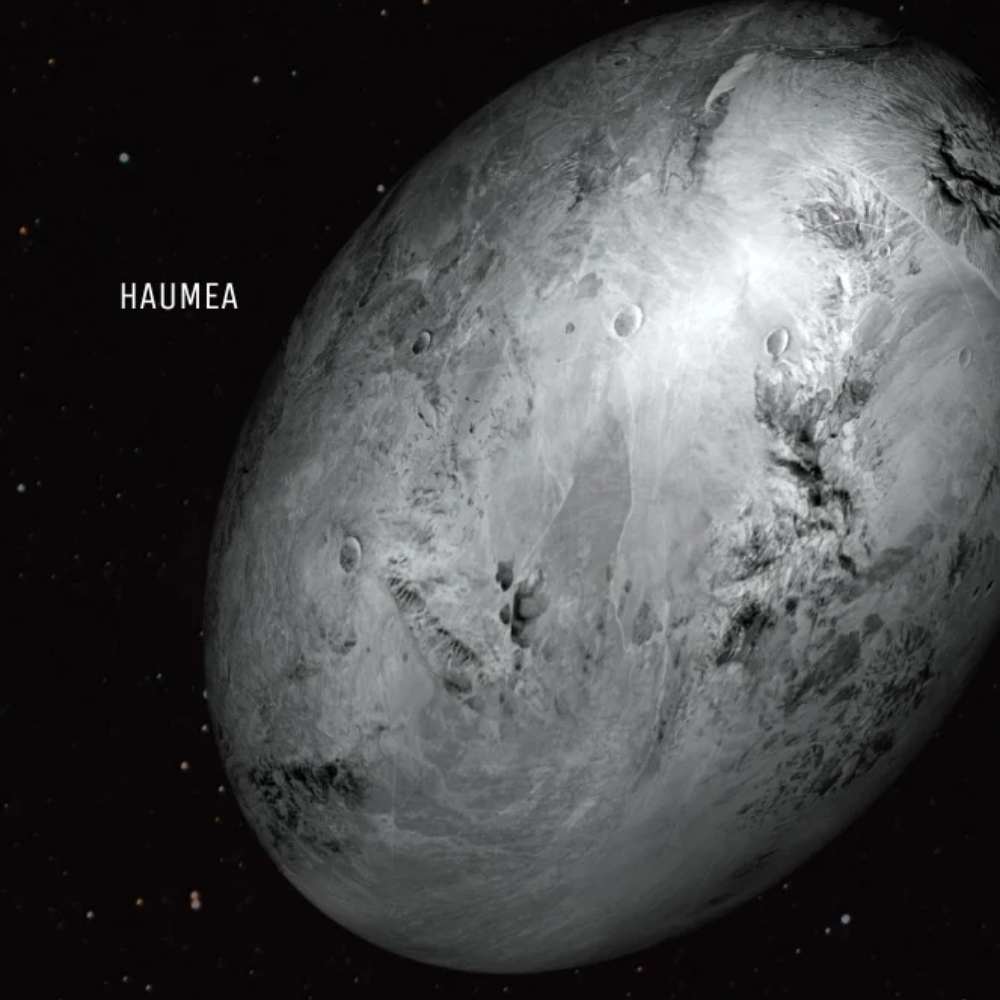
| Shape | Highly elongated (triaxial ellipsoid) |
| Diameter (equivalent) | ~1,600 km (mean) |
| Moons | 2 (Hiʻiaka, Namaka) |
| Ring System | Yes (discovered 2017) |
| Surface Composition | Crystalline water ice |
| Naming Origin | Hawaiian mythology (goddess of childbirth) |
Introduction – A Dwarf Planet That Broke the Rules
Among all known dwarf planets, Haumea is the most physically extreme.
It spins faster than almost any large object in the Solar System, is stretched into a football-like shape, has two moons, and even possesses a ring system—a feature once thought exclusive to giant planets.
Haumea is not simply another icy body beyond Neptune. It is a relic of violent collisions, rapid rotation, and unusual internal structure. Its very shape challenges traditional definitions of planetary equilibrium and forces scientists to rethink how dwarf planets form and evolve.
If Pluto is complex and Eris is massive, Haumea is dynamic.
Discovery – One Object, Two Teams, One Controversy
Haumea’s discovery is one of the most controversial in modern astronomy.
Observations began in 2004
Discovery was announced in 2005
Two independent teams claimed credit:
Mike Brown’s team (USA)
José Luis Ortiz’s team (Spain)
The dispute revolved around data access and timing, making Haumea’s discovery story as dramatic as the object itself.
Ultimately:
The IAU recognized Haumea as a dwarf planet
Credit was shared in a complex compromise
The object received its permanent name in 2008
This episode highlighted the growing competitiveness of Kuiper Belt research in the early 21st century.
Naming and Mythological Meaning
Haumea is named after Haumea, the Hawaiian goddess of childbirth and fertility.
The name was chosen because:
Haumea “gave birth” to many offspring in mythology
The dwarf planet has multiple moons
It appears to have produced a family of related Kuiper Belt objects
This mythological parallel is unusually precise in astronomy and reflects Haumea’s role as the center of a unique collisional family.
Orbit – A Classical Kuiper Belt Object
Haumea orbits the Sun at an average distance of about 43 AU, placing it in the classical Kuiper Belt, not the scattered disk.
Orbital Characteristics
Orbital period: ~284 years
Moderate eccentricity
Inclined orbit (~28°)
Its stable orbit suggests Haumea formed near its current location and was not dramatically scattered by Neptune.
Extreme Rotation – The Fastest Large Body
Haumea’s most defining feature is its extraordinary rotation speed.
Rotation period: ~3.9 hours
Faster than any other known dwarf planet
Approaches the limit before structural breakup
This rapid spin causes Haumea to stretch into a triaxial ellipsoid, making it one of the most elongated large objects in the Solar System.
Without this rotation, Haumea would likely be nearly spherical.
Shape – Why Haumea Is Not Round
Most dwarf planets are spherical due to gravity. Haumea is different.
Its shape is governed by:
Strong self-gravity
Extremely rapid rotation
Rigid icy structure
The result is a shape similar to a Jacobi ellipsoid, predicted by fluid dynamics for fast-spinning bodies.
This makes Haumea a rare real-world example of theoretical rotational physics.
Size and Mass – Smaller but Denser Than Expected
Although Haumea’s mean diameter is smaller than Pluto’s, it is relatively dense.
Implications:
Higher rock fraction
Loss of outer icy layers
Evidence of a massive past collision
This density supports the idea that Haumea lost much of its original ice mantle during a catastrophic impact.
Surface Composition – Pure Water Ice
Spectroscopy reveals that Haumea’s surface is dominated by crystalline water ice.
This is unusual because:
Radiation should amorphize ice over time
Crystalline ice suggests resurfacing or heating
Possible explanations include:
Past internal heating
Impact-related resurfacing
Continuous exposure of fresh ice due to fragmentation
Haumea’s surface appears surprisingly clean and bright for its age.
The Haumea Family – Evidence of a Giant Collision
Haumea is surrounded by a group of Kuiper Belt objects that share:
Similar orbits
Similar surface composition
Similar spectral signatures
This Haumea collisional family is the strongest evidence for a large-scale collision in the Kuiper Belt.
Fragments from this impact likely formed:
Haumea’s moons
Nearby icy objects
The basis for its rapid rotation
Why Haumea Matters
Haumea is scientifically crucial because it demonstrates that:
Giant impacts occur even in the outer Solar System
Dwarf planets can have rings
Rapid rotation can dominate planetary shape
Kuiper Belt objects can form families
It is a bridge between planetary science, collision physics, and disk evolution.
Haumea’s Moons – Hiʻiaka and Namaka
Haumea is accompanied by two known moons, both discovered in 2005. Their existence strongly supports the idea that Haumea experienced a violent collisional past.
Hiʻiaka – The Larger Moon
Hiʻiaka is Haumea’s outer and larger satellite.
Key characteristics:
Diameter: ~300–350 km (estimated)
Orbital distance: ~49,500 km
Orbital period: ~49 days
Surface composition: crystalline water ice
Hiʻiaka’s icy surface closely matches Haumea’s, reinforcing the idea that both formed from the same collisional debris.
Namaka – The Inner, Chaotic Moon
Namaka is smaller and orbits much closer to Haumea.
Key characteristics:
Diameter: ~150–170 km (estimated)
Orbital distance: ~25,600 km
Orbital period: ~18 days
Orbit: highly inclined and eccentric
Namaka’s unstable orbital behavior suggests that Haumea’s system is still dynamically evolving, even billions of years after formation.
What the Moons Reveal About Haumea’s Origin
The properties of Hiʻiaka and Namaka provide critical clues:
Similar surface composition → shared origin
Irregular orbits → aftermath of a collision
Low total mass → stripped icy mantle
Together, these point to a giant impact scenario, where Haumea lost much of its outer ice, spun up rapidly, and produced orbiting fragments that became moons.
Haumea’s Ring – A Dwarf Planet with a Ring System
In 2017, astronomers made a surprising discovery: Haumea has a ring.
This was detected during a stellar occultation, when Haumea passed in front of a distant star and briefly blocked its light.
Ring Properties
Location: ~2,287 km from Haumea’s center
Width: ~70 km
Orientation: aligned with Haumea’s equator
This marked the first ring system discovered around a dwarf planet.
How Did Haumea’s Ring Form?
Several hypotheses exist:
1. Collision Debris
Ring formed from leftover fragments of the original impact
Material failed to re-accrete into a moon
2. Moon Disruption
A former small moon may have been torn apart by tidal forces
Debris spread into a stable ring
3. Rotational Shedding
Rapid rotation caused surface material to escape
Ice accumulated in orbit as a ring
Most evidence currently favors a collision-related origin, consistent with Haumea’s broader history.
Internal Structure – A Dense, Rocky Core
Haumea’s density is higher than most Kuiper Belt objects.
This implies:
A rock-rich core
Loss of much of its original icy mantle
Partial differentiation early in its history
Likely internal layers:
Rocky core
Thick water-ice mantle (reduced by impact)
Thin surface layer of crystalline ice
This structure helps explain both Haumea’s shape and its fast rotation.
Why Haumea Spins So Fast
Haumea’s rotation is almost certainly the result of angular momentum transfer during a massive collision.
Effects of rapid rotation include:
Extreme elongation
Equatorial bulging
Possible mass shedding
Without this spin, Haumea would likely resemble Makemake or Pluto far more closely.
Haumea Compared with Other Dwarf Planets
Haumea vs Pluto
Pluto: slower rotation, active geology, thick atmosphere
Haumea: rapid rotation, no atmosphere, rigid icy surface
Haumea vs Eris
Eris: more massive, spherical, extremely cold
Haumea: smaller, denser, rotationally distorted
Haumea vs Makemake
Makemake: bright methane ice, thin atmosphere
Haumea: water-ice surface, no detectable atmosphere
Haumea stands out as the most collisionally altered of the known dwarf planets.
Why Haumea Is Scientifically Unique
Haumea combines features rarely found together:
Extreme rotation
Elongated shape
Two moons
A ring system
A collisional family
No other known dwarf planet displays all of these characteristics simultaneously.
Long-Term Evolution of the Haumea System
Haumea is not a frozen relic; it is a dynamically evolving system shaped by rotation, collisions, and gravitational interactions.
Evolutionary Drivers
Extreme rotation keeps Haumea near structural limits
Moons exchange angular momentum with the primary
Ring material slowly spreads and dissipates
Over billions of years, these forces may subtly alter Haumea’s shape, ring density, and moon orbits—though dramatic changes are unlikely in the near future.
Stability of Haumea’s Ring
Haumea’s ring occupies a narrow, stable region aligned with the dwarf planet’s equator.
Why the Ring Is Stable
Lies near a 1:3 spin–orbit resonance
Strong equatorial gravity from Haumea’s rapid rotation
Low collision velocities among ring particles
Despite its stability, the ring is likely temporary on cosmic timescales. Gradual spreading, collisions, and radiation pressure will eventually thin or disperse it.
The Future of Hiʻiaka and Namaka
The two moons have very different long-term prospects.
Hiʻiaka
Large and relatively stable
Likely to remain bound to Haumea for billions of years
Acts as a long-term tracer of Haumea’s mass and gravity field
Namaka
Eccentric, inclined orbit
More dynamically fragile
Could experience orbital changes or even ejection over extremely long timescales
Namaka’s behavior suggests Haumea’s system has not fully settled since the original collision.
Does Haumea Meet the Definition of a Dwarf Planet?
Yes—but Haumea tests the boundaries of the definition.
According to the IAU, a dwarf planet must:
Orbit the Sun
Have sufficient mass for hydrostatic equilibrium
Not have cleared its orbital neighborhood
Haumea satisfies these criteria, but its non-spherical shape is an exception caused by rotation, not lack of gravity. This makes Haumea a rare case where physics overrides intuition.
Frequently Asked Questions (FAQ)
Why is Haumea shaped like a football?
Because it spins extremely fast. Rapid rotation stretches the body into a triaxial ellipsoid.
Does Haumea have an atmosphere?
No. Its gravity is too weak to retain volatile gases.
Is Haumea larger than Pluto?
No. Pluto is larger and more massive, though Haumea is denser.
Why is Haumea’s surface made of water ice instead of methane?
Most methane was likely stripped away during a massive collision, leaving exposed water ice.
Is Haumea unique?
Yes. No other known dwarf planet combines extreme rotation, elongation, moons, a ring system, and a collisional family.
Haumea’s Role in Kuiper Belt Science
Haumea transformed how astronomers view the outer Solar System by showing that:
Giant impacts occur far beyond Neptune
Dwarf planets can host complex systems
Rings are not exclusive to giant planets
Kuiper Belt objects can form families, like asteroids
Haumea bridges asteroid physics, planetary science, and disk dynamics.
Related Topics for Universe Map
Kuiper Belt
Dwarf Planets
Hiʻiaka
Namaka
Haumea Ring
Pluto
Eris
Makemake
Together, these objects reveal the diversity and violence of the Solar System’s outer frontier.
Final Perspective
Haumea is a reminder that planets and dwarf planets are not always calm, round, and predictable. Some are born in violence, shaped by speed, and preserved as cosmic anomalies.
With its rapid spin, stretched form, moons, and ring, Haumea stands as the most physically extreme dwarf planet we know—an object that defies expectations and rewrites rules.
In studying Haumea, we are not just learning about one distant world. We are uncovering how chaos, collision, and motion sculpt planetary systems across the universe.