




Hi’iaka
The Powerful Moon of Haumea
Quick Reader
| Attribute | Details |
|---|---|
| Name | Hiʻiaka |
| Parent Body | Haumea (dwarf planet) |
| Type | Natural satellite |
| Discovery Date | January 2005 |
| Discoverers | Mike Brown and team |
| Discovery Method | Ground-based telescope observations |
| Orbital Distance | ~49,500 km from Haumea |
| Orbital Period | ~49 days |
| Estimated Diameter | ~300–350 km |
| Shape | Likely irregular to semi-spherical |
| Surface Composition | Water ice (crystalline) |
| Surface Color | Neutral to slightly blue |
| Atmosphere | None |
| Naming Origin | Hawaiian goddess Hiʻiakaikapoliopele |
| Scientific Importance | Moon formation, ice crystallinity |
Introduction to Hiʻiaka – A Moon Born from Catastrophe
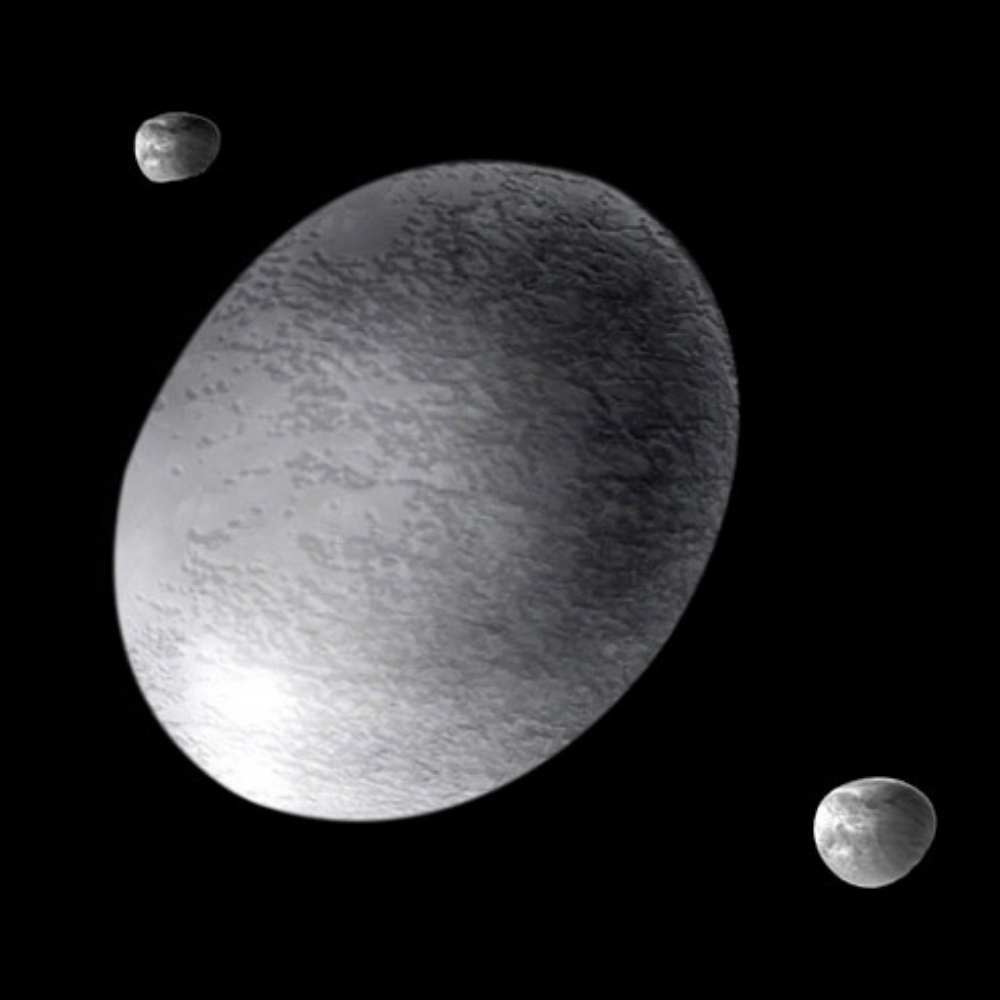
Hiʻiaka is the largest and most intriguing moon of the dwarf planet Haumea, one of the fastest-spinning large bodies in the Solar System. Although much smaller than its parent, Hiʻiaka plays an outsized role in helping astronomers understand how violent collisions shaped the outer Solar System.
Discovered in 2005, Hiʻiaka quickly stood out not just because of its size, but because of its unexpectedly crystalline water ice surface—a surprising feature for an object orbiting in the deep cold of the Kuiper Belt.
Hiʻiaka is not a captured object. It is almost certainly a fragment of Haumea itself, born from a massive ancient collision that reshaped an entire planetary system.
Discovery of Hiʻiaka
Hiʻiaka was discovered shortly after Haumea itself was identified as a large trans-Neptunian object. At the time, Haumea was still known by its provisional designation 2003 EL₆₁.
Key discovery facts:
Detected using high-resolution ground-based telescopes
Initially referred to as “S1”
Later confirmed as Haumea’s largest moon
The discovery of Hiʻiaka immediately strengthened the case that Haumea had experienced a catastrophic collision in its past.
Naming and Mythological Context
Hiʻiaka is named after Hiʻiakaikapoliopele, a Hawaiian goddess associated with fire, healing, and journeys. She is the sister of Pele, the goddess of volcanoes.
The name reflects:
Haumea’s Hawaiian naming theme
A close familial relationship between the dwarf planet and its moons
Cultural recognition tied to the discovery site in Hawaii
The use of Hawaiian mythology highlights the connection between modern astronomy and ancient cultural narratives.
Orbit Around Haumea
Hiʻiaka follows a wide, stable orbit around Haumea.
Orbital characteristics:
Average distance of about 49,500 km
Orbital period of roughly 49 days
Slightly inclined orbit relative to Haumea’s equator
Compared to Haumea’s smaller inner moon Namaka, Hiʻiaka’s orbit is less perturbed and more stable over long timescales.
Size and Shape
Hiʻiaka is estimated to be 300–350 km in diameter, making it one of the largest known moons of a Kuiper Belt object.
Implications of its size:
Likely retains a mostly solid interior
Possibly near hydrostatic equilibrium, though not perfectly spherical
Large enough to preserve surface features for billions of years
Its size makes it more comparable to mid-sized asteroids than to small irregular moons.
Surface Composition – Crystalline Water Ice
One of Hiʻiaka’s most remarkable features is its surface.
Spectroscopic observations reveal:
Dominance of crystalline water ice
Minimal dark organic material
High reflectivity compared to many TNOs
This is surprising because crystalline ice normally converts to amorphous ice at Kuiper Belt temperatures unless energy is regularly supplied.
Why Crystalline Ice Is a Mystery
Hiʻiaka’s surface should be frozen and inactive, yet crystalline ice suggests:
Past heating events
Possible tidal interactions
Residual heat from the original impact
This makes Hiʻiaka a key object in understanding energy processes in the outer Solar System.
Hiʻiaka and the Haumea Collision Family
Hiʻiaka is part of a larger Haumea collisional family, a group of icy objects sharing similar orbital properties and surface compositions.
This family indicates:
A massive collision shattered Haumea’s outer layers
Fragments spread across the Kuiper Belt
Hiʻiaka and Namaka are the largest remaining pieces
Hiʻiaka is effectively a preserved shard of an ancient planetary-scale impact.
Why Hiʻiaka Matters
Hiʻiaka is scientifically important because it:
Confirms collisional moon formation in the Kuiper Belt
Preserves crystalline ice in extreme cold
Helps measure Haumea’s mass and density
Links dwarf planets to asteroid-family–like structures
It shows that moons can act as historical records, not just companions.
Hiʻiaka vs Namaka – Two Very Different Moons
Haumea hosts two known moons: Hiʻiaka and Namaka. Although they share a common origin, their properties differ significantly.
Key Differences Between Hiʻiaka and Namaka
| Feature | Hiʻiaka | Namaka |
|---|---|---|
| Size | Larger (~300–350 km) | Smaller (~170 km) |
| Orbit | Wide, stable | Close, dynamically active |
| Orbital Period | ~49 days | ~18 days |
| Inclination | Relatively low | Strongly inclined |
| Stability | Long-term stable | Chaotic and evolving |
Hiʻiaka’s calm, wide orbit contrasts sharply with Namaka’s more chaotic motion, making Hiʻiaka the more dynamically settled remnant of the Haumea collision.
What Hiʻiaka Reveals About Moon Formation
The Haumea system provides one of the clearest examples of collision-driven moon formation beyond the asteroid belt.
Hiʻiaka likely formed when:
A massive impact stripped icy material from Haumea’s mantle
Debris re-accumulated into satellites
Angular momentum was redistributed throughout the system
This process resembles how Earth’s Moon may have formed, but in a far colder and more distant environment.
Internal Structure of Hiʻiaka
Although direct measurements are not available, Hiʻiaka’s size and density suggest a relatively simple internal structure.
Likely characteristics include:
An ice-dominated composition
Minimal rock content compared to Haumea
Little to no internal differentiation
Any internal heat Hiʻiaka once possessed would have dissipated long ago, leaving it geologically inactive today.
The Source of Hiʻiaka’s Crystalline Ice
Crystalline water ice should not survive long in the Kuiper Belt without an energy source. Several explanations have been proposed.
Possible Energy Sources
Impact Heating
The original collision that created Hiʻiaka may have heated its surface sufficiently to crystallize ice.Tidal Heating
Weak tidal interactions with Haumea could have provided limited heating early in the moon’s history.Radiogenic Heating
Decay of radioactive elements may have contributed small amounts of internal heat shortly after formation.
The persistence of crystalline ice suggests at least one of these processes played a role.
Orbital Stability and Long-Term Evolution
Hiʻiaka’s orbit is dynamically stable on billion-year timescales.
Key factors include:
Its distance from Haumea
Minimal resonance interactions
Weak perturbations from Namaka
This stability allows Hiʻiaka to preserve ancient surface features with little alteration.
Hiʻiaka in the Context of the Kuiper Belt
Hiʻiaka is one of the largest known moons in the Kuiper Belt and among the few that can be studied spectroscopically in detail.
Its properties help astronomers:
Understand satellite formation beyond Neptune
Compare collisional families across the Solar System
Investigate how icy bodies respond to extreme cold
Hiʻiaka bridges the study of moons and dwarf planets in the outer Solar System.
Observational Challenges
Studying Hiʻiaka is difficult due to:
Its faintness
Proximity to bright Haumea
Great distance from Earth
Most data comes from large ground-based telescopes equipped with adaptive optics, along with space-based infrared observations.
Why Hiʻiaka Is Scientifically Important
Hiʻiaka matters because it:
Preserves evidence of a massive ancient collision
Demonstrates crystalline ice survival in extreme environments
Helps constrain Haumea’s mass and rotation
Serves as a model for moon formation in debris-rich systems
It shows that even small moons can provide deep insight into planetary history.
The Long-Term Fate of Hiʻiaka
Hiʻiaka’s wide and stable orbit makes it one of the most dynamically secure moons in the Kuiper Belt. Unlike many small satellites that may eventually be ejected or collide with their parent bodies, Hiʻiaka is expected to remain bound to Haumea for billions of years.
Over extremely long timescales:
Its orbit may slowly evolve due to minor gravitational interactions
External perturbations from passing objects are very rare
The system remains largely isolated in the Kuiper Belt
Hiʻiaka is essentially a long-term survivor of an ancient cosmic catastrophe.
Could Hiʻiaka Ever Be Explored by a Spacecraft?
No dedicated mission to Hiʻiaka currently exists, and none are planned in the near future.
Challenges include:
Extreme distance from Earth
Long travel times exceeding several decades
Low priority compared to larger dwarf planets
However, if future missions target the Haumea system as a whole, Hiʻiaka would be a prime secondary science target due to its exposed icy surface and collisional origin.
What Hiʻiaka Teaches Us About the Outer Solar System
Hiʻiaka provides rare insight into processes that are otherwise hidden.
It helps scientists understand:
How large impacts shaped dwarf planets
How moons form from debris rather than capture
How crystalline ice can survive in extreme cold
Because Hiʻiaka is a fragment rather than a primordial body, it offers a direct look into Haumea’s internal composition.
Hiʻiaka as Evidence of Violent Planetary Histories
For many years, the Kuiper Belt was thought to be a quiet graveyard of icy relics. Hiʻiaka tells a different story.
Its existence proves that:
Massive collisions occurred beyond Neptune
Dwarf planets experienced dramatic reshaping
The outer Solar System was once highly dynamic
Hiʻiaka stands as a witness to one of the most violent events in the Kuiper Belt’s history.
Frequently Asked Questions (FAQ)
What is Hiʻiaka?
Hiʻiaka is the largest moon of the dwarf planet Haumea. It is an icy satellite formed from debris produced by a massive collision early in the Solar System’s history.
How was Hiʻiaka formed?
Hiʻiaka likely formed from material ejected during a giant impact that stripped icy layers from Haumea. The debris re-accumulated into moons rather than being captured from elsewhere.
Why is crystalline water ice on Hiʻiaka unusual?
At Kuiper Belt temperatures, water ice should become amorphous over time. The presence of crystalline ice suggests past heating from impacts, tidal effects, or residual heat from formation.
Is Hiʻiaka larger than Haumea’s other moon?
Yes. Hiʻiaka is significantly larger than Namaka and follows a wider, more stable orbit.
Does Hiʻiaka have an atmosphere?
No. Hiʻiaka is too small and cold to retain any atmosphere.
Can Hiʻiaka be seen with amateur telescopes?
No. Hiʻiaka is extremely faint and can only be observed using large professional telescopes with advanced imaging techniques.
Why is Hiʻiaka important to astronomy?
Hiʻiaka provides direct evidence of collision-driven moon formation in the Kuiper Belt and helps scientists study the composition and evolution of dwarf planets.
Hiʻiaka’s Place in the Universe Map
Within the Universe Map framework, Hiʻiaka represents:
A textbook example of collisional moon formation
A key piece of the Haumea family puzzle
A bridge between dwarf planets and asteroid-family–like systems
It connects planetary science, orbital dynamics, and surface chemistry into a single coherent story.
Final Thoughts
Hiʻiaka may be only a moon, but its scientific importance rivals that of much larger worlds. It preserves a frozen record of a catastrophic collision that reshaped Haumea and scattered fragments across the Kuiper Belt.
In the silent cold beyond Neptune, Hiʻiaka continues to orbit — a crystalline reminder that even the most distant regions of the Solar System were forged through violence, energy, and transformation.