








Hoag’s Object
The Perfect Cosmic Ring That Defies Explanation
Quick Reader
| Attribute | Details |
|---|---|
| Name | Hoag’s Object |
| Type | Ring Galaxy |
| Constellation | Serpens Caput |
| Distance from Earth | ~600 million light-years |
| Diameter | ~120,000 light-years |
| Discovery | 1950, by Arthur Hoag |
| Galaxy Structure | Nearly perfect circular ring surrounding a yellow spherical core |
| Ring Composition | Hot blue stars (young stellar population) |
| Core Composition | Old yellow stars (elliptical-like nucleus) |
| Possible Origin Theories | Collision ring, accretion ring, or gravitational resonance |
| Apparent Magnitude | ~16.2 |
| Notable Feature | A smaller ring galaxy visible through the outer ring — a galaxy behind it |
| Observation Tools | Hubble Space Telescope, GALEX, and SDSS |
| Best Viewing Season | Late spring to summer (for northern observers) |
| Scientific Importance | Offers insight into galaxy formation mechanisms and ring dynamics |
Introduction — A Cosmic Puzzle in Perfect Symmetry
In a universe full of chaotic collisions and asymmetric spirals, Hoag’s Object stands apart as a stunning example of geometric perfection.
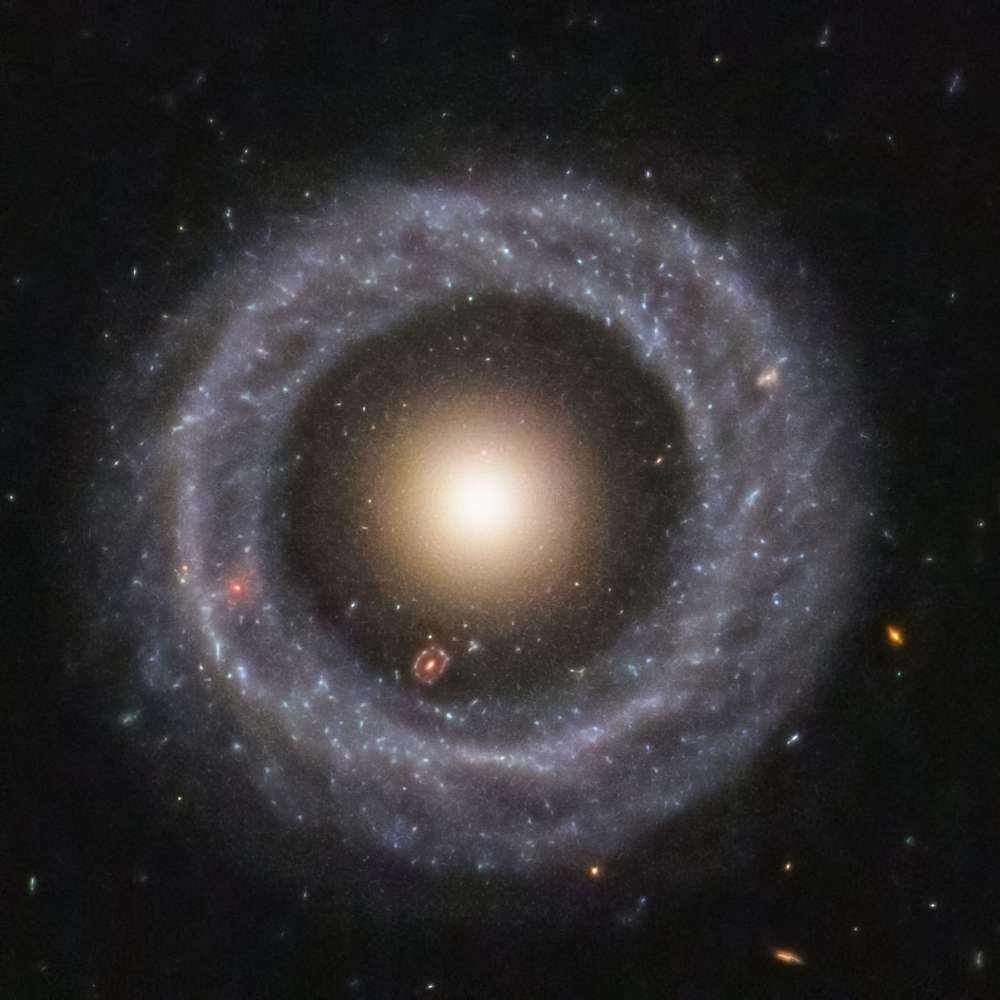
It is a ring galaxy, appearing as a golden core of old stars surrounded by a flawless, glowing blue ring of young stars — a cosmic structure so symmetrical that it almost looks artificial.
Discovered in 1950 by American astronomer Arthur Hoag, this galaxy baffled scientists from the very beginning. Initially, Hoag himself thought it might be a planetary nebula or a gravitational lens — but deeper analysis revealed it to be a completely unique type of galaxy.
The mystery of how such a structure could form — a detached ring orbiting a spherical core — continues to challenge modern astrophysics.
Unlike most ring galaxies formed by head-on collisions, Hoag’s Object shows no evidence of recent interaction or disturbance, making it an astronomical enigma.
Visual Appearance and Structure — Beauty Beyond Logic
From a distance, Hoag’s Object looks like a celestial eye — a bright yellow nucleus surrounded by a wide, smooth ring of brilliant blue stars.
Between the core and the ring lies a dark, nearly empty gap — as if the two components belong to entirely different galaxies.
The Core
The inner region consists mostly of old, evolved stars, similar to those in an elliptical galaxy. It spans about 17,000 light-years and emits a soft, golden glow.
Spectroscopic studies indicate very little gas or dust, meaning star formation in this region ended long ago.
The Ring
Encircling the core at a distance of nearly 70,000 light-years, the outer ring is filled with young, hot, blue stars.
These stars are actively forming in clusters, likely triggered by a wave of density that swept outward through the galaxy’s disk millions of years ago.
The Gap
The most striking aspect is the empty void between the ring and the core — a vast gulf with little to no stellar presence.
This separation defies the usual structure of galaxies, where disk and halo regions are smoothly connected.
Discovery and Early Observations
When Arthur Hoag first observed this galaxy through the Palomar Observatory in 1950, he described it as a “peculiar ring-like nebula” but hesitated to classify it.
At that time, no other galaxy like it was known.
In the following decades, improved imaging and spectroscopy confirmed it to be a ring galaxy located in the constellation Serpens Caput (the Serpent’s Head), approximately 600 million light-years away.
However, what makes it exceptional is not just its form, but its perfection — the ring is nearly circular, evenly distributed, and symmetrically centered around the core.
Even the Hubble Space Telescope image taken in 2001 surprised astronomers — deep within the ring’s background lies a second, smaller ring galaxy, visible through the open space — a lucky alignment that only deepened the intrigue.
The Theories Behind Its Formation
Scientists have proposed several competing models to explain how Hoag’s Object might have formed.
Yet, none perfectly fit all its observed features.
1. Collision Ring Theory
One explanation is that a smaller intruder galaxy once passed through the center of a larger disk galaxy.
The impact would have created shock waves, compressing gas into a circular front — forming the ring.
This process is seen in galaxies like the Cartwheel Galaxy, a known collision ring.
However, Hoag’s Object shows no signs of a companion galaxy or tidal debris, which makes this scenario less convincing.
2. Bar Instability or Resonance Theory
Another theory suggests that it once had a barred spiral structure.
Over time, gravitational resonances between the rotating bar and the disk may have reorganized gas into a stable, circular ring — while the bar later dissolved.
This model explains the symmetry but not the large gap or the complete detachment of the ring from the core.
3. Accretion or External Gas Capture
A third idea proposes that Hoag’s Object accreted gas from its surroundings or from a nearby galaxy.
That gas could have settled into an orbital ring, forming new stars while leaving the old elliptical-like core intact.
This model aligns with the observed difference in stellar ages between the ring and the nucleus.
Comparison with Other Ring Galaxies
To appreciate how special Hoag’s Object is, it helps to compare it with more typical ring systems.
| Galaxy | Type | Formation Trigger | Notable Feature |
|---|---|---|---|
| Cartwheel Galaxy | Collision Ring | Head-on impact between galaxies | Expanding, irregular ring with spokes |
| NGC 1291 | Resonance Ring | Bar-induced resonance | Multiple nested rings around a central bar |
| Hoag’s Object | Isolated Ring | Unknown (no collision evidence) | Perfect symmetry, clear gap, detached ring |
Unlike these, Hoag’s Object stands completely alone, showing no recent interactions or distortions — making it one of the cleanest examples of galactic isolation and symmetry in the universe.
Multi-Wavelength Studies — Seeing Beyond the Visible
Although Hoag’s Object looks serene in optical images, observations across different wavelengths reveal a much richer and more dynamic picture.
Each spectrum — optical, infrared, ultraviolet, and radio — uncovers a new layer of the galaxy’s history and structure.
Optical Light (Visible Spectrum)
Optical telescopes like the Hubble Space Telescope (HST) show Hoag’s Object in exquisite detail:
a golden-yellow nucleus surrounded by a sharply defined blue ring, separated by a clean dark gap.
The ring’s symmetry is so precise that it became an early test case for image-processing algorithms used in astrophotography and AI-based galaxy classification.
The stellar population in optical light reveals:
The core: dominated by old, metal-rich stars, typical of elliptical galaxies.
The ring: filled with young, massive, blue stars, suggesting ongoing star formation within the last few hundred million years.
Infrared Observations — The Hidden Warmth
Infrared data from the Spitzer Space Telescope and 2MASS survey provide a peek through any remaining dust, confirming that:
The nucleus emits a steady IR signature consistent with ancient stellar populations.
The ring emits bright IR radiation from young, warm dust grains — a sign of active star formation zones.
The lack of a connecting infrared bridge between the core and the ring further confirms that these two structures are physically separate and not simply phases of the same galactic disk.
Ultraviolet and GALEX Findings
The GALEX (Galaxy Evolution Explorer) survey observed Hoag’s Object in the ultraviolet range and revealed intense UV emission across the outer ring.
This UV light traces the birth of new stars — many less than 10 million years old — indicating that star formation is still occurring today.
Key findings:
The star formation rate (SFR) is estimated at around 0.7 solar masses per year, modest but sustained.
The ring’s uniform UV brightness suggests a stable, long-lived structure, not a short-term wave from a violent collision.
This stability challenges the collision model, implying the ring might have formed gradually or through resonance rather than impact.
Radio and HI Emission
Radio studies of Hoag’s Object using the Westerbork Synthesis Radio Telescope (WSRT) and VLA (Very Large Array) detected a substantial amount of neutral hydrogen gas (HI) in the ring, but almost none in the core.
This pattern matches what is expected for:
Gas-rich, star-forming outer regions, and
Gas-poor, evolved elliptical cores.
The ring’s rotation speed, measured from the Doppler shifts in the HI line, shows that the entire structure rotates as a coherent system — another sign of stability and isolation.
Estimated rotational velocity: ~150 km/s at the ring’s edge.
This smooth kinematic behavior further supports the theory that Hoag’s Object has not experienced a recent merger or external gravitational disruption.
Kinematics and Dynamics — A Stable Balance
The dynamics of Hoag’s Object reveal an astonishingly harmonious balance between gravity and rotation. In most galaxies, internal asymmetries — bars, arms, mergers — cause turbulence and uneven distribution. But in Hoag’s Object, the ring remains nearly circular and dynamically calm.
Measured Properties
| Parameter | Value | Interpretation |
|---|---|---|
| Rotation Velocity | ~150 km/s | Stable circular motion |
| Total Mass | ~7 × 10¹¹ M☉ | Comparable to Milky Way |
| Star Formation Rate | ~0.7 M☉/yr | Moderate, sustained |
| Age of Core | ~10 billion years | Ancient stellar population |
| Age of Ring | ~1 billion years | Young, recent formation |
The significant age difference between the core and the ring suggests that they did not form together, strengthening the accretion or external gas capture theory.
Hoag’s Object in the Context of Galactic Evolution
Understanding Hoag’s Object helps astronomers probe deeper questions about how galaxies evolve over cosmic time.
It may represent a transitional form, bridging early-type ellipticals and late-type disk galaxies.
Possible Evolutionary Scenarios
From Elliptical to Ring Galaxy
A dormant elliptical captured external gas, which settled into a rotating ring.
This process could create both the age contrast and structural separation seen today.Bar Dissolution Model
A once-barred spiral galaxy underwent internal resonance, forming a ring.
Over time, the bar faded, leaving behind the smooth nucleus and detached ring.Long-Term Stability Model
The system may be gravitationally self-stabilizing, maintaining the ring for billions of years without outside interference.
Each scenario implies a different timeline of galactic transformation, making Hoag’s Object a natural laboratory for testing models of secular evolution.
Comparison with Milky Way and Other Galaxies
| Feature | Hoag’s Object | Milky Way | Cartwheel Galaxy |
|---|---|---|---|
| Type | Ring Galaxy | Barred Spiral | Collision Ring |
| Diameter | ~120,000 ly | ~100,000 ly | ~150,000 ly |
| Star Formation | Ongoing (ring only) | Ongoing (disk) | Intense (ring) |
| Structure | Detached ring + core | Continuous disk | Shockwave ring |
| Environment | Isolated | Local Group | Post-collision |
| Stability | Extremely high | Moderate | Temporary (~300 Myr) |
This comparison highlights how uniquely ordered and balanced Hoag’s Object is. While most galaxies evolve through violence, it seems to have reached a peaceful equilibrium — an example of cosmic engineering by natural forces.
Unresolved Mysteries — The Puzzle of a Perfect Galaxy
Even after decades of detailed imaging and modeling, Hoag’s Object remains one of the greatest mysteries in extragalactic astronomy.
It stands out not just for its beauty, but for its defiance of known formation mechanisms.
Several questions still puzzle astronomers today:
1. How Did the Ring Form So Perfectly?
Most ring galaxies are messy — their rings are asymmetric, lopsided, or contain tidal debris from a collision.
But Hoag’s Object shows:
No sign of an intruder galaxy,
No disrupted gas trails,
No warped or irregular structure.
Even computer simulations struggle to produce such flawless symmetry without some fine-tuned parameters.
The lack of evidence for any violent event makes it difficult to reconcile with standard galactic formation models.
2. Why Is the Ring Completely Detached?
In other ring galaxies, the ring connects to the core through faint bridges of stars or gas.
Hoag’s Object, however, has a completely dark, empty gap separating its core and outer ring — a feature rarely seen in nature.
This gap could mean:
The system is extraordinarily stable,
Or it’s in a unique gravitational equilibrium where inner and outer components rotate independently but harmoniously.
Some simulations suggest that such configurations can arise if accreted gas settles into a resonant orbit around a dense elliptical core, maintaining separation over billions of years.
3. Could It Be a Product of Ancient Accretion?
One possible answer lies in the long-term evolution of isolated galaxies.
Hoag’s Object might once have been an elliptical galaxy that, billions of years ago, slowly captured gas from the intergalactic medium or a faint neighboring galaxy.
That gas settled into a circular orbit, forming a stable ring where new stars were born.
If true, Hoag’s Object would demonstrate that galaxies can reshape themselves naturally, without the need for major collisions — a revolutionary idea in galactic evolution.
4. Are There More “Hoag-Type” Galaxies?
Although extremely rare, a few galaxies share Hoag-like features.
These include SDSS J151713.93+213516.8 and UGC 4599, both of which show detached rings with symmetrical cores.
Yet none match the near-perfect geometry and isolation of Hoag’s Object.
If future surveys find more such galaxies, astronomers may finally understand whether Hoag’s Object is a rare anomaly or part of a broader class of self-stabilizing ring systems.
Theoretical and Simulation Insights
Modern computer models have tried to replicate Hoag’s Object through N-body and hydrodynamic simulations.
Some have shown that under certain gravitational resonance conditions, rings can spontaneously form around an elliptical core — even without collisions.
However, these models require:
Very fine-tuned angular momentum,
Stable dark matter halo symmetry, and
Minimal external gravitational disturbances.
This suggests that Hoag’s Object is likely located in a cosmic quiet zone — far from massive clusters or intergalactic winds — allowing it to preserve its form for hundreds of millions of years.
What Hoag’s Object Teaches Us About Symmetry in the Universe
Symmetry in nature often signifies stability and balance.
In galaxies, however, perfect symmetry is almost impossible due to the chaotic processes that drive their evolution.
Hoag’s Object is an exception — a natural laboratory for studying how gravity, rotation, and dark matter interact to produce equilibrium.
Key lessons from Hoag’s Object:
Not all galactic beauty comes from destruction — some emerge from long-term harmony.
The universe may have self-organizing mechanisms where order arises naturally from chaos.
Galactic evolution is more diverse than previously thought, spanning beyond collisions and mergers.
In essence, Hoag’s Object represents the quiet side of cosmic evolution — one driven by symmetry, not violence.
Frequently Asked Questions (FAQ)
Q1: Why is Hoag’s Object so perfectly round?
Because its ring formed in a highly stable gravitational resonance or accretion process, with no external disturbance to distort its shape. Its location in a quiet cosmic environment may have preserved this symmetry for billions of years.
Q2: Is Hoag’s Object a collisional ring galaxy?
Probably not. There’s no evidence of a companion or shockwave pattern. Its structure and stability suggest a non-collisional origin — possibly resonance or accretion.
Q3: Can Hoag’s Object be seen with amateur telescopes?
No, it’s too faint, with an apparent magnitude of about 16.2. It requires a large research telescope or space-based observatories like Hubble to capture in detail.
Q4: Is the small galaxy visible inside the ring related to Hoag’s Object?
No. That’s a background galaxy, coincidentally aligned along our line of sight — a lucky cosmic alignment that deepens the illusion of symmetry.
Q5: Why is Hoag’s Object scientifically important?
It challenges existing galaxy formation theories, showing that even in isolation, galaxies can evolve into highly ordered, long-lived structures without external triggers.
Related Objects and Further Exploration
Cartwheel Galaxy (Ring Galaxy via Collision) — a chaotic contrast to Hoag’s perfection.
NGC 7742 — another face-on ring galaxy with an old core and young ring.
UGC 4599 — considered a “Hoag’s Object analog.”
Resonance Rings in Barred Spirals — studies on how bars and orbits create symmetric rings.
Dark Matter Halos — essential in maintaining such stable galactic structures.
Final Thoughts
Hoag’s Object remains a breathtaking mystery suspended in cosmic isolation — a perfect ring of blue stars encircling a golden heart.
In its quiet corner of the universe, it has defied every rule of galactic formation, existing as a timeless sculpture of gravitational harmony.
For astronomers, it’s a reminder that the universe is not only violent and unpredictable — it is also capable of delicate balance and astonishing order.
As telescopes grow more powerful and simulations more precise, Hoag’s Object will continue to serve as a beacon for understanding the elegant side of cosmic evolution.