








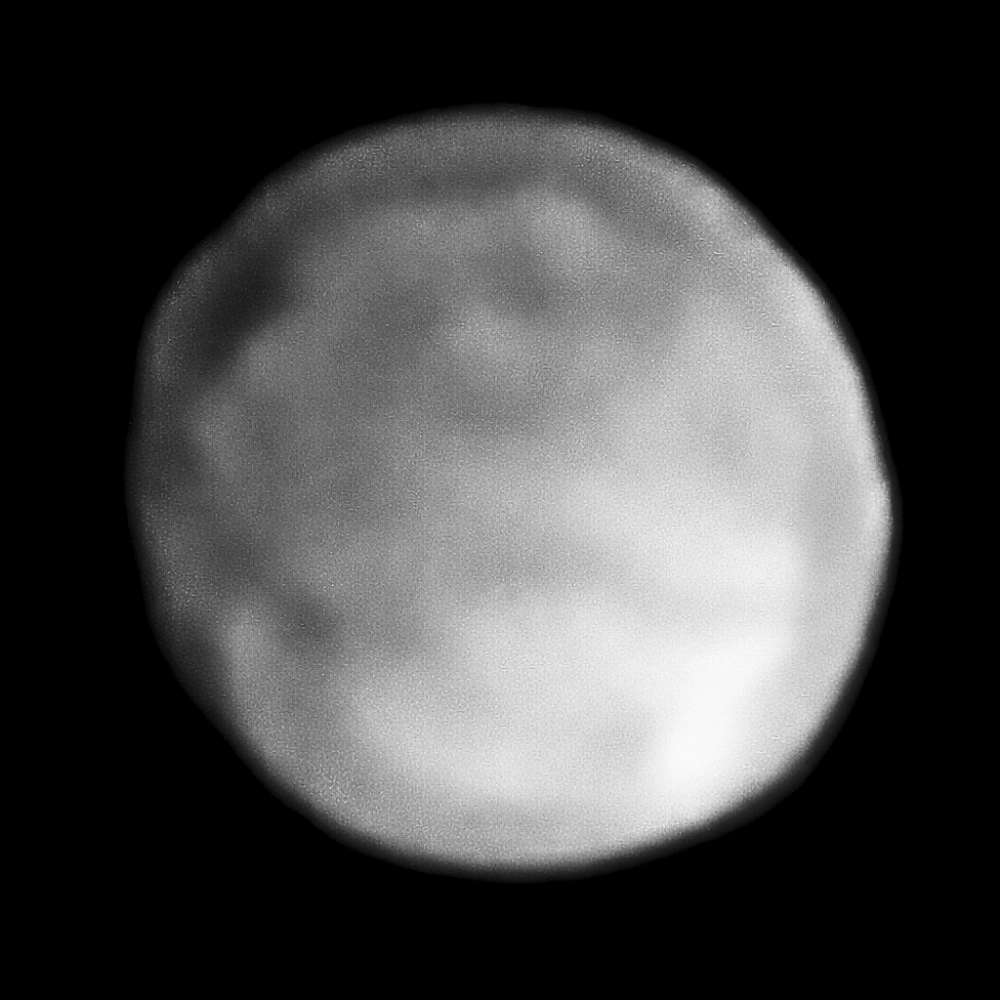
Hygiea
The Dark Giant That Almost Became a Dwarf Planet
Quick Reader
| Attribute | Details |
|---|---|
| Object Name | 10 Hygiea |
| Object Type | Large asteroid / Dwarf planet candidate |
| Location | Main Asteroid Belt |
| Discovery | 1849 |
| Discoverer | Annibale de Gasparis |
| Mean Diameter | ~430–450 km |
| Rank by Size | 4th largest object in asteroid belt |
| Shape | Nearly spherical |
| Orbital Period | ~5.57 Earth years |
| Rotation Period | ~13.8 hours |
| Inclination | ~3.8° (low) |
| Composition | Carbonaceous (C-type) |
| Density | Low (ice + rock mixture) |
| Differentiation | Minimal or partial |
| Surface | Dark, primitive, smooth |
| Atmosphere | None |
| Special Status | Missed dwarf-planet status by a narrow margin |
Key Points
- Hygiea is the fourth-largest object in the asteroid belt
- It is one of the roundest asteroids ever observed
- Composition is primitive and carbon-rich
- Likely formed through catastrophic reaccumulation
- Came very close to qualifying as a dwarf planet
Introduction – The Quiet Giant of the Asteroid Belt
Hygiea is easy to overlook.
It has no dramatic volcanoes like Vesta, no bright surface like Ceres, and no extreme orbit like Pallas. Instead, Hygiea is dark, calm, and almost featureless—yet scientifically, it may be one of the most important objects in the asteroid belt.
Hygiea represents a near-miss in planetary classification: an object large and round enough to resemble a dwarf planet, but just below the threshold required to officially become one.
It is a reminder that planetary status is not always about size alone—it is about history.
What Is Hygiea?
Hygiea is a carbonaceous asteroid, belonging to the C-type class, meaning it is composed of primitive material left largely unchanged since the Solar System’s formation.
Unlike Vesta, Hygiea shows little evidence of:
Volcanism
Internal melting
Crust–mantle separation
Instead, it appears to be a cold, chemically primitive world, preserving early Solar System material in near-original form.
This makes Hygiea fundamentally different from rocky protoplanets.
Size and Shape – Almost a Dwarf Planet
What makes Hygiea exceptional is its shape.
High-resolution observations show that Hygiea is:
Nearly spherical
More round than Vesta
Comparable in shape to Ceres
This raised a major scientific question:
If Hygiea is round, why is it not a dwarf planet?
The answer lies in its internal structure and formation history, not just geometry.
Why Hygiea Is Not Classified as a Dwarf Planet
To qualify as a dwarf planet, an object must:
Orbit the Sun
Be nearly round (hydrostatic equilibrium)
Not clear its orbital neighborhood
Not be a satellite
Hygiea satisfies most criteria—but the problem lies with hydrostatic equilibrium.
Evidence suggests:
Hygiea’s round shape may not come from internal melting
Instead, it may be the result of reaccumulation after a massive collision
Gravity reshaped rubble, not a molten interior
In other words, Hygiea may look planet-like without ever behaving like one internally.
Composition – A Carbon-Rich Time Capsule
Hygiea’s C-type composition implies:
Abundant carbon compounds
Possible hydrated minerals
Primitive rock–ice mixtures
This material is similar to:
Carbonaceous meteorites
Early solar nebula dust
Building blocks of planets and life
Unlike differentiated bodies, Hygiea retains this chemistry unaltered, making it a valuable sample of primordial Solar System material.
Surface Characteristics – Smooth, Dark, and Ancient
Hygiea’s surface is unusually smooth for an object of its size.
Observations indicate:
Few large craters compared to expectations
A relatively uniform surface
Very low reflectivity
This supports the idea that Hygiea’s surface was reset by a massive impact event, after which debris fell back and smoothed the body.
Rather than preserving scars, Hygiea may have erased them.
The Hygiea Family – Evidence of a Violent Past
Hygiea is the largest member of the Hygiea asteroid family, a group of asteroids sharing similar orbital and spectral properties.
This family likely formed when:
A massive impact shattered Hygiea’s parent body
Debris spread through nearby space
Gravity reassembled the largest remnant
Hygiea may not be a pristine survivor—but a rebuilt world.
Hygiea vs Ceres vs Vesta – First Comparison
| Feature | Hygiea | Ceres | Vesta |
|---|---|---|---|
| Composition | Carbon-rich | Ice-rich | Basaltic |
| Shape | Nearly spherical | Spherical | Irregular |
| Differentiation | Minimal | Partial | Full |
| Volcanism | None | Cryovolcanism | Ancient |
| Planetary Status | Asteroid | Dwarf planet | Protoplanet |
Hygiea occupies a middle ground, neither fully primitive nor fully evolved.
Why Hygiea Matters
Hygiea matters because it:
Challenges dwarf planet definitions
Shows that roundness does not equal differentiation
Preserves primitive Solar System chemistry
Represents a collision-built planetary body
It expands our understanding of how planet-like shapes can arise without planet-like processes.
Formation History – A World Rebuilt, Not Born Smooth
Hygiea’s current appearance is misleading.
For many years, astronomers assumed that Hygiea formed quietly and remained largely unchanged. High-resolution observations and dynamical modeling now suggest a far more dramatic history.
The leading hypothesis is that Hygiea is the product of catastrophic disruption followed by gravitational reaccumulation.
The likely sequence:
A large primordial body existed in the outer asteroid belt
A massive impact shattered this body early in Solar System history
Thousands of fragments were produced
Gravity caused the largest remnant to slowly reassemble into a round shape
Hygiea is therefore not a primordial survivor like Pallas, nor a differentiated protoplanet like Vesta. It is a second-generation world, shaped by destruction rather than growth.
Reaccumulation vs Differentiation – A Crucial Distinction
This distinction explains why Hygiea almost—but not quite—qualifies as a dwarf planet.
Differentiated bodies (like Vesta):
Melt internally
Separate into core, mantle, and crust
Become round through internal gravity and heat
Reaccumulated bodies (like Hygiea):
Never fully melt
Remain compositionally mixed
Become round through gravitational settling of rubble
Hygiea’s roundness does not imply a molten past.
It implies gravitational self-organization after a collision.
This is a fundamentally different pathway to planetary shape.
Internal Structure – Cold, Mixed, and Primitive
Hygiea’s internal structure is believed to be:
Weakly consolidated
Compositionally mixed (rock + ice + carbon compounds)
Largely undifferentiated
Unlike Ceres, there is little evidence for:
A dense core
Internal layering
Long-lived internal heat
Any heat generated during its formation was likely:
Short-lived
Quickly lost due to low density
Insufficient for sustained melting
Hygiea never crossed the thermal threshold required for planetary evolution.
Why Hygiea Stayed Cold While Vesta Did Not
Hygiea and Vesta formed in broadly similar regions—but their outcomes diverged sharply.
Key differences include:
Accretion timing: Vesta formed early and fast; Hygiea formed slower
Radioactive heating: Vesta trapped short-lived isotopes; Hygiea did not
Impact history: Hygiea’s growth was interrupted early
As a result:
Vesta melted and differentiated
Hygiea fragmented and reassembled
One became a protoplanet, the other a rebuilt asteroid
This contrast shows how timing, not just location, determines planetary fate.
The Hygiea Family – Fingerprints of a Shattered Past
The Hygiea family provides strong evidence for the reaccumulation scenario.
This family:
Contains hundreds of carbon-rich asteroids
Shares similar orbital elements
Shows compositional consistency
These features indicate a single massive disruption event, not gradual erosion.
Importantly:
Many family members are small and irregular
Hygiea alone is large and spherical
This strongly supports the idea that Hygiea is the largest gravitational remnant of a shattered parent body.
Surface Properties – Why Hygiea Looks So Smooth
Hygiea’s surface lacks the dramatic relief seen on Vesta or Pallas.
Possible explanations include:
Debris fallback smoothing the surface after reassembly
Low internal strength causing gradual shape relaxation
Ice-rich material enabling slow surface flow
Rather than preserving ancient craters, Hygiea may have buried them under fallback material.
Its smoothness is not youth—it is post-impact renewal.
The Classification Debate – Asteroid or Dwarf Planet?
Hygiea sits at the center of a genuine scientific debate.
Arguments for dwarf planet status:
Nearly spherical shape
Large size
Gravitational dominance over its fragments
Arguments against:
Lack of evidence for hydrostatic equilibrium through melting
No confirmed internal differentiation
Shape likely achieved through rubble reaccumulation
Current consensus favors classifying Hygiea as a large asteroid, not a dwarf planet—but with an asterisk.
It challenges the simplicity of existing definitions.
Why Hygiea Is a Boundary Object
Hygiea occupies a rare category:
Too round to be a typical asteroid
Too cold to be a true dwarf planet
Too primitive to be a protoplanet
These boundary objects are extremely valuable because they stress-test our classification systems.
Hygiea forces scientists to ask:
Is planetary status defined by shape, process, or history?
What Hygiea Teaches Planetary Science
Hygiea reveals that:
Round worlds can form without melting
Catastrophic impacts can create planet-like bodies
Planet formation is not a single pathway
It expands the range of outcomes between dust and planets.
The Long-Term Future of Hygiea
Hygiea’s future is expected to be quiet and stable.
Because it lacks internal heat, tectonics, or tidal interactions, Hygiea will not undergo further geological evolution. Its nearly spherical shape will persist, maintained by self-gravity rather than active internal processes.
Over the next billions of years, Hygiea will likely experience:
Gradual accumulation of small impact craters
Slow surface alteration from space weathering
Minor orbital changes driven by long-term resonances
Unlike differentiated bodies, Hygiea’s internal structure will remain cold, mixed, and unchanged.
Hygiea is not evolving—it is preserving.
Can Hygiea’s Shape Change Over Time?
Significant reshaping is unlikely.
For Hygiea to lose its roundness or evolve further, it would require:
A catastrophic impact comparable to its original disruption
Internal melting that no longer exists
Strong tidal forces, which are absent
Small impacts may roughen the surface locally, but they cannot alter the global shape.
Hygiea’s near-spherical form is effectively locked in.
Why Hygiea Will Never Become a Dwarf Planet
Even though Hygiea looks planet-like, its history prevents reclassification.
Key limiting factors:
No evidence of hydrostatic equilibrium driven by heat
No layered internal structure
Shape achieved through reaccumulation, not differentiation
Planetary status is not retroactive.
Hygiea cannot become a dwarf planet unless its formation mechanism changes—which is no longer possible.
This reinforces an important lesson:
classification depends on process, not appearance.
Scientific Value of a Reassembled World
Hygiea is uniquely valuable because it represents a third evolutionary pathway:
Not primitive survival (like Pallas)
Not successful differentiation (like Vesta)
But reconstruction after destruction
Studying Hygiea allows scientists to:
Test models of catastrophic disruption
Understand gravitational reaccumulation
Study primitive material at large scales
Refine definitions of planetary equilibrium
Few objects sit so precisely on a classification boundary.
Frequently Asked Questions (FAQ)
Is Hygiea larger than Vesta?
No. Vesta is slightly larger and significantly denser. Hygiea is rounder but less massive.
Why is Hygiea darker than Vesta?
Because Hygiea is carbon-rich, absorbing more sunlight and reflecting less light.
Does Hygiea contain water or ice?
Likely yes, in the form of hydrated minerals and possibly subsurface ice mixed with rock.
Has any spacecraft visited Hygiea?
No. All current knowledge comes from telescopic observations and modeling.
Could Hygiea be explored in the future?
Yes. Its size, shape, and boundary status make it an excellent future mission target.
Hygiea in the Context of Universe Map
Hygiea connects several key Universe Map themes:
Planetary classification boundaries
Asteroid belt evolution
Catastrophic impacts and reaccumulation
Primitive Solar System chemistry
Related Universe Map topics include:
Ceres
Vesta
Pallas
Asteroid Belt
Dwarf planet definitions
Together, these bodies show that the asteroid belt contains multiple incomplete pathways toward planets, not a single evolutionary story.
Final Perspective
Hygiea is a planet-shaped object without a planetary past.
Its roundness suggests maturity, but its interior tells a different story—one of cold assembly after violent destruction. Hygiea reminds us that appearances can mislead, even in planetary science.
Where planets grow, Hygiea rebuilt.
Where others evolved, Hygiea settled.
In that quiet distinction lies its true importance.