






I.S.S.
Humanity’s Permanent Outpost in Low Earth Orbit
Quick Reader
| Attribute | Details |
|---|---|
| Official Name | International Space Station (ISS) |
| Mission Type | Modular space station |
| Orbit Type | Low Earth Orbit (LEO) |
| Orbital Altitude | ~400 km |
| Orbital Period | ~90 minutes |
| Speed | ~28,000 km/h |
| First Module Launched | 1998 (Zarya) |
| Continuous Human Presence | Since November 2000 |
| Partner Agencies | NASA, Roscosmos, ESA, JAXA, CSA |
| Crew Size | Typically 6 astronauts |
| Mission Status | Operational |
In two sentences
The International Space Station is a permanently inhabited laboratory orbiting Earth, where humans live and work in microgravity. It represents the longest-running international collaboration in space history.
Key takeaway
The ISS is not just a spacecraft—it is a living research ecosystem above Earth.
Best for
Human spaceflight studies, microgravity science, international cooperation, and future deep-space mission preparation.
Introduction – A City That Never Lands
Every 90 minutes, the ISS circles Earth.
Inside, astronauts sleep, work, exercise, and conduct experiments—while floating.
No other structure built by humans has remained continuously occupied in space for over two decades. The ISS is where humanity learned how to live beyond Earth, not briefly, but sustainably.
What Is the International Space Station?
The ISS is a modular space station assembled piece by piece in orbit.
It functions as:
A scientific laboratory
A testbed for space technologies
A training ground for long-duration missions
A symbol of post-Cold War cooperation
Rather than being launched whole, it was built gradually—one module at a time—over many years.
Why Low Earth Orbit Matters
The ISS orbits close to Earth for practical reasons:
Easier crew access and resupply
Lower radiation than deep space
Real-time communication with Earth
At ~400 km altitude, the ISS experiences:
Microgravity (not zero gravity)
Atmospheric drag requiring regular reboosts
Frequent day–night cycles (16 sunrises per day)
This environment is ideal for controlled scientific study.
International Collaboration on an Unprecedented Scale
The ISS is jointly operated by five major space agencies:
NASA (United States)
Roscosmos (Russia)
ESA (Europe)
JAXA (Japan)
CSA (Canada)
Each partner contributed modules, hardware, or expertise. The ISS is governed by complex agreements that make it the most ambitious international engineering project ever completed.
Station Architecture – How the ISS Is Built
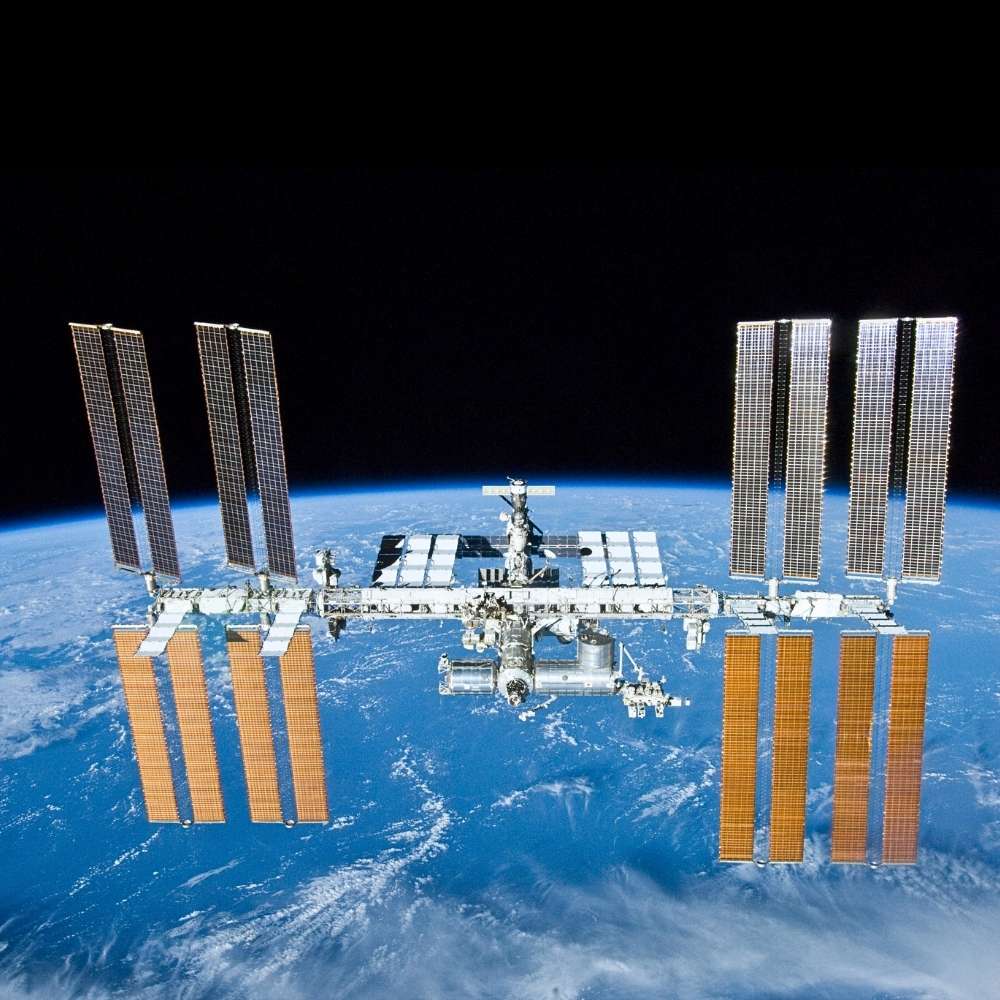
The ISS consists of interconnected modules:
Pressurized living and working areas
Solar arrays for power generation
Radiators for thermal control
Docking ports for spacecraft
Major segments include:
US Orbital Segment
Russian Orbital Segment
European and Japanese laboratories
This modular design allows upgrades, replacements, and expansion.
Life Aboard the ISS
Astronauts aboard the ISS:
Conduct scientific experiments daily
Exercise ~2 hours per day to maintain bone and muscle
Communicate with Earth in real time
Perform maintenance and spacewalks
Living in microgravity requires adapting to:
Floating sleep
Specialized food packaging
Strict schedules and procedures
The ISS proved that humans can live and work in space for months at a time.
Why Continuous Human Presence Matters
Since November 2000, the ISS has never been unoccupied.
This continuity allowed:
Long-term health studies
Psychological and social research
Cumulative operational experience
Without this uninterrupted presence, future missions to the Moon and Mars would remain speculative.
Scientific Role of the ISS
The ISS supports research in:
Biology and human physiology
Materials science
Fluid physics
Earth observation
Fundamental physics
Many experiments require microgravity conditions impossible to replicate on Earth.
Why the ISS Changed Human Spaceflight
Before the ISS:
Space missions were short and isolated
Long-term habitation was unproven
After the ISS:
Long-duration missions became routine
International crews became standard
Space living became operational science
The ISS transformed spaceflight from exploration into sustained presence.
Science on the ISS – What We Learn in Microgravity
Microgravity changes how matter behaves. The ISS provides a laboratory where gravity’s dominance is removed, allowing scientists to isolate other forces.
Major research domains include:
Human physiology: bone density, muscle loss, vision changes
Fluid physics: capillary action, surface tension, combustion
Materials science: crystal growth, alloys, semiconductors
Biology: cell behavior, microbes, plant growth
Earth science: climate, oceans, forests, disasters
Many of these experiments cannot be performed accurately on Earth.
Human Health – Preparing for Long-Duration Spaceflight
One of the ISS’s most critical roles is understanding how the human body adapts to space.
Key findings include:
Bone density loss of ~1–2% per month without countermeasures
Muscle atrophy without regular resistance exercise
Fluid shifts toward the head, affecting vision
Changes in immune system behavior
Countermeasures—exercise, diet, medical monitoring—were developed and refined aboard the ISS. These are essential for future missions to the Moon and Mars.
Microgravity and the Brain
Long-duration missions revealed subtle neurological effects:
Changes in balance and spatial orientation
Adaptation of motor control
Psychological effects of isolation and confinement
The ISS enabled long-term cognitive and behavioral studies that inform crew selection, training, and mission design for deep-space travel.
Technology Testing Platform
The ISS is a proving ground for space technology.
Tested systems include:
Life-support and recycling systems
Advanced robotics
Radiation shielding concepts
Autonomous operations and AI-assisted monitoring
These technologies reduce risk for missions far from Earth, where resupply and rescue are impossible.
Robotics and External Operations
Robotic systems play a major role on the ISS.
Key examples:
Canadarm2: moves cargo, supports spacewalks
Dextre: performs delicate external maintenance
External experiment platforms exposed to vacuum and radiation
Robotics extend crew capability and reduce exposure to danger.
Spacewalks – Building and Maintaining the Station
Astronauts regularly perform extravehicular activities (EVAs).
Purposes include:
Installing new modules and hardware
Repairing and upgrading systems
Testing tools and procedures
ISS spacewalks refined techniques essential for constructing future space stations and lunar bases.
Earth Observation from the ISS
From low Earth orbit, the ISS offers a unique vantage point.
Astronauts and instruments monitor:
Climate patterns
Urban growth
Wildfires and volcanic eruptions
Hurricanes and storms
This data supports environmental science and disaster response.
Commercial Use of the ISS
In recent years, the ISS evolved into a mixed-use platform.
Activities include:
Commercial research experiments
Private astronaut missions
Technology demonstrations by startups
This transition marks the beginning of commercial low Earth orbit operations.
International Cooperation in Practice
ISS crews are multinational by default.
Daily operations require:
Shared procedures
Cross-agency training
Unified safety standards
Despite geopolitical tensions on Earth, the ISS has remained a zone of continuous cooperation, demonstrating how shared goals can transcend borders.
Limitations of the ISS
Despite its success, the ISS has constraints:
Aging hardware
Increasing maintenance demands
Limited radiation shielding compared to deep space
Dependence on regular resupply
These realities shape plans for the station’s eventual retirement.
The Future of the ISS – What Happens Next
The ISS was never meant to last forever.
Current plans indicate:
Continued operation through the late 2020s
Gradual transition to commercial low Earth orbit stations
Controlled deorbit at the end of its life
Rather than being abandoned, the ISS will be retired deliberately and safely, closing one chapter while enabling the next.
ISS Deorbit – A Controlled End
When the ISS reaches the end of its operational life:
A controlled deorbit will be performed
Most of the structure will burn up in Earth’s atmosphere
Remaining debris will fall into a remote ocean region
This process ensures:
No risk to populated areas
Compliance with space safety standards
Responsible end-of-life management
The ISS will not become space debris—it will be intentionally guided home.
Transition to Commercial Space Stations
The ISS is paving the way for a new era.
Future low Earth orbit stations will likely be:
Commercially owned and operated
Used for research, tourism, and manufacturing
Supported by multiple governments and companies
NASA and partners aim to become customers, not owners—freeing resources for deep-space exploration.
ISS as a Gateway to the Moon and Mars
The ISS directly supports future exploration by:
Validating long-duration life-support systems
Training crews for isolation and autonomy
Testing technologies needed far from Earth
Lessons learned aboard the ISS feed directly into:
Lunar Gateway operations
Artemis missions
Future human missions to Mars
Without the ISS, these ambitions would lack real-world validation.
Cultural and Educational Impact
Beyond science and engineering, the ISS reshaped public perception of space.
It became:
A visible symbol of international cooperation
A platform for education and outreach
A daily reminder that humans live above Earth
Millions of students have learned science through ISS experiments, images, and live connections.
Frequently Asked Questions (FAQ)
Is the ISS visible from Earth?
Yes.
The ISS is often visible to the naked eye as a bright, fast-moving object shortly after sunset or before sunrise.
Why doesn’t the ISS fall back to Earth?
The ISS is in continuous free fall around Earth. Periodic engine burns counteract atmospheric drag and maintain its orbit.
How long can astronauts stay on the ISS?
Typical missions last about six months, though some astronauts have stayed for nearly a year to study long-duration effects.
Does the ISS experience zero gravity?
No.
Astronauts experience microgravity because the station is constantly falling around Earth, not because gravity is absent.
Who owns the ISS?
No single country owns the ISS. It is jointly operated under international agreements by five space agencies.
What will replace the ISS?
A mix of commercial space stations and specialized platforms is expected to replace the ISS in low Earth orbit.
Why is the ISS important for Universe Map readers?
The ISS represents humanity’s first sustained presence beyond Earth and the foundation for all future human space exploration.
ISS in the Context of Human History
For over two decades, the ISS has proven that:
Humans can live in space long-term
International cooperation can succeed beyond politics
Space can be a workplace, not just a destination
It transformed spaceflight from heroic visits into daily operations.
Related Topics for Universe Map
Low Earth Orbit (LEO)
Human Spaceflight
Microgravity Research
Space Stations
Artemis Program
Lunar Gateway
Together, these topics explain how humanity is expanding its presence beyond Earth.
Final Perspective
The International Space Station is not the end of human spaceflight—it is the foundation.
Built piece by piece by many nations, inhabited continuously by people from around the world, the ISS showed that space is not just something we visit. It is a place where we can live, work, and cooperate.
When the ISS finally leaves orbit, it will not mark a failure—but a graduation.
Humanity learned how to stay in space.
Now, it is ready to go farther.