









Iapetus
Saturn’s Two-Faced Moon with a Giant Ridge
Quick Reader
| Attribute | Details |
|---|---|
| Name | Iapetus |
| Parent Planet | Saturn |
| Moon Type | Large regular satellite |
| Discovery Year | 1671 |
| Discoverer | Giovanni Domenico Cassini |
| Mean Diameter | ~1,469 km |
| Rank | 3rd largest moon of Saturn |
| Average Orbital Distance | ~3.56 million km |
| Orbital Period | ~79.3 Earth days |
| Orbital Direction | Prograde |
| Shape | Slightly oblate, “walnut-like” |
| Surface Composition | Water ice with dark organic-rich material |
| Albedo Contrast | Extreme (bright hemisphere + dark hemisphere) |
| Most Famous Feature | Equatorial ridge (~20 km high) |
| Geological Activity | Inactive today |
| Rotation | Tidally locked |
Key Points
- Iapetus has the strongest surface color contrast of any moon
- One hemisphere is very dark, the other extremely bright
- A mysterious mountain ridge runs almost exactly along the equator
- Its slow rotation preserves ancient surface features
- Iapetus likely formed far from Saturn’s rings and major tidal heating
Introduction – Saturn’s Most Unusual Large Moon
Among Saturn’s many moons, Iapetus is the strangest at first glance.
One side of the moon is almost as bright as snow, while the other is as dark as coal. This dramatic contrast is so extreme that early astronomers could only see Iapetus when its bright side faced Earth.
Even today, Iapetus continues to puzzle scientists—not because it is active, but because its surface preserves ancient, unexplained features that no other large moon displays.
Discovery – A Moon That Disappeared and Reappeared
Iapetus was discovered in 1671 by Giovanni Domenico Cassini, one of the most important astronomers of the 17th century.
Cassini noticed something odd:
Iapetus was visible on one side of Saturn
But nearly invisible on the opposite side
This strange behavior was later explained by Iapetus’s two-tone surface, making it one of the earliest clues that moons could have complex surface properties.
Orbit – Far, Slow, and Isolated
Iapetus orbits Saturn much farther out than most major moons.
Orbital Characteristics
Very distant compared to Titan and Rhea
Weak tidal interactions with Saturn
Slow orbital and rotational period
Because of this:
Iapetus experienced little internal heating
Its interior cooled early
Ancient surface features remain well preserved
Iapetus is effectively a frozen relic of Saturn’s early history.
Size and Shape – Not Quite Spherical
Iapetus is large enough to be mostly spherical—but not perfectly.
Key observations:
Slightly flattened shape
Bulging equator
“Walnut-like” appearance
This shape suggests that Iapetus once rotated much faster than it does today. As it slowed down, its shape “froze” before gravity could fully smooth it out.
The Two-Tone Surface – Bright and Dark Hemispheres
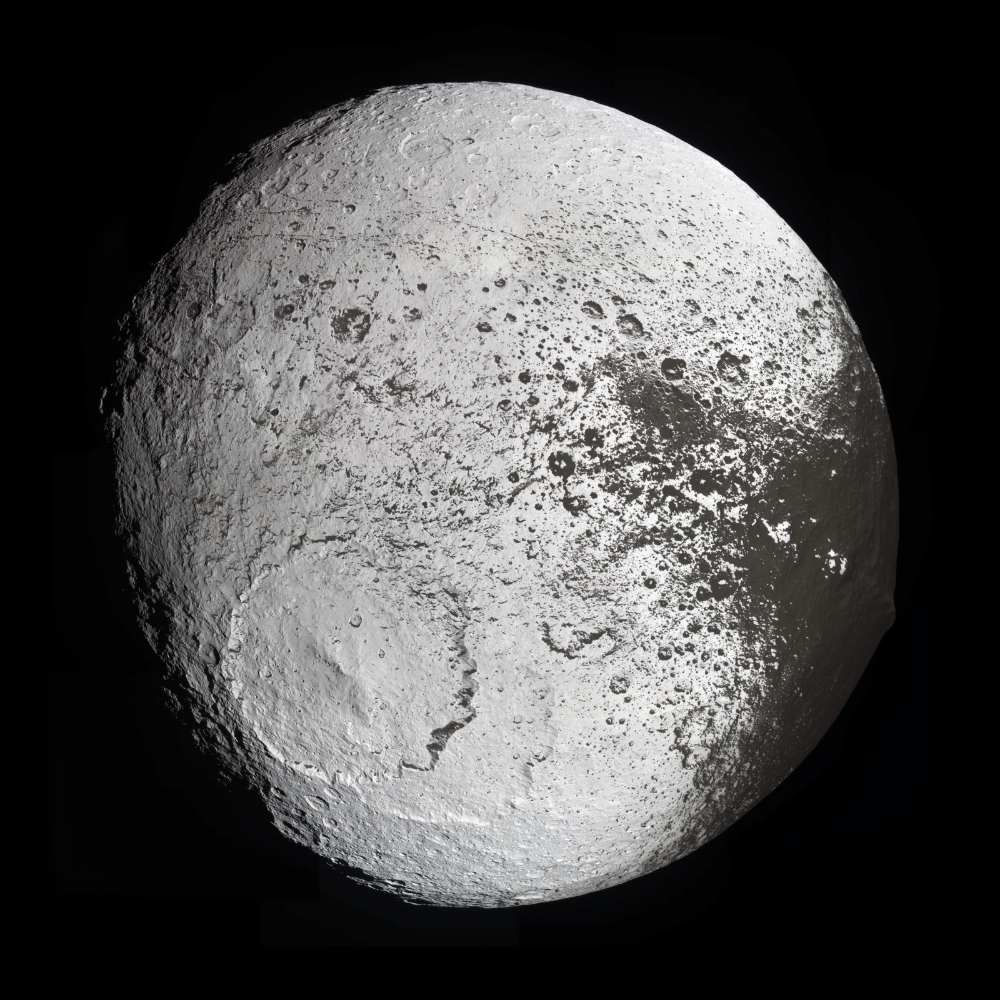
Iapetus’s most famous feature is its dramatic albedo dichotomy.
The Two Regions
Cassini Regio – Dark, leading hemisphere
Bright trailing hemisphere – Ice-rich and reflective
The dark side absorbs more sunlight, making it warmer. This temperature difference plays a key role in shaping Iapetus’s surface.
Why Is One Side So Dark?
The leading explanation involves a thermal feedback process.
Likely steps:
Dark material (possibly from outer Saturnian dust) coats one side
Dark surface absorbs more heat
Ice sublimates from warm regions
Vapor migrates and freezes on cooler areas
Bright regions grow brighter, dark regions grow darker
This self-reinforcing cycle exaggerates the contrast over time.
The Equatorial Ridge – Iapetus’s Greatest Mystery
Running almost exactly along Iapetus’s equator is a giant ridge unlike anything else in the Solar System.
Ridge Characteristics
Height: up to ~20 km
Width: ~20–70 km
Length: covers much of the equator
This ridge makes Iapetus look as if it once wore a massive belt.
How Did the Ridge Form?
Several hypotheses exist, but no single explanation is confirmed.
Leading ideas include:
Collapse of an ancient ring around Iapetus
Remnant of rapid early rotation
Material falling onto the equator from orbit
What is clear is that:
The ridge is very old
It formed early in Iapetus’s history
It has remained largely unchanged
Cassini Mission – Revealing the Details
NASA’s Cassini spacecraft provided the first detailed images of Iapetus in the 2000s.
Cassini revealed:
Sharp boundaries between bright and dark terrain
Detailed ridge structure
Ancient cratered landscapes
These observations confirmed that Iapetus is geologically inactive, preserving a snapshot of early moon evolution.
Why Iapetus Is Scientifically Important
Iapetus helps scientists understand:
Surface evolution driven by thermal processes
How slow rotation preserves ancient shapes
Interactions between dust, ice, and temperature
Early conditions in Saturn’s moon system
It represents a moon shaped more by surface physics than internal geology.
Cassini Regio – The Dark Face of Iapetus
The most visually striking feature on Iapetus is Cassini Regio, the vast dark region covering most of the moon’s leading hemisphere.
Key Characteristics
Extremely low albedo compared to the rest of the surface
Sharp boundary with the bright terrain
Concentrated mainly on the hemisphere that faces forward in orbit
This distribution is not random. The fact that the dark material dominates the leading side strongly suggests an external source and a process tied to orbital motion.
Where Did the Dark Material Come From?
Several hypotheses have been proposed, but most evidence supports a dust-coating origin.
Likely Source: Outer Saturnian System
Dust particles from distant irregular moons (especially Phoebe)
Material spirals inward toward Saturn
Iapetus, moving slowly and far out, sweeps up this dust on its leading side
This explains:
Why Cassini Regio is concentrated on one hemisphere
Why the dark material appears superficial rather than deep
The dust acts as a trigger, not the full explanation.
Thermal Migration – The Process That Amplified the Contrast
Once dark material settled on part of Iapetus, a powerful thermal feedback loop took over.
Step-by-Step Process
Dark regions absorb more sunlight
Surface temperature rises locally
Water ice sublimates from warmer areas
Vapor migrates toward colder regions
Ice re-condenses on bright terrain
Over time:
Dark areas became darker and drier
Bright areas became brighter and ice-rich
This process transformed a modest color difference into the most extreme albedo contrast seen on any large moon.
Why the Boundary Is So Sharp
One of the most puzzling aspects of Iapetus is how abruptly Cassini Regio ends.
This sharp transition is explained by:
Temperature thresholds for ice sublimation
Slopes and elevation differences
Self-reinforcing migration of ice
Once a region crosses a certain thermal boundary, the process accelerates—creating a clear, almost artificial-looking edge.
The Equatorial Ridge – Competing Formation Theories
Iapetus’s equatorial ridge remains one of the greatest unsolved problems in planetary science.
Leading Hypotheses Compared
1. Collapsed Ring Theory
Iapetus once had a temporary ring system
Ring material gradually fell onto the equator
Produced a narrow, linear ridge
This theory explains:
Ridge alignment with the equator
Extreme height
Limited lateral spread
2. Rapid Rotation Remnant
Iapetus once rotated much faster
Equatorial bulge formed
Rotation slowed, but shape froze
This model explains Iapetus’s shape, but:
Struggles to explain ridge sharpness
Does not easily match ridge height
3. Debris Accretion from Orbit
Material from orbit slowly accumulated
Settled preferentially at the equator
This overlaps with ring-collapse models but requires very specific conditions.
What the Ridge Tells Us for Sure
Regardless of the exact mechanism:
The ridge is ancient
It formed early in Iapetus’s history
It has remained largely unchanged
This indicates:
Minimal tectonic activity since formation
A cold, rigid crust
Long-term structural stability
Iapetus has effectively preserved a geological fossil.
Comparison with Other Saturnian Moons
Iapetus is an outlier among Saturn’s large moons.
| Moon | Activity Level | Surface Style |
|---|---|---|
| Enceladus | Active | Cryovolcanic |
| Titan | Active | Atmospheric + surface processes |
| Rhea | Inactive | Cratered, uniform |
| Dione | Limited | Tectonic features |
| Iapetus | Inactive | Extreme contrast + ridge |
Unlike Enceladus or Titan, Iapetus evolved primarily through external and surface-driven processes, not internal heat.
Why Iapetus Rotates So Slowly
Iapetus is tidally locked, but its slow rotation is unusual even by that standard.
Reasons include:
Large distance from Saturn
Weak tidal forces
Early rotational braking that froze its shape
This slow spin allowed:
Extreme thermal differences to persist
Surface processes to dominate evolution
Why Iapetus Is a Natural Laboratory
Iapetus allows scientists to study:
Thermal-driven surface evolution
Dust–ice interactions
Long-term preservation of ancient features
Effects of weak tidal environments
Few other moons preserve such a clear record of early Solar System surface physics.
The Long-Term Future of Iapetus
Iapetus is one of the most geologically stable large moons in the Solar System. With no internal heat source and extremely weak tidal forces from Saturn, its future will be shaped almost entirely by slow surface processes.
What Will (and Won’t) Change
No renewed volcanic or tectonic activity
No atmosphere to drive erosion
Very slow crater accumulation from micrometeoroids
In practical terms, Iapetus will look almost the same billions of years from now as it does today.
Will the Equatorial Ridge Ever Collapse?
The enormous equatorial ridge appears remarkably stable.
Reasons include:
A thick, rigid icy crust
Lack of seismic or tectonic activity
Extremely low erosion rates
While small landslides may occur along steep slopes, there is no evidence that the ridge is collapsing or spreading laterally. It is likely to remain one of the most striking landforms in the Solar System for the foreseeable future.
Could Iapetus Ever Become Active Again?
Under current conditions, the answer is almost certainly no.
Iapetus:
Is too far from Saturn for significant tidal heating
Has already lost most of its internal heat
Shows no signs of subsurface liquids
Only a highly improbable orbital disturbance—such as a major moon-system rearrangement—could change this, and no such process is expected.
Frequently Asked Questions (FAQ)
Why is Iapetus half dark and half bright?
Dark material from the outer Saturnian system coated one hemisphere. Thermal feedback then caused ice to migrate away from warm regions and accumulate on cooler areas, amplifying the contrast.
Is the dark material volcanic?
No. There is no evidence of volcanism. The material is likely external dust mixed with organic-rich compounds.
How tall is Iapetus’s equatorial ridge?
In some places, it rises up to ~20 km, making it one of the tallest known mountains in the Solar System.
Does any other moon have a similar ridge?
No. Iapetus’s ridge is unique among known moons and planets.
Can Iapetus be seen from Earth?
Yes, with large telescopes, though its brightness varies depending on which hemisphere faces Earth.
Iapetus in the Context of Saturn’s Moon System
Iapetus plays a very different role from moons like Titan or Enceladus.
It orbits far from Saturn
It experienced minimal tidal heating
Its evolution was dominated by surface and thermal processes
This makes Iapetus an important control case—a moon that shows what happens when internal activity is absent.
Why Iapetus Matters in Planetary Science
Iapetus demonstrates that:
Surface processes alone can dramatically reshape a world
Albedo and temperature feedback can dominate evolution
Ancient features can survive almost unchanged for billions of years
It helps scientists separate:
Internal-driven geology
External, environment-driven evolution
Few objects make this distinction so clearly.
Related Topics for Universe Map
Saturn
Titan
Enceladus
Phoebe
Thermal migration on icy bodies
Equatorial ridges in planetary science
These topics together help explain why Iapetus evolved so differently from its neighbors.
Final Perspective
Iapetus is not a moon shaped by fire or motion—but by contrast and time.
Its stark two-tone surface and towering equatorial ridge are reminders that dramatic planetary features do not always require internal heat or violent activity. Sometimes, slow physics acting over immense time is enough to sculpt something truly unique.
Among Saturn’s many moons, Iapetus stands apart as a frozen archive—quiet, ancient, and still holding unanswered questions about the earliest days of the Solar System.