



Jupiter Trojans
The Ancient Guardians of Jupiter’s Orbit
Quick Reader
| Attribute | Details |
|---|---|
| Object Type | Asteroid population (minor planets) |
| Primary Association | Jupiter |
| Orbital Relationship | Co-orbital with Jupiter |
| Lagrange Points | Sun–Jupiter L4 and L5 |
| Orbital Stability | Long-term (billions of years) |
| Discovery of First Trojan | 1906 (588 Achilles) |
| Known Population | >12,000 confirmed (and growing) |
| Estimated Total | Hundreds of thousands (≥1 km size) |
| Typical Size Range | ~1 km to >200 km |
| Largest Members | 624 Hektor, 911 Agamemnon, 617 Patroclus |
| Composition | Mostly dark, primitive (D-type, P-type) |
| Surface Reflectivity | Very low (dark, carbon-rich) |
| Water / Ice | Likely present internally or as hydrated minerals |
| Age | Formed in early Solar System (~4.5 billion years) |
| Scientific Importance | Fossils of planet formation |
Key Highlights
- Share Jupiter’s orbit without colliding with it
- Trapped at gravitationally stable points
- Represent one of the Solar System’s most ancient populations
- Preserve material from the era of planet formation
- Key targets for understanding planetary migration
Introduction – Asteroids That Should Not Be There
Jupiter dominates the Solar System.
Its gravity sculpts asteroid belts, ejects comets, and reshapes planetary orbits.
Yet surrounding this giant planet is a vast population of small bodies that remain remarkably stable—moving with Jupiter, not against it.
These are the Jupiter Trojans.
They do not orbit Jupiter directly.
They orbit the Sun, just like planets—yet they remain locked in step with Jupiter for billions of years. Their existence reveals one of the most elegant gravitational arrangements in celestial mechanics.
What Are Jupiter Trojans?
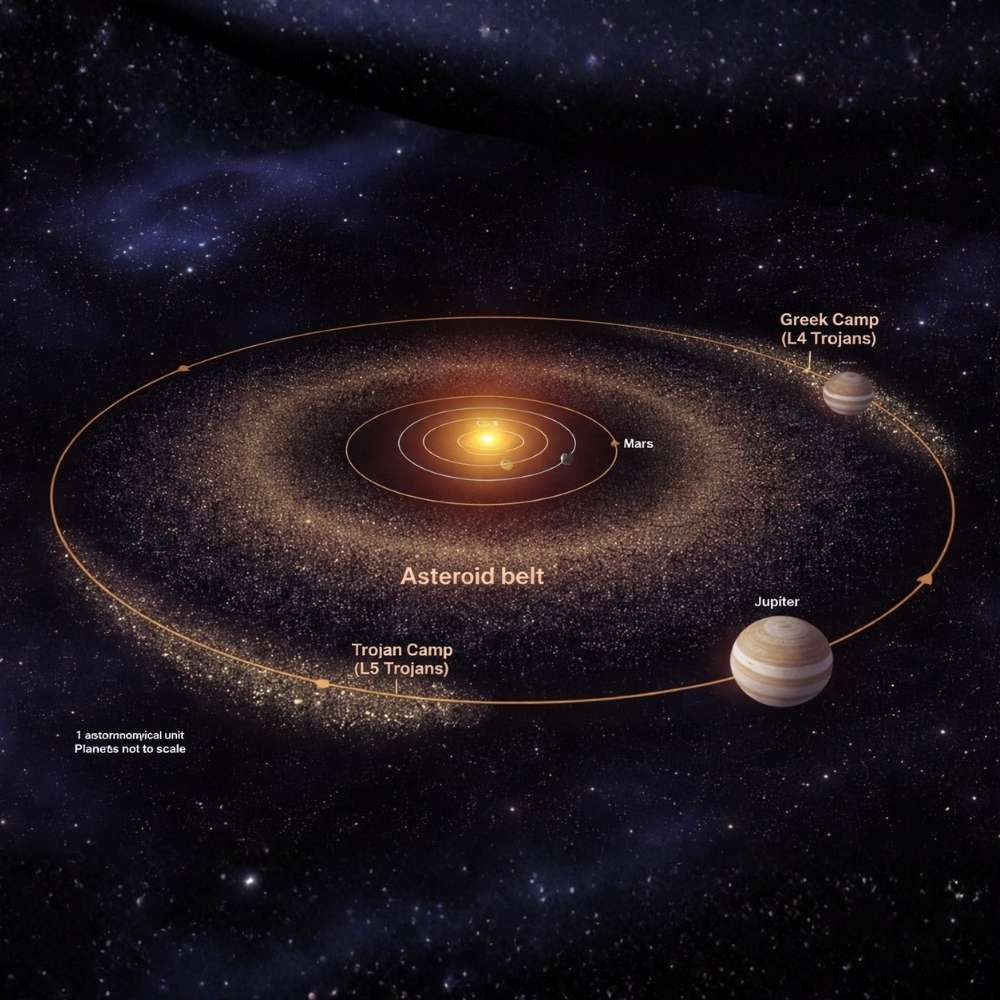
Jupiter Trojans are asteroids that share Jupiter’s orbital path around the Sun.
They reside in two vast swarms:
One leading Jupiter by ~60° (L4)
One trailing Jupiter by ~60° (L5)
These locations are known as Lagrange points, where gravitational forces and orbital motion balance perfectly.
As a result, Trojan asteroids:
Do not drift away
Do not fall into Jupiter
Do not collide with the planet
They are gravitationally protected.
Lagrange Points – The Key to Trojan Stability
The stability of Jupiter Trojans comes from a precise gravitational balance.
At the L4 and L5 points:
Jupiter’s gravity
The Sun’s gravity
The asteroid’s orbital motion
combine to create a stable equilibrium.
Small deviations do not lead to escape. Instead, Trojan asteroids perform slow, looping motions called libration, keeping them safely confined for immense spans of time.
This makes Jupiter Trojans among the longest-lived small bodies in the Solar System.
Two Camps – Greek and Trojan Asteroids
By convention, Jupiter Trojans are named after heroes of the Trojan War.
L4 group → Greek camp (Achilles, Ajax, Odysseus)
L5 group → Trojan camp (Hektor, Aeneas, Priam)
This naming scheme reflects their division—but physically, the two groups are similar.
Interestingly, the L4 swarm appears slightly more populated than L5, a difference that remains an active research topic.
Physical Nature – Dark, Primitive Worlds
Jupiter Trojans are among the darkest objects known.
Their properties suggest:
Carbon-rich composition
Minimal surface processing
Extremely ancient material
Most Trojans belong to D-type and P-type asteroids, which are thought to be rich in organic compounds and possibly water-bearing minerals.
They are not rubble from collisions—they are preserved building blocks.
Did Jupiter Trojans Form Near Jupiter?
For decades, scientists believed Trojans formed near Jupiter.
Modern models suggest otherwise.
Leading theories propose that:
Trojans formed much farther from the Sun
They were captured during planetary migration
Jupiter’s early movement reshaped small-body populations
This makes Jupiter Trojans crucial evidence in understanding how the giant planets migrated in the early Solar System.
Why Jupiter Trojans Matter
Jupiter Trojans are not just another asteroid group.
They help answer fundamental questions:
How did the giant planets form and move?
What material existed in the early Solar System?
How common are stable co-orbital systems?
They act as time capsules, preserving conditions from billions of years ago.
Jupiter Trojans vs Main Belt Asteroids – A Fundamental Difference
Although both groups are labeled “asteroids,” Jupiter Trojans and Main Belt asteroids represent very different populations.
Comparison of Asteroid Populations
| Feature | Jupiter Trojans | Main Belt Asteroids |
|---|---|---|
| Primary Location | Jupiter’s orbit (L4 & L5) | Between Mars and Jupiter |
| Orbital Stability | Extremely long-lived | Moderately stable |
| Typical Composition | Dark, carbon-rich (D/P-type) | Mixed (S, C, M-types) |
| Surface Reflectivity | Very low | Variable |
| Water Content | Likely present in minerals/ice | Limited, variable |
| Formation Region | Outer Solar System (likely) | Inner/central Solar System |
| Scientific Role | Planet migration fossils | Collisional evolution record |
This comparison shows that Jupiter Trojans are not displaced Main Belt objects—they represent a distinct origin.
How Were Jupiter Trojans Captured?
The most accepted explanation involves planetary migration.
Early in Solar System history:
Giant planets did not occupy their current orbits
Jupiter and Saturn migrated due to disk interactions
Gravitational resonances shifted dramatically
During this chaotic period:
Small bodies from the outer Solar System were scattered
Some became trapped near Jupiter’s L4 and L5 points
As migration slowed, these objects remained locked in place
This process naturally explains:
The wide orbital inclinations of Trojans
Their dark, primitive composition
Their similarity to Kuiper Belt objects
The Nice Model – Reshaping the Solar System
The Nice Model provides a framework for Trojan capture.
According to this model:
Jupiter moved slightly inward
Saturn moved outward
Resonances swept through the Solar System
These changes destabilized existing populations while capturing new ones.
Jupiter Trojans are among the clearest surviving signatures of this era.
Binary Trojans – A Clue to Their Origin
Several Jupiter Trojans exist as binary systems, where two objects orbit each other.
Notable examples include:
617 Patroclus–Menoetius
624 Hektor (complex multiple system)
Binary systems are more common in the outer Solar System, suggesting:
Gentle capture conditions
Low-velocity interactions
Formation far from the Sun
This strengthens the idea that Trojans originated in colder regions.
Internal Structure – More Than Rubble
Observations suggest many Trojans are:
Porous
Low density
Weakly consolidated
This implies they formed through:
Gentle accretion
Limited collisional processing
Rather than being fragments, many Trojans may be primordial aggregates.
Why Trojan Stability Is Remarkable
Despite Jupiter’s immense gravity, Trojans survive because:
L4 and L5 are dynamically stable
Perturbations cause oscillations, not escape
Long-term simulations show survival over billions of years
Even minor orbital disturbances tend to self-correct.
This makes Trojan regions gravitational sanctuaries.
What Jupiter Trojans Reveal About the Early Solar System
Their existence implies:
The Solar System was once highly dynamic
Planetary orbits were not fixed
Material exchange between regions was common
Jupiter Trojans preserve that memory.
Exploring the Jupiter Trojans – The Lucy Mission
For over a century, Jupiter Trojans were known only through telescopes.
That changed with NASA’s Lucy mission, the first spacecraft designed to explore multiple Trojan asteroids.
Lucy’s objectives include:
Studying Trojan composition and surface geology
Understanding size, shape, and density
Investigating binary Trojan systems
Testing models of planetary migration
Lucy will visit several Trojans from both the L4 and L5 swarms, offering the first close-up view of these ancient bodies.
Why the Lucy Mission Matters
Lucy is not just an asteroid mission—it is a Solar System archaeology project.
By examining Trojans, Lucy aims to:
Sample primordial material from planet formation
Validate or challenge the Nice Model
Compare Trojan surfaces with Kuiper Belt objects
Reveal how stable co-orbital systems evolve
These data will refine our understanding of how planets and small bodies shaped one another.
The Long-Term Future of Jupiter Trojans
Jupiter Trojans are among the most stable small-body populations known.
Long-term simulations show:
Most Trojans will survive for billions of years
Only slow leakage from resonances occurs
Major destabilization requires planetary-scale changes
Barring dramatic Solar System rearrangement, the Trojan swarms will remain long after humanity.
Frequently Asked Questions (FAQ)
Are Jupiter Trojans moons of Jupiter?
No. They orbit the Sun, not Jupiter, while sharing Jupiter’s orbital period.
Can Trojans collide with Jupiter?
Extremely unlikely due to the stabilizing Lagrange points.
Why are Trojans so dark?
Their surfaces are rich in carbonaceous material and lack reflective ice.
Do other planets have Trojans?
Yes. Mars, Neptune, and even Earth have Trojan objects.
Could Trojans contain water or organics?
Yes. Many are thought to contain hydrated minerals and organic compounds.
Jupiter Trojans in the Broader Solar System Context
Jupiter Trojans connect several major themes:
Planetary migration
Co-orbital dynamics
Primordial Solar System material
Stability within chaos
They represent a bridge population between asteroids and distant icy bodies.
Final Perspective
Jupiter Trojans are not wanderers.
They are keepers.
Locked at gravitational balance points, they have witnessed the Solar System’s most dramatic transformations without being erased. In their dark surfaces and stable orbits lies a record of planetary movement, capture, and survival.
To study Jupiter Trojans is to study the architecture of the early Solar System itself.