




JWST
The Observatory That Rewrote the Cosmos
Quick Reader
| Attribute | Details |
|---|---|
| Mission Name | James Webb Space Telescope (JWST) |
| Mission Type | Space-based infrared observatory |
| Operating Agencies | NASA, ESA, CSA |
| Launch Date | 25 December 2021 |
| Launch Vehicle | Ariane 5 |
| Orbit | Sun–Earth L₂ halo orbit |
| Primary Wavelengths | Near-infrared & mid-infrared (0.6–28 µm) |
| Mirror Diameter | 6.5 meters (segmented, gold-coated) |
| Primary Goals | First galaxies, star formation, exoplanets |
| Mission Status | Active |
| Design Lifetime | 10+ years (fuel-limited) |
Why JWST Is Different (Quick Context)
JWST is not a replacement for Hubble—it is a time machine and chemical analyzer combined. It observes the Universe primarily in infrared light, allowing it to see through dust, study cold objects, and detect light stretched by cosmic expansion from the earliest galaxies.
Key Insight Snapshot
- Most powerful space telescope ever built
- Designed to observe the first light after the Big Bang
- Revolutionized exoplanet atmospheric science
- Reveals hidden star formation through cosmic dust
- Operates far beyond Earth for extreme thermal and orbital stability
Introduction — Why JWST Was Necessary
Hubble transformed astronomy—but it had limits.
The earliest galaxies, the coldest planets, and the most dust-enshrouded regions of space emit little visible light. Their signals are shifted into the infrared, beyond Hubble’s optimal range.
To answer the biggest cosmic questions, astronomers needed a new kind of observatory—one that could:
Detect extremely faint infrared light
Remain ultra-cold and stable
Operate far from Earth’s heat and interference
The James Webb Space Telescope was built for exactly this purpose.
What JWST Sees That Others Cannot
JWST specializes in infrared light, which reveals phenomena invisible in optical wavelengths.
Infrared allows JWST to observe:
The first galaxies formed after the Big Bang
Stars being born inside dense dust clouds
Protoplanetary disks where planets are forming
Cool exoplanets and their atmospheres
Molecular fingerprints of water, CO₂, methane, and more
In essence, JWST sees the hidden Universe.
A True Successor — But Not to Hubble Alone
JWST builds on decades of space astronomy, especially missions like Spitzer and Hubble.
Hubble showed us structure
Spitzer showed us heat and dust
JWST combines both with far greater sensitivity
Rather than replacing Hubble, JWST extends the Great Observatories vision into the infrared era.
The Mirror — Why 6.5 Meters Changed Everything
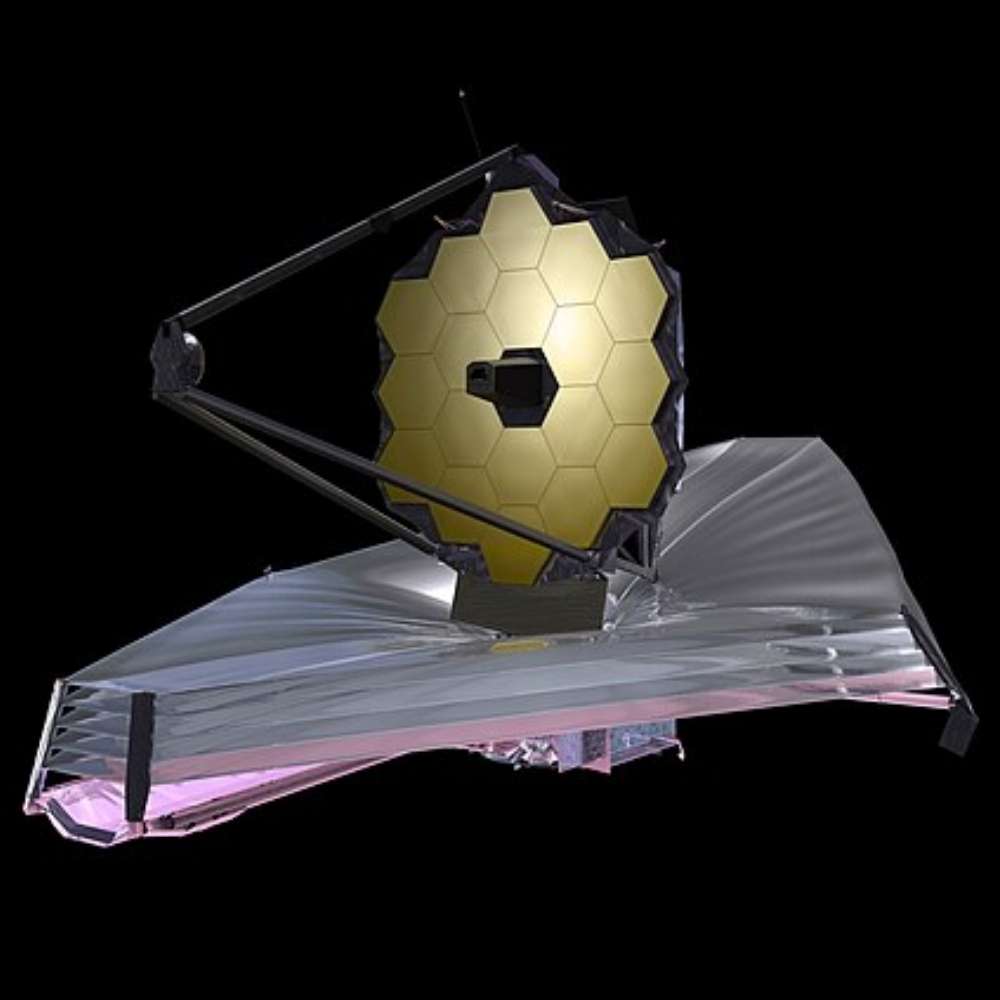
JWST’s segmented primary mirror is the largest ever flown in space.
Why size matters:
Larger mirrors collect more light
More light means fainter objects become visible
Fainter objects include the earliest galaxies
The mirror is:
Made of 18 hexagonal segments
Coated in gold for infrared reflectivity
Folded for launch and deployed in space
This deployment alone was one of the most complex engineering feats in spaceflight history.
Why JWST Had to Go to L₂
JWST operates near the Sun–Earth L₂ Lagrange point, about 1.5 million km from Earth.
This location provides:
Constant alignment of Sun, Earth, and Moon on one side
A stable thermal environment
Continuous sky access without Earth eclipses
At L₂, JWST can remain extremely cold—essential for infrared astronomy.
The Sunshield — A Spacecraft the Size of a Tennis Court
To observe infrared light, JWST must be kept below 50 Kelvin.
This is achieved by a massive five-layer sunshield that:
Blocks heat from the Sun, Earth, and Moon
Passively cools the telescope without cryogenics
Creates a temperature difference of over 300°C across its layers
Without this sunshield, JWST simply could not function.
JWST’s Scientific Instruments — Designed for Precision
JWST carries four main instruments:
NIRCam — Near-infrared imaging
NIRSpec — Multi-object spectroscopy
MIRI — Mid-infrared imaging and spectroscopy
FGS/NIRISS — Fine guidance and specialized spectroscopy
Together, they allow JWST to:
Image faint galaxies
Analyze chemical compositions
Study atmospheres of distant worlds
Measure cosmic structures with extreme accuracy
Early Results — A Telescope That Exceeded Expectations
Within months of activation, JWST delivered:
The deepest infrared images ever taken
Galaxies older and more massive than expected
Detailed chemical spectra of exoplanet atmospheres
Star-forming regions with unprecedented clarity
These results did not just confirm theories—they challenged them.
Why JWST Matters to Modern Astronomy
JWST matters because it:
Pushes observation closer to cosmic origins
Turns exoplanets into chemically characterized worlds
Bridges astrophysics, cosmology, and astrobiology
Forces revisions of galaxy formation models
It is not just answering questions—it is reshaping the questions themselves.
JWST and Exoplanets — From Detections to Detailed Worlds
JWST has transformed exoplanet science from discovery to diagnosis.
Earlier telescopes could detect planets and estimate sizes or temperatures. JWST goes further by directly probing atmospheres, measuring composition, structure, and even weather patterns.
Using ultra-precise infrared spectroscopy during transits and eclipses, JWST can isolate a planet’s faint atmospheric signal from its host star.
What this enables:
Detection of molecular gases
Temperature–pressure profiling
Constraints on cloud layers and hazes
Comparative planetology across systems
Exoplanets are no longer points on a chart—they are physical environments.
Atmospheric Chemistry — What JWST Can Actually Measure
JWST’s sensitivity allows robust detections of key molecules, including:
Water vapor (H₂O)
Carbon dioxide (CO₂)
Carbon monoxide (CO)
Methane (CH₄)
Sulfur-bearing compounds (in some cases)
These measurements matter because:
They reveal formation pathways
They constrain planetary migration histories
They help assess potential habitability
JWST has already produced the clearest atmospheric spectra ever obtained for exoplanets.
Temperate Worlds and Super-Earths
One of JWST’s most anticipated goals is studying smaller, cooler planets, not just hot Jupiters.
JWST is uniquely capable of:
Observing super-Earths and mini-Neptunes
Measuring atmospheres around M-dwarf stars
Distinguishing hydrogen-rich from secondary atmospheres
Early results show that many small planets have complex or depleted atmospheres, reshaping expectations about how common Earth-like conditions may be.
Star Formation — Seeing Through the Dust
JWST’s infrared vision allows it to peer into dense molecular clouds where stars are actively forming.
Compared to previous observatories, JWST reveals:
Protostars embedded deep in dust
Jets and outflows shaping star-forming regions
Fine structure in protoplanetary disks
This level of detail allows astronomers to track stellar evolution from collapse to disk formation in a single observational framework.
Planetary Nurseries — Protoplanetary Disks in Detail
JWST has delivered unprecedented views of protoplanetary disks, including:
Disk gaps and rings linked to forming planets
Chemical gradients across disk radii
Ice lines where different molecules condense
These observations connect directly to planet formation theory, showing:
Where planets are likely forming
How disk chemistry influences planetary composition
Why planetary systems diverge so widely in architecture
JWST provides the missing link between disks and mature planetary systems.
The First Galaxies — Early Results That Surprised Everyone
JWST’s deep-field observations revealed galaxies at extremely high redshifts, meaning they existed very early in cosmic history.
Key surprises include:
Galaxies appearing earlier than expected
Systems more massive than models predicted
Rapid star formation shortly after the Big Bang
These findings suggest that galaxy formation may have been faster and more efficient than previously assumed, prompting revisions to cosmological models.
Cosmic Reionization — JWST’s Role
JWST is uniquely positioned to study the Epoch of Reionization, when the first stars and galaxies transformed the Universe from opaque to transparent.
It helps answer questions such as:
Which objects drove reionization?
How quickly did it occur?
What were the properties of the first stellar populations?
By detecting faint, redshifted light, JWST directly samples this formative era.
JWST vs Hubble vs Spitzer — A Functional Comparison
| Capability | Hubble | Spitzer | JWST |
|---|---|---|---|
| Primary Wavelength | Visible / Ultraviolet | Infrared | Infrared |
| Mirror Size | 2.4 m | 0.85 m | 6.5 m |
| Atmospheric Spectra | Limited | Pioneering | Transformative |
| Early Galaxies | Moderate | Limited | Exceptional |
| Disk Chemistry | Limited | Partial | Detailed |
Interpretation
Hubble revealed the structure of the Universe with unprecedented clarity.
Spitzer revealed the hidden heat of cosmic objects, uncovering star formation and warm dust invisible to optical telescopes.
JWST now reveals composition, physical processes, and cosmic origins—marking a fundamental leap from seeing the Universe to truly understanding it.
Why JWST’s Precision Changes Theory
JWST’s data quality forces theory to keep up.
With higher signal-to-noise and broader wavelength coverage, JWST:
Reduces model degeneracy
Eliminates ambiguous interpretations
Exposes weaknesses in long-standing assumptions
This is why JWST results often challenge, not just confirm, existing models.
JWST’s Long-Term Legacy — A Telescope That Redefined the Baseline
JWST’s true legacy will not be a single discovery, but a permanent reset of what astronomers consider “normal” data quality.
Before JWST:
Many models survived because data was sparse or noisy
Multiple explanations could fit the same observation
After JWST:
Chemical abundances are measured directly
Temperatures and structures are constrained, not guessed
Competing theories are rapidly ruled out
JWST has moved astronomy from interpretation-dominated to measurement-dominated science.
Mission Lifetime — What Limits JWST
JWST is not limited by hardware degradation or scientific relevance, but by fuel.
Key constraints:
Fuel is required for station-keeping around L₂
Mirror, instruments, and sunshield remain healthy
No onboard refueling capability exists
Current estimates suggest:
10–20+ years of operation are possible
Careful fuel management could extend the mission significantly
Unlike Hubble, JWST was designed to work perfectly without servicing, relying instead on extreme reliability and passive cooling.
How JWST Is Changing Future Observatory Design
JWST has already influenced how future telescopes are planned.
Lessons absorbed by the next generation include:
Segmented mirrors are viable and scalable
Passive cooling outperforms complex cryogenic systems
L₂ is ideal for ultra-stable astrophysical observatories
Infrared capability is no longer optional
Upcoming mission concepts now assume JWST-level precision as the starting point, not the goal.
Frequently Asked Questions (Expanded)
Is JWST replacing Hubble?
No. JWST and Hubble are complementary. Hubble excels in visible and ultraviolet light, while JWST dominates infrared observations.
Can JWST detect life directly?
No. JWST can detect biosignature-related molecules, but interpreting life requires context, follow-up observations, and future missions.
Why does JWST focus on infrared instead of visible light?
Because the earliest galaxies, cold planets, and dust-enshrouded regions emit primarily in infrared, and cosmic expansion shifts ancient light into infrared wavelengths.
Is JWST affected by Earth’s atmosphere?
No. Operating at Sun–Earth L₂ places JWST far beyond atmospheric interference.
Can JWST observe the entire sky?
Over time, yes—but not simultaneously. Sunshield orientation restricts instantaneous pointing, but full-sky coverage is achieved over months.
Will JWST find an Earth twin?
It may characterize atmospheres of nearby Earth-sized planets, but discovering a true Earth twin likely requires future dedicated missions.
Why JWST Matters Beyond Astronomy
JWST’s impact extends beyond astrophysics.
It advances:
Cryogenic and thermal engineering
Autonomous deployment and control
Ultra-precise spectroscopy
International scientific collaboration
The technologies and methodologies developed for JWST will influence space science for decades.
JWST in the Universe Map Context
Within Universe Map, JWST connects directly to:
Infrared astronomy
First galaxies and cosmic dawn
Exoplanet atmospheres and habitability
Star and planet formation
Lagrange-point observatories
JWST acts as a central reference observatory, anchoring modern understanding across nearly every cosmic scale.
Final Perspective
JWST did not merely sharpen our view of the Universe—it changed what the Universe looks like.
It revealed galaxies forming faster than expected, planets with complex atmospheres, and star-forming regions sculpted by physics we can now see in action. It showed that the early Universe was not quiet or simple, but dynamic, efficient, and surprisingly mature.
In doing so, JWST taught astronomy a humbling lesson:
The Universe was never the problem.
Our instruments were.